

For apparel brands navigating the complexities of sustainable sourcing, lyocell presents both a significant opportunity and a series of technical questions. The conversation around its eco-friendly credentials often overshadows the practical concerns of production, cost, and long-term performance. Answering the question of what is lyocell fabric requires more than a simple definition; it demands a manufacturer’s perspective on its real-world application, from fiber strength and dye affinity to its behavior in a high-volume production environment.
This comprehensive guide is engineered to bridge that knowledge gap. We move beyond the marketing to deliver a technical breakdown of lyocell’s properties, production nuances, and strategic value for your apparel line. By the end, you will have the clarity to confidently assess if lyocell aligns with your brand’s quality standards and possess the specific knowledge needed to begin a productive dialogue with your manufacturing partner. Our goal is to equip you with the data needed to make an informed, profitable decision for your next collection.
Key Takeaways
- Answering what is lyocell fabric requires understanding its technical properties and closed-loop production, which directly impacts its performance and sustainability credentials for your brand.
- Develop a strategic framework to evaluate lyocell against conventional fabrics, comparing critical factors such as performance, production cost, and marketability.
- Anticipate and overcome common manufacturing challenges unique to lyocell, from dyeing to finishing, to ensure consistent quality and production efficiency.
- Learn to verify the authenticity and sustainability of your lyocell supply chain through essential certifications, safeguarding your brand’s reputation and avoiding greenwashing.
What is Lyocell Fabric? The Core Technical Profile
For apparel brands evaluating advanced materials, the primary question is often: what is lyocell fabric? At its core, lyocell is a semi-synthetic fiber and a form of rayon, engineered from regenerated cellulose. This cellulose is typically sourced from the wood pulp of fast-growing, sustainably managed trees like eucalyptus. As a third-generation cellulosic fiber, Lyocell represents a significant advancement in textile technology, prized for its unique balance of performance and environmental consideration.
To provide a clear technical definition: Lyocell is a man-made cellulosic fiber known for its exceptional softness, high absorbency, and sustainable closed-loop production process. Its principal characteristics include a remarkably soft hand-feel, superior moisture absorption, and an elegant, fluid drape, making it a versatile choice for a wide range of garment applications.
Key Performance Characteristics
Lyocell’s technical properties make it a high-value material for quality-focused apparel collections. Its performance is defined by four key attributes:
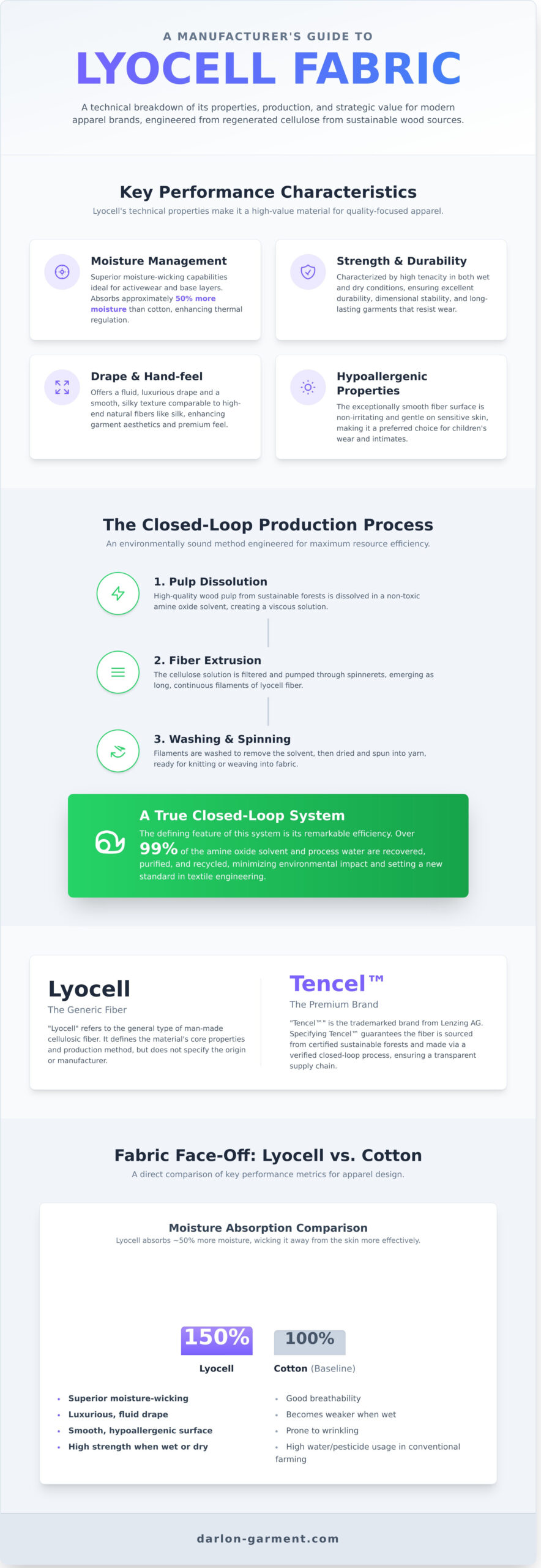
- Moisture Management: The fiber structure exhibits moisture-wicking capabilities superior to cotton, absorbing approximately 50% more moisture. This thermal-regulating quality makes it an ideal material for activewear, intimates, and base layers.
- Strength & Durability: It is characterized by high tenacity in both wet and dry conditions. This inherent strength ensures excellent durability and dimensional stability, contributing to long-lasting garments that resist wear.
- Drape & Hand-feel: Lyocell offers a fluid, luxurious drape and a smooth, silky texture comparable to high-end natural fibers like silk. This quality enhances garment aesthetics and provides a premium feel.
- Hypoallergenic Properties: The exceptionally smooth fiber surface is non-irritating and gentle on sensitive skin, making it a preferred choice for children’s wear and garments with direct skin contact.
Lyocell vs. Tencel™: Understanding the Difference
While the terms are often used interchangeably, it is crucial for sourcing and marketing to distinguish between them. “Lyocell” refers to the generic fiber type. In contrast, “Tencel™” is the globally recognized trademarked brand name for lyocell and modal fibers produced by the Austrian company Lenzing AG. For apparel brands, specifying Tencel™ Lyocell in a tech pack guarantees a premium product sourced from certified sustainable forests and manufactured via a verified closed-loop process, offering a transparent and verifiable supply chain.
How Lyocell is Made: The Closed-Loop Production Process
Understanding what is lyocell fabric begins with its innovative and highly controlled manufacturing cycle. Unlike other regenerated cellulosic fibers, lyocell is produced using an environmentally sound method engineered for maximum resource efficiency. This technical mastery ensures both superior quality and a verifiable commitment to sustainability for our apparel brand partners.
The core manufacturing process is executed in three precise stages:
- Pulp Dissolution: The process commences with high-quality wood pulp, sourced from sustainably managed forests. This raw cellulose is dissolved in a non-toxic amine oxide solvent, creating a viscous, clear solution.
- Fiber Extrusion: This cellulose solution is then filtered and pumped through spinnerets-devices perforated with fine holes. As the solution is forced through, it emerges as long, continuous filaments of lyocell fiber.
- Washing and Spinning: The newly formed filaments are washed in demineralized water to remove and recover the solvent. After the fibers are dried, they are spun into yarn, which is then ready for knitting or weaving into finished fabric.
The defining feature of this system is its remarkable efficiency. The genius of the lyocell method is its acclaimed closed-loop production process, in which over 99% of the amine oxide solvent and process water are recovered, purified, and recycled back into the system. This cyclical operation represents a significant technological advantage in modern textile engineering.
Why the Closed-Loop System Matters for Sustainability
This production model stands in stark contrast to conventional viscose rayon manufacturing, which relies on more hazardous chemicals. The lyocell process consumes significantly less water and energy, drastically reducing its environmental footprint. For apparel brands focused on transparent sourcing, this minimal-waste, low-impact production cycle offers a compelling and verifiable sustainability claim that resonates with conscious consumers.
Quality Control Points in Lyocell Production
Consistent, high-quality output is assured through stringent quality control at every stage. It begins with the selection of raw materials from FSC or PEFC certified forests. Throughout production, fiber consistency is meticulously maintained to guarantee uniform dye uptake and a flawless finish in the final garment. Furthermore, the purity of the recycled solvent is continuously monitored, as it directly impacts the tensile strength and exceptionally soft hand-feel of the yarn.
Lyocell vs. Alternatives: A Strategic Fabric Comparison for Brands
Selecting the optimal textile is a critical strategic decision for any apparel brand. To fully understand what is lyocell fabric and its market position, it is essential to evaluate its performance, sustainability, and commercial viability against established industry staples. While technically a regenerated cellulose fiber, Lyocell utilizes a modern, closed-loop production process that distinguishes it as a technologically advanced and environmentally superior material compared to its predecessors.
This comparative framework analyzes lyocell based on criteria essential for brand managers: performance, sustainability, and ideal use case.
| Attribute | Lyocell | Cotton | Polyester | Viscose Rayon |
|---|---|---|---|---|
| Sustainability Profile | High (Closed-loop, biodegradable) | Low-Medium (High water/pesticide use) | Low (Petroleum-based, microplastics) | Low (Chemical-intensive process) |
| Moisture Management | Excellent | Good (Absorbs but dries slowly) | Poor (Hydrophobic) | Moderate |
| Feel & Drape | Silky, smooth, high drape | Varies; can be crisp or soft | Smooth, synthetic feel | Soft, high drape |
| Wet Strength | High | High | High | Low (Weakens significantly) |
Lyocell vs. Cotton
Lyocell consistently outperforms conventional cotton in key performance areas. It exhibits superior moisture-wicking capabilities, drawing perspiration away from the skin more efficiently and creating a less hospitable environment for bacterial growth. From a production standpoint, its cultivation requires significantly less water and arable land. The resulting fabric offers a recognizably smoother, silkier hand-feel and a more fluid drape, elevating the final garment’s perceived value.
Lyocell vs. Polyester
The primary distinction lies in their origins and performance characteristics. Lyocell, derived from wood pulp, is highly breathable and absorbent, making it ideal for next-to-skin applications like activewear and lifestyle apparel. In contrast, polyester is a synthetic, hydrophobic polymer derived from petroleum, excelling in applications requiring high durability and water resistance, such as rugged outerwear. Crucially, lyocell is fully biodegradable, whereas polyester persists in the environment.
Lyocell vs. Viscose & Modal
Lyocell represents a significant technological leap over older rayons. Its award-winning closed-loop solvent spinning process recycles over 99% of the non-toxic solvent and water used-a stark contrast to the chemically intensive methods often used for viscose. This results in a stronger fiber, particularly when wet, which enhances garment longevity and reduces waste during production. While modal offers comparable softness, branded TENCEL™ Lyocell typically provides superior moisture management properties.
Manufacturing with Lyocell: A Guide for Designers and Production
Successfully integrating lyocell into an apparel line requires more than just understanding what is lyocell fabric; it demands technical expertise in production. As a material prized for its unique properties, lyocell presents both opportunities and challenges on the factory floor. For brands aiming to capitalize on its sustainable appeal and luxurious feel, partnering with a manufacturer experienced in handling cellulosic fibers is critical to achieving a high-quality final product.
At Dar Lon Garment, we have refined our processes to master the intricacies of lyocell. The following guidance is based on our extensive OEM/ODM experience and is designed to help your brand navigate the production journey with confidence.
Design Considerations for Lyocell Garments
The physical characteristics of lyocell directly inform its ideal applications. To maximize its potential, designers should consider:
- Fluid Drape: Lyocell’s signature fluidity makes it exceptional for garments with flowing silhouettes, such as wide-leg trousers, draped blouses, dresses, and luxury sleepwear. Its elegant movement adds perceived value.
- Moisture Absorbency: With absorbency superior to cotton, lyocell is an excellent choice for performance-oriented wellness apparel, yoga wear, and base layers where moisture management is key to comfort.
- Wrinkle Tendency: Pure lyocell is prone to wrinkling. While this can be part of its relaxed aesthetic, incorporating blends with fibers like polyester or cotton can significantly improve crease resistance for more structured applications.
Technical Guidance for Cutting and Sewing
Precision during the cutting and sewing phases is non-negotiable for a professional finish. Our quality assurance protocols emphasize the following:
- Cutting: Use extremely sharp, well-maintained blades (rotary or straight-knife) to prevent snagging or pulling the fine, smooth fibers.
- Sewing: Employ fine-gauge needles (e.g., 65/9 or 70/10) and a high-quality, continuous filament thread to minimize puckering along seams.
- Seam Finishing: Due to its drape and potential for fraying, French seams, bound seams, or a clean overlock (serged) finish are recommended to ensure garment longevity and a premium interior.
Blending Lyocell for Enhanced Performance
Strategic blending unlocks new functionalities for lyocell fabric. At Dar Lon Garment, we frequently work with innovative blends to meet specific client needs:
- Lyocell/Cotton: Adds structure, breathability, and a more familiar hand-feel while often improving cost-effectiveness.
- Lyocell/Spandex (Elastane): Essential for activewear and form-fitting basics, this blend provides necessary stretch and recovery.
- Lyocell/Wool or Cashmere: Creates a premium textile with exceptional thermoregulation, softness, and a luxurious finish, ideal for high-end knitwear and base layers.
Navigating the complexities of lyocell production is a core competency at Dar Lon Garment. Our one-stop production services ensure that every technical detail, from fabric sourcing to final seam, is executed to global export standards. To discuss how your brand can leverage this advanced material, contact our technical team for a consultation.
Sourcing Lyocell: How to Ensure Quality and Sustainability
Understanding what is lyocell fabric is only the first step; sourcing it responsibly is the critical challenge for apparel brands. The market is filled with materials of varying quality and dubious environmental claims. To protect your brand’s reputation and deliver a superior product, a strategic approach to sourcing is essential, focusing on verifiable credentials and manufacturing expertise.
Key Certifications to Look For
Third-party certifications are non-negotiable for validating sustainability claims and ensuring material integrity. They serve as your primary defense against greenwashing and guarantee that the fabric meets global standards for environmental and consumer safety. When evaluating suppliers, demand documentation for the following:
- TENCEL™ Certification: This is the hallmark of authenticity, guaranteeing the lyocell fibers are produced by Lenzing AG, the industry pioneer known for its resource-efficient closed-loop manufacturing process.
- FSC/PEFC Certification: The Forest Stewardship Council (FSC) or the Programme for the Endorsement of Forest Certification (PEFC) ensures that the wood pulp used to create the lyocell originates from responsibly managed, renewable forests.
- OEKO-TEX® STANDARD 100: This certification verifies that the final fabric has been tested and is free from a wide range of harmful substances, making it safe for human skin contact and a mark of high-quality production.
Partnering with the Right Manufacturer
The quality of a finished lyocell garment depends heavily on the technical proficiency of your manufacturing partner. Cellulosic fibers like lyocell have unique properties that require specialized handling during knitting, dyeing, and finishing to achieve the desired drape, colorfastness, and durability. An experienced manufacturer acts as more than a vendor; they are an extension of your quality assurance team, safeguarding your investment from raw material to final shipment.
A reliable partner navigates the complexities of the textile supply chain, sourcing certified materials and implementing stringent quality control at every stage. This is the core of the one-stop solution model offered by Darlon Garment. With decades of experience in OEM/ODM services for global brands, we possess the technical mastery required to transform high-quality lyocell fabric into impeccable finished apparel. Our established processes ensure that your production line benefits from both efficiency and a steadfast commitment to “Quality First.”
Consult with our experts on integrating lyocell into your production line.
Partnering for Success with Lyocell Fabric
As we have detailed, lyocell represents a significant advancement in textile innovation. Its closed-loop production process delivers a fabric that is not only environmentally responsible but also boasts superior performance characteristics, including exceptional softness, moisture management, and durability. Understanding what is lyocell fabric is the first step for any forward-thinking apparel brand; leveraging its potential is what sets market leaders apart from the competition.
Successfully integrating this material into your collection requires a manufacturing partner with technical mastery. At Darlon Garment, our expertise in advanced materials, from performance wool to seamless garments, is matched by our commitment to sustainable production practices. We provide comprehensive, one-stop OEM/ODM solutions engineered for quality and efficiency. When you are ready to elevate your apparel line with a superior material, we are prepared to deliver.
Partner with Darlon Garment to produce your next high-performance apparel line. We look forward to transforming your vision into a market-ready reality.
Frequently Asked Questions About Lyocell Fabric
Is Tencel the same thing as lyocell?
Essentially, yes. Tencel™ is the most recognized brand name for lyocell fibers, manufactured by the Austrian company Lenzing AG. While lyocell is the generic name for the fiber, Tencel™ is often specified by brands due to Lenzing’s stringent quality control, guaranteed sourcing from certified sustainable forests, and a highly refined closed-loop production process. For apparel brands, specifying Tencel™ ensures a high standard of both performance and verifiable sustainability in the final garment.
Is lyocell a good fabric for sportswear and activewear?
Lyocell is an excellent material choice for performance-driven sportswear and activewear collections. Its fiber structure provides superior moisture management, wicking perspiration away from the skin more efficiently than cotton to keep the wearer dry and comfortable. The fabric is also exceptionally breathable, soft against the skin, and possesses natural antibacterial properties that inhibit odor development. These performance characteristics make it ideal for products ranging from yoga apparel to high-intensity training gear.
Does lyocell fabric shrink or wrinkle easily?
Lyocell exhibits good dimensional stability. When subjected to standard home laundering, it typically shrinks by a minimal 3-5%, a rate comparable to or better than many natural fibers. While it is more wrinkle-resistant than cotton or linen, it is not completely wrinkle-proof. Proper finishing treatments during the manufacturing process can significantly enhance its crease recovery properties, ensuring the end garment maintains a smooth appearance and requires minimal ironing for the consumer.
How does the cost of lyocell compare to cotton or polyester?
From a sourcing perspective, lyocell is positioned as a premium fiber and is therefore more costly to produce than conventional cotton or standard polyester. The higher price point is attributed to the sophisticated solvent-spinning technology and the capital-intensive closed-loop system required for its manufacturing. For apparel brands, this cost translates to a higher-end product, justifying a premium retail price by offering superior comfort, performance, and a compelling sustainability narrative.
Is lyocell truly a sustainable and eco-friendly fabric?
Yes, lyocell is widely regarded as one of the most sustainable man-made cellulosic fibers. Answering what is lyocell fabric from an environmental perspective highlights its origins in wood pulp from certified sustainable forests and its signature closed-loop production. In this system, over 99% of the non-toxic amine oxide solvent is recovered and reused, minimizing water usage and environmental discharge. The resulting fiber is also fully biodegradable, offering a responsible end-of-life solution.
What is the difference between lyocell, viscose, and modal?
Lyocell, modal, and viscose are all regenerated cellulosic fibers derived from wood, but they differ in their production generation and properties. Viscose is the first-generation fiber, produced with a chemically intensive process. Modal, the second generation, uses a modified process for higher wet strength and a softer feel. Lyocell is the third-generation fiber, utilizing an advanced, eco-friendly closed-loop process that results in the strongest fiber (both wet and dry) with the most efficient moisture absorption.
Can lyocell be blended with other fibers like spandex or cotton?
Absolutely. Lyocell’s versatility makes it an ideal component in fabric blends, enabling manufacturers to engineer materials with specific performance targets. Blending with cotton can enhance softness and breathability while improving on cotton’s drape. When combined with spandex (elastane), the resulting fabric gains the necessary stretch and recovery for activewear. Further blends with fibers like wool or polyester can be developed to achieve unique textures, durability, or thermal regulation properties for diverse apparel applications.