
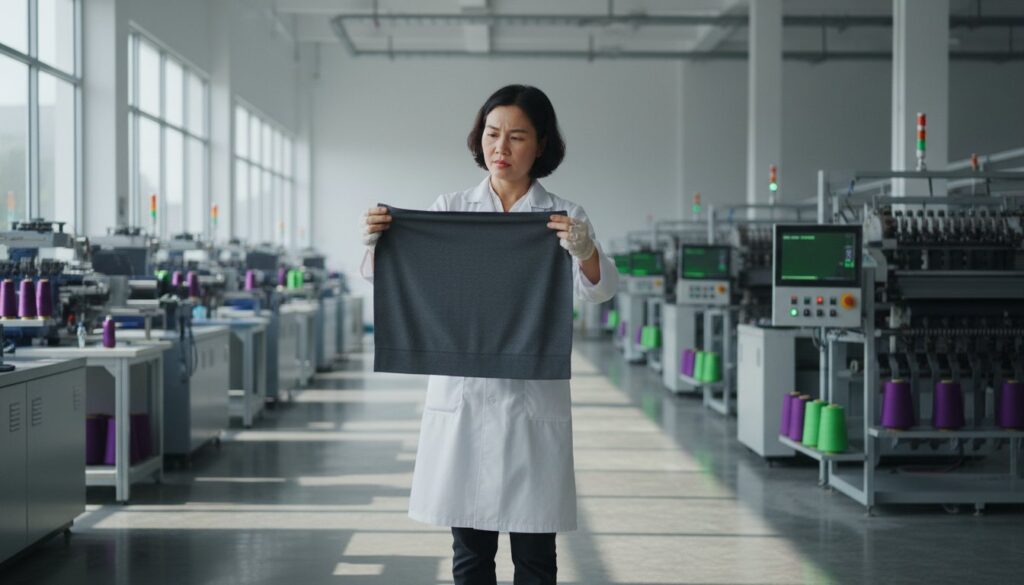
For international brands, the decision to partner with a new factory is fraught with operational risk. The prospect of navigating communication barriers, verifying ethical standards from a distance, and managing complex logistics can be a significant deterrent. As the global supply chain evolves, the search for reliable vietnam apparel manufacturers has intensified, but simply finding a list of names is insufficient. True success requires a deeper, more strategic approach to partnership-one that mitigates risk and ensures production excellence from the outset.
This guide is engineered to provide that strategic framework. Moving beyond surface-level directories, we will detail the critical criteria for a systematic evaluation of potential partners. You will learn how to assess production capacity, scrutinize quality assurance protocols, and confidently navigate the path from initial sampling to full-scale, compliant production. By the end, you will be equipped with the knowledge to select a long-term manufacturing partner in Vietnam that aligns with your brand’s standards for quality, cost, and operational integrity.
Key Takeaways
- Understand the strategic advantages of Vietnam’s skilled labor force and advanced infrastructure for producing high-value, quality-driven garments.
- Implement a structured 5-step vetting framework to systematically identify and qualify the right factory for your brand’s specific production requirements.
- Learn how a detailed tech pack becomes your primary tool for ensuring quality control and minimizing errors when evaluating vietnam apparel manufacturers from a distance.
- Recognize the critical differences in machinery and expertise required for technical activewear, and discover how to source a true specialist partner.
Why Global Brands Choose Vietnam for Apparel Manufacturing
Once regarded primarily as a low-cost production alternative, Vietnam has systematically evolved into a top-tier global apparel manufacturing hub. International brands are no longer selecting Vietnam solely for competitive pricing; they are choosing it for its sophisticated capabilities, consistent quality, and strategic advantages in the global supply chain. This shift reflects a maturing industry where technical proficiency and operational stability have become the primary drivers of growth, positioning the nation as a reliable partner for complex garment production.
The decision to partner with vietnam apparel manufacturers is increasingly based on a balanced value proposition that combines cost-efficiency with superior production outcomes. The country offers a unique synthesis of benefits that are difficult to replicate elsewhere:
- High-Quality Output: A strong emphasis on quality assurance and the adoption of international standards.
- Production Versatility: Expertise across a wide range of product categories, from technical activewear to high-fashion knitwear.
- Logistical Efficiency: Developing deep-water ports and modern logistics networks that streamline global exports.
Skilled Workforce and Production Infrastructure
Vietnam’s manufacturing prowess is built upon a long history of textile craftsmanship, which has been successfully industrialized over recent decades. This legacy provides a foundation of skilled labor capable of executing intricate designs and maintaining high standards of quality. Major industrial zones in and around Ho Chi Minh City, Binh Phuoc, and Hanoi have become epicenters of garment production, attracting significant investment in state-of-the-art machinery and production technologies. This commitment to modernization ensures that Vietnamese factories can meet the technical demands of leading global brands.
Favorable Trade Agreements and Economic Stability
A key strategic advantage for brands manufacturing in Vietnam is the country’s extensive network of free trade agreements. The EU-Vietnam Free Trade Agreement (EVFTA) and the Comprehensive and Progressive Agreement for Trans-Pacific Partnership (CPTPP) provide significant financial incentives by reducing or eliminating import tariffs for brands in member nations. This operational security is underpinned by a stable political climate and decades of consistent policy, with remarkable Vietnam’s Economic Growth creating a predictable environment for long-term investment and supply chain planning. The government’s continued support for the textile industry further solidifies its status as a secure and forward-looking manufacturing base.
The 5-Step Framework for Vetting Vietnamese Manufacturers
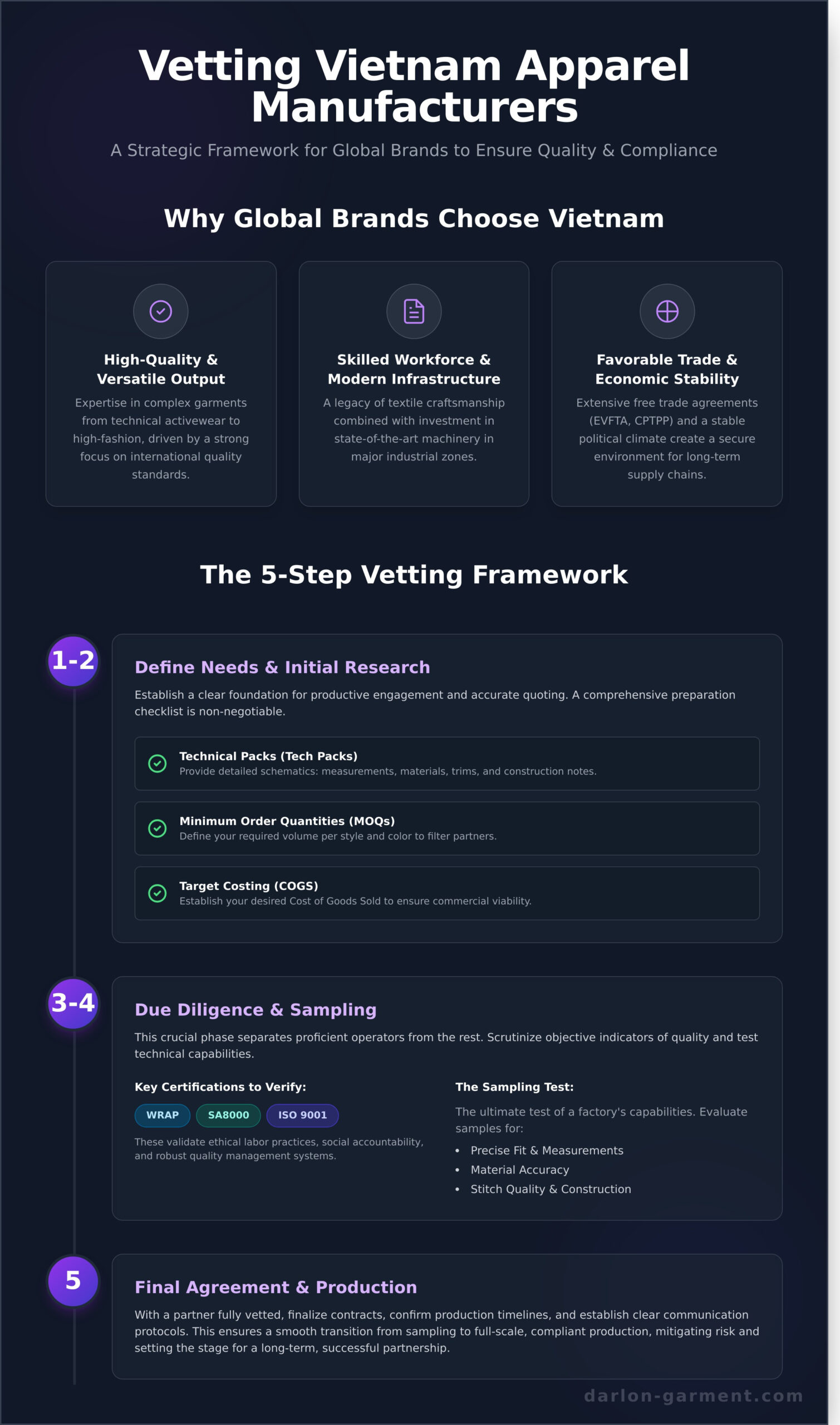
Engaging the right manufacturing partner is the most critical decision for a fashion brand’s operational success. To navigate the landscape of vietnam apparel manufacturers with precision, a structured, methodical approach is non-negotiable. This five-step framework provides a clear pathway from initial concept to finalized production agreement, ensuring that quality, compliance, and communication standards are met at every stage.
Step 1-2: Defining Needs and Initial Research
Before initiating contact, a brand must have its technical and commercial requirements fully defined. A comprehensive preparation checklist is essential for productive engagement and accurate quoting. This includes:
- Technical Packs (Tech Packs): Detailed schematics of each garment, including measurements, materials, trims, and construction notes.
- Minimum Order Quantities (MOQs): A clear understanding of your required volume per style and color.
- Target Costing: Your desired Cost of Goods Sold (COGS) to ensure commercial viability.
With these assets prepared, initial research can commence beyond simple web searches. Reliable sources include industry directories like the Vietnam Textile and Apparel Association (VITAS), international trade shows, and professional referrals. For a deeper exploration of this phase, review our guide on the 5 Steps to Find Your Ideal Clothing Manufacturer in Vietnam.
Many of these crucial industry gatherings take place in major Southeast Asian business centers, which are easily accessible from Vietnam’s manufacturing hubs. For instance, venues designed for large-scale international events, such as the BDMS Connect Center in Bangkok, often host trade fairs where brands can meet a wide array of regional suppliers in one trip.
Step 3-4: Due Diligence and Sampling
This phase separates proficient operators from the rest. Scrutinize a potential partner’s certifications, as they are objective indicators of operational standards. Certifications like WRAP (Worldwide Responsible Accredited Production) confirm ethical labor practices, SA8000 addresses social accountability, and ISO 9001 validates robust quality management systems. The recent surge in U.S. imports of Vietnamese textiles has increased competition, making such credentials a key differentiator. During this stage, communication responsiveness serves as a direct proxy for a factory’s professionalism and internal organization.
The sampling process is the ultimate test of a manufacturer’s technical capabilities. Evaluate samples not just for appearance but for technical execution: stitch quality, material accuracy against specifications, and precise fit. This is a critical checkpoint before committing to bulk production. For targeted inquiries during this stage, consult our resource on Vetting Vietnam Apparel Manufacturers: Key Questions to Ask.
The final step involves negotiating production terms-including payment schedules, lead times, and quality assurance protocols-and formalizing the partnership with a comprehensive manufacturing agreement. This systematic vetting process ensures a stable, reliable, and high-quality supply chain foundation for your brand’s future growth.
Evaluating Production Quality & Compliance from a Distance
For global brands, the primary objection to offshore manufacturing is the perceived challenge of overseeing quality control from afar. However, this concern is systematically mitigated through robust documentation, transparent processes, and independent verification. Established vietnam apparel manufacturers operate with sophisticated Quality Management Systems (QMS) designed specifically to provide international partners with confidence and clarity at every stage of production. The key lies in leveraging standardized tools and verification methods that leave no room for ambiguity.
The Power of the Tech Pack
A great tech pack is your first line of defense against production errors. This comprehensive document serves as the master blueprint for your garment, translating design concepts into precise, actionable instructions for the factory floor. It functions as both a technical guide and a production contract. A meticulously detailed tech pack should always include:
- Bill of Materials (BOM): A complete list of all fabrics, trims, threads, and accessories.
- Graded Spec Sheet: Precise measurements for all sizes in your production run.
- Construction Details: Instructions on stitching types, seam allowances, and finishing techniques.
- Artwork & Labeling: Exact placement, dimensions, and color codes for prints, embroideries, and labels.
Verifying Certifications and Social Compliance
In the modern market, technical quality must be matched by ethical production. Verifying a factory’s social and quality compliance is non-negotiable for brand reputation. Reputable manufacturers will readily provide proof of certifications such as WRAP (Worldwide Responsible Accredited Production), SA8000, or ISO 9001. These credentials demonstrate a commitment to fair labor, safety, and environmental standards. Ethical manufacturing is no longer optional; it is a core component of brand value and a key factor in maintaining a strong position for Vietnam’s apparel industry in the global value chain. When reviewing a factory audit report, look for red flags like inconsistent record-keeping, lack of worker safety protocols, or resistance to third-party inspections. For an added layer of assurance, brands can engage third-party quality control agencies on the ground in Vietnam to conduct pre-production, in-line, and final random inspections.
Finding a Specialist: Sourcing Sportswear & Activewear in Vietnam
While Vietnam’s apparel industry is robust, the production of high-performance sportswear and activewear is a specialized discipline. Unlike basic fashion garments, activewear demands a synthesis of advanced materials, complex construction, and functional durability. A standard cut-and-sew factory lacks the requisite machinery and technical knowledge to meet the stringent requirements of performance apparel. Brands must therefore partner with vietnam apparel manufacturers who possess a proven track record in this demanding category.
Key considerations when vetting a potential partner include their expertise in:
- Performance Fabrics: Mastery of handling and sourcing synthetic blends like spandex, nylon, and technical polyesters that offer specific functional properties.
- Complex Construction: The ability to execute multi-panel patterns, ergonomic seam placements (like flatlock stitching), and features such as gussets that enhance mobility and comfort.
- Durability and Quality Assurance: In-house testing protocols for seam strength, abrasion resistance, and colorfastness to ensure garments withstand intense physical activity and repeated laundering.
Technical Fabric and Material Sourcing
The supply chain for performance fabrics is a critical factor. Sourcing high-grade materials like moisture-wicking polyamide, four-way stretch spandex, or innovative textiles like Nuyarn requires established relationships with specialized fabric mills. A capable manufacturer manages this entire process, conducting rigorous tests to verify material specifications for properties such as moisture management, compression levels, UV protection, and anti-odor treatments. This ensures the final product performs exactly as designed.
Specialized Production Capabilities
Advanced activewear moves far beyond traditional cut-and-sew. Modern production relies on technologies that enhance both performance and aesthetics. Techniques like bonding create seamless, low-profile hems that prevent chafing, while laser cutting ensures perfectly clean edges for intricate ventilation patterns. These methods require significant capital investment and skilled operators, distinguishing a true activewear specialist. For a more detailed analysis, see our guide on Why Choose Vietnam for Your Activewear OEM Partner?
At Dar Lon Garment, our dedicated activewear lines are equipped with these advanced technologies, forming a core component of our comprehensive one-stop OEM solution for global brands.
Partnering with Dar Lon: A Leader in Vietnamese Sportswear Manufacturing
Navigating the landscape of Vietnam apparel manufacturers requires a partner with proven expertise, advanced infrastructure, and a deep understanding of global brand requirements. For companies specializing in performance-driven garments, Dar Lon represents the culmination of this search. With decades of focused experience, we have established ourselves as a premier manufacturer of high-quality sportswear, activewear, and swimwear, engineered to meet the exacting standards of the international market.
Our operational philosophy is built on providing a seamless and reliable production experience. We act as a strategic extension of your brand, translating complex designs into market-ready products with precision and efficiency. By integrating advanced technology with skilled craftsmanship, we offer a partnership that prioritizes quality, transparency, and long-term growth.
Our ‘One-Stop’ OEM/ODM Service Model
Dar Lon’s comprehensive OEM/ODM service model is designed to streamline the entire production lifecycle. This integrated approach simplifies supply chain management for our clients, covering every critical stage from initial concept to final delivery. The process begins with your tech pack and design specifications, moves through material sourcing and sample development, and culminates in full-scale production and logistics management. This model offers the flexibility to support both emerging brands and established labels, ensuring consistent quality at any volume.
Commitment to Quality and Innovation
At the core of our operations is an unwavering commitment to quality, backed by investment in state-of-the-art technology. Our modern facility is equipped with advanced machinery to handle the most technical garment constructions. Key capabilities include:
- Advanced Fabric Technologies: Expertise in performance textiles, including licensed production of innovative materials like Nuyarn for superior stretch and durability.
- Precision Manufacturing: Utilization of laser cutting for flawless accuracy and automatic sewing systems to ensure consistency across high-volume orders.
- Rigorous Quality Control: A multi-stage quality assurance process is embedded throughout production, from raw material inspection to final garment audit, guaranteeing every piece meets global export standards.
Partnering with leading Vietnam apparel manufacturers like Dar Lon provides the technical foundation and production stability your brand needs to succeed. We invite you to leverage our expertise for your next collection. Contact our experts to discuss your sportswear production needs.
Secure Your Production Future with a Premier Vietnamese Partner
As we look toward 2026, the strategic advantages of manufacturing in Vietnam are undeniable. Success hinges on a structured vetting process and finding a partner with specialized expertise. Navigating the landscape of vietnam apparel manufacturers requires a clear framework for evaluating quality, compliance, and technical capability, especially for demanding categories like performance activewear.
At Dar Lon, we provide the stability and technical mastery global brands require. As specialists in Sportswear, Activewear, and Swimwear, we offer a comprehensive one-stop OEM/ODM service built on a foundation of reliability. Our advanced technology, including precision laser cutting and bonding, ensures your designs are executed to the highest global standards. We are positioned not merely as a vendor, but as the silent, powerful backbone for your brand’s production needs.
Take the definitive step toward securing a resilient supply chain. Request a Consultation to Discuss Your Production Needs and discover how our commitment to quality can elevate your brand.
Frequently Asked Questions About Sourcing from Vietnam Apparel Manufacturers
What is the average Minimum Order Quantity (MOQ) for apparel manufacturers in Vietnam?
Minimum Order Quantities (MOQs) typically range from 500 to 1,000 units per style and colorway. However, this figure is highly dependent on the factory’s scale, the complexity of the garment, and the fabric sourcing requirements. For specialized materials or intricate designs, MOQs may be higher to ensure production efficiency and cost-effectiveness. It is crucial to discuss these specifics directly with potential manufacturing partners to align with their production capabilities and your brand’s needs.
Is it cheaper to manufacture clothing in Vietnam than in China?
Vietnam often presents a more competitive pricing structure, particularly for cut-and-sew garments, due to lower labor costs and benefits from free trade agreements like the EVFTA and CPTPP. While China maintains a highly sophisticated and rapid supply chain for raw materials, Vietnam’s operational expenses can result in a lower final Free On Board (FOB) price. A comprehensive cost analysis should factor in materials, labor, logistics, and import tariffs to determine the most advantageous option.
How do I handle shipping and logistics when working with a Vietnamese manufacturer?
Most transactions are conducted under Free On Board (FOB) terms, where the manufacturer is responsible for transporting goods to a designated port, such as Hai Phong or Ho Chi Minh City. From there, your brand assumes responsibility. Established manufacturers can connect you with reliable freight forwarders and customs brokers to manage international shipping, insurance, and import duties. A full-service partner will often provide logistical support as part of their one-stop solution for global clients.
What are the typical payment terms for clothing production in Vietnam?
The standard payment structure requires an upfront deposit, typically 30-50% of the total order value, upon confirmation of the purchase order. This initial payment secures raw materials and initiates production scheduling. The remaining balance, usually 50-70%, is due upon completion of production, often before the goods are shipped or against the presentation of the Bill of Lading (B/L) and other shipping documents. These terms provide security for both the brand and the manufacturer.
Can I find sustainable and eco-friendly apparel manufacturers in Vietnam?
Yes, Vietnam’s apparel sector has a growing number of factories committed to sustainable practices. Leading suppliers are increasingly adopting international standards and certifications such as GOTS (Global Organic Textile Standard), Oeko-Tex, and Bluesign. When vetting partners, inquire about their use of recycled materials, water treatment systems, and social compliance audits. The most reputable sustainable and eco-friendly vietnam apparel manufacturers provide transparent documentation of their certifications and ethical production processes.
How long does the apparel production process take in Vietnam, from sample to delivery?
A standard production timeline, from initial tech pack submission to final delivery, typically spans 12 to 18 weeks. This includes 2-4 weeks for sample development and approval, followed by 8-12 weeks for bulk production, which covers fabric sourcing, cutting, sewing, and quality control. Air or sea freight will add another 1-5 weeks depending on the chosen method and destination. Complex designs or large-volume orders may require an extended lead time, which should be confirmed upfront.
What are the main clothing and textile manufacturing hubs in Vietnam?
Vietnam’s apparel industry is concentrated in two primary regions. In the north, Hanoi and its surrounding provinces, including Hai Phong and Nam Dinh, are established hubs with a long history in textile production. In the south, Ho Chi Minh City serves as the commercial center, with a vast network of modern, export-focused factories located in adjacent provinces like Binh Duong and Dong Nai. These southern hubs are particularly noted for their advanced infrastructure and logistical efficiency.
How do I protect my brand’s intellectual property when working with an overseas factory?
Protecting your intellectual property (IP) requires a multi-faceted legal and operational approach. Always execute a comprehensive Manufacturing Agreement that includes robust Non-Disclosure (NDA), Non-Use, and Non-Circumvention (NUNC) clauses before sharing any designs or tech packs. Partnering with established, reputable factories that have a proven track record with international brands is critical. These manufacturers understand the importance of IP protection and have internal systems in place—from digital security to physical access control like the systems offered by AN Digital Lock—to safeguard client confidentiality and proprietary designs.