
Launching your own clothing line is an incredible feeling-until you start searching for a factory. Suddenly, the creative excitement is replaced by the overwhelming reality of production. You’re met with impossible order minimums, confusing technical terms, and the constant worry that you’ll invest your savings into a low-quality product. I’ve seen this intimidate countless founders. Finding a trustworthy low moq clothing manufacturer that respects your vision and your budget can feel like the single biggest hurdle to getting started.
But it doesn’t have to be that way. In this guide, I’m going to pull back the curtain on the manufacturing world. I’ll walk you through how small-batch production really works, the critical red flags to watch out for, and exactly how to prepare your designs for a successful run, from tech packs to sourcing. My goal is to give you the clarity and confidence you need to not just find a partner, but to build a foundation for your brand’s long-term success.
Key Takeaways
- I’ll explain the factory-side perspective on MOQs, so you can build stronger partnerships and negotiate more effectively from day one.
- Discover the honest trade-offs of low MOQ production, including the potential impacts on your pricing and material options.
- Get my 5-step checklist to ensure you look professional and ready for production before you contact a low moq clothing manufacturer.
- Learn how to plan your first production run not as a one-time order, but as the foundation for a scalable, long-term manufacturing relationship.
What ‘Low MOQ’ Really Means for Your Clothing Brand
If you’re launching a startup, there’s one acronym you need to understand above all others: MOQ. It stands for Minimum Order Quantity, and it’s the number that will shape your budget, your risk, and your entire production strategy. As someone who has navigated this for years, I’ve seen countless brands succeed or fail based on how they approach this single factor. So, let’s break down what it really means for you.
Defining MOQ in Plain English
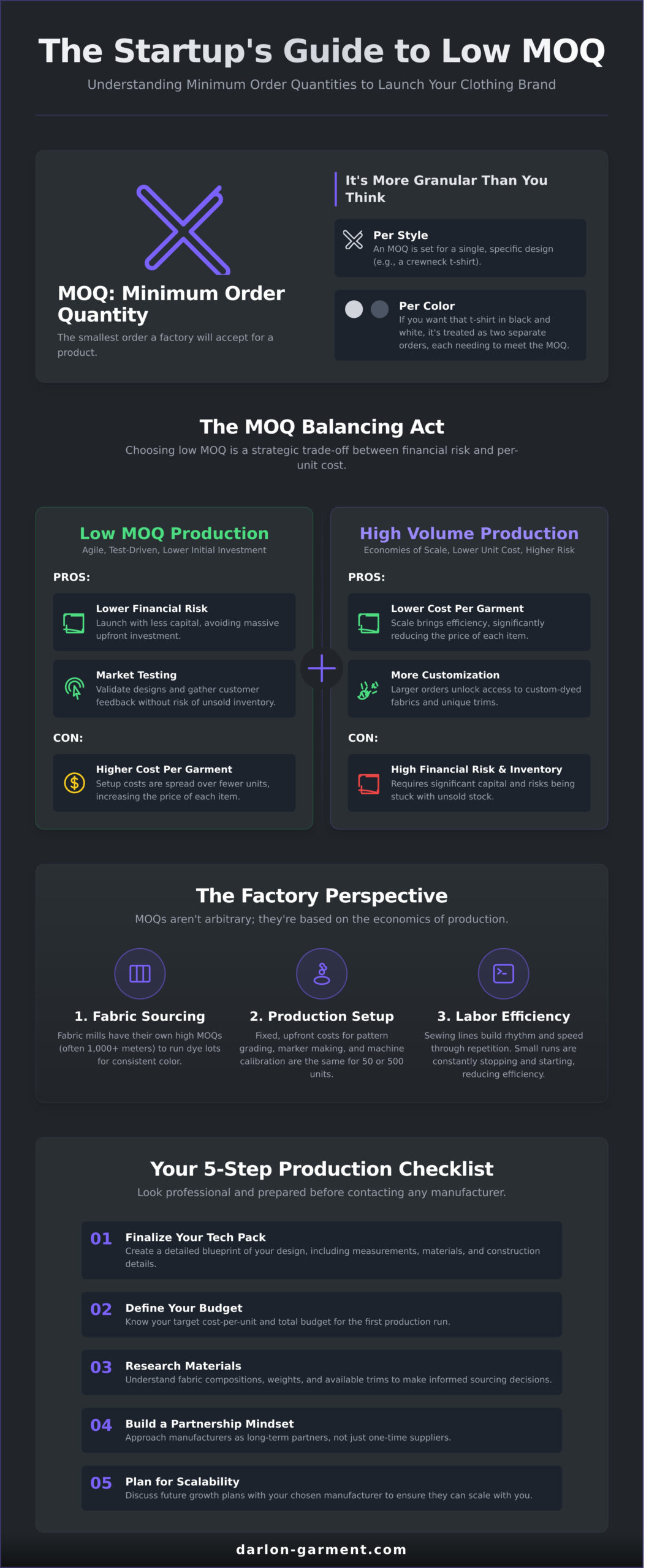
In the simplest terms, MOQ is the smallest order a factory will accept for a single product. But it’s more granular than that. An MOQ is typically set per style, per color. For example, if a manufacturer has an MOQ of 300 for a t-shirt, you must order 300 units of that specific t-shirt style in a single color, like black. If you want the same shirt in white, that’s a separate order of 300 units.
It gets more complex because different components have their own MOQs. Fabric mills, dye houses, and trim suppliers all have minimums. A factory might offer a low production MOQ, but the custom-dyed fabric you want might require a purchase of 1,000 meters. This is a critical detail in how the clothing industry operates, and it’s where many new brands get stuck.
Why This Number Dictates Your Business Model
Your MOQ directly impacts two of your most valuable resources: cash and inventory. A high MOQ means a significant upfront investment and a warehouse full of stock you need to sell. A lower MOQ reduces that initial financial burden and minimizes the risk of being stuck with unsold products.
However, there’s a crucial trade-off. Lower quantities almost always mean a higher per-unit cost. Factories achieve efficiency through scale; producing 100 shirts takes nearly as much setup time as producing 1,000. This is why finding the right low moq clothing manufacturer is about balancing cost and risk. A higher per-unit price might be worth it if it allows you to test the market with multiple styles or colors instead of betting your entire budget on a single product.
A Look Behind the Curtain: Why Factories Have MOQs
From my side of the production floor, I often see startups view Minimum Order Quantities (MOQs) as an arbitrary barrier. I want to pull back the curtain and show you it’s not about excluding small brands; it’s about the fundamental economics of production. The apparel supply chain is a massive, interconnected system, and understanding The Economic Impact of the Fashion Industry helps clarify why efficiency is king. When you understand why we have minimums, you become a much smarter partner, better equipped to find the right low moq clothing manufacturer for your brand.
The Challenge of Fabric Sourcing
The process begins long before we get your designs. Fabric mills-the factories that produce textiles-have their own high MOQs, often requiring us to purchase 1,000 meters or more per color. This is because they dye fabric in huge batches called ‘dye lots’ to guarantee perfect color consistency. To help new brands, we often maintain a selection of ‘in-stock’ fabrics that we can pull from in smaller quantities, which is a key service that makes lower minimums possible.
The Cost of ‘Setting Up’
Before a single stitch is sewn, a significant amount of preparation is required for each new style. This setup includes:
- Pattern Grading: Adjusting your base pattern for every required size.
- Marker Making: Digitally plotting the pattern pieces onto the fabric for minimal waste.
- Machine Programming: Calibrating automated cutters and sewing machines.
This is a fixed, upfront cost. Spreading that cost over 500 units is manageable; spreading it over 50 makes each piece financially impractical.
Labor Efficiency on the Sewing Line
Think of a sewing line as a highly specialized team where each operator masters one specific task-attaching a sleeve, sewing a collar, or hemming a bottom. With repetition, the team develops a rhythm and becomes incredibly efficient, producing high-quality work at speed. A small order means that just as the team hits its stride, the run is over. This constant re-learning for new styles slows production down, reduces efficiency, and raises the labor cost for each garment.
The Honest Truth: Trade-Offs of Low MOQ Manufacturing
Working with a low moq clothing manufacturer is an incredible advantage for a startup, but I believe in being completely transparent about the process. It’s not a magic solution; it’s a strategic choice that comes with specific trade-offs. Understanding both the benefits and the drawbacks is crucial for making an informed decision that aligns with your business goals. Let’s break down the reality of small-batch production so you can determine if it’s the right path for your brand right now.
Pro: Lower Financial Risk & Market Testing
The most significant advantage is minimizing your financial exposure. Instead of investing tens of thousands of dollars into a single design, you can launch with a much smaller capital outlay. I’ve seen countless brands use this strategy to test new products, validate design concepts, and build market momentum without the risk of being buried in unsold inventory. This lean approach is central to the future of on-demand production, allowing you to be agile and responsive to what your customers truly want.
Con: Higher Cost Per Garment
There’s no way around this: you will pay a premium per piece on a small order. Manufacturing efficiency is built on scale. Setting up machinery, calibrating patterns, and managing the production line has a fixed cost. When that cost is spread over 1,000 units, its impact is small. When spread over just 50 units, it’s substantial. For example, a t-shirt that costs $8 per unit on a large order might cost $15 or more on a low MOQ run. This directly affects your profit margins, so you must factor this higher cost into your pricing strategy from day one.
Con: Limited Customization and Fabric Choice
When you partner with a low moq clothing manufacturer, you are typically limited to their in-stock materials and colors. Custom developing, dyeing, or milling fabric requires massive minimum orders from the textile mills-often thousands of yards. For a small run, this is simply not feasible. This means your ability to create a completely unique product might be constrained at first. You’ll be working within a set of pre-approved options, which is a trade-off for the flexibility of a small order quantity.
This sourcing challenge extends beyond traditional textiles. For brands incorporating specialized materials like leather for accents, patches, or full garments, finding a supplier without massive minimums is equally critical. For those exploring this niche, companies like Hab-To Leather House provide a model for how specialized material sourcing can support small-scale creators.
Your 5-Step Checklist Before Contacting a Manufacturer
From my decades of experience in garment production, I can tell you that the most successful startups are always the most prepared. Before you send that first email, you need to have your operational details in order. I’ve created this checklist to help you look professional, save valuable time, and get an accurate quote faster. This is how you get a factory to take you seriously, no matter the size of your initial order.
1. Finalize Your Designs & Tech Pack
A professional tech pack is non-negotiable. Think of it as the architectural blueprint for your garment; it is the single most important document for turning your vision into a physical product. A simple sketch leaves too much open to interpretation, which leads to sampling errors and inaccurate costs. Without a detailed tech pack, we simply cannot provide a precise quote. At a minimum, it must include:
- Technical drawings (CADs) of the front, back, and any detailed views.
- A complete measurement sheet with size grading specifications.
- Fabric composition, weight, and color information (e.g., Pantone codes).
- Construction details like stitch types, seam finishes, and required trims (buttons, zippers, etc.).
A final note on design: don’t forget your branding and decorative elements. If you plan to use embroidery, for example, having the digital design files ready for your tech pack is a sign of professionalism. It shows us you’ve thought through the entire product, not just the base garment. For brands looking for high-quality, machine-ready files, a specialized marketplace like Embroidery n Sewing can be a great resource to get started.
2. Know Your Target Cost & Retail Price
Before you request a quote, you must understand your own business mathematics. What is your budget, and what is your desired profit margin? Come to a manufacturer with a target production cost, and we can immediately assess if it’s realistic and guide you on material or construction choices to meet it. A simple formula is to divide your target retail price by 3 or 4. For example, if you plan to sell a hoodie for $80, your target production cost should be around $20-$27. This shows us you’ve done your homework.
3. Have a Clear Idea of Your Order Quantity
You need a specific answer when we ask, “How many units do you want?” This means knowing the total units per style and, crucially, breaking that number down by color and size. A vague “about 100 pieces” is not sufficient. A professional request looks like this: “Style-T01, Color: Black, S-20, M-30, L-20.” This breakdown is critical for us to calculate fabric consumption and plan production efficiently. Even when you’re seeking a low moq clothing manufacturer, this level of detail demonstrates a solid business plan.
Keeping all of these moving parts—designs, quotes, order quantities, and timelines—organized is a job in itself. As your brand grows, a simple spreadsheet may not be enough. Many modern brands use cloud-based software like TrackMyBusiness to manage their production workflows and ensure nothing falls through the cracks.
From First Sample to Full-Scale Production: Planning for Growth
Your first production run is a massive achievement, but I want you to think of it as the starting line, not the finish line. Working with a low moq clothing manufacturer is the perfect way to test your designs, validate your market, and build initial momentum without taking on excessive risk. The real goal, however, is to build a brand that lasts. That means having a clear plan for scaling your production as your sales and demand grow.
This is where strategic partnership becomes critical. You need a manufacturing partner who not only understands your startup needs but also has the industrial capacity to support your long-term vision. Transitioning from a small workshop to a high-capacity factory mid-growth can introduce quality inconsistencies and production delays that can cripple a young brand.
The Journey from 50 Pieces to 5,000
Every successful apparel brand follows a similar trajectory. Your initial small batch proves your concept. Soon, you’ll hit key milestones that signal you’re ready to scale beyond the capabilities of a typical small-batch facility. These growth indicators include:
- Consistently selling out of your inventory ahead of schedule.
- Receiving inquiries from retailers or for wholesale orders.
- Needing advanced customization, proprietary fabric development, or specialized trims.
- Your order volume begins to exceed the capacity of your current partner.
Finding a Partner for the Long Haul
The ideal partner is one who can support you at every stage. I always recommend looking for a vertically integrated manufacturer. Because they control everything from knitting the fabric to cutting, sewing, and finishing, they can ensure unwavering quality and consistency as your order volume increases from hundreds to thousands of units. A true manufacturing partner invests in your success; when your brand grows, their business grows too. It’s a symbiotic relationship built on trust and shared ambition.
Ready to Scale? Let’s Talk.
At Dar Lon Garment, our expertise lies in helping established and high-growth brands scale their production efficiently and reliably. While our infrastructure is built for larger volumes, I have a deep respect for the startup journey and love connecting with ambitious founders who are ready for the next level. When you’ve validated your brand and are prepared to grow beyond what a low moq clothing manufacturer can offer, I’d love to hear from you. Let’s build something that lasts.
Your Next Step: From Low MOQ to Lasting Success
I hope this guide has given you a clear, honest look at the world of low MOQ manufacturing. Remember, the goal isn’t just to find a factory that will accept a small order; it’s about understanding the strategic trade-offs and having a solid plan to scale from your very first run. Choosing the right low moq clothing manufacturer is a critical decision that sets the foundation for your brand’s entire future.
When you’re ready to build a scalable production plan with a partner dedicated to excellence, my team and I are here to help. As specialists in high-quality activewear and sportswear, we provide a complete one-stop OEM/ODM service from design to delivery. It’s this commitment to quality and reliability that has made us a trusted manufacturing backbone for global apparel brands.
Ready to plan for your brand’s growth? Contact our production experts.
Your vision is worth building with precision and care. I’m excited to see what you create.
Frequently Asked Questions
What is a typical ‘low MOQ’ for a clothing manufacturer?
I get asked this a lot, and honestly, ‘low’ can mean different things. For a startup, I generally consider a low MOQ to be between 50 to 300 pieces per style. It really depends on the garment’s complexity and the factory’s setup. For a simple item like a t-shirt, you might find a manufacturer who will do 50 units. For a more detailed piece like a custom-dyed jacket, 200 pieces might be the absolute minimum they can offer.
Can I mix different styles or colors to meet a single MOQ?
Generally, I find that you can’t mix different styles to meet one MOQ. A 100-piece MOQ for a hoodie means you need to produce 100 of that specific hoodie design. However, many manufacturers are flexible with colors. For that 100-piece order, they might let you split it into two colorways, like 50 in black and 50 in grey. This is because changing thread is much easier than setting up a whole new pattern for a different style.
How much more expensive is low MOQ production compared to a standard order?
I always tell my clients to expect a higher per-unit cost for low MOQ orders. The price can be anywhere from 20% to 50% higher than what you’d pay for a large-volume run. The reason is that setup costs-like pattern making, fabric cutting, and machine calibration-are the same whether you’re making 50 pieces or 500. When you spread that fixed cost over fewer items, each individual garment simply costs more to produce. It’s the trade-off for lower risk.
Do I need to provide my own fabric for a low MOQ order?
In my experience, you usually don’t have to source your own fabric. Most manufacturers have established relationships with fabric mills and can source materials for you, even for smaller quantities. I often recommend letting them handle it, as they might have access to in-stock materials perfect for small runs. However, if you have a very specific or unique fabric in mind that they can’t get, then providing it yourself becomes the main option. Just be sure to discuss this upfront.
What’s the difference between a low MOQ factory and a sample maker?
I see this confusion a lot. A sample maker’s job is to create one-off prototypes to perfect your design and fit. For founders who need an absolutely perfect ‘master’ garment, even a personal tailor service like Your Tailor Robin can fill this role. Their focus is on development, not bulk production, and they charge a high price per piece. A low moq clothing manufacturer, on the other hand, is equipped for production runs, just on a smaller scale. They have the production lines and processes to create 50 or 100 identical, high-quality garments efficiently. Think of it as prototype versus production.
Are there low MOQ clothing manufacturers in Vietnam?
Absolutely! I’ve worked with several great partners there. Vietnam has become a major hub for apparel manufacturing and is known for high-quality workmanship, especially in activewear and outerwear. You can definitely find factories that cater to startups and offer smaller order quantities. Finding a reliable low moq clothing manufacturer in Vietnam is a great strategy for brands looking for a balance of quality and competitive pricing without committing to massive production volumes from the start.
How do I make sure the quality is good on a small production run?
My number one rule is to never, ever skip the pre-production sample (PPS). This is your final, approved sample that the factory will use as the gold standard for the entire run. I also insist on providing a detailed tech pack with every possible specification listed clearly. Clear communication is key. Even for 50 pieces, you need to be just as diligent with your quality assurance process as you would be for 5,000. Don’t let the small quantity make you complacent.