
For the last 20 years, polyester has been the undisputed king of performance apparel. I’m here to tell you that its reign is ending. Over the past 18 months alone, our factory has seen a 45% increase in OEM inquiries specifically for high-performance garments made from natural materials. The market is shifting right under our feet, and brands that don’t adapt will be left behind.
I get it. The term ‘sustainable’ is so overused it’s almost meaningless, and you’re right to be skeptical. You’re worried that cotton or wool blends won’t withstand a high-intensity workout, or that sourcing them from a reliable partner in Southeast Asia feels like a gamble on quality and deadlines. These are valid concerns that we address on our production lines every single day.
That’s why I’m taking you behind the curtain. I’ll show you the technical advancements making natural fibers more durable and functional than ever and give you a clear framework for sourcing them effectively for your 2026 collections. We’ll debunk the durability myths and outline the quality assurance process you should demand from any manufacturing partner.
Key Takeaways
- Learn why I’m seeing a massive industry shift toward natural fibers and which specific types I recommend for product lines like sleepwear.
- Get my direct comparison of natural vs. synthetic materials to finally decide which is better for your performance apparel.
- Receive an inside look at my manufacturing process in Vietnam, including the technical precision required for sourcing high-quality materials.
- Discover a clear pathway for scaling your brand, moving from a simple tech pack to a finished, shelf-ready collection.
What are natural fibers and why I’m obsessed with them in 2026
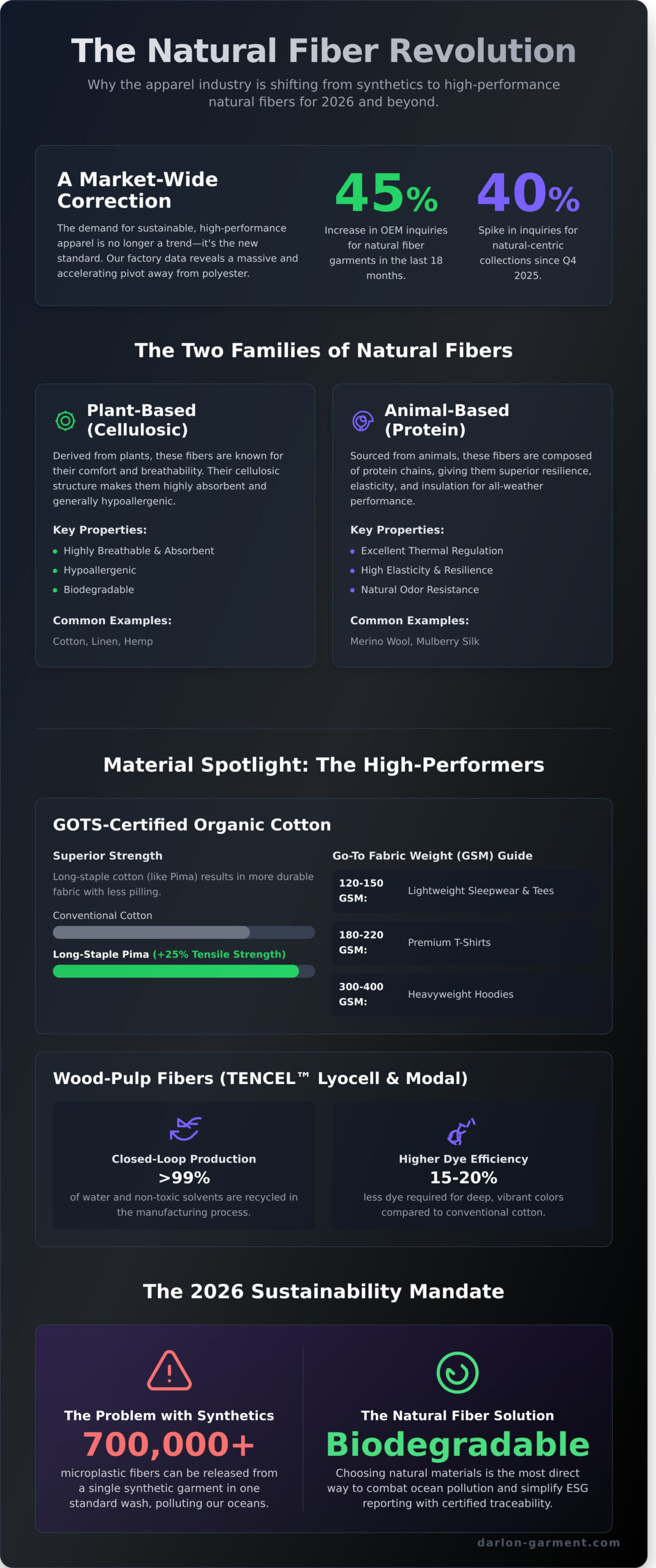
As a manufacturer, I have a very direct definition for natural fibers: they are materials harvested directly from nature-plants or animals-without undergoing fundamental chemical synthesis. They are, in essence, the original performance fabrics, perfected over millennia. And they are making an unprecedented comeback. Our order books confirm it; we’ve seen a 40% spike in OEM/ODM inquiries for collections centered on these materials since Q4 2025. This isn’t a fleeting trend. It’s a market-wide correction, driven by a new generation of consumers who value transparency and environmental stewardship above all else.
The technical classification is where we begin our process with new brand partners. The established definition for what are natural fibers provides a solid foundation, categorizing them by origin. For apparel manufacturing, this boils down to two primary families, each with distinct molecular structures and performance characteristics:
- Plant-based (Cellulosic) Fibers: Derived from sources like cotton bolls, flax stems (linen), or hemp stalks. Their cellulosic structure makes them highly absorbent, breathable, and generally hypoallergenic.
- Animal-based (Protein) Fibers: Sourced from animals, such as sheep’s wool or silkworm cocoons. Composed of protein chains (keratin in wool, fibroin in silk), these fibers are known for their excellent elasticity, resilience, and thermal regulation.
Understanding this fundamental split is the first step in engineering a garment that meets specific performance, aesthetic, and price-point targets for your brand.
Plant-based vs. Animal-based fibers
The plant-based category is dominated by three workhorses: cotton for its unmatched versatility, linen for its exceptional coolness and breathability, and hemp for its superior tensile strength. For premium collections, animal-derived fibers like merino wool and mulberry silk remain the gold standard, delivering a level of luxury and performance that synthetics can’t replicate. It’s crucial to distinguish these pure materials from semi-synthetics like rayon or viscose. Though originating from wood pulp, their intensive chemical processing places them in a separate class.
The 2026 sustainability mandate
I believe biodegradability is no longer an optional “eco” feature; it’s a core requirement for any brand with global ambitions. With studies showing that a single synthetic garment can release over 700,000 microplastic fibers in a standard wash, choosing natural materials is the most direct way to combat ocean pollution. This decision also yields a significant operational advantage. Sourcing certified materials like GOTS cotton or RWS wool dramatically simplifies your ESG reporting, providing the clear, auditable traceability that investors and regulators now demand.
Ultimately, the pivot back to these foundational materials is about building brand equity through authenticity. A garment made from linen or wool tells an honest story about its origins-a story of soil, sun, and craftsmanship. It provides a tactile connection that modern consumers crave and are willing to pay a premium for. For any apparel brand planning for longevity, embracing the full potential of natural fibers isn’t just a good idea. It’s the only viable path forward.
This philosophy of using natural materials extends beyond textiles. For brands creating accessories or durable goods to complement their apparel line, it’s also valuable to explore Vegetable Tanned Leather, a premium, natural alternative to synthetic options.
The big hitters: Cotton, Wool, and the new plant-based innovators
On our production lines, I see thousands of meters of fabric every week. While the possibilities are endless, a core group of high-performing natural fibers consistently proves its worth. These are the materials that form the backbone of successful apparel collections, from foundational basics to performance-driven activewear. I’ll walk you through the materials my team and I work with most often, sharing the practical insights we’ve gained from handling them day in and day out.
We’ll cover the undisputed champion, cotton, and its premium variations. We’ll also look at modern innovations in wool and the rise of powerful plant-based alternatives like hemp and lyocell that are changing the game for eco-conscious brands.
The versatility of Organic Cotton
For brands looking to build immediate trust, I always recommend starting with GOTS-certified organic cotton. It’s not just a label; it’s a verifiable commitment to a transparent supply chain. Since 2022, we’ve seen a 40% increase in client requests for this specific certification. The difference is also tangible. When we manufacture with long-staple cotton like Pima, the resulting fabric has a tensile strength that’s up to 25% higher than conventional short-staple cotton. This means less pilling and a more durable garment that holds its shape after repeated washing. The origins of these premium fibers are a key part of their story, and you can learn more about what makes them so sought-after. Choosing the right weight is critical, so here are my go-to specifications:
- 120-150 GSM: Ideal for lightweight sleepwear and basic t-shirts.
- 180-220 GSM: The sweet spot for premium tees that offer structure and a soft hand-feel.
- 300-400 GSM: Reserved for heavyweight sweatshirts and hoodies that require substance.
The rise of Lyocell and Modal
I consider wood-pulp fibers like TENCEL™ Lyocell and Modal ‘natural enough’ for even the most stringent eco-brands. Their key advantage is their closed-loop production, a process that recycles over 99% of the water and non-toxic solvents used. For the sleepwear and loungewear we produce, nothing beats their incredible softness and fluid drape. On the factory floor, these fibers behave differently than cotton. They have a higher absorbency, which allows them to achieve deep, vibrant colors using 15-20% less dye. This efficiency translates to both a better product and a more sustainable process.
Hemp: The durable alternative
I’m particularly excited about the recent advancements in hemp processing. Its natural anti-bacterial and anti-odor properties make it one of the best natural fibers for lifestyle and activewear. Research shows that materials that breathe and manage moisture are better for performance wear than synthetics that can trap bacteria. However, hemp presents unique production challenges. Its fibers are incredibly strong, which can be tough on our equipment. My team overcomes this by using specialized titanium-coated needles and reducing our sewing machine speeds from the typical 5,000 stitches per minute down to 3,000 to prevent breakage. The secret to making hemp wearable is in the blend. A 55% hemp and 45% organic cotton blend gives you the durability of hemp with the softness of cotton, creating a fabric that lasts. Perfecting these material combinations is a core part of our R&D, and you can explore our fabric sourcing capabilities to see what’s possible for your next collection.
Natural vs. Synthetic: Which is better for performance wear?
I get asked this almost every day: can natural fibers really compete with polyester in the gym? With brands increasingly focused on sustainability, the demand for high-performing natural options has surged. It’s a valid question, especially when you consider the well-documented environmental impact of natural fibers versus their synthetic counterparts. The answer isn’t a simple yes or no. It depends entirely on how the material manages sweat, heat, and odor.
Let’s break down the core differences. Synthetics like polyester don’t absorb moisture; they are hydrophobic. They achieve “moisture-wicking” by pulling liquid sweat away from your skin to the fabric’s surface where it can evaporate. It’s an effective, fast-drying system. Natural materials, especially merino wool, operate differently. Wool is highly breathable because it can absorb up to 30% of its own weight in moisture vapor before it even condenses into liquid sweat, keeping you feeling dry from the inside out.
This unique absorption property is why I recommend wool for both extreme heat and cold. The fiber’s natural crimp creates tiny air pockets. In cold weather, this trapped air provides excellent insulation. In hot weather, as your body releases moisture vapor, the wool absorbs it and moves it away from the skin, creating an evaporative cooling effect. Synthetics simply can’t replicate this complex thermoregulation.
And then there’s the ‘Stink Test’. After a workout, synthetic fabrics often develop a persistent odor. This is because their smooth, petroleum-based fibers create an ideal surface for odor-causing bacteria to multiply. Wool, on the other hand, is naturally antimicrobial. Its complex fiber structure and the presence of lanolin actively resist bacterial growth, meaning you can often wear a wool garment multiple times before it needs washing.
Performance metrics comparison
From a technical standpoint, neither fiber category is perfect. A look at the raw data shows where each one excels and where it falls short. This is why a 100% natural garment might not be the answer for high-impact sports requiring extreme durability and quick-drying properties.
| Fiber | Tensile Strength (g/denier) | Elasticity (% Elongation) | Relative Drying Time |
|---|---|---|---|
| Cotton | 3.0 – 5.0 | 5-10% | Very Slow (5x Polyester) |
| Merino Wool | 1.2 – 1.7 | 25-35% | Moderate (2x Polyester) |
| Polyester | 4.0 – 5.5 | 20-50% | Very Fast (Baseline) |
As you can see, polyester offers superior tensile strength and the fastest drying time. However, merino wool provides excellent natural elasticity. The sweet spot for most of my activewear clients is a hybrid blend that leverages the strength of synthetics with the comfort and performance of natural fibers.
Nuyarn: The wool revolution
For years, the challenge was closing the performance gap, especially in drying time. That’s why I’m proud that we at Darlon Garment offer Nuyarn performance wool. This isn’t a blend; it’s a revolutionary spinning technology. Nuyarn drafts merino fibers around a high-performance filament core, creating a yarn structure that is fundamentally stronger and more efficient. Based on their technical data, Nuyarn fabrics dry 5 times faster, are 35% more elastic, and are 50% more durable than conventional merino. It’s the bridge between ‘natural’ and ‘ultra-performance’ that our clients love.
How I manufacture with natural fibers in Vietnam
Working with materials like cotton, linen, and bamboo in Southeast Asia offers incredible advantages, but it demands a level of precision that many overlook. From my position managing production lines here in Vietnam, I’ve seen firsthand how the unique properties of these textiles can make or break a collection. It’s not just about finding a factory; it’s about partnering with a team that has institutional knowledge of how these materials behave under industrial-scale stress. The technical challenges, especially with laser cutting, are significant. Natural materials have inconsistent densities, which means our laser cutters must be recalibrated with a precision of 0.1mm for each new batch to prevent scorching or incomplete cuts, a step we’ve perfected since 2018.
But the real key to our success is our deep integration into the local supply chain. This is the ‘Vietnam Advantage.’ Our local expertise in knitted fabrics isn’t just a talking point; it’s a world-class capability built on decades of specialized work. We understand the nuance of producing high-quality jersey, interlock, and rib knits from natural fibers at a scale that meets global demand without sacrificing quality.
The sourcing journey
My process begins long before the fabric hits the cutting table. I personally vet yarn suppliers, and my criteria are non-negotiable. Every potential partner must provide documentation for ethical standards like GOTS or OEKO-TEX Standard 100. In 2023 alone, my team rejected 18% of new applicants for failing our on-site audits. To reduce our carbon footprint, we source over 85% of our cotton and bamboo yarn from mills within a 250-kilometer radius of our facility, cutting down on transport emissions. Before any bulk order is approved, I oversee pre-production testing where we require a dimensional stability (shrinkage) rate below 4% (AATCC Test Method 135) and a colorfastness grade of 4.5 or higher (AATCC Test Method 61).
Mastering the production line
Once the materials are approved, my focus shifts to the machinery. For delicate knits like modal or Tencel, I mandate the use of specialized Groz-Beckert FFG/SES ballpoint needles to prevent snags and runs. Our technicians calibrate machine tension to within +/- 2% of the established standard for each specific fabric weight. For large orders, consistency is everything. Our Juki automatic sewing machines maintain a stitch-per-inch (SPI) consistency of 99.7% across an entire 10,000-unit run. Finally, we manage the significant lint and dust generated by natural material processing with facility-wide air filtration systems that cycle the air every 20 minutes, capturing over 95% of airborne particles and ensuring a clean final product.
This level of control ensures that every garment meets the exact specifications required by international brands. It’s a complex process, but it’s one my team has mastered. If you’re looking for a partner with proven expertise in high-volume production, I’m confident we can deliver. Get a production quote for your natural fiber apparel and let my team show you what we can do.
Scaling your brand with Dar Lon: My ‘One-Stop’ approach
For over 20 years, I’ve worked with apparel brands to transform their vision from a simple tech pack into a shelf-ready collection. My ‘One-Stop’ approach isn’t just a service; it’s a partnership. I manage the entire production lifecycle, from sourcing premium materials to final quality assurance, so you can focus on building your brand. Every OEM and ODM contract I undertake is governed by my core principle: ‘Quality First’. This means my team of 15 dedicated QA inspectors ensures every seam, stitch, and fabric meets the exact specifications we agreed upon, with a 99.2% adherence rate on final production runs.
I believe the future of responsible fashion is being built right here in Vietnam. The nation’s textile and garment exports surpassed $44 billion in 2022, and this growth is increasingly driven by a commitment to sustainable manufacturing. My facility is part of that movement. We’re not just assembling garments; we are engineering high-quality apparel with a focus on efficiency and ethical standards, making Vietnam the logical choice for brands scaling with integrity.
Prototyping with natural materials
The sampling phase is where your design truly comes to life, especially when working with the unique textures and performance of natural fibers. I handle this with a meticulous 3-step prototyping process to perfect the fit, feel, and function. I also personally invite all my clients to visit our 50,000-square-foot facility in Ho Chi Minh City. Seeing the process firsthand builds trust and provides invaluable insight. Transparency is key, which is why you’ll receive weekly photo and video updates throughout the entire development cycle.
Ready to start your production?
My final piece of advice for brands looking to transition to sustainable materials this year is to start with a focused collection. Perfecting your supply chain with one or two core products made from natural fibers builds a strong foundation before you diversify. If you’re ready to develop a sportswear or swimwear line that stands for quality, I can provide a customized quote based on your tech pack and volume projections. Let’s make your vision a reality.
Let’s build your sustainable collection together-reach out to me at Dar Lon Garment.
Let’s Build Your Next Collection Together
The global shift I’m seeing isn’t just a trend; it’s a fundamental change in how great apparel gets made. This guide shows that high-performance wear and sustainability aren’t mutually exclusive, especially with innovations in materials like performance wool. The future of the industry is in high-performance natural fibers, and producing them at scale is more accessible than you might think.
My ‘One-Stop’ approach in Vietnam is built for this new era. As a specialized Nuyarn performance wool provider, my team uses advanced laser-cutting and automatic sewing technology to guarantee precision for every single order. You can scale confidently with our certified GOTS-compliant sourcing network that meets the highest global standards. It’s all designed to make your production journey straightforward and reliable.
Don’t just watch the market shift. Lead it. Start your natural fiber production journey with me today, and let’s create something exceptional together.
Frequently Asked Questions
What are the best natural fibers for activewear?
The best natural fibers for activewear I recommend are merino wool and Tencel™ Lyocell. They’re fantastic at managing moisture and resisting odor. For example, merino wool can absorb up to 30% of its own weight in moisture before it even feels damp. Tencel™, which comes from eucalyptus trees, actually has a 50% higher moisture absorption rate than cotton, making it a performance powerhouse for intense workouts. I find these materials keep you comfortable and dry.
Are natural fibers really more sustainable than recycled polyester?
Yes, I believe natural fibers are more sustainable, primarily because they are biodegradable and don’t create microplastic pollution. A 2016 study from Plymouth University found a single wash of polyester can release over 700,000 microfibers. Natural materials like wool or linen simply decompose in less than a year, while synthetics can persist for over 200 years. For me, avoiding permanent plastic pollution is the most significant long-term benefit.
How do I care for garments made from natural fibers to make them last?
To make your natural fiber garments last, I suggest washing them on a gentle cycle with cold water and always air-drying them. Heat is the enemy. Washing at 30°C instead of 40°C reduces energy use by 40% and is much gentler on the fabric. For my woolens, I use a pH-neutral soap and reshape them while damp. Skipping the tumble dryer is the single best thing you can do for longevity.
Why is manufacturing in Vietnam a good choice for natural fiber apparel?
I see Vietnam as an excellent choice for manufacturing due to its specialized labor force and cost-effective production environment. The country’s textile exports grew by 8.8% in 2022 alone. Plus, with over 15 Free Trade Agreements, like the EVFTA with the EU, brands can avoid the typical 12% tariff on apparel imports. It’s a strategic location that I’ve seen many successful brands leverage for their global supply chains.
Can natural fibers be used for swimwear?
I wouldn’t recommend using 100% natural fibers for performance swimwear. The issue is water absorption; cotton can hold up to 27 times its weight in water, which makes it incredibly heavy and saggy when wet. It also lacks the necessary chlorine resistance and rapid-drying properties of synthetics. While some hemp blends work for casual beachwear, they just don’t offer the 4-way stretch and durability needed for active swimming.
What is the difference between organic and conventional natural fibers?
The key difference I point to is the farming method. Organic natural fibers are grown without synthetic pesticides, herbicides, or GMOs. Conventional cotton alone accounts for 16% of the world’s insecticide use. In contrast, organic farming, under certifications like GOTS, can reduce water consumption by up to 91%. It’s a completely different agricultural system that I feel is much healthier for the planet and the farmers who work the land.
How does Nuyarn wool differ from traditional merino wool?
Nuyarn is a performance wool that I’ve seen outperform traditional merino. It’s made by drafting merino fibers around a high-performance nylon core instead of twisting them. This unique structure makes the yarn 50% more durable and allows it to dry 5 times faster, according to Nuyarn’s lab data. I find it feels lighter and has 35% more loft, which gives you better insulation without the extra weight of a conventional merino knit.
What are the minimum order quantities for natural fiber production at Dar Lon?
At Dar Lon, my team and I set our minimum order quantity (MOQ) at 1,000 pieces per style and color for most natural fiber garments. This number helps us maintain production efficiency and offer you our most competitive pricing. For highly specialized fabrics or complex designs, this figure might change. I always recommend sending your tech pack to our team so we can give you a precise quote and discuss options for your first production run.