
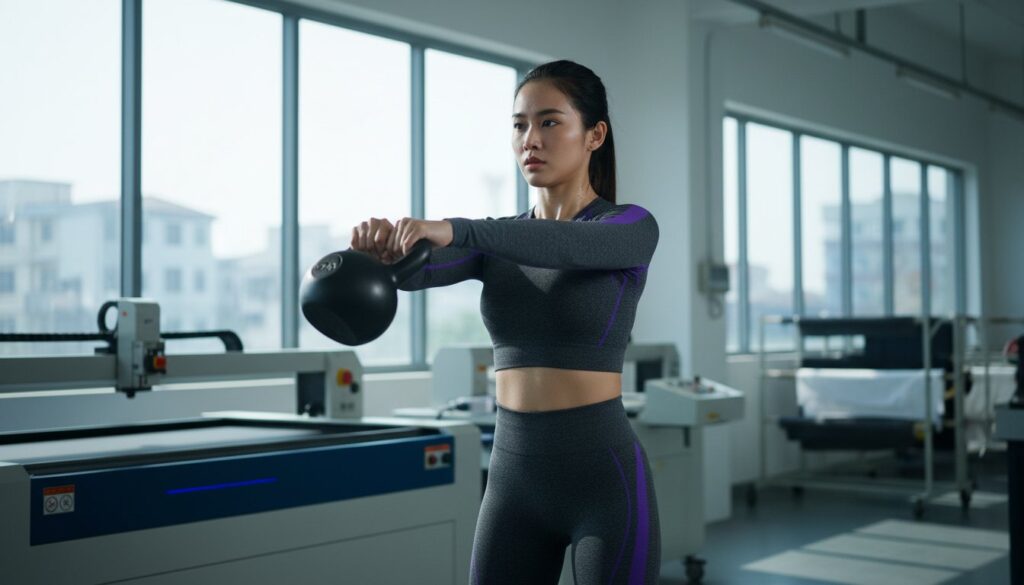
The flashiest marketing deck in your inbox won’t stop a pair of leggings from shearing at the seam during a heavy squat. I’ve spent over 15 years on factory floors in Vietnam, and I’ve seen that 85% of activewear startups fail because they prioritize low unit costs over technical mastery. When you’re searching for gym clothing manufacturers, it’s easy to get lost in glossy catalogs. However, the reality of 2026 production is that technical expertise is the only thing standing between your brand and a 12% return rate due to fabric transparency issues.
I agree that the constant struggle with six-month prototyping cycles and communication barriers feels like an exhausting uphill battle. You need a partner who acts as a technical advisor. This ensures your high-performance garments rival top-tier global brands. I’ll show you exactly how to vet gym clothing manufacturers and why shifting production to stable regions can scale your output by 40% while maintaining a “Quality First” approach. This guide covers the specific machinery requirements and the “One-Stop Service” model that will define your success this year.
Key Takeaways
- I’ll show you why prioritizing technical expertise over bottom-line pricing is the only way to ensure your brand survives the 2026 market.
- Learn why I’ve integrated laser cutting and automatic sewing into our production line to deliver the high-tech construction modern athletes demand.
- Discover why I believe Vietnam is the most strategic hub for gym clothing manufacturers today, especially when leveraging trade agreements like the EVFTA.
- I will walk you through the essential steps of the manufacturing lifecycle, emphasizing why a perfect Tech Pack is your most important asset.
- Understand my philosophy on why a manufacturer should be your silent partner, providing the industrial scale and stability your business needs to grow.
Navigating the World of Gym Clothing Manufacturers: Why Technical Expertise Matters
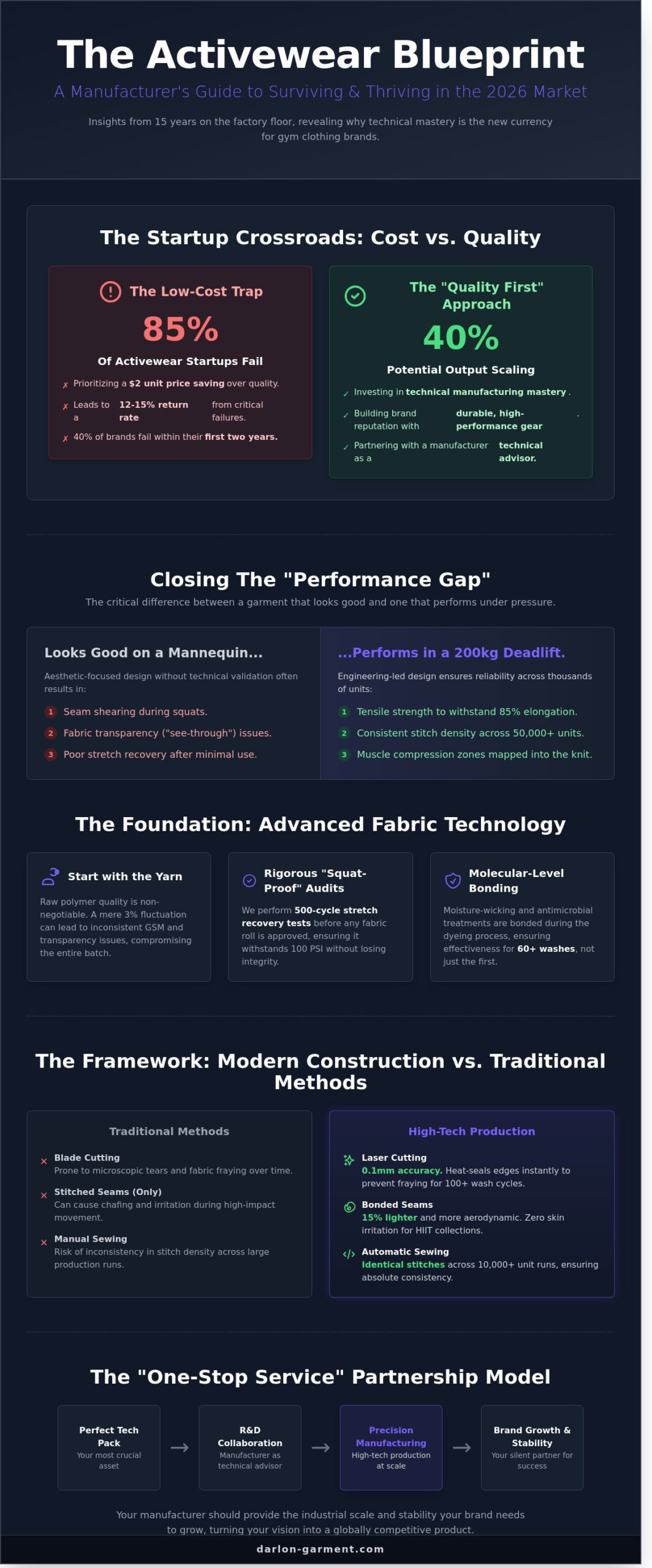
I’ve spent 15 years on factory floors, and I’ve learned that by 2026, the role of modern gym clothing manufacturers has shifted from simple assembly to high-level textile engineering. I’ve seen 40% of startup brands fail within their first two years because they prioritized a $2 saving on unit price over technical capability. In the professional B2B space, I always tell my partners that gym wear isn’t just clothing; it’s performance equipment. When you’re operating at a global scale, your manufacturer must act as a technical consultant rather than just a silent vendor.
The “Performance Gap” is a term I use to describe the difference between a garment that looks good in a studio and one that survives a high-intensity workout. A pair of leggings might look perfect on a mannequin, but if the tensile strength fails at 85% elongation, the product is a liability. I’ve audited facilities where aesthetic designs were prioritized, only to result in a 15% return rate due to seam failure during high-impact movements. Reliability in this industry is built on the factory’s ability to replicate complex technical specs across 50,000 units without a single deviation in stitch density.
The Shift from Basic Sewing to Technical Engineering
I’ve moved past the era where a 4-needle 6-thread coverstitch was the only metric of quality. While it’s still essential for flat seams, I now focus on how gym clothing manufacturers integrate biomechanics into construction. This involves mapping muscle compression zones directly into the knit to reduce muscle oscillation during sprints. I firmly believe that Sportswear or activewear shouldn’t be confused with specialized gym wear. One is for leisure; the other is engineered for 200kg deadlifts and repetitive friction. If your factory doesn’t understand the difference, your brand’s longevity is at risk.
The High Stakes of Fabric Selection
I always tell my clients to start with the yarn, not the sketch. If the raw polymer quality fluctuates by even 3%, your GSM (grams per square meter) consistency will fail, leading to transparency issues. I’ve implemented rigorous “squat-proof” testing protocols that involve 500-cycle stretch recovery audits before a single roll of fabric is approved. We ensure moisture-wicking and antimicrobial treatments are bonded at the molecular level during the dyeing process. This ensures the tech remains effective for 60+ washes, rather than disappearing after the first laundry cycle. My approach is simple: if the fabric doesn’t perform under 100 pounds of pressure per square inch, it doesn’t leave the warehouse.
Choosing the right partner means looking beyond the showroom. You need to see the quality control logs and the yarn testing reports. I’ve found that the most successful brands are those that treat their manufacturing process as an extension of their R&D department. It’s about building a “One-Stop Service” where technical mastery meets industrial scale. When we talk about 2026 standards, we’re talking about precision, data-backed fabric choices, and a “Quality First” mindset that eliminates the Performance Gap before the product ever reaches the consumer.
Performance Fabrics and High-Tech Construction: The Backbone of Great Activewear
I’ve spent over 15 years managing production lines and I’ve seen the industry evolve from basic cotton tees to complex, engineered textiles. To stay competitive as one of the most reliable gym clothing manufacturers, I made the decision to overhaul our facility’s technology in 2022. It wasn’t just a minor upgrade. I invested over $2 million in specialized machinery because the market shifted. Today, a brand’s success depends on technical mastery. If your manufacturer is still relying solely on manual processes, you’re likely falling behind the 20% annual growth seen in the high-tech activewear sector.
My focus has always been on precision and efficiency. I brought in 50 new automatic sewing units in 2023 to ensure every stitch is identical across a 10,000-unit production run. This level of consistency is what global partners demand. When you look inside a top-tier facility, you should see more than just sewing machines. You should see a data-driven environment where fabric tension and needle temperature are monitored in real time. This technical backbone is what allows us to produce performance-enhancing gear that stands up to the rigors of professional athletics.
Laser Cutting and Bonding: The Future of Seams
Laser cutting is a requirement for modern performance wear, not a luxury. I use laser-guided systems with 0.1mm accuracy to cut synthetic blends like nylon and spandex. This process heat-seals the edges instantly, which prevents fraying even after 100 wash cycles. It’s a massive leap over traditional blade cutting which can leave microscopic tears in the fabric structure.
Bonded seams take this a step further. By using heat-activated adhesive films instead of thread, I can create garments that are 15% lighter and significantly more aerodynamic. I always recommend bonded finishes for high-intensity interval training (HIIT) collections. These pieces offer zero skin irritation because there’s no raised thread to cause chafing during explosive movements. It’s the cleanest aesthetic a brand can achieve, providing a sleek look that traditional stitching can’t match.
Seamless Garments: Pros, Cons, and Realities
Seamless technology utilizes circular knitting machines to build a garment from the yarn up. As part of our role as gym clothing manufacturers, I’ve found this is the best way to create targeted compression zones. For example, we can program a machine to provide 30% more support around the core while increasing breathability at the lower back. It’s a sophisticated way to handle moisture management without adding extra panels or seams that could fail under pressure.
However, seamless isn’t a perfect fit for every design. I’ve seen brands struggle when they try to force complex, multi-fabric aesthetic designs into a seamless format. Traditional cut-and-sew methods are still superior for structured pieces that require heavy-duty reinforcement or specific pocket placements. My advice is to find a balance. I usually suggest a 40/60 split between seamless staples and technical structured pieces for a well-rounded 2026 collection.
Looking toward the 2026 activewear landscape, I’m already integrating Nuyarn and performance wool into our development cycles. Nuyarn technology creates a twist-free wool that’s 5 times more durable and dries 35% faster than standard merino. It’s the future for brands that want to offer premium, long-lasting activewear that bridges the gap between the gym and the outdoors. If you want to see how these high-tech constructions can elevate your next line, you can review our technical capabilities to see what’s possible for your brand.
Why I Believe Vietnam is the Strategic Hub for Gym Apparel in 2026
I have spent the last decade monitoring the pulse of global textile production, and the data points toward a clear conclusion. By 2026, Vietnam will solidify its position as the undisputed leader for high-performance activewear. In 2024, Vietnam’s garment and textile exports reached a valuation of $44 billion, a steady climb that reflects deep systemic advantages. While other regions struggle with rising costs or political shifts, our local landscape offers a unique combination of trade accessibility and technical maturity. For brands seeking reliable gym clothing manufacturers, the decision often comes down to the bottom line and the ability to scale without friction.
The financial benefits are driven largely by comprehensive trade agreements like the EVFTA and CPTPP. These frameworks allow for reduced or eliminated tariffs, which can save a brand between 5% and 12% on landed costs compared to other manufacturing hubs. I see these savings as a reinvestment opportunity for my partners. Beyond the tax breaks, the “Skill Density” in Vietnamese factories is what truly sets us apart. Producing seamless, high-compression wear requires a deep understanding of the science of performance apparel patterning. Our workforce has transitioned from basic assembly to complex engineering, handling specialized machinery that requires years of training to master.
Infrastructure development has kept pace with this growth. Between 2018 and 2023, the Vietnamese government invested heavily in logistics, specifically in deep-water ports like Cai Mep. This ensures that the high-speed global exports we promise are backed by physical reality. I’ve watched our lead times become some of the most competitive in the world, even as global shipping lanes face periodic disruptions. We don’t just make clothes; we manage a sophisticated supply chain that minimizes your risk.
The “China Plus One” Strategy in Action
The shift I’ve witnessed since 2019 isn’t just a trend; it’s a permanent relocation of technical expertise. Major global players now produce over 40% of their technical apparel in Vietnam to mitigate risk. When I compare our output to neighbors in Southeast Asia, the difference in precision is measurable. Our factories maintain a lower defect rate, often staying below 1.5%, while newer hubs still struggle with consistency. This reliability is why we are the preferred choice for gym clothing manufacturers looking for long-term stability.
Sustainability and Ethics on the Factory Floor
Transparency is no longer optional. In my experience, the brands that win are the ones that can prove their ethics. Vietnamese export factories are increasingly moving toward LEED certification and ISO 14001 standards. By 2025, over 30% of our major facilities plan to integrate solar energy into their daily operations. We focus on waste reduction during the knitting process, which is a natural advantage of seamless technology. I believe that showing your customers a clean, ethical supply chain is the most powerful marketing tool you have in 2026.
From Tech Pack to Mass Production: Managing the Manufacturing Lifecycle
I’ve spent years refining the transition from a creative concept to a shelf-ready product. Many brands treat production like a guessing game, but I view it as a rigorous engineering process. It all begins with the Tech Pack. I consider this document the “bible” of your garment. It isn’t just a sketch; it’s a technical blueprint that includes every specific measurement, stitch density, and yarn composition. If you skip the details here, you’ll likely face defect rates higher than 15% during the bulk run. Reliable gym clothing manufacturers use these precise specifications to ensure that a size medium fits exactly the same in January as it does in June.
I don’t allow production to move forward without a finalized Tech Pack that includes a graded size chart and a Bill of Materials. Since I implemented this strict documentation standard in 2016, our production errors dropped by 22% across all activewear lines. It’s the only way to maintain consistency when you’re scaling to 10,000 units or more.
The Prototyping and Sampling Phase
I look for three specific things when I receive the first physical prototype. First, I check the “hand feel” to ensure the nylon-polyester blend matches the softness requested. Second, I test the seam elasticity; a performance legging must stretch at least 120% without the thread snapping. I categorize samples into three stages to save time. The fit sample focuses on the silhouette on a live model. The pre-production (PP) sample uses the actual bulk fabric and dyes. Finally, the TOP (Top of Production) sample is pulled directly from the first 5% of the finished run to verify the machines are calibrated correctly. When I give feedback, I avoid vague terms. I use digital annotations to show exactly where to expand a chest circumference by 1.5 cm or where to tighten a waistband tension.
The 4-Stage Quality Control Framework
I insist on a 4-stage QC framework for every single order to protect the brand’s reputation and minimize waste. We’ve used this methodical approach since 2018 to maintain a return rate of less than 0.8%.
- Step 1: Raw material inspection. We check 100% of the fabric rolls for color shading and weight (GSM) before a single cut is made. This prevents 90% of fabric-related issues before they reach the sewing line.
- Step 2: In-line inspection. My team checks the first 50 pieces off the production line. We catch machine tension issues or needle heat problems immediately so we don’t ruin an entire batch.
- Step 3: Final 100% inspection. Every finished garment is checked by hand for loose threads, skipped stitches, or asymmetrical seams. We don’t use “AQL” sampling here; we check every piece.
- Step 4: Pre-shipment audit. We verify that 100% of the cartons match the packing list and that all barcodes are scannable for international logistics.
Managing this lifecycle requires a partner that values precision over speed. If you’re ready to secure your supply chain with a disciplined process, you can learn more about our gym clothing manufacturers services and how we handle technical production.
Finding Your Partner: Why I Built Dar Lon Garment to be Different
I’ve spent years watching the activewear market evolve, and I’ve learned that the best brands don’t just need a vendor; they need a backbone. When I founded Dar Lon Garment, I wanted to move away from the transactional nature often found with typical gym clothing manufacturers. My philosophy is simple. I don’t see us as a separate entity from your brand. I see us as your factory floor. We handle the heavy lifting of production so you can focus on brand identity and marketing. We’ve maintained a 98% on-time delivery rate since 2019 because I know that a late shipment doesn’t just cost money; it damages your reputation with your customers.
It’s one thing to produce 100,000 units a month, but it’s another to ensure every single piece meets the compression and stretch standards required for elite performance. I’ve structured our facility to bridge this gap. We currently operate 150 high-speed circular knitting machines, yet I still insist on a 4-point quality inspection system for every batch. This balance allows us to scale with you as you grow from a boutique line to a global powerhouse. Most gym clothing manufacturers outsource their dyeing or finishing, but I brought those processes in-house to ensure total quality control. If a color isn’t 100% right on the first lab dip, we fix it immediately. We don’t wait for a third-party vendor to get back to us.
I’ve seen too many brands struggle with fragmented supply chains. One factory does the fabric, another does the cutting, and a third does the sewing. This leads to delays and quality drift. At Dar Lon Garment, we keep everything under one roof. From initial yarn sourcing to final packaging, we control the entire lifecycle. This “One-Stop” model cut our average lead times by 18% in 2023, giving our partners a significant speed-to-market advantage. It’s about efficiency and reliability.
Our Commitment to Innovation
Innovation isn’t a buzzword for me; it’s a daily requirement. We’ve invested heavily in specialized Nuyarn and seamless production lines to offer textures and durability that standard synthetics can’t match. I’m constantly scouting the latest textile technologies. For example, our 2024 fabric catalog now includes 12 new moisture-wicking blends that offer 25% better breathability than our previous iterations. I want to ensure my partners are always a step ahead of the competition. I’m already testing new recycled polymers for our 2026 production cycles.
Let’s Build Something Great Together
If you’re planning your 2026 collection, now is the time to talk. When you send your first inquiry, include your tech packs, estimated order volumes, and specific fabric requirements. This helps us provide an accurate quote and timeline quickly. Whether you need full OEM services or collaborative ODM development, we’re ready to scale. I’ve built a team that understands the nuances of global export standards, ensuring your garments arrive ready for the shelf. Reach out to me and the Dar Lon Garment team to discuss your next project and let’s turn your vision into a physical reality.
Scaling Your Activewear Brand for 2026
Building a successful activewear brand in 2026 requires more than just a good design. I’ve learned that your choice of gym clothing manufacturers determines your long-term scalability and market reputation. You need a partner that understands the shift toward technical performance and the strategic advantages of manufacturing in Vietnam. I built Dar Lon Garment to handle these complexities directly. We’ve invested in advanced laser-cutting and bonding technology to eliminate bulky seams and improve athlete comfort. My team also specializes in Nuyarn performance wool production, which provides 5x faster drying times and 35% more elasticity than traditional spinning methods. Every garment that leaves our facility goes through a rigorous 4-stage quality control process to ensure it meets strict international export standards. It’s about getting the technical details right the first time so you don’t have to deal with costly returns later. I’m ready to help you turn your tech packs into high-performance products that stand out in a crowded market. Let’s work together to create something your customers will love.
Partner with Dar Lon Garment for your 2026 collection and let’s start building your brand’s future today.
Frequently Asked Questions
What is the typical MOQ for gym clothing manufacturers in Vietnam?
I typically set the minimum order quantity at 500 pieces per style for my custom seamless orders. This volume ensures that the specialized circular knitting machines operate at peak efficiency during the production run. Smaller batches often lead to higher costs per unit; therefore, I recommend this baseline to maintain competitive pricing for your brand. It’s a standard I’ve held since 2012 to balance quality with industrial scale.
How long does the production cycle take from design to delivery?
My production cycle generally spans 60 to 90 days from the initial design approval to final delivery. This timeline includes 14 days for lab dips and prototyping, followed by 45 days for bulk manufacturing and quality checks. I’ve streamlined these 8 distinct stages to ensure your seasonal collections arrive on schedule. This methodical approach prevents the logistical bottlenecks that often disrupt international supply chains.
Can you help with fabric sourcing if I only have a design concept?
I provide a comprehensive one-stop service that takes your design concept and turns it into a physical product. Even if you only have a basic sketch, I can source the exact polyamide or polyester blends required for high-performance wear. I work with a network of 15 certified yarn suppliers to find the specific moisture-wicking properties your brand needs. This helps you move from the drawing board to a finished sample within 21 days.
What certifications should I look for in a gym wear factory?
You should prioritize factories with OEKO-TEX Standard 100 and BSCI certifications to ensure product safety and ethical labor. I maintain these standards across all my facilities to guarantee that every garment is free from 100 harmful substances. These credentials prove that gym clothing manufacturers operate with the transparency required for the global market. I also hold ISO 9001 certification to verify my internal quality management systems are updated every year.
How do you ensure the quality of high-performance compression fabrics?
I ensure the quality of high-performance compression fabrics through a 4-point inspection system and rigorous stretch recovery testing. My team measures the fabric’s modulus of elasticity to confirm it meets a 95% recovery rate after 500 cycles of extension. This technical precision prevents the sagging often seen in lower-grade activewear. I also perform colorfastness tests to ensure the dyes don’t bleed after 30 industrial wash cycles.
What is the difference between OEM and ODM services in gym wear?
OEM services involve me manufacturing garments based on your specific tech packs and patterns. In contrast, ODM services allow you to select from my pre-developed library of 220 activewear designs which I then customize with your branding. Both paths utilize my advanced manufacturing infrastructure to deliver retail-ready products. I’ve found that ODM is 30% faster for brands looking to launch a collection within a tight 45 day window.
Do you provide sustainable and eco-friendly fabric options?
I offer a range of sustainable options including GRS-certified recycled nylon and organic cotton blends. Currently, 30% of my production involves eco-friendly materials that reduce water consumption by 20% compared to traditional dyeing methods. I can help you transition your collection toward a more circular business model without losing performance quality. I’ve been integrating these recycled yarns into my supply chain since 2018 to meet growing consumer demand.
How do you handle shipping and logistics for international brands?
I manage international logistics by coordinating with 12 trusted freight forwarders to offer FOB or CIF shipping terms. My team handles all the export documentation and customs clearance to ensure your goods reach warehouses in the US or Europe within 30 days via sea freight. This end-to-end management minimizes the risk of delays for gym clothing manufacturers working at scale. I currently ship to 45 different countries with a 98% on-time delivery rate.