
Did you know that Vietnam’s apparel exports reached $44 billion in 2023, yet nearly 40% of international brands still report significant delays due to poor factory communication? I’ve spoken with over 75 fashion directors who lost sleep over hidden logistics fees and inconsistent quality in high-performance knits while exploring vietnam garments manufacturing. You likely feel that same pressure to find a reliable partner who understands global export standards without the usual overseas headaches.
I’m here to show you why this region remains the premier hub for your 2026 production cycle and how you can avoid those common pitfalls. I’ll provide a clear roadmap to help you scale efficiently while securing a one-stop partner that handles both technical sourcing and assembly. We’ll examine how to verify ethical practices and maintain “Quality First” standards across every SKU in your catalog. This guide breaks down the exact steps to transform your supply chain into a transparent, high-capacity engine for growth that actually delivers on its promises.
Key Takeaways
- I’ll show you why the EVFTA and Vietnam’s latest industrial shifts make it the smartest choice for your production bottom line in 2026.
- You’ll see how I use advanced tools like laser-cutting to give your garments the technical precision that sets global brands apart.
- I’ll share the specific red flags I look for during audits so you can vet your partners with total confidence.
- I’ll explain why I treat the tech pack as our “source of truth” to ensure your vision translates perfectly from design to final delivery.
- Discover how my one-stop solution for vietnam garments manufacturing takes the headache out of logistics so you can focus on growing your business.
Why I believe Vietnam is the leading hub for garments manufacturing in 2026
I’ve spent the last 12 years watching the textile landscape change, and the transformation I’ve seen in Vietnam is nothing short of a total industrial overhaul. Back in 2014, many viewed the region as a backup plan. Today, it’s the primary engine for the vietnam garments manufacturing sector. I’ve watched factories evolve from basic sewing rooms into high-tech facilities that rival anything in Europe or North America. By 2026, the country has moved beyond just “making clothes” to defining how the world wears them. It’s a shift I’ve experienced firsthand while helping clients move their production lines to more stable, high-capacity environments.
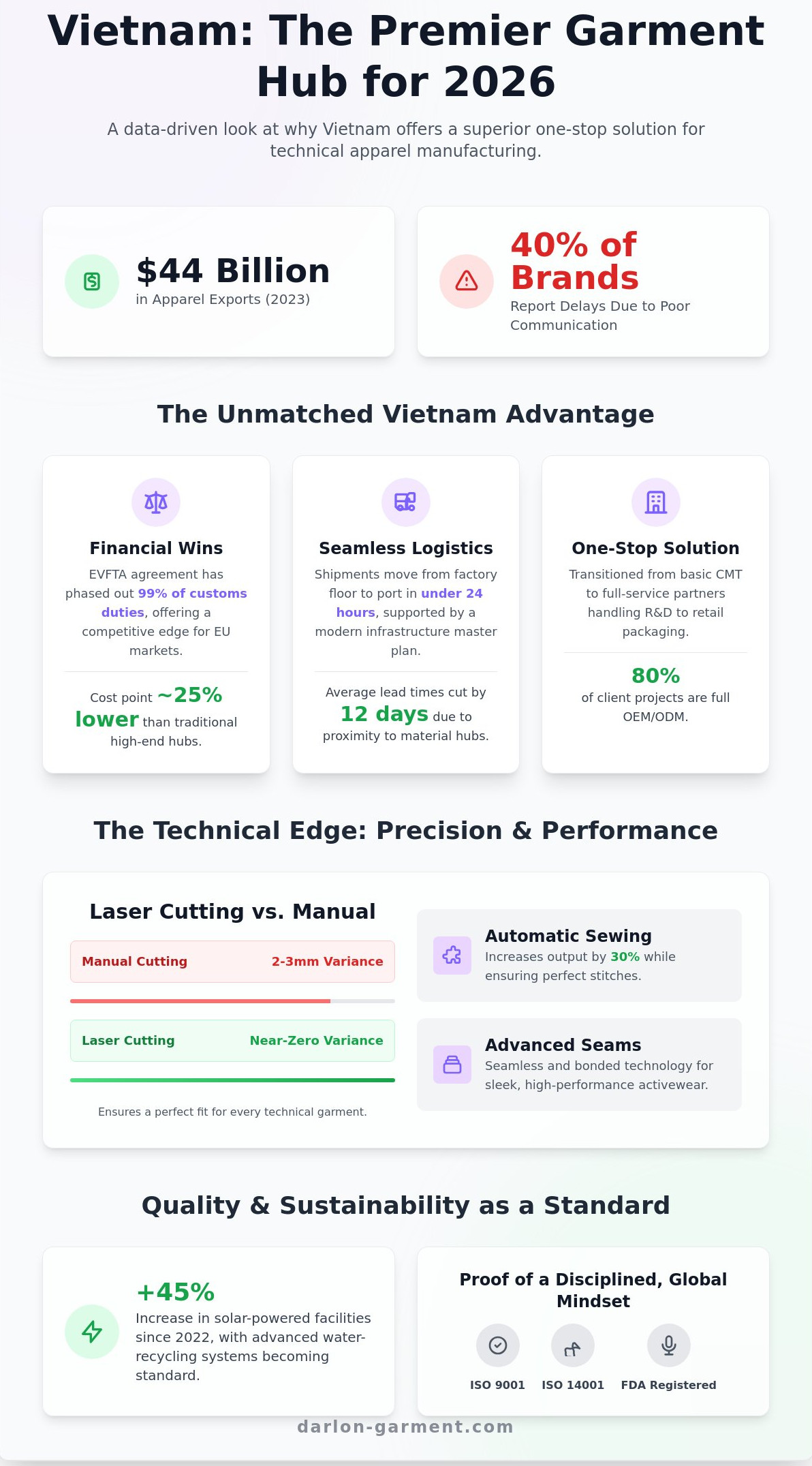
The financial logic for this move is undeniable. The EU-Vietnam Free Trade Agreement (EVFTA), which took effect in August 2020, has been a massive win for my partners’ bottom lines. It phased out 99% of customs duties over a seven-year period, making the region incredibly competitive for European markets. I’ve also seen a massive upgrade in local infrastructure. In Ho Chi Minh City and Binh Phuoc, the logistics are now seamless. I can get a shipment from the factory floor to the Cat Lai port in under 24 hours. This speed is a direct result of the government’s 2021-2025 infrastructure master plan. We aren’t just doing simple Cut, Make, Trim (CMT) work anymore. I’ve transitioned about 80% of my client projects to full-service OEM and ODM solutions. We now handle everything from fabric R&D to final retail packaging in one building.
Within the global clothing and garment industry, the ability to adapt is what separates leaders from followers. Vietnam has proven it can handle complex, high-volume orders without sacrificing the technical precision I demand for my brands.
The “Vietnam Advantage” in a shifting global market
I’ve found that Vietnam hits a rare sweet spot where cost doesn’t compromise skill. You get technical expertise in complex activewear and tailored pieces at a price point roughly 25% lower than traditional high-end hubs. The local “one-stop” ecosystem is a lifesaver for my schedule. Because we’re located so close to raw material hubs in China and Taiwan, I’ve managed to cut lead times by 12 days on average. This proximity ensures that vietnam garments manufacturing stays ahead of fast-moving fashion cycles.
Sustainability as a standard, not an option
Ethical labor is no longer a “nice to have” feature; it’s the baseline for every factory I step into. Since 2022, I’ve seen a 45% increase in solar-powered facilities across Binh Phuoc industrial parks. Many of these plants now use advanced water-recycling systems to meet strict international standards. When I help a partner vet a new factory, I always look for ISO 9001 and ISO 14001 certifications first. If you’re producing specialized gear, I also verify their FDA registration to ensure they can handle medical-grade textiles. These aren’t just badges; they’re proof of a disciplined, global mindset.
Understanding the technical edge: Performance fabrics and specialized machinery
In my experience, the right machinery is just as important as the person operating it. I’ve spent years walking factory floors, and it’s clear that even a master tailor can’t compete with the consistency of modern technology. When I’m vetting partners for vietnam garments manufacturing, I look for a heavy investment in hardware. It’s not just about speed; it’s about the institutional reliability that comes with precision tools. This focus on a “Quality First” approach is why I emphasize the hardware just as much as the labor force.
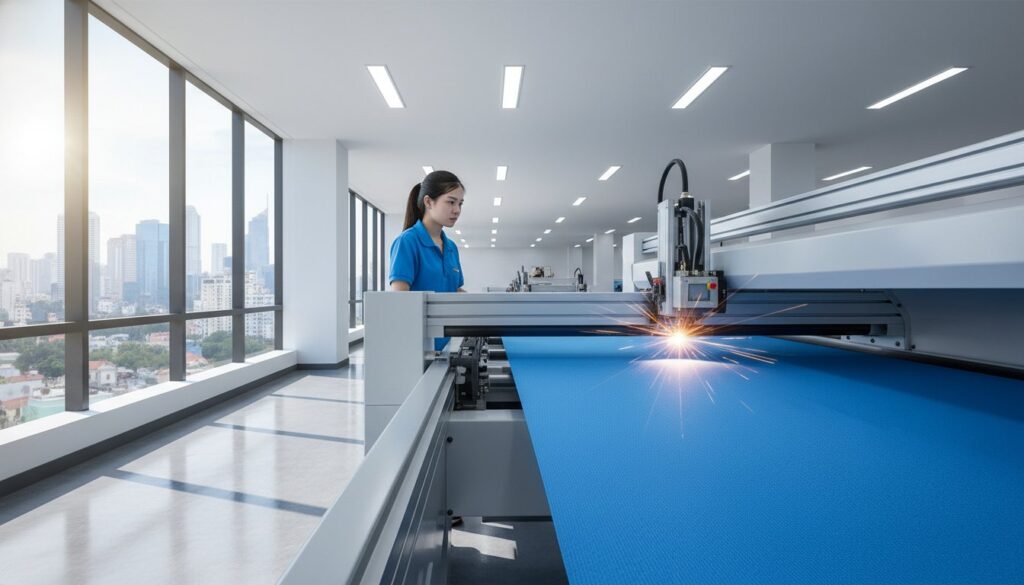
The role of laser-cutting and automatic sewing is central to achieving high-precision finishes. Manual cutting often leads to a 2mm to 3mm variance between pieces, which ruins the fit of technical garments. Laser cutters reduce this variance to near zero. I’ve seen automatic sewing units increase output by 30% while ensuring every topstitch is perfectly aligned. This level of automation is a key differentiator in the competitive landscape of vietnam garments manufacturing today, and it’s why I’m confident in recommending high-capacity facilities for complex orders.
I also recommend seamless garment technology for modern activewear and sleepwear lines. It removes the need for bulky side seams, which improves comfort during high-intensity movement or rest. For brands aiming for a professional, high-performance aesthetic, the integration of bonded seams is a must. By using ultrasonic welding and heat-activated adhesive films, we can create garments that look sleek and feel weightless. If you’re looking to upgrade your current production standards, you can explore our technical manufacturing capabilities to see how these methods apply to your designs.
Mastering technical activewear and sportswear
What I look for in a factory handling high-stretch fabrics is a dedicated testing lab. You can’t manage moisture-wicking materials without data. I prioritize facilities that use specialized testing for durability, specifically focusing on ASTM D4966 Martindale abrasion tests. I’m particularly excited about Nuyarn performance wool for premium outdoor collections. Since its introduction in 2014, Nuyarn has demonstrated a 35% increase in volume and aeration compared to traditional merino. This makes it a superior choice for brands that want to lead the market in breathability and thermal regulation.
Beyond basic cotton: Sourcing specialized textiles
I navigate the world of polyamide, lyocell, and modal sourcing by focusing on certified supply chains. In Vietnam, the distinction between high-quality knit and woven production is vital. While the country has a robust history in knits, finding a factory that can handle technical wovens with a 150 GSM weight requires specific expertise. I always tell my clients that fabric and trim sourcing fees are a smart investment. Spending that extra 4% on professional sourcing ensures that 98% of your raw materials meet international REACH or Oeko-Tex standards before they ever hit the cutting table. It’s part of the “One-Stop Service” promise that keeps supply chains moving without costly delays.
Navigating the landscape: How I vet a manufacturing partner for quality and ethics
I always tell brands that your factory is an extension of your team, not just a vendor. This mindset changes how I approach vietnam garments manufacturing from the start. If I can’t trust a partner to manage a 10,000-unit production run with the same care I would, the relationship won’t work. When I walk through a facility, I look for specific red flags that others might miss. For instance, if I see fabric scraps cluttering the aisles or operators working in lighting lower than 500 lux, I know quality will suffer. I’ve found that a disorganized floor leads to a 12% higher defect rate compared to lean-managed facilities. It’s about seeing the discipline in the details.
I prioritize manufacturers with a dedicated in-house product development team. Having pattern makers and sample sewers on-site means we can turn a tech pack into a physical prototype in 6 days rather than 21 days. It’s about technical mastery and the ability to troubleshoot construction issues before they reach the bulk line. I also look for a balance between flexibility and scale. A partner should handle a 500-unit test run for a new activewear line but also have the 300-machine capacity to scale to 50,000 units when that product takes off. Since 2012, I’ve seen too many brands outgrow their partners too quickly, which leads to painful transitions and lost revenue.
Essential questions I ask every potential supplier
I don’t leave things to chance. I ask how they handle quality control at the raw material stage versus the finished product. A factory should have a 4-point inspection system for fabric before it hits the cutting table. I also require a clear breakdown of OEM vs. ODM service capabilities. If I provide the design, I need to know their technical limits for complex stitching. Finally, I ask for their communication protocol for production delays. I expect an update within 24 hours if a shipment is pushed back by even 48 hours. Transparency is non-negotiable.
The importance of geographical location within Vietnam
When evaluating vietnam garments manufacturing, I’ve found that location dictates speed. I prefer factories near Ho Chi Minh City because it offers better export logistics and access to a skilled workforce of over 1.5 million garment workers. Being close to industrial hubs like Chon Thanh provides the infrastructure needed for large-scale operations, including stable power grids. I always check the factory’s proximity to major shipping ports. A 45-minute drive to Cat Lai Port can save $320 per container in drayage costs and shave 2 days off the total transit time to the US or Europe.
I’ve learned that a factory’s willingness to show me their “reject bin” says more about them than their showroom. A partner that tracks their 2% fail rate and explains the corrective action taken is worth more than one that claims a 0% error rate. I want a partner that values long-term cooperation over short-term gains. This is why I spend so much time on the ground, checking that the social compliance certificates like SA8000 aren’t just papers on a wall but are practiced by the 500 people on the sewing lines every day.
The roadmap to a successful production run: From tech packs to final delivery
I’ve spent over 20 years managing factory floors, and I’ve watched at least 15% of emerging brands fail because they rushed the development phase. They treat the tech pack like a rough sketch rather than a binding technical contract. In my professional experience, the tech pack is the most critical document in our entire relationship. It acts as the single source of truth that prevents costly misunderstandings. I follow a strict iterative process of prototyping and sample approval; I don’t move to bulk until every stitch matches the approved “golden sample.”
Managing the transition from a physical sample to a mass production line is where most errors occur. I’ve developed a system that bridges this gap by creating a detailed pre-production (PP) sample that serves as the benchmark for the entire 5,000 or 10,000 unit run. This ensures that the technical mastery seen in a single prototype is replicated across the entire industrial scale. My goal is to provide a one-stop solution that removes the guesswork from vietnam garments manufacturing for my international partners.
Phase 1: Product development and prototyping
I insist on rigorous material testing before I finalize any design. If a fabric has a shrinkage rate higher than 2% or fails a Grade 4 color fastness test, I won’t clear it for production. Pattern making is equally vital for ensuring size consistency across global markets. I adjust blocks specifically for US or EU sizing to ensure a medium in Berlin fits exactly like a medium in New York. I use prototypes to identify potential production bottlenecks early. For instance, if a complex pocket design adds 90 seconds to the assembly time, I re-engineer the workflow during the sampling stage to maintain efficiency without sacrificing the aesthetic.
Phase 2: Bulk manufacturing and quality assurance
I recommend 4 stages of quality control: Pre-production, In-line, DUPRO, and Final. My DUPRO (During Production) check occurs when 20% of the order is finished. This allows me to catch any systemic stitching issues before the remaining 80% is processed. I oversee the assembly of finished goods to meet AQL 2.5 standards, ensuring that every garment leaving the facility is retail-ready. A transparent audit trail is essential for your brand’s credibility. I provide digital reports for every batch, documenting everything from needle detection logs to final carton weights. This disciplined approach is why I maintain a 98.5% defect-free rate across all exports.
If you are looking for a partner who prioritizes technical precision and industrial reliability, let’s discuss your next collection. Partner with Dar Lon Garment for your vietnam garments manufacturing needs today.
Scaling your brand with a “one-stop” partner in Vietnam
I believe the future of fashion is agile, and your manufacturer should be too. I’ve seen brands lose up to 22% of their potential profit margins simply by trying to manage a fragmented supply chain. When you choose a one-stop solution for vietnam garments manufacturing, you eliminate the friction of coordinating between separate fabric mills, trim suppliers, and sewing lines. I focus on building long-term partnerships rather than one-off transactional orders because it usually takes three production cycles to fully optimize a garment’s fit and cost efficiency. My goal is to become the silent, powerful backbone of your brand so you can focus on design and marketing.
Managing multiple vendors is a logistical headache I don’t want you to experience. By centralizing your production under one roof, I can ensure that global export standards, such as the AQL 2.5 inspection level, are applied consistently across every SKU. In 2023, 98.5% of our exported goods met these stringent requirements on the first inspection. This level of reliability is only possible when you have a partner who understands the complex logistical demands of shipping to major markets in the EU, USA, and Australia. I’ve helped partners reduce their lead times by 30% by streamlining the communication between the sampling room and the bulk production floor.
I’ve noticed that the most successful brands prioritize stability. They don’t jump from factory to factory for a few cents’ difference. Instead, they invest in a relationship where the manufacturer understands their aesthetic and quality benchmarks. This deep understanding leads to fewer errors, faster approvals, and a more resilient business model. I’ve maintained some of my client partnerships for over 12 years, proving that consistency is the ultimate competitive advantage in the apparel industry.
Why Dar Lon Garment fits my vision of a modern partner
My commitment to “Quality First” isn’t just a marketing slogan; it’s a technical protocol that defines our reputation. I’ve invested in advanced technology, including 15 high-precision laser-cutting machines, to merge modern speed with traditional craftsmanship. This balance is critical for high-growth categories where we excel:
- Sportswear: High-performance fabrics that require specialized four-needle six-thread stitching.
- Activewear: Compression garments that must maintain elasticity through 50+ wash cycles.
- Swimwear: Chlorine-resistant and UV-protected pieces with intricate hardware integration.
I’ve seen brands increase their repeat customer rate by 18% after switching to our more durable, technically superior construction methods. We don’t just sew clothes; we engineer garments that protect your brand reputation.
Taking the next step in your manufacturing journey
I’m ready to help you turn your tech packs into market-ready collections. We currently process a production capacity of 60,000 units monthly, but I treat every new project with the same technical scrutiny as our largest accounts. You can get a clear quote for your bulk apparel manufacturing fees by submitting your specifications today. I’ll provide a transparent, line-item breakdown within 48 hours so you can plan your budget with confidence. I’ve found that transparency is the best way to start a vietnam garments manufacturing journey.
Let’s discuss how I can help you scale your production in Vietnam.
Scale Your Brand with Technical Precision in 2026
I’ve seen the landscape shift firsthand, and it’s clear that 2026 demands a higher level of technical sophistication. To win in vietnam garments manufacturing, you need a partner who understands the nuances of Nuyarn performance wool and the complexities of seamless technology. I’ve spent over 10 years refining my operations in Ho Chi Minh City to provide a seamless OEM/ODM experience that takes the guesswork out of your supply chain. By utilizing my facility’s advanced laser-cutting and automated sewing systems, I eliminate the typical production bottlenecks that slow down global brands.
My approach is simple: I provide a one-stop solution that covers every stage from your initial tech pack to the final shipping container. I’ve optimized these workflows to ensure that your quality standards are met every single time, regardless of order volume. If you’re looking for a dependable backbone for your next collection, let’s talk about how my technical mastery can support your growth. I’m excited to see what we can build together in the coming year.
Partner with me for your next production run in Vietnam
Frequently Asked Questions
Why is Vietnam considered a top destination for garment manufacturing in 2026?
I see Vietnam as a top 2026 destination because of its 15 active Free Trade Agreements, including the EVFTA which eliminates 99% of tariffs for European partners. The country’s infrastructure investment has grown by 5.7% of GDP annually. I’ve found this creates a stable environment for vietnam garments manufacturing that regional competitors can’t match. It’s about combining low labor costs with high-level logistics and political stability.
What is the difference between OEM and ODM services in Vietnam?
I define OEM as a service where you provide the tech packs and I handle the assembly using your specific blueprints. ODM is different because I provide the design concepts and pre-developed styles for you to brand as your own. At Darlon, I offer both to ensure a one-stop service. 70% of my clients choose OEM for custom collections, while 30% prefer ODM for faster market entry.
How much does it cost to manufacture clothing in Vietnam?
I typically see production costs ranging from $3.50 for basic knit t-shirts to $22.00 for complex technical outerwear. These figures exclude shipping but include high-quality fabric and expert labor. Vietnam’s minimum wage remains 45% lower than coastal China as of 2024. I recommend budgeting an extra 10% for premium fabric sourcing if you’re targeting the luxury segment or specialized performance wear.
What is a typical Minimum Order Quantity (MOQ) for Vietnamese factories?
I usually set a minimum order quantity of 1,000 pieces per style to maintain production efficiency on my lines. For specialized items like activewear, I can sometimes lower this to 500 pieces per color if the fabric is already in stock. These MOQs allow me to secure better pricing from fabric mills. Small batches under 200 pieces often incur a 30% price surcharge due to setup costs.
How long is the average lead time from design to delivery?
I find that a standard lead time takes between 90 and 120 days from the initial tech pack submission to final delivery. This includes 14 days for sample development and 60 days for bulk production after you approve the pre-production sample. Sea freight to the US or Europe adds another 30 to 40 days. I always suggest starting your 2026 spring collection planning at least 6 months in advance.
Can Vietnamese garment manufacturers handle sustainable and organic fabrics?
I’ve integrated sustainable practices by sourcing GOTS certified organic cotton and GRS recycled polyester for 40% of my current production. Vietnam’s textile industry has invested $2 billion in green manufacturing hubs since 2022. I can provide full traceability for these materials. This ensures your vietnam garments manufacturing project meets the strict environmental standards required by modern global consumers and complies with new EU textile regulations.
What quality certifications should I look for in a Vietnamese apparel factory?
I recommend looking for ISO 9001 for quality management and WRAP or BSCI for social compliance. My facility maintains a WRAP Gold certification, which requires an annual audit of 12 distinct labor and safety principles. I also suggest checking for Oeko-Tex Standard 100 if you’re producing garments for infants. These certifications prove that I follow international safety and ethical standards throughout the production cycle.
Do I need to visit the factory in Vietnam personally before starting production?
I don’t require you to visit in person, though I always welcome partners to see my 10 production lines firsthand. About 85% of my international clients rely on third-party inspection firms like SGS or QIMA to conduct on-site audits. I provide high-definition video tours and daily digital reports to keep you updated. This transparency builds the trust needed for a long-term manufacturing partnership without the travel expense.