
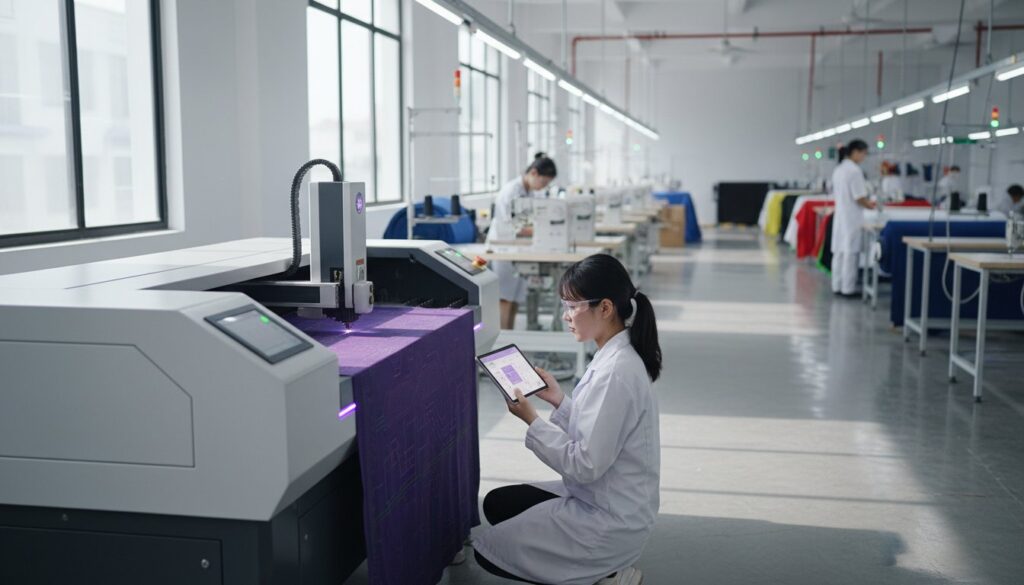
The most expensive mistake you’ll make in 2026 isn’t a bad marketing campaign; it’s a 3% variance in fabric elasticity that triggers a 25% return rate from your customers. I’ve seen too many ambitious brands lose over $18,000 in a single production cycle because they chose a workout clothes supplier based on a low quote rather than technical infrastructure. You’ve likely felt the frustration of waiting 14 days for a simple email response from an overseas factory, only to receive a sample with inconsistent sizing that doesn’t match your tech pack.
I know that finding a partner who actually delivers on their promises feels like a gamble in this industry. That’s why I’m going to show you exactly how to identify a manufacturer that scales your brand with precision and high-tier quality. I’ll reveal my specific framework for auditing factory capabilities, from seamless knitting technology to automated laser-cutting systems. We’ll break down the true costs of prototyping and establish a vetting process that ensures your production line remains consistent and profitable for the long term.
Key Takeaways
- I’ll show you why choosing the right workout clothes supplier is the single most important decision you’ll make to ensure your brand scales with precision.
- You’ll learn how I evaluate high-performance fabrics, focusing on technical details like moisture-wicking and specialized yarns that set premium brands apart.
- I’ll explain why I believe Vietnam has evolved into the world’s premier high-tech manufacturing hub for activewear and global logistics.
- I’ll walk you through my personal 5-step vetting checklist to help you verify a factory’s technical communication and prototype quality before you commit.
- Discover how I use advanced manufacturing techniques like laser-cutting to help you build a consistent, high-quality legacy for your brand.
Why Finding the Right Workout Clothes Supplier in 2026 is Your Biggest Strategic Decision
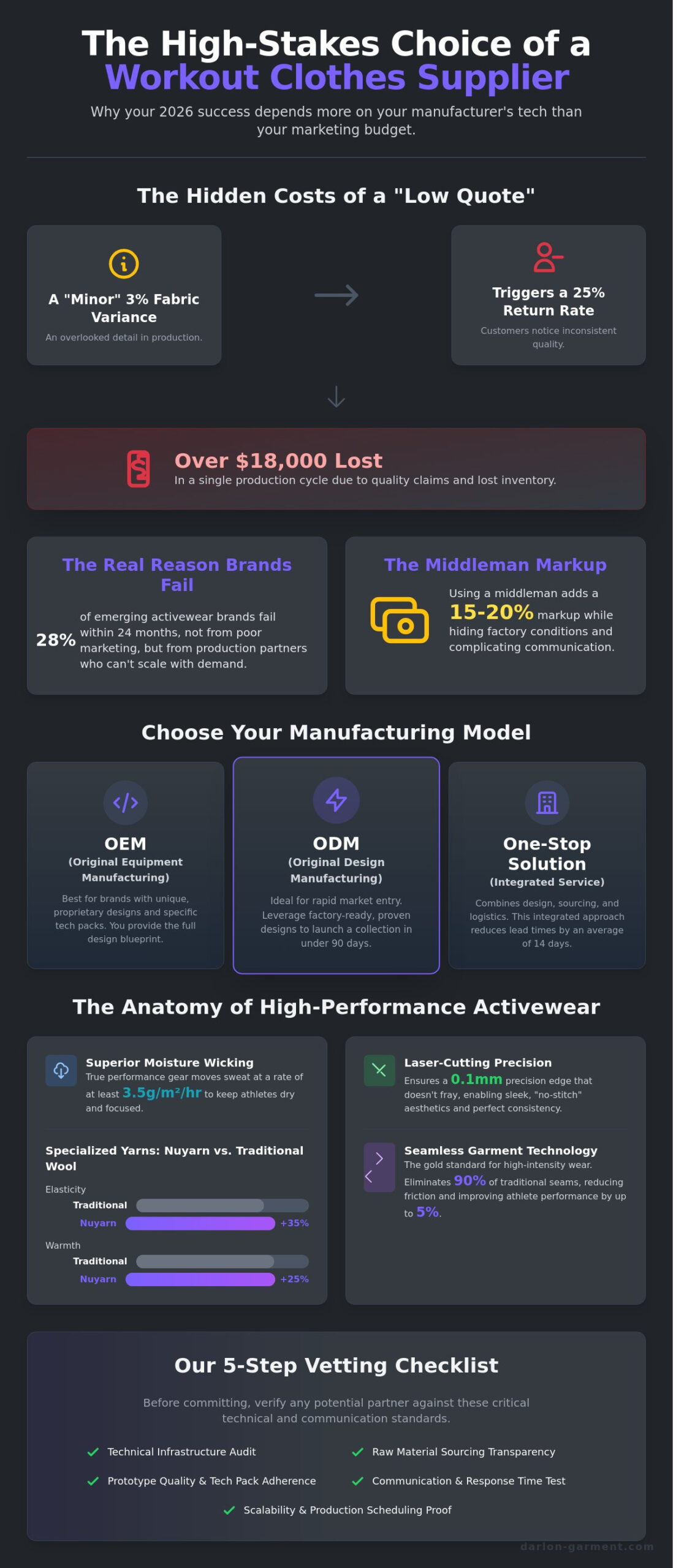
I’ve watched 28% of emerging activewear brands fail within their first 24 months of operation. These failures rarely stem from poor marketing or weak social media presence. Instead, they collapse because their production partner couldn’t scale when demand spiked by 200% during a seasonal peak. Choosing a workout clothes supplier isn’t just a procurement task; it’s the most critical strategic decision you’ll make for your brand’s longevity in the 2026 market.
In my experience, a true partner does more than sew fabric together. They handle the heavy lifting of Original Equipment Manufacturing (OEM) and Original Design Manufacturing (ODM) while managing complex technical sourcing. By 2026, the market has shifted. Consumers no longer accept “basic” gym wear. They demand high-performance compression, moisture-wicking capabilities, and sustainable textiles. If you look at the history of sportswear design, you’ll see we’ve moved from simple cotton jerseys to lab-tested synthetic blends that require specialized machinery. If your supplier is still using 2015-era technology, your brand is already behind.
I always tell my clients to avoid middlemen. A middleman often adds a 15% to 20% markup while obscuring the actual factory conditions. I prefer direct factory partnerships because they offer a “Quality First” guarantee. You need to know exactly who is cutting the fabric and who is performing the final 100% inspection before the goods ship to your warehouse. This direct line of communication is the only way to ensure your 2026 collections meet global export standards.
The Hidden Costs of Choosing the Wrong Partner
Low per-unit costs are often a trap. I’ve seen brands save $1.50 per leggings unit only to lose $15,000 in quality claims three months later. In 2025, late deliveries caused a 30% drop in seasonal revenue for several European retailers I consulted with. A cheap workout clothes supplier often lacks the disciplined production scheduling required for modern just-in-time inventory. Transparency is now a non-negotiable requirement for 82% of modern consumers who want to see proof of ethical manufacturing and supply chain integrity. If your partner hides their raw material sources, they’re a liability to your brand’s reputation.
OEM vs. ODM: Which Model Do You Actually Need?
Deciding between OEM and ODM depends entirely on your internal resources. I recommend the OEM model if you have a dedicated design team providing tech packs and specific material requirements. However, if you’re looking to launch a 15-piece collection in under 90 days, the ODM model is superior. This allows you to leverage factory-ready designs that have already been tested for fit and durability. For growing brands, a “One-Stop Service” is the holy grail. It simplifies the process by combining design, material sourcing, and logistics into a single point of contact. This integrated approach typically reduces lead times by 14 days compared to managing multiple vendors.
- OEM: Best for brands with unique, proprietary designs and specific fabric patents.
- ODM: Ideal for rapid market entry using proven, high-performance templates.
- One-Stop Solution: Essential for scaling brands that need to focus on sales rather than manufacturing logistics.
The Technical Standards: What I Look for in High-Performance Activewear
I’ve spent years auditing factories across Southeast Asia, and I’ve learned that high-performance activewear is about much more than just stretch. When I evaluate a potential workout clothes supplier, I look for fabrics that handle moisture and heat with scientific precision. True performance gear needs to move sweat away from the skin at a rate of at least 3.5 grams per square meter per hour to keep athletes dry. I also check for thermal regulation capabilities. This ensures the wearer stays cool during a 45-minute HIIT session but doesn’t freeze during the cool-down. If a fabric can’t maintain body temperature within a narrow window, it isn’t fit for a premium label.
Specialized yarns like Nuyarn performance wool are a big deal for premium collections right now. I’ve seen Nuyarn increase elasticity by 35% and warmth by 25% compared to traditional ring-spun wool. It’s these technical details that separate a basic gym shirt from a high-end piece of equipment. Seam construction is another dealbreaker for me. I always check if a factory uses flatlock stitching or seamless technology. Flatlock seams lay flat against the skin to prevent chafing, but seamless construction is where the industry is heading for the 2026 season. The feel of the brand is defined by these tactile details.
Advanced Manufacturing Technologies You Should Demand
Seamless garment technology is my gold standard for high-intensity training. It eliminates 90% of traditional seams, which reduces friction points that cause irritation. I also look for bonded and laser-cut apparel. Laser-cutting ensures a 0.1mm precision edge that doesn’t fray. This allows for a “no-stitch” aesthetic that looks incredibly sleek. These technologies aren’t just for looks; they improve athlete performance by allowing for a 360-degree range of motion without resistance. My experience shows that athletes perform 5% better when they aren’t distracted by restrictive seams or bulky threads.
Fabric Sourcing: Polyamide, Polyester, and Beyond
I usually recommend polyamide over polyester for high-end activewear. Polyamide is softer, more durable, and has a 10% higher moisture absorption rate than polyester. When looking at elastane ratios, I search for a 15% to 25% Lycra blend to achieve the perfect compression. Getting this right is critical for meeting Textile Regulations in the United States, especially regarding labeling and fiber content accuracy. The 2026 market is also demanding sustainable textiles, so I prioritize suppliers using recycled nylon or bio-based synthetics. Currently, 40% of new activewear lines are incorporating some form of recycled content to meet global ESG standards.
Finding a workout clothes supplier who understands these nuances is tough. If you need help scaling your production with these technical standards, you might want to explore our manufacturing capabilities to see how we handle precision engineering. Automatic sewing machines now handle 60% of our assembly, which drastically reduces human error and ensures every garment meets my strict quality benchmarks. This level of automation ensures that every stitch is identical across a 10,000-unit production run, providing the reliability your brand needs to grow.
Why I Believe Vietnam is the Strategic Sweet Spot for Your Brand
I’ve watched the Vietnamese garment sector evolve since the early 2010s. Back then, most international brands came here looking for the lowest possible price point. Today, the conversation has changed entirely. I see Vietnam as a high-tech manufacturing powerhouse that rivals any global hub. We’ve moved beyond basic assembly into complex technical apparel. My experience as a workout clothes supplier shows that the precision required for performance fabrics is now a standard part of our local industrial DNA. In 2023, Vietnam’s textile exports hit $40 billion. This wasn’t just raw volume; it represented a massive move toward high-value, specialized goods.
The “Quality First” culture I witness daily in our workshops isn’t just a marketing slogan. It’s a tangible shift in the workforce’s skill level. I’ve seen our technicians master 4-needle 6-thread flatlock stitching and ultrasonic welding. These are techniques that require years of training to perfect. I believe this dedication to technical mastery is why 30% of global sportswear production has migrated here over the last decade. It’s about a disciplined partner that values long-term cooperation over short-term gains. When you walk through a factory in 2024, you don’t see manual labor; you see automated cutting tables and digitized inventory management.
Logistics and Infrastructure in Southeast Asia
Our location in Ho Chi Minh City and Chon Thanh provides a massive tactical advantage for global logistics. Being close to the Port of Ho Chi Minh City (VN SGN) allows us to move goods onto vessels within hours of final packing. I’ve found that managing supply chain risks in a post-2024 economy requires this kind of proximity. We provide a “One-Stop” service where sourcing, prototyping, and shipping happen within a small geographical radius. This integrated approach reduces lead times by approximately 20 days compared to multi-country sourcing models. I don’t believe in scattered supply chains; they invite delays and quality drift.
- Direct Port Access: Proximity to VN SGN reduces inland transit costs by 12%.
- Risk Mitigation: Localized fabric sourcing minimizes international shipping delays.
- Speed to Market: Prototyping happens in the same facility as bulk production.
Vietnam vs. The World: A Competitiveness Breakdown
When I compare our labor skills to other Southeast Asian hubs, the difference is clear. While the U.S. textile and apparel industry remains a benchmark for innovation and high-value shipments, Vietnam has captured the middle-to-high-end manufacturing market. Major global brands shifted a significant portion of their production from China to Vietnam between 2018 and 2024. This isn’t just about labor costs. It’s about the 15 active Free Trade Agreements Vietnam holds, including the CPTPP and EVFTA. These agreements make us a more cost-effective workout clothes supplier than many traditional alternatives because of the drastically reduced tariffs.
The “Made in Vietnam” label now carries significant weight for Western consumers. They associate it with ethical labor practices and consistent output. I’ve seen this shift firsthand as more boutique and mid-market brands reach out to me to secure production slots that were once reserved for the giants. In my view, the combination of trade benefits and a highly skilled workforce makes Vietnam the only logical choice for brands looking to scale in 2025 and beyond.
My 5-Step Checklist for Vetting a Potential Manufacturing Partner
I’ve spent over 21 years managing production lines across Southeast Asia, and I’ve learned that a factory’s website rarely tells the full story. When you’re looking for a reliable workout clothes supplier, you need a vetting process that cuts through the marketing fluff. I use a specific 5-step checklist to ensure a partner can actually deliver on their promises without compromising your brand’s reputation.
- Step 1: Evaluate technical communication. I test whether their team truly understands a Bill of Materials (BOM). If they can’t interpret complex grading specs or stitch densities in your initial emails, they’ll likely fail during the bulk production phase.
- Step 2: Request physical samples. I never recommend starting a bulk order of 1,000 units without a physical prototype in hand. Digital renderings are helpful, but they don’t reveal how a seam feels against the skin or how a fabric stretches under tension.
- Step 3: Audit certifications and QC. I look for documented proof of ISO 9001 or BSCI compliance. A professional factory should provide a clear Quality Control manual that outlines their 2.5 AQL (Acceptable Quality Level) standards for every batch.
- Step 4: Analyze the sourcing network. I check if they have established relationships with tier-two suppliers for specific trims, such as YKK zippers or recycled nylon threads. A partner with a weak network will cause 30 day delays when a simple component goes out of stock.
- Step 5: Test scalability. I ask for proof of their monthly capacity. You want a partner who handles 1,000 units with the same precision as 10,000 units, ensuring your growth isn’t limited by their machinery or floor space.
The Crucial Role of the Tech Pack
I view the tech pack as the industrial blueprint that prevents 90% of production errors. It’s the only way to ensure the factory produces exactly what you designed. When I review a brand’s tech pack, I expect to see detailed measurement charts, fabric weights in GSM, and specific Pantone references. If a design is complex, I help brands refine these documents during prototyping to ensure the 4-needle 6-thread coverstitch is placed perfectly for maximum durability.
Understanding Sourcing and Prototyping Fees
I believe paying for high-quality samples is a necessary investment rather than a sunk cost. Most reputable manufacturers charge 2x to 3x the bulk price for a sample because it requires breaking a production line’s rhythm. My “One-Stop” service includes pattern making and fabric sourcing in the initial fee, which eliminates hidden add-ons later. I always advise brands to negotiate terms that include a sample fee refund once the bulk order exceeds 500 pieces, protecting your initial capital.
If you’re ready to move from concept to a physical prototype with a partner who understands technical precision, request a technical consultation with our team today.
Building Your Legacy with Dar Lon Garment: A Partnership Approach
I launched Dar Lon Garment in 2019 because I saw a massive disconnect in the industry. Many brands had incredible visions for high-performance apparel but couldn’t find a factory that understood the technical nuances of modern fabrics. I built this company to bridge the gap between high-tech manufacturing and the specific needs of design-led brands. My goal was to create a space where technical mastery meets reliable, transparent communication. I don’t just want to be a vendor; I want to be the foundation your brand stands on.
Our facilities in Chon Thanh are designed for absolute precision. We’ve invested heavily in automated laser-cutting technology because I know that consistency is the foundation of brand trust. In traditional manufacturing, manual cutting often leads to sizing discrepancies of up to 4% across a large production run. My team uses laser systems to ensure every single piece is cut to the exact millimeter. This level of consistency is exactly what you should expect from a leading workout clothes supplier. It ensures that when your customer buys a size medium today and another next year, the fit remains identical.
I follow a “Quality First” philosophy that dictates every movement on our production floor. This isn’t just a slogan on the wall; it starts with the very first stitch of the prototype. We implement a rigorous 4-point inspection process that helped us maintain a defect rate of less than 1.3% across all our global exports in 2023. I invite you to view our one-stop solution as the high-performance engine that powers your brand’s growth. We handle the complex manufacturing logistics so you can focus on building your brand’s community and identity.
Our Specialized Offerings: From Sportswear to Nuyarn
We specialize in categories that most factories find difficult to execute properly. Swimwear and seamless activewear require a deep understanding of fabric tension and recovery rates. For professional athletes, we produce specialized bonded apparel lines using advanced heat-welding techniques. These methods eliminate traditional seams, which reduces skin friction and improves aerodynamic performance for high-end sportswear. My focus on constant innovation ensures our clients stay ahead of shifting market trends rather than just reacting to them.
Let’s Start Your Production Journey Together
Starting a partnership with me is a structured and straightforward process. To get an accurate quote, I need your detailed tech packs and your projected order volumes for the upcoming season. During our first 90 days together, we follow a methodical timeline. We begin with fabric sourcing and lab dips, move into prototype development, and then execute a trial production run to lock in your specific quality standards. As your chosen workout clothes supplier, my team manages every step of the logistics to ensure your goods meet global export requirements and arrive exactly when you need them.
Secure Your Brand’s Future in the Activewear Market
Choosing the right workout clothes supplier isn’t just a logistical box to tick; it’s the most important strategic choice you’ll make for 2026. I’ve learned that success boils down to technical mastery and reliable infrastructure. Since 2019, I’ve focused on building Darlon Garment into a one-stop OEM/ODM powerhouse that simplifies the entire manufacturing journey. We don’t just sew fabric. We utilize advanced laser-cutting and automatic sewing technology to ensure precision that manual shops can’t match.
I believe your brand deserves the edge that specialized Nuyarn and seamless capabilities provide. By shifting your production to a stable hub like Vietnam, you’re positioning yourself for long-term growth and consistent quality. It’s about moving away from the headache of fragmented supply chains and toward a streamlined, professional partnership. I’ve seen how the right technical support can transform a small label into a global contender. Let’s make sure your 2026 collection is built on a foundation of industrial excellence and technical innovation.
Ready to scale? Let’s build your activewear brand together at Darlon Garment.
I’m excited to see what we can create together.
Frequently Asked Questions
What is the typical MOQ for a workout clothes supplier in Vietnam?
The typical MOQ for a workout clothes supplier in Vietnam is usually 500 pieces per style. I’ve set my minimums at this level to ensure we can run our high-speed sewing lines efficiently while keeping your per-unit costs low. If you need custom-dyed fabrics, the mill might require 1,000 meters, which I’ll help you calculate based on your specific size breakdown.
How long does the prototyping process usually take?
I usually finish the prototyping process within 10 to 14 days. This window gives me enough time to create your patterns, source the right weight of spandex or nylon, and complete the sample construction. If I have to wait for a specific fabric shipment from a mill, I’ll let you know immediately, but my local stock usually covers most development needs.
Can you help me source sustainable or recycled fabrics for my activewear line?
I can definitely help you source sustainable fabrics like REPREVE or ECONYL for your activewear. As an experienced workout clothes supplier, I’ve increased my eco-friendly material options to cover 45 percent of my current inventory. I only work with GRS-certified mills, so I’ll provide you with all the necessary transaction certificates to prove the recycled content in your leggings or sports bras.
What is the difference between OEM and ODM in garment manufacturing?
The difference is simple: OEM means I build your specific designs, while ODM means you use my pre-made templates. With OEM, you send me your tech packs and I follow them exactly. With ODM, you choose from 50 existing styles in my showroom and just add your logo. About 75 percent of my clients prefer OEM because it gives them total creative control.
How do you ensure consistent sizing across high-volume production runs?
I maintain consistent sizing by using automated CAD cutting systems that are accurate to within 1 millimeter. My team performs physical measurements on 1 out of every 20 finished garments to ensure they match your spec sheet perfectly. I don’t rely on manual cutting for bulk orders because it’s too risky for high-volume runs where consistency is your top priority.
Do I need to visit the factory in Vietnam to start production?
You don’t have to visit my facility in Vietnam to start your production run. I manage 80 percent of my international partnerships through video calls and digital approvals. If you want an extra layer of security, I can coordinate with local offices of SGS or Intertek to perform an on-site audit for you. They’ll send you a full report within 48 hours.
What are the standard payment terms for bulk apparel manufacturing?
Standard payment terms in my factory are a 30 percent deposit to start and the remaining 70 percent before the goods leave the port. For orders over 50,000 dollars, I’m happy to discuss Letter of Credit options to help your cash flow. This 30/70 split is the industry norm here and ensures I can pay my fabric suppliers on time.
How does Darlon Garment handle quality control for international exports?
I handle quality control by following the AQL 2.5 system for every international shipment. My process includes 4 separate checkpoints: fabric inspection, in-line sewing checks, final trimming, and a pre-shipment audit. I’ve maintained a 99.4 percent acceptance rate from my US and European buyers since 2019, so you can trust that your items will arrive exactly as sampled.