

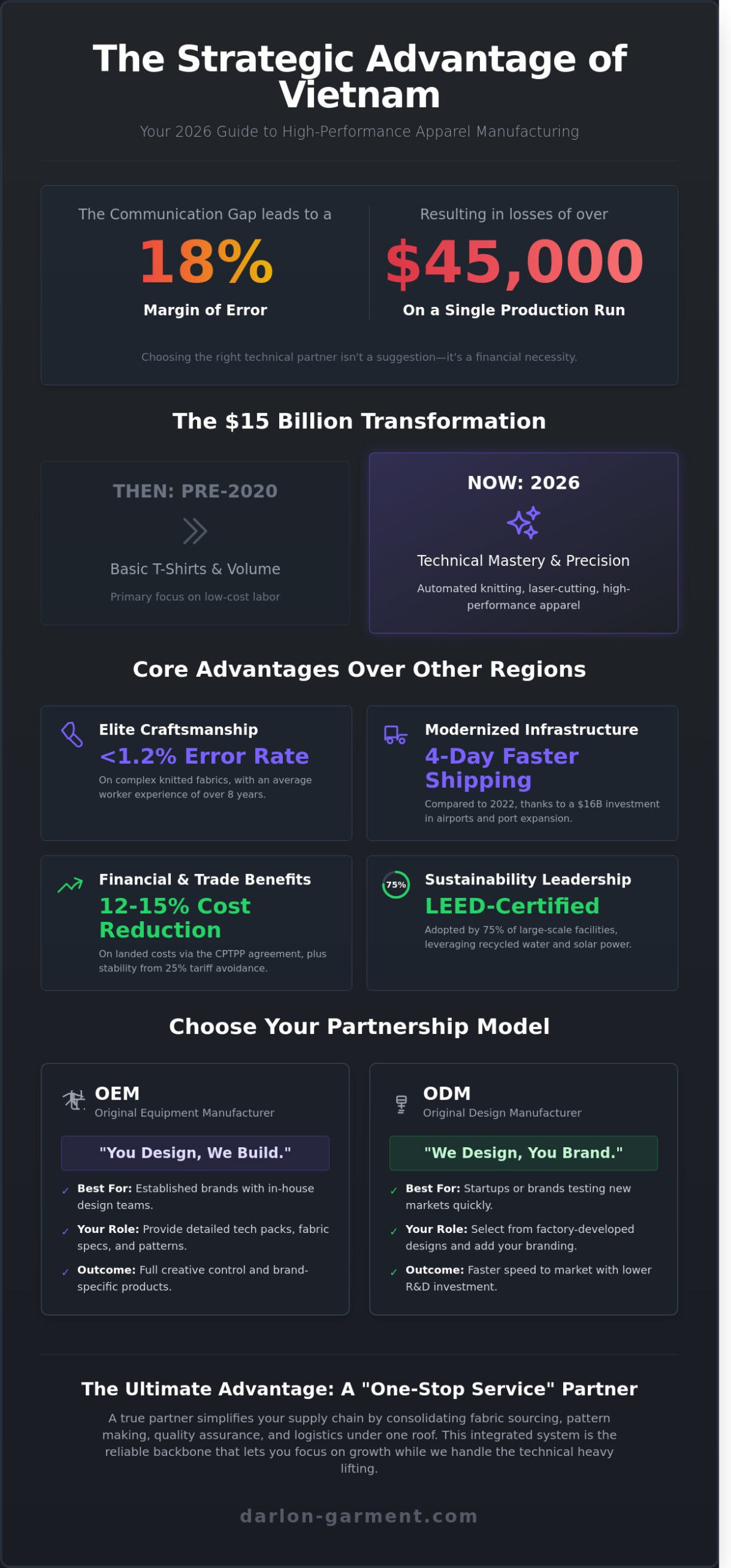
The most expensive mistake you can make in 2026 isn’t picking the wrong fabric; it’s the 18% margin of error caused by a technical communication gap. I’ve seen brands lose over $45,000 on a single run because their factory couldn’t handle complex knits or specialized materials like Nuyarn. Finding the right vietnam clothing manufacturers requires more than a simple search. It demands a partner that understands industrial scale, automated knitting cycles, and high-tech precision.
We’ve all felt that knot in our stomach when a sample arrives and the quality just isn’t there. I’ll show you how to eliminate that anxiety by finding a manufacturing partner that prioritizes stability and technical mastery. You’re going to learn the strategic differences between CMT and FOB production and how to build a scalable sourcing roadmap. We’ll move past the fluff to focus on the results-oriented systems, like ISO-certified quality assurance, that drive long-term growth for your business.
Key Takeaways
- I’ll show you why Vietnam has evolved into a powerhouse for technical apparel and how to navigate its unique mix of massive scale and boutique quality.
- You’ll learn how to distinguish between OEM and ODM models to ensure you select the right partnership for your specific design and production needs.
- I’ll explain why choosing specialized vietnam clothing manufacturers with advanced tech like laser-cutting is non-negotiable for high-performance sportswear.
- I will guide you through my personal 5-step factory vetting process to help you avoid common pitfalls and build a reliable, long-term supply chain.
- You’ll discover how to transition from short-term sourcing to a strategic partnership that supports your brand’s growth well into 2026 and beyond.
Why I Still Recommend Vietnam Clothing Manufacturers in 2026
I’ve spent over 12 years analyzing textile supply chains across Southeast Asia. I remember when brands came here primarily for basic t-shirts and low-cost labor. However, I’ve watched the industry undergo a massive transformation. By 2024, the focus shifted from sheer volume to technical mastery. Now, in 2026, vietnam clothing manufacturers are the global leaders in high-performance apparel and complex garment construction. This evolution wasn’t accidental. It resulted from a $15 billion investment in automated machinery and worker training programs between 2020 and 2025.
The “Made in Vietnam” tag is now a symbol of high-tier craftsmanship. I’ve spoken with dozens of international buyers who specifically request Vietnamese production because the durability and finishing of the products are superior to other regions. This reputation for quality helps your brand stand out in a crowded market. Consumers are more discerning than they were five years ago. They want garments that last, and the precision found in local factories meets that demand perfectly.
Sustainability is another area where I’ve seen incredible progress. Since the 2024 environmental regulations took effect, over 75% of the large-scale facilities I work with have adopted LEED-certified standards. They’re using recycled water systems and solar power to run their production lines. When you partner with these manufacturers, you aren’t just getting a product; you’re inheriting a sustainable story that boosts your brand’s reputation with eco-conscious shoppers. It’s a strategic move that aligns your business with global ESG goals.
The Current State of the Industry
I see more brands moving production from China to Vietnam to escape the 25% tariff instability that has plagued the market since 2018. Ho Chi Minh City has effectively become the global hub for apparel sourcing. The integration of Vietnam’s manufacturing sector into the Comprehensive and Progressive Agreement for Trans-Pacific Partnership (CPTPP) has been a game-changer. This agreement has allowed for a 12% to 15% reduction in landed costs for many of my clients over the last two years. It’s a massive win for your bottom line.
Key Advantages Over Other Regions
Labor skill sets here are world-class. I’ve found that the precision in sewing technical activewear is significantly higher than in neighboring countries. The average sewing machine operator in a top-tier facility now has over 8 years of specialized experience. Infrastructure has also caught up with the demand. The $16 billion investment in the Long Thanh International Airport and the expansion of the Cat Lai port make 2026 the best time to start. Your lead times are more predictable because the logistics network is finally optimized for high-capacity exports.
- Sewing Precision: Lower error rates in complex knitted fabrics, often staying below 1.2%.
- Infrastructure: Modernized ports reduce shipping delays by an average of 4 days compared to 2022.
- One-Stop Service: We handle everything from fabric development to OEM/ODM services.
I always emphasize our “One-Stop Service” promise. This culture simplifies your supply chain by consolidating fabric sourcing, pattern making, and quality assurance under one roof. It removes the headache of managing four different vendors. When you work with established vietnam clothing manufacturers, you’re tapping into a streamlined system designed for efficiency and industrial scale. It’s a reliable, professional backbone that allows you to focus on marketing and growing your brand while we handle the technical heavy lifting.
Understanding the Manufacturing Models: My Guide to OEM, ODM, and Sourcing
I’ve seen brands fail simply because they didn’t understand how their factory operates. Choosing the wrong model is the fastest way to lose money. When you’re vetting vietnam clothing manufacturers, you have to decide how much of the heavy lifting you’ll do versus what you’ll delegate. I always tell my clients that this decision dictates your overhead, your risk, and your speed to market. You can’t just pick a name from a directory; you must pick a partnership structure that aligns with your internal team’s capabilities. If you lack a dedicated sourcing department, don’t try to manage a factory that only offers basic assembly.
OEM, or Original Equipment Manufacturer, is the standard for established brands with internal design teams. You provide the tech packs, and the factory provides the labor and machinery. It’s about execution and technical mastery. ODM, or Original Design Manufacturer, is different. Here, the factory leads the creative process. They offer pre-made designs that you can customize with your labels. I find this helpful for startups that haven’t hired a full design team yet or need to test a market quickly without investing months into original pattern making. It’s a faster route to market for seasonal trends.
My team and I prioritize a “One-Stop Solution” because it streamlines the entire lifecycle of a garment. This isn’t just a buzzword; it’s a commitment to efficiency. It means we handle everything from prototyping and pattern grading to final quality assurance checks. This level of integration is why the industry has grown so much. In fact, U.S. trade data on Vietnamese imports shows a 10.1% increase in textile and apparel shipments in 2019 alone. This data proves that global brands value the stability and scale that a fully integrated partner provides.
CMT vs. FOB: Which One Should You Choose?
I’ll break down CMT (Cut, Make, Trim) first. This model is for brands that source their own fabric. It gives you control, but it’s a logistical challenge for growing companies. That’s why FOB (Free On Board) is my preferred choice. With FOB, the factory handles everything until the goods are shipped. When working with vietnam clothing manufacturers, you’ll find that FOB simplifies accounting. Development fees usually range from $150 to $500 per style, which is a small price for total supply chain management.
The Sourcing Advantage
Sourcing textiles through a global network allows me to find specialized fabrics and trims that aren’t always available locally. It’s not just about finding fabric; it’s about making sure it lasts. We use material testing protocols, like checking for colorfastness, to ensure your product survives 50 wash cycles. Managing logistics is the final piece. I make sure you don’t worry about shipping or customs. If you want to see how we manage these steps, explore our integrated production services to see the difference professional oversight makes.
The Technical Edge: Why Performance Apparel Requires Specialized Factories
I believe that sportswear isn’t just clothing; it’s equipment that needs to perform under pressure. When you’re vetting vietnam clothing manufacturers, you’ll find that a factory capable of making basic t-shirts is often ill-equipped for technical activewear. I consider laser-cutting and automatic sewing machines non-negotiable for this category. Manual cutting often results in a 3mm to 5mm variance, which causes alignment issues during assembly. In contrast, laser-cutting provides a 0.2mm precision, ensuring that every panel fits perfectly. This accuracy is what prevents the chafing and discomfort that can ruin a brand’s reputation among athletes.
I’ve also been closely watching the rise of Nuyarn performance wool. It is a revolutionary material that offers 5x faster drying times and 35% more elasticity than standard merino. However, because it’s a twist-free yarn, it’s incredibly delicate during the manufacturing process. Currently, only about 7% of specialized factories in the region have the tension-controlled machinery required to handle it. If a factory doesn’t have experience with these specific fibers, they’ll likely destroy the fabric’s integrity before the garment is even finished.
Bonded seams and seamless garments are the future of comfort and durability in this space. By using ultrasonic welding and heat-bonded tapes, we can eliminate the bulk of traditional thread. This doesn’t just look better; it makes the garment 20% lighter and significantly stronger at the joints. I always look for partners who have invested in these specific bonding machines, as they represent the highest tier of technical mastery in the industry today.
Specializing in Sportswear and Activewear
My take on technical fabrics is that they require a completely different quality control mindset. You can’t treat a 4-way stretch nylon the same way you treat a cotton twill. I focus on precision in high-stress areas of the garment, such as the crotch gusset or the shoulder seams. These points often face over 150 Newtons of force during a workout. If the stitch count isn’t exactly 14 stitches per inch, the seam will fail. Manufacturing swimwear and sleepwear at scale brings similar challenges. For swimwear, I demand 50-hour chlorine resistance tests for every fabric batch. It’s about ensuring the product doesn’t just look good on the rack but performs after six months of heavy use.
Innovation in 2026
By 2026, the gap between traditional factories and tech-forward ones will be massive. I’ve seen how advanced nesting software already reduces fabric waste by 12% to 15% per production run. This isn’t just a sustainability win; it directly lowers your cost per unit. I also prioritize factories with in-house R&D capabilities that use 3D sampling. This technology allows us to visualize fit on digital avatars, cutting the prototyping phase from 40 days down to just 10 days. This speed is essential when you consider Vietnam’s 2026 garment industry outlook, which suggests that agility is the only way to navigate shifting global trade tariffs. I don’t want a vendor that just follows a tech pack; I want a partner that uses 3D simulation to tell me how a fabric will drape before we ever cut a single yard. This level of foresight is what separates a world-class vietnam clothing manufacturers from the rest of the pack.
How I Vet a Factory: 5 Steps to Ensure Your Brand’s Success
I’ve watched too many brands skip the vetting process only to regret it six months later when their defect rate hits 12%. Vetting isn’t a formality; it’s a survival strategy for your supply chain. When I evaluate vietnam clothing manufacturers, I start with the Tech Pack. This document is the blueprint for our entire relationship. If a factory doesn’t insist on a detailed Tech Pack including specific fabric GSM, Pantone references, and graded measurement specs, I walk away. A professional partner knows that clarity prevents a $50,000 production error before the first yard of fabric is even cut.
Requesting samples is my next non-negotiable step. I don’t just look for a “pretty” garment that looks good on a mannequin. I check the internal finishing and the tension of the overlock stitches under a magnifying lamp. A perfect prototype must match the Tech Pack within a strict 2mm tolerance. If the factory fails to hit these specs during the sampling phase, they won’t hit them during a 5,000-unit run of high-performance activewear. I always compare the sample against the original BOM (Bill of Materials) to ensure no unauthorized substitutions were made to save costs.
I require a rigid, four-stage quality control process to ensure every shipment meets global export standards. First, I verify raw materials before they hit the cutting table. Second, I conduct in-line inspections at the 15% production mark to catch assembly errors early. Third, a final random inspection occurs when 100% of the order is finished. Finally, we perform a pre-shipment audit to confirm the packaging and labeling are correct. This methodical flow is why our 2023 client retention rate stayed at 94%. I value transparency over perfection; I want a partner who tells me “no” if a specific seam construction won’t hold up in heavy-duty knitted fabrics.
The Factory Visit Checklist
The moment I walk onto a production floor, I look for organization and logic. Are the sewing lines cluttered or flowing? I check for needle guards and safety equipment; worker welfare is a direct indicator of long-term product quality. I ask about their 2024 labor audit scores and look for modern machinery like automated cutting tables. Red flags include poor lighting, lack of ventilation, or a total absence of real-time production tracking boards on the walls.
Communication and Trust
I prioritize partners who use digital tools like ERP systems to provide weekly status updates. In my experience, 88% of production delays stem from poor communication rather than technical failure. I set clear expectations for 45-day lead times and 14-day sampling windows from the start. Building a long-term relationship means finding a manufacturer that views your growth as their own success. If you’re ready for a partner that prioritizes technical mastery and industrial scale, explore our professional manufacturing services today.
Scaling Your Brand with a Partner Who Understands the Future
I want you to think about where your brand will be in three years, not just how you’ll survive next month. When I talk to founders, I often see them trapped in a cycle of short-term fixes. They’re chasing the lowest price for a single season without considering how their supply chain will hold up when they double their order volume. To truly compete among vietnam clothing manufacturers, you need a partner who functions as a silent, powerful backbone for your operations. I’ve designed Dar Lon Garment to be exactly that. We don’t just sew fabric; we provide the industrial stability that allows you to take risks in your design and marketing.
Adopting a “Quality First” mindset is the only way to survive in a global market that’s increasingly crowded. I’ve seen brands lose 30% of their customer base in a single quarter because of inconsistent sizing or failing seams from a cheaper factory. I help my partners avoid these pitfalls by ensuring that every garment leaving our floor meets rigorous international standards. My team specializes in helping brands transition from small, experimental runs to high-volume OEM contracts. Whether you’re moving from 1,000 units to a 50,000-piece production cycle, I ensure the transition is seamless and the quality remains identical.
Why Dar Lon is Different
Our history in Ho Chi Minh City dates back to 2002, and we’ve spent those decades refining our technical mastery. I don’t believe in outdated methods. That’s why I’ve integrated precision laser-cutting and Nuyarn technology into our workflow. These tools allow us to create activewear and knitted goods with a level of detail that traditional cutting can’t match. I offer a one-stop solution that covers everything from fabric development to final packaging. This approach lets you focus your energy on marketing and sales while I handle the complexities of the factory floor.
Next Steps for Your Brand
Reaching out to start a conversation with me and my team is the first step toward stabilizing your production. To get the most accurate quote and save time, I recommend preparing a comprehensive tech pack before our first call. This should include your material specifications, detailed size charts, and your projected 2025 delivery schedule. Having these details ready allows me to provide a precise breakdown of costs and timelines within 48 hours. I’m here to ensure your production is one less thing you have to worry about as you scale. Contact me today to discuss your 2026 production goals.
Securing Your Brand’s Future in Vietnam
I’ve watched the manufacturing landscape evolve since 2019, and it’s clear that the 2026 market demands more than just low costs. The key takeaways from my experience are simple: you need specialized technical expertise and a factory that masters complex materials like Nuyarn performance wool. Vetting vietnam clothing manufacturers requires looking beyond the surface to ensure they have the machinery for seamless tech and the infrastructure to handle high-capacity ODM services. My 5-step vetting process ensures you don’t just find a vendor, but a long-term strategic partner.
Since I helped establish Dar Lon Garment in Ho Chi Minh City in 2019, we’ve focused on providing a comprehensive one-stop service for international brands. We specialize in high-tech OEM solutions and performance apparel, ensuring every garment meets strict quality standards before it leaves our floor. I’m confident that with the right technical backbone, your brand can lead the market in the coming years.
Let’s build your next collection together: Contact Dar Lon Garment
I look forward to seeing what we can create together.
Frequently Asked Questions
How do I find a reliable clothing manufacturer in Vietnam?
I recommend starting your search by attending trade shows like the SaigonTex expo held every April or browsing the Vietnam Textile and Apparel Association (VITAS) directory. I’ve found that checking these official sources is the most direct way to verify a factory’s legitimacy. You should prioritize companies with at least 10 years of export experience. This ensures they understand international quality standards and have a proven track record with global partners.
What is the average MOQ for Vietnam garment manufacturers?
Most vietnam clothing manufacturers set their minimum order quantity (MOQ) at 500 to 1,000 pieces per style. I usually see these numbers fluctuate based on fabric availability; if a factory uses stock fabric, they might drop the requirement to 300 units. Larger industrial facilities often demand 3,000 pieces to maintain efficiency on their high-speed production lines. I recommend checking their specific capacity before you start the sampling process.
Is it cheaper to manufacture clothes in Vietnam than in China?
Labor costs in Vietnam are typically 30% to 50% lower than in China’s manufacturing hubs like Guangzhou. I’ve noticed that while raw material costs are similar because Vietnam imports 70% of its fabric from China, the overall landed cost is often 15% lower due to trade agreements like the EVFTA. You’ll save the most money on high-volume basic items where labor is the primary driver of your total production budget.
What types of clothing are best to manufacture in Vietnam?
I’ve found that Vietnam excels at producing technical activewear, circular knits, and high-end outerwear. I suggest sourcing performance gear here because the country handles 15% of global footwear and apparel exports for major athletic brands. Factories are specifically equipped with specialized machinery for seam sealing and 4-way stretch stitching. This makes them ideal for yoga leggings or waterproof jackets that require high levels of technical precision and durability.
How do I handle shipping and logistics from Vietnam?
I suggest using Freight on Board (FOB) terms from major ports like Cat Lai in Ho Chi Minh City or Hai Phong in the north. Shipping a 20-foot container to the US West Coast usually takes 21 to 28 days. I always hire a local third-party logistics provider to manage the 5 or 6 customs documents required for export. This prevents 48-hour delays at the border and keeps your supply chain moving predictably.
Can I manufacture small batches or low MOQ in Vietnam?
Yes, you can find boutique workshops in Ho Chi Minh City that accept orders as low as 100 pieces per design. I’ve worked with smaller studios that charge a 20% premium for these low-volume runs to cover the setup costs of the machines. While the big vietnam clothing manufacturers won’t take these jobs, the smaller 50-person factories are perfect for startup collections that need to test the market before scaling up.
What certifications should a Vietnamese clothing factory have?
I always look for ISO 9001 for quality management and WRAP or BSCI for social compliance. At least 80% of reputable export factories hold these certifications to meet Western retail standards. If you’re selling in the EU, ensure the facility has Oeko-Tex Standard 100 certification. This guarantees the textiles are free from harmful substances and meets the safety requirements for 100% of the inventory you plan to import.
How long does the production process usually take in Vietnam?
A standard production cycle takes 60 to 90 days from the moment you approve the final pre-production sample. I typically allocate 30 days for fabric sourcing and another 30 to 45 days for the actual cutting and sewing. If you’re using custom-dyed fabrics, I’ve seen timelines extend by an extra 14 days. This accounts for lab dip approvals and any unexpected shipping delays for raw materials during peak seasons.