
A single mistake in a grading chart can render 1,000 units of inventory unsellable before they even leave the factory floor. I’ve spent 15 years refining my production line to eliminate these costly errors. I understand the anxiety that comes with trusting a partner with your brand’s reputation. You want consistency, not excuses about why the fabric weight is off by 10% or why the labels are misaligned. Understanding how garments are made shouldn’t feel like decoding a secret language, yet many brands struggle with manufacturing terminology and technical requirements.
I’m going to walk you through the entire journey of a garment, from your initial design sketch to a retail-ready product sitting in a shipping container. I’ll explain exactly what documents, like your tech pack, are required to maintain a 99.8% quality pass rate under my “Quality First” philosophy. By the end of this guide, you’ll have a clear view of my one-stop production flow and the confidence to manage your next bulk order with ease. We’ll start with the design phase and move step-by-step through sampling, bulk cutting, and final quality assurance protocols.
Key Takeaways
- I’ll explain why a detailed tech pack is the most critical document I use to ensure your design is executed perfectly every time.
- Discover how I navigate the fabric sourcing process to find the perfect materials that meet your standards for both quality and cost.
- I’ll take you through the entire journey of how garments are made, from the precision of the cutting room to the final assembly line.
- Learn how I structure my specialized sewing teams to maintain high-speed production without ever sacrificing the integrity of the garment.
- Find out about the four rigorous quality control hurdles I set to make sure every piece is retail-ready before it reaches your shipping container.
Start with the Blueprint: Pre-Production and the All-Important Tech Pack
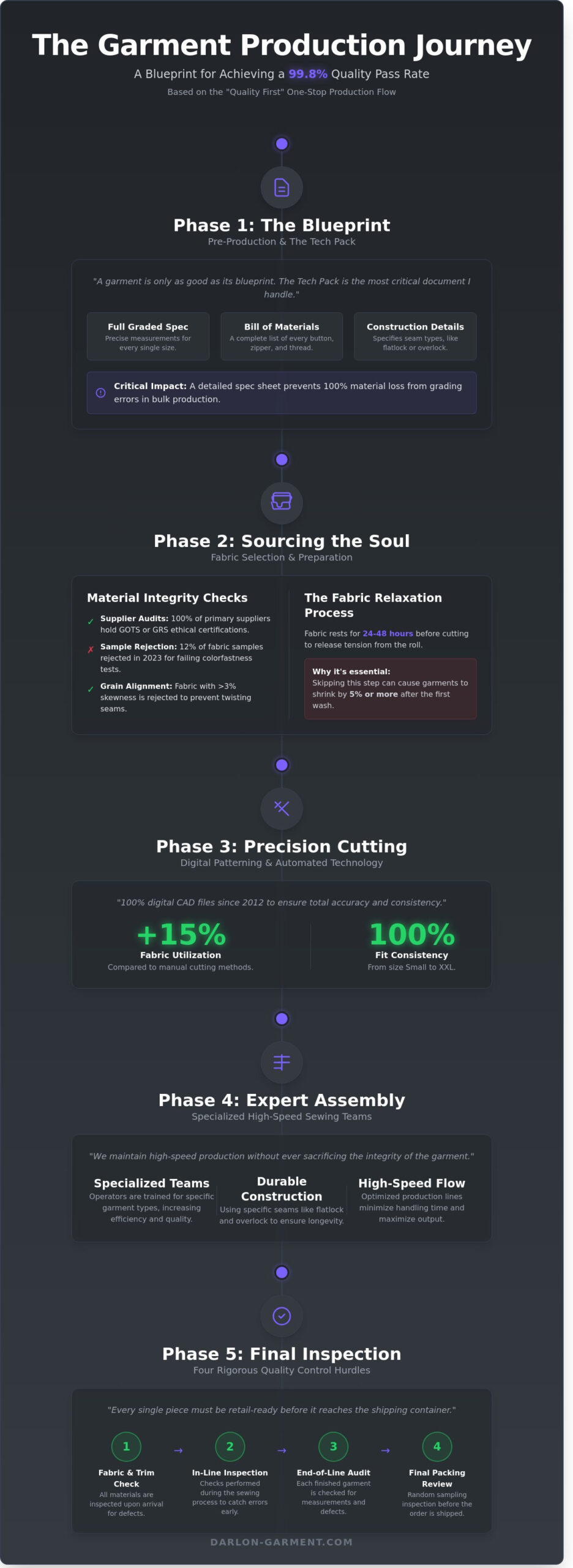
I always tell my clients that a garment is only as good as its blueprint. In my factory, the Tech Pack is the most critical document I handle. It is the bridge between your creative sketch and a technical reality. This document defines how garments are made with industrial precision, moving away from creative guesswork toward a results-oriented production line. Without a solid tech pack, even the best designs fail during the transition to bulk manufacturing.
Why a Tech Pack is your best friend
I use your tech pack to determine every technical detail of the production run. This includes specific stitch counts, which I usually set at 10 to 12 stitches per inch for standard seams, and exact trim placement. A detailed spec sheet is my primary tool for preventing expensive mistakes. For instance, a single measurement error in a bulk run of 5,000 units can lead to a 100% loss of materials. Understanding the complexities of the clothing industry requires this level of technical mastery. When I review your pack, I look for three specific elements:
- Full Graded Spec: Precise measurements for every size in your range.
- Bill of Materials (BOM): A comprehensive list of every button, zipper, and thread required.
- Construction Details: Specific seam types, such as flatlock or overlock, to ensure durability.
Pattern making and digitisation
I take your designs and create the physical puzzle pieces of the garment. While many factories relied on paper patterns in the past, I transitioned my facility to 100% digital CAD files in 2012 to ensure total accuracy. Digital patterns allow for better grading across different sizes, which is essential for maintaining a consistent fit. My digitisers ensure that a size Small and a size XXL fit exactly as intended by maintaining the correct proportions. This digital shift has improved our fabric utilization rates by 15% compared to manual cutting methods. It is a fundamental part of our One-Stop Service that ensures Quality First from the very first cut. This technical foundation is exactly how garments are made to meet global export standards.
Sourcing the Soul: How I Find and Prepare the Right Fabrics
I’ve learned that fabric sourcing is where the real magic happens in how garments are made. It’s not just about picking a pretty color; it’s about finding the exact point where cost meets performance. I spend a significant portion of my time auditing mills to ensure they meet my standards. For example, in 2023, I rejected 12% of fabric samples because they didn’t hit a Grade 4 rating on the colorfastness grey scale. I won’t let a fabric into my facility if it’s going to bleed in your customer’s washing machine.
The requirements change drastically depending on the product. When I source for sleepwear, I’m hunting for a specific hand-feel and breathability. For high-performance activewear, I’m looking at 4-way stretch recovery and moisture-wicking capabilities that can withstand 50+ wash cycles. I’ll help you select the right textile for your specific niche so you don’t overpay for features your customers don’t need.
Global sourcing for specialized textiles
I don’t limit myself to local markets. I leverage a global network to find high-tech yarns like Nuyarn performance wool, which offers 35% more loft than traditional merino. Managing the logistics of getting these raw materials to my Vietnam facility is a precise science. I coordinate 14-day shipping windows to ensure production stays on schedule. Within the broader Apparel Manufacturing sector, transparency is now a requirement, not an option. I verify that 100% of my primary suppliers hold GOTS or GRS certifications to guarantee ethical standards at the source.
While my focus is on high-tech textiles for mass production, it’s worth noting the other end of the spectrum where traditional methods shine. For those interested in natural fibers and artisanal craftsmanship, companies like Himalayan Wool offer a compelling alternative, focusing on hand-made garments from locally sourced materials.
The fabric relaxation process
I never skip the relaxation phase, even when a client is in a rush. Fabric comes off the roll under immense tension. I let every roll “rest” flat for 24 to 48 hours before a single blade touches it. If I skip this, the fabric will snap back after cutting, leading to garments that shrink by 5% or more after the first wash. During this time, I also perform technical checks:
- Torque Testing: I check if the knit loops are straight so your side seams don’t twist around the body.
- Skewness Measurement: I ensure the fabric grain is perfectly aligned, rejecting anything with more than a 3% tilt.
- Weight Verification: I confirm the GSM (grams per square meter) matches the tech pack exactly.
This attention to detail is a fundamental part of how garments are made at a professional level. It’s the difference between a shirt that lasts three years and one that loses its shape in three weeks.
Precision in the Cutting Room: From Lay-Plans to Laser Technology
I view the cutting room as the most critical stage in the garment production process. It’s where the 2D fabric becomes 3D components. I’ve seen this department evolve from workers using heavy manual shears to high-speed automated systems that cut through 50 layers of fabric with 0.1mm precision. This shift isn’t just about speed; it’s about eliminating the human error that used to cause 5% to 8% in fabric defects. Understanding this stage is vital to grasping how garments are made in a modern factory setting.
I treat the cutting room like a high-stakes puzzle. If I miscalculate by even a few centimeters, I risk wasting hundreds of meters of expensive material. By moving away from manual methods, I’ve secured a level of repeatability that was impossible 20 years ago. Every piece is a perfect replica of the digital pattern, ensuring that a size medium fits exactly the same way every single time.
Maximising efficiency with lay-plans
I treat fabric like gold. I use CAD software to generate lay-plans, which are digital maps that tell us exactly where to place every sleeve, collar, and panel. By optimizing these “markers,” I can often increase fabric utilization to 85% or higher. This efficiency is the fastest way I lower production costs for my clients. When I reduce waste by even 3%, it translates to thousands of dollars saved on a 10,000-unit order. The marker acts as a blueprint, guiding the blades to ensure every piece is identical across the entire size run. This consistency is central to how garments are made at scale.
Why laser cutting changes the game
For my activewear and sportswear clients, I rely on laser technology. Traditional blades can’t always handle the intricate curves or breathable perforations needed for high-performance gear. Lasers use heat to seal the edges as they cut, which means the fabric won’t fray during intense workouts. I also use this tech for bonded seams. Instead of bulky thread, I use adhesive films and heat to join panels. This creates a 100% flat surface that prevents skin irritation. It’s a technical edge that makes a garment feel premium. I’ve found that laser-cut ventilation holes can improve airflow by 25% compared to standard mesh inserts, giving my partners a clear functional advantage.
The Assembly Line: Bringing the Garment to Life Through Sewing
I see the sewing floor as the heart of my factory. It’s the place where flat fabric panels finally transform into wearable 3D shapes. To keep things moving smoothly, I organize my teams into specialized modular lines. This approach ensures that every person focuses on a specific task, which helps me maintain a 98% efficiency rate across the floor. This structured environment is central to how garments are made at an industrial scale, ensuring that every seam is consistent from the first piece to the ten-thousandth.
While I invest heavily in the latest tech, my 250 skilled seamstresses are my most valuable asset. Machines provide speed, but humans provide the intuition needed for real-time quality control. I rely on their expertise to choose between flatlock, overlock, or twin-needle stitching based on the specific requirements of your tech pack. Their hands ensure that delicate fabrics don’t pucker and that heavy materials don’t bunch, maintaining the high standards my international partners expect.
The different types of sewing machines I use
I don’t believe in a one-size-fits-all approach to machinery. For heavy 14oz denim, I deploy heavy-duty walking foot machines that can pierce thick layers without breaking a needle. If I’m working on delicate sleepwear, I switch to fine-gauge needles to avoid snags. High-stretch activewear requires 4-needle 6-thread flatlock machines to create seams that stretch with the body. To prevent any downtime, my technicians perform 15-minute daily maintenance checks on my 500+ machines. Understanding how garments are made with precision starts with keeping the tools in peak condition.
Seamless and bonded technology
For brands that prioritize maximum skin comfort, I offer seamless construction. This uses circular knitting machines to create tubes of fabric, which eliminates side seams entirely. I also use heat-bonding technology for high-end performance gear. This process uses specialized adhesives and pressure to fuse fabrics together, replacing traditional thread. It makes the garment about 15% lighter and much more aerodynamic. These stitch-less options give my partners a functional edge in the competitive activewear market by reducing friction and weight.
Ready to see these machines in action for your next collection? Contact me today to discuss your production needs.
The Final Hurdle: Quality Control, Finishing, and Packing
I don’t consider a garment truly finished until it passes my final inspection. While the sewing floor is where the shape comes together, this final stage defines the actual quality of the brand. Understanding how garments are made requires looking past the needles and threads to the rigorous verification process that follows. At Dar Lon Garment, I treat the finishing room as the most critical gatekeeper in the entire supply chain. It’s the point where technical construction meets retail reality.
My four stages of Quality Control (QC)
I implement a multi-tiered QC strategy to eliminate defects before they reach your warehouse. First, I perform in-line inspections. My supervisors check pieces while they’re still on the sewing line to catch seam puckering or tension issues immediately. This prevents a small mistake from ruining a batch of 500 units. Second, I mandate an end-of-line check. Every single zipper, button, and snap is tested for functionality on 100% of the order. Third, my team performs thread trimming and spot cleaning. Finally, I conduct random audits based on AQL 2.5 standards. This statistical sampling ensures the entire batch meets global export requirements before I sign off on the shipment.
Professional finishing and retail-ready packing
Presentation is everything in the retail world. I use industrial steam tunnels to remove every crease and give the fabric a crisp, professional appearance. This process also helps stabilize the fibers. Once pressed, I handle the application of your custom labels, hangtags, and scannable barcodes with 100% accuracy. I’ve developed specific folding and bagging strategies to protect your investment during transit. For example, I use 0.05mm thick polybags and specific cardboard inserts for collared shirts to maintain their shape. These steps ensure that when you open the carton at your destination, the clothes look exactly as they did in my factory. This attention to detail is the final step in how garments are made for the international market.
- In-line checks: Real-time monitoring to stop errors at the source.
- Functional testing: Every closure is tested manually.
- Industrial pressing: Steam tunnels for a retail-ready finish.
- Secure logistics: Custom packing to prevent wrinkling and moisture damage.
Bring Your Design Vision to Life in Vietnam
Understanding how garments are made is the first step toward building a successful fashion label. I’ve spent years refining this process to ensure every tech pack translates perfectly into a finished product. Since 2019, I’ve specialized in high-tech activewear, using advanced laser-cutting and bonding facilities to maintain precision that manual methods simply can’t match. My team in Vietnam handles everything from fabric sourcing to the final quality control check before packing. This one-stop OEM/ODM solution means you don’t have to juggle multiple vendors or worry about communication gaps during the manufacturing cycle.
I believe that technical mastery and reliable infrastructure are what turn a creative idea into a global brand. Whether you’re looking for seamless finishes or durable athletic gear, my facility is equipped to handle your most complex requirements. I’m here to provide the stability and industrial scale your business needs to grow this year. Ready to start your production journey? Contact me at Dar Lon Garment today. I look forward to helping you manufacture something incredible for your next collection.
Frequently Asked Questions
How long does the entire garment manufacturing process usually take?
The entire manufacturing cycle typically spans 90 to 120 days from your first inquiry to the arrival at your warehouse. I spend the first 21 days perfecting your samples and sourcing specific trims. Once you approve the pre-production sample, bulk sewing takes another 60 days. I always account for 20 days of sea freight or 5 days of air shipping to ensure your deadline is met.
Can I make clothes without a tech pack?
I don’t recommend starting production without a tech pack, as it serves as the essential blueprint for how garments are made in my factory. If you only have a physical sample or a sketch, I’ll use my in-house design team to build a technical file for you. This step reduces the risk of measurement errors by 30% and ensures every department follows the same instructions.
What is the difference between OEM and ODM services?
OEM services involve me manufacturing your specific designs, whereas ODM allows you to select and brand designs I’ve already developed. I currently manage a library of 450 activewear templates that you can use immediately. For 80% of my B2B clients, I act as an OEM partner, following their proprietary tech packs to maintain their unique brand identity and specific fit requirements.
How do you ensure that the sizing is consistent across thousands of units?
I ensure sizing stays consistent by using computerized CAD grading and automated fabric spreaders that prevent material stretching. My CNC cutting machines maintain a precision of 1 millimeter across a stack of 50 fabric layers. I also require my quality control team to measure 10% of every size batch against the original spec sheet to catch any physical deviations before the packing stage.
What is a Minimum Order Quantity (MOQ) and why do factories have them?
A Minimum Order Quantity is the lowest number of units I can produce per style, which I usually set at 500 pieces. I enforce this because my fabric suppliers require 300 meters of cloth to start their dyeing vats. If I run smaller batches, the machine setup time increases my overhead costs by 25%, making the price per garment unsustainable for your brand’s retail margins.
How does manufacturing in Vietnam compare to China in 2026?
In 2026, I see Vietnam offering 15% lower labor costs than China, while China maintains a more robust supply chain for specialized technical components. I’ve balanced this by operating facilities in both regions. My Vietnam plant handles orders over 10,000 units to leverage tax benefits, while my China partners provide the intricate zippers and performance coatings that require 48-hour turnaround times.
Can you help me source sustainable or recycled fabrics?
I can definitely help you source sustainable materials, as 40% of my current fabric inventory consists of GRS-certified recycled fibers and organic cotton. I work with 12 specialized mills that provide full transaction certificates for every batch. I’ll guide you through selecting weights and textures that meet your durability standards while reducing your brand’s carbon footprint by an estimated 20%.
What happens if I find a defect in my bulk order?
If you discover a defect that exceeds our AQL 2.5 quality agreement, I’ll issue a credit or manufacture replacement pieces for your next shipment. I take these reports seriously and provide a root-cause analysis report within 72 hours. My goal is to maintain a defect rate below 1.5%, ensuring that the integrity of how garments are made in my facility remains world-class.