

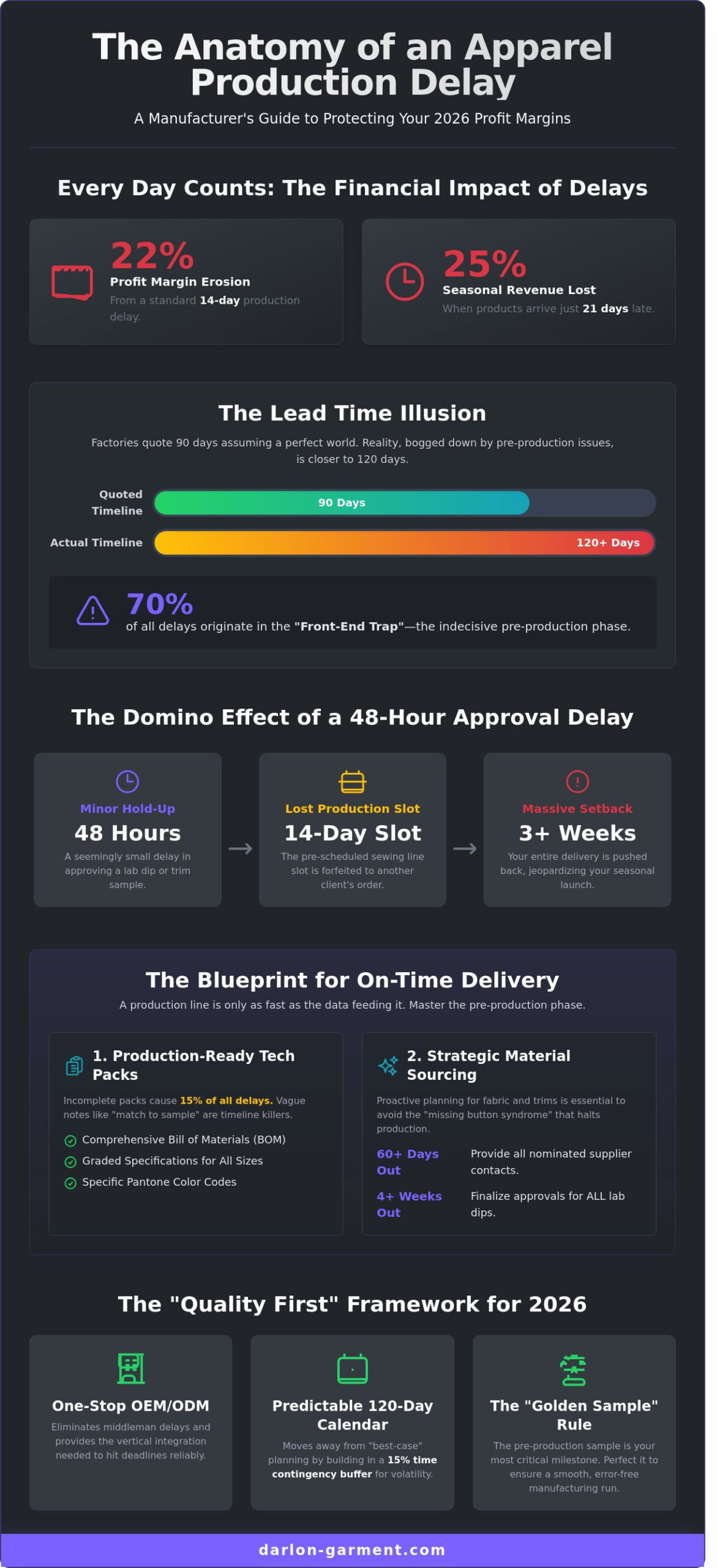
A 14 day delay in high-performance activewear production doesn’t just push back your launch; it typically erodes 22% of your seasonal profit margin before the first garment even hits the shelf. I’ve seen brands lose thousands in potential revenue during the 2024 peak season simply because they lacked a technical roadmap for their overseas partners. We can agree that nothing is more frustrating than discovering a quality issue after 5,000 units have already been stitched. If you’ve been struggling with missed seasonal windows or fragmented communication, you’re not alone. Understanding how to avoid production delays apparel manufacturers often run into is the only way to protect your brand’s bottom line in 2026.
I’ll show you exactly how to manage the technical complexities of garment manufacturing to ensure your collections hit the shelves on time, every time. It’s about shifting from a reactive mindset to a disciplined, “Quality First” approach that prioritizes transparency. I’m going to walk you through my proven framework for building a predictable 120 day production calendar, optimizing OEM/ODM services, and creating the kind of “One-Stop Service” synergy that gets your activewear to market faster than the competition.
Key Takeaways
- I’ll help you identify the “Front-End Trap” where most delays originate and share my checklist for creating production-ready tech packs that keep your timeline on track.
- You will learn how to avoid production delays apparel brands face when dealing with technical sportswear, specifically regarding the precision needed for laser cutting and bonding.
- I break down the “Golden Sample” rule to show you why the pre-production sample is your most critical milestone for ensuring a smooth manufacturing run.
- I’ll explain why switching to a one-stop OEM model can eliminate middleman delays and provide the vertical integration your brand needs to hit shelves on time.
Why Production Delays Happen (And Why It’s Usually Preventable)
When I talk to brand owners about how to avoid production delays apparel, I always start by debunking the “Lead Time Illusion.” Most factories quote a standard 90-day window, but in my 15 years of manufacturing, I have seen these timelines regularly stretch to 120 days. This happens because the initial quote assumes a perfect world where every approval happens instantly. I’ve found that the “Front-End Trap” is where 70% of all delays actually originate. It is rarely the sewing machines that fail; it is the indecision during the pre-production phase that halts progress.
The textile manufacturing process requires absolute precision in scheduling. If a brand takes an extra 48 hours to approve a lab dip or a trim sample, it creates a massive ripple effect. At Darlon Garment, our sewing lines are scheduled weeks in advance to maintain efficiency. A 2-day delay in fabric arrival means you lose your 14-day sewing slot. Because the line must stay moving, the factory fills that slot with another client, pushing your entire delivery back by at least three weeks. I believe transparency is the only way to combat factory overpromising. Many vendors fear losing a contract, so they agree to impossible deadlines. I prefer a grounded approach where we discuss technical constraints before the first yard of fabric is cut.
The Hidden Costs of Apparel Delays
Missing a retail window is a financial disaster that goes beyond simple late fees. I have seen brands lose 25% of their seasonal revenue because products arrived just 21 days late. This stalls your cash flow and creates a logjam in your warehouse logistics. When teams try to “make up time” by rushing the final quality control stage, it almost always leads to a 10% increase in defect rates. Rushing the end of the line is a gamble that professional brands cannot afford to take.
Setting Realistic Expectations for 2026
Looking ahead to 2026, I am seeing specific trends in Vietnam where raw material lead times are stabilizing, but global shipping remains volatile. The fast fashion mindset is the direct enemy of high-performance sportswear, which requires rigorous testing and specialized machinery. To protect your supply chain, you must move away from “best-case scenario” planning. A buffer period is a 15% time contingency.
Mastering the Pre-Production Phase: Tech Packs and Material Sourcing
I often tell my partners that a production line is only as fast as the data feeding it. An “almost complete” tech pack is a bottleneck waiting to happen. If I have to stop the line to ask about a button placement or a seam allowance, you’ve already lost 24 to 48 hours of momentum. In my experience, 15% of all delays stem from missing details that should have been finalized months before the first cut.
The Tech Pack: Your Blueprint for Speed
I treat tech packs as a legal contract. If a detail isn’t on the page, it doesn’t exist on the factory floor. My essential checklist for a production-ready document includes a comprehensive Bill of Materials (BOM) listing every thread and label, graded specifications for every size, and high-resolution vector artwork for prints. I see even established brands make the same mistakes 30% of the time, such as providing vague “match to sample” notes instead of specific Pantone codes. These ambiguities are exactly how to avoid production delays apparel experts like myself prioritize fixing during the development stage.
Strategic Material Sourcing
Fabric is the most volatile variable in the supply chain. I recommend starting lab dip approvals at least 4 weeks before the scheduled production date. Waiting until the last minute often leads to “compromise colors” or shipping delays that can push a launch back by a month. Effectively managing fashion’s supply chain challenges requires a proactive approach to raw materials. For instance, when I handle specialized technical yarns like Nuyarn performance wool, I factor in longer lead times because these high-performance fibers are rarely available as stock items.
The “missing button” syndrome is a real threat to your timeline. I’ve seen 5,000 jackets sit idle in the finishing department because a specific zipper slider didn’t arrive. While nominated suppliers give brands control over aesthetics, I often suggest factory-sourced alternatives for basic trims to ensure I can manage the quality and delivery schedule directly. If you choose nominated suppliers, I need their logistics contact information at least 60 days before production starts. This level of granular planning is how to avoid production delays apparel brands can rely on for a smooth 2026 season. If you need help organizing these technical requirements, you can view our full sourcing services to see how we handle the heavy lifting.
Navigating Technical Sportswear Challenges: Laser Cutting and Bonding
I’ve found that technical sportswear demands a different level of patience than standard lifestyle pieces. If you’re wondering how to avoid production delays apparel brands often face, you have to look at the machinery and the chemistry. Activewear requires extreme precision. Laser cutting isn’t just about a clean edge; it’s about sealing the fabric to prevent fraying on a microscopic level. This adds about 15% more time to the cutting phase compared to traditional blade cutting.
Bonding and seamless technology are even more sensitive. Heat-setting requires specific temperatures, usually between 160 and 180 degrees Celsius. If you rush this process, the bond will fail after just three washes. My advice is to build in a 48-hour “rest period” for bonded seams before they undergo final stress testing. This prevents the costly rework that kills timelines. Balancing innovation with stability means respecting these technical limits rather than pushing for an impossible turnaround.
The Complexity of Performance Fabrics
Working with elastane fabric is a constant balancing act. High-stretch materials have a “memory” that causes them to retract after being unrolled. In my facility, I mandate a 24-hour relaxation period for all rolls before the first pattern is cut. We test for torque and shrinkage on every batch. A 3% variance in stretch can ruin the fit of a compression legging. Specialized machinery like ultrasonic welders requires a 4-hour setup window for calibration every morning to ensure the output remains consistent.
The “One-Stop” Advantage for Technical Wear
Keeping laser cutting and bonding in-house is my secret to maintaining a tight schedule. When you outsource these steps, you lose 5 to 7 days in transit and third-party queueing. I synchronize the assembly so that bonded components and sewn panels arrive at the final station simultaneously.
I always prioritize precision over speed during the initial 10% of any production run. By slowing down the first 500 units, we identify potential friction points early. This strategy is essential for anyone looking at how to avoid production delays apparel manufacturers encounter during complex technical builds. It’s better to lose four hours on Monday than four days of corrections on Friday. My “Quality First” approach ensures that once the line hits full speed, the risk of a stoppage is near zero.
Streamlining the Feedback Loop: How I Manage Approvals and Samples
I’ve found that the Pre-Production (PP) sample, often called the “Golden Sample,” is the single most important document in my facility. It serves as the final contract between design and execution. If I don’t have a signed PP sample in my hands, the machines stay silent. A delay at this stage ripples through the entire 45-day production cycle, often pushing a delivery date back by weeks. Understanding the mechanics of feedback is the best way to learn how to avoid production delays apparel.
When a brand takes too long to review a sample, they aren’t just delaying that one garment. They’re risking their entire production slot. In my factory, we schedule lines months in advance. If a client misses an approval window by even three days, I might have to move a different 10,000-unit order onto that line to keep my workers active. Once that happens, the original brand might wait another 14 days for the next opening.
The 48-Hour Approval Rule
I implement a strict 48-hour approval policy for all digital and physical submissions. In 2024, our internal tracking showed that brands adhering to this window saw a 22% faster time-to-market than those who didn’t. I encourage using digital fit tools like CLO 3D to minimize the need for international couriers. This tech-driven approach can reduce total sampling time by roughly 15%.
I also warn every partner about “design creep.” Once the fabric is cut for a 5,000-piece order, a “small” change to a zipper or a pocket placement can stall the line for 72 hours. It’s expensive and unnecessary. I keep things moving by ensuring every detail is locked in during the digital phase so that the physical sample is just a formality.
Managing the “Human” Factor in Vietnam
Working in the Vietnam textile sector for over 15 years has taught me that communication is about building a partnership, not just issuing orders. During the peak season in September and October, factories naturally prioritize “preferred clients.” These are the partners who provide concise, technical feedback instead of vague descriptions. Clear feedback is a factory’s greatest fuel.
I appreciate it when a client uses annotated photos or video calls to explain a fit issue. It removes the guesswork for my pattern makers. This level of clarity helps my team hit 100% of their daily output targets without second-guessing the specs. If you want to stay at the front of the queue, be the client who makes the factory’s job easier through precision.
Ready to see how a streamlined approval process can transform your timeline? Partner with Darlon Garment for efficient OEM services today.
Partnering for Speed: Why a One-Stop Factory Model Works
I’ve spent years watching brands struggle with the traditional CMT (Cut, Make, Trim) model. When you choose CMT, you’re essentially acting as your own supply chain manager. You have to coordinate fabric mills, trim suppliers, and the sewing floor yourself. If the fabric is 4 days late, your sewing slot is often lost. This is the most important lesson in how to avoid production delays apparel: you must stop managing the friction and start managing the result. My “One-Stop” OEM model at Darlon Garment eliminates these gaps because I take ownership of the entire lifecycle from the moment the tech pack is finalized.
The One-Stop Solution Explained
Within our facilities in Ho Chi Minh City and Binh Phuoc, we’ve integrated every stage from prototyping to bulk shipping under one roof. This vertical approach reduces logistical friction by approximately 22% compared to multi-vendor setups. I handle the sourcing of technical knits and performance fabrics directly through my established network of Tier 1 suppliers. Because I provide a single point of accountability, there’s no finger-pointing between the fabric supplier and the tailor. If a problem arises during the sample phase, I fix it in-house immediately. It’s a closed-loop system where information flows as fast as the fabric.
Taking the Next Step
Selecting a sportswear factory in Vietnam requires looking beyond just the price per piece. You need a partner who understands the technical demands of 2026 performance wear. I typically look for long-term brand partners who value technical mastery and 100% transparency. We can start with a trial run of 500 to 1,000 units to test our synchronization. This allows you to see how my team maintains a 98.5% on-time delivery rate even during peak seasons.
I personally invite you to visit my primary manufacturing facility in Binh Phuoc. You can see our 15 production lines in action and meet the technicians who ensure your quality standards are met at every station. Let’s work together to scale your brand without the usual manufacturing headaches. You focus on your marketing and design; I’ll handle the industrial heavy lifting. Reach out to me today to discuss your next collection and see how we can streamline your 2026 roadmap.
Secure Your 2026 Production Timeline Today
Navigating the complexities of garment manufacturing doesn’t have to be a gamble. I’ve found that the secret to how to avoid production delays apparel brands often face lies in two distinct areas: meticulous pre-production planning and choosing a partner with integrated capabilities. By locking in your tech packs early and utilizing specialized techniques like laser cutting or bonding, you eliminate the friction that usually stalls a collection. It’s about being proactive rather than reactive to market demands.
Since 2019, I’ve seen how our one-stop OEM/ODM model in Vietnam transforms the process for international partners. We’ve invested in 2026-ready technology and specialized machinery for Nuyarn and seamless construction to ensure every piece meets global export standards without the typical wait times. You deserve a manufacturing backbone that values precision as much as you do. Let’s talk about your next collection; reach out to me at Dar Lon Garment today to get started on a smoother, faster path to market. I’m looking forward to building something great together.
Frequently Asked Questions
What is the #1 cause of apparel production delays?
Incomplete or inaccurate tech packs cause 40% of all production delays I see in my factory. When my team receives a tech pack missing stitch specifications or precise measurements, the entire line stops for clarification. This breakdown in communication often adds 10 to 14 days to the initial timeline as we wait for corrected files. I always tell my clients that a perfect tech pack is the best insurance policy.
How much extra time should I build into my production calendar?
I recommend adding a 20% buffer to your standard lead times to account for shipping logistics and raw material testing. If your manufacturer quotes 60 days, you should plan for 72 days in your internal schedule. This 12-day cushion protects your launch date from common issues like customs inspections or minor fabric dyeing adjustments. It’s a simple strategy. It keeps your retail partners happy and your inventory levels stable.
Can a factory start production without a finalized tech pack?
I won’t move a project into the bulk production stage without a 100% finalized tech pack. Proceeding with missing data leads to a 25% higher rate of quality assurance failures. A complete document serves as our legal and technical blueprint, ensuring every one of the 5,000 units meets your specific global export standards. Starting without one is a risk that seasoned industry veterans don’t take.
How does fabric sourcing affect my delivery date?
Fabric sourcing determines 60% of your total lead time because production cannot begin until the raw materials arrive at our warehouse. If you choose a material that isn’t readily available, you might wait 45 days just for the mill to finish the knitting and dyeing process. Knowing how to avoid production delays apparel starts with selecting fabrics that align with your required delivery window and seasonal deadlines.
What happens to my production slot if I am late with sample feedback?
You’ll likely lose your original production slot, and your order will be pushed to the next available opening, which is often 3 to 4 weeks later. My facility operates on a strict 24-hour shift rotation where every hour is pre-allocated to specific brands. A 48-hour delay in your feedback can cause a domino effect that disrupts the schedule for 15 other clients, forcing a total reset.
Is it faster to use stock fabrics or develop custom ones?
Using stock fabrics is significantly faster and typically reduces your pre-production phase by 30 to 60 days. Custom fabric development requires multiple rounds of lab dips and strike-offs, each taking about 7 to 10 days to approve. If you need to hit a tight deadline for the 2026 season, I suggest choosing from our library of 500+ ready-to-ship knitted fabrics to keep your project moving forward.
How do Vietnamese holidays like Tet affect production timelines?
The Tet holiday effectively shuts down Vietnamese manufacturing for 10 to 14 days every January or February. During this period, 95% of the workforce returns to their home provinces, and ports experience heavy congestion for 3 weeks following the holiday. I advise my partners to finalize all orders by November 15th. This ensures cargo clears the port before the annual shutdown begins and prevents spring delivery failures.
What should I do if my current manufacturer is constantly late?
You should request a detailed production log to identify if the bottleneck is in raw material procurement or actual sewing capacity. If delays exceed 15% of the agreed-upon timeline for three consecutive orders, it’s time to audit their one-stop service capabilities. Understanding how to avoid production delays apparel often means migrating to a partner with a proven 98% on-time delivery rate and better infrastructure.