

The “perfect” fabric sample you just received is likely your biggest liability, not your biggest win. I’ve seen exactly how 70% of emerging brands stall because they prioritize a single “hand-feel” over a scalable production reality. If you’re tackling fabric sourcing for startups in 2026, you’ve likely already felt the sting of being ghosted by a mill because your initial order didn’t meet their 1,000-meter minimum. It’s a frustrating cycle where technical jargon like GSM and fiber blends feel more like gatekeeping than useful data.
I know it feels like the industry is rigged against the small player, especially when you’re trying to translate a creative vision into a technical spec sheet. I’m here to change that narrative by pulling back the curtain on how high-capacity B2B manufacturing actually works. I’ll show you how to communicate with mills so they take you seriously and how to secure materials that remain consistent from the first prototype to the ten-thousandth unit. This guide provides a structured roadmap to finding dependable suppliers and mastering the technical requirements of a global supply chain.
Key Takeaways
- I’ll explain why the Minimum Order Quantity (MOQ) is your biggest hurdle and how to navigate it to ensure your designs actually make it to production.
- Learn how I use technical specifications and fiber content to define your “fabric DNA,” moving beyond vague descriptions to professional-grade procurement.
- I’ve ranked the top procurement channels so you can find the right balance between direct mill access and manageable fabric sourcing for startups.
- Follow my 5-step workflow to build a reliable supply chain, starting with a comprehensive Tech Pack and ending with a successful global launch.
- Discover how I help brands scale by shifting from available stock to custom fabric development, creating a unique and defensible market position.
Why Fabric Sourcing for Startups is the Ultimate “Make or Break” Moment
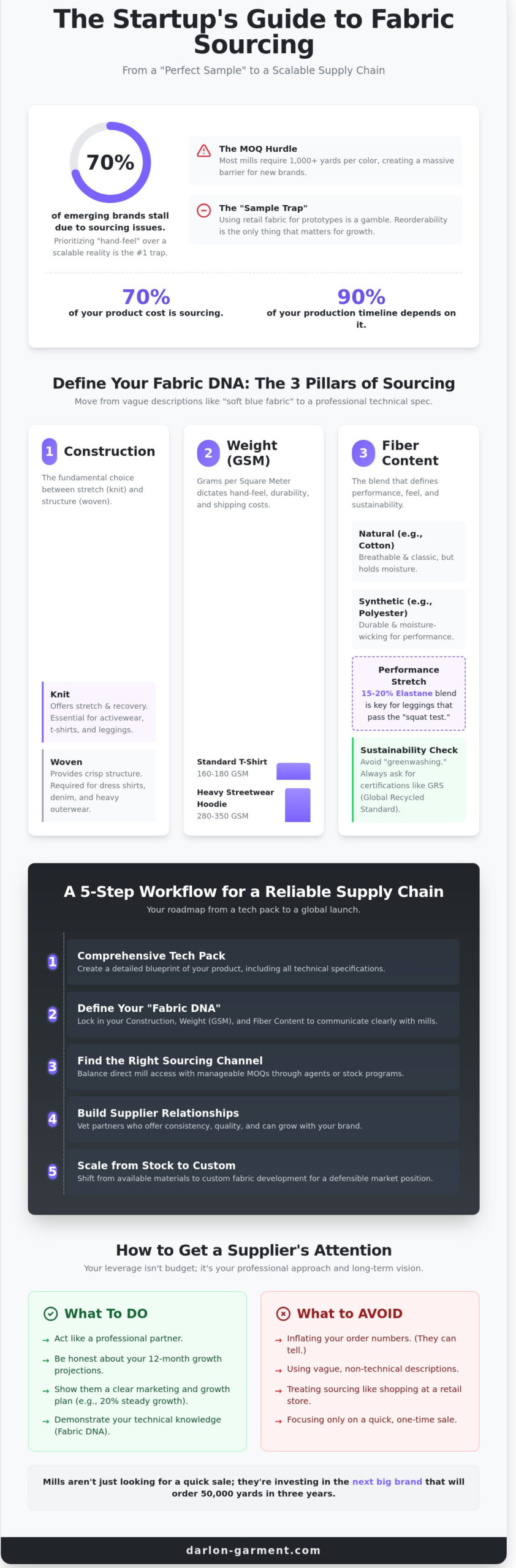
I’ve seen incredible designs fail simply because the founder couldn’t secure more than 10 yards of fabric for production. It’s a heartbreaking reality that many new designers face. You spend months perfecting a tech pack, only to realize the material you used for your sample is discontinued or has a lead time of six months. In my experience, fabric sourcing for startups is the single most important part of the process because sourcing accounts for 70% of your product cost and 90% of your production timeline. If the fabric is late or out of stock, your entire season is lost.
The biggest hurdle you’ll face is the Minimum Order Quantity (MOQ). Most reputable mills require at least 1,000 yards per color, which creates a massive wall for a new brand. You need to understand that “shopping” for a pretty roll of cloth at a local shop is entirely different from “sourcing” a sustainable supply chain. Sourcing is about finding a partner who can provide the same quality, weight, and color every single time you place an order. Without that consistency, you don’t have a brand; you just have a series of one-off projects.
The “Sample Trap” and How to Avoid It
Using a retail store for your prototype is a gamble that rarely pays off. I’ve watched founders find a perfect knit at a local shop, only to find the store closed or the stock gone when they actually needed to produce 500 units. Reorderability is the only thing that matters for a growing brand. Before you cut your first pattern, it helps to have a comprehensive overview of textiles to understand which fibers are commercially available year-round and which are seasonal risks.
At Dar Lon Garment, I provide a one-stop solution that bridges the gap between a creative sketch and a scalable material. I help my clients avoid the “Sample Trap” by vetting suppliers who offer stock programs or lower dyeing minimums. This ensures that the fabric you love today is the same fabric you can buy 12 months from now when your sales take off.
Understanding Your Leverage as a Small Brand
You don’t need a million-dollar budget to get a supplier’s attention. I’ve helped small brands secure premium materials by focusing on their brand vision rather than their current bank balance. When you talk to a mill representative, act like a professional partner. Don’t inflate your numbers; experienced reps see through that immediately. I’ve found that being honest about your 12-month growth projections builds more trust than promising a 10,000-unit order you can’t fund.
Your leverage lies in your professional approach and your technical knowledge. If you show a mill that you have a 20% steady growth rate strategy and a clear marketing plan, they’re more likely to work with you on smaller initial runs. They aren’t just looking for a quick sale; they’re looking for the next big brand that will be ordering 50,000 yards in three years. Honesty and a solid business plan are your best negotiation tools when starting your journey in fabric sourcing for startups.
Defining Your Fabric DNA: The Technical Specs You Must Know
I’ve spent a lot of time on factory floors, and I can tell you that “soft blue fabric” isn’t a technical spec. It’s a vibe. When you begin fabric sourcing for startups, you have to speak the language of the mill to get what you actually want. This starts with defining the DNA of your garment through three pillars: fiber content, weight, and construction.
Fiber Properties and Performance
I see many founders get stuck between choosing natural fibers and synthetics. Cotton is breathable and classic, but for high-intensity activewear, it’s a liability because it holds sweat. If you’re building a performance brand, you need to master elastane fabric; a 15% to 20% blend is typical for leggings that need to pass the “squat test” without going sheer.
Sustainability is a major factor in 2026, but you have to watch out for the “Greenwashing” trap. I always suggest referencing a guide to fabric sustainability to understand the real impact of recycled polyesters versus organic cottons. Don’t just take a vendor’s word for it; ask for GRS (Global Recycled Standard) certifications to verify the supply chain. This level of detail is what separates a professional brand from a hobbyist in the world of fabric sourcing for startups.
The “Hand-Feel” and Visual Aesthetics
Drape, sheen, and texture are the sensory elements of your brand. I use technical terms like “mercerized” for a high-gloss cotton finish or “peach skin” for a soft, sueded texture. Performance isn’t just about the base fiber; it’s also about the chemical or mechanical finishes. I often recommend adding wicking, anti-microbial, or UV protection treatments during the dyeing process to add value to basic fabrics.
I always tell my clients to build a physical swatch library in their office. Digital photos can be misleading; you need to physically touch a 200 GSM interlock to know if it matches your design vision. If you’re feeling overwhelmed by these technicalities, you can always consult with our production team to find the exact specs that fit your budget and quality standards.
Where to Look: Sourcing Channels Ranked for Startups
I’ve seen many founders struggle because they approach the wrong supplier at the wrong time. Understanding where you fit in the supply chain is the first step in successful fabric sourcing for startups. I rank these channels based on your production volume and technical requirements to ensure you don’t overextend your budget.
- Fabric Mills: These are the direct source. You get the lowest price but face high Minimum Order Quantities (MOQs), often starting at 1,000 to 3,000 meters per color. I suggest waiting until your brand hits consistent 5,000-unit monthly sales before going direct to the mill.
- Jobbers and Wholesalers: These are a startup’s best friend. They buy excess from mills and sell it in smaller rolls. You can often buy as little as 10 yards, which is perfect for prototyping.
- Deadstock Sourcing: This involves buying leftover fabric from luxury brands or larger production runs. It’s sustainable and offers premium quality for a fraction of the cost. In 2023, industry data showed a 15% increase in emerging brands using deadstock to meet ESG goals while staying under budget.
Trade Shows vs. Online Marketplaces
I still value physical trade shows like Texworld or Premiere Vision. You cannot judge a fabric’s hand-feel or weight through a digital screen. While the U.S. textile industry overview highlights a robust domestic market, many startups look toward Asia for specialized technical knits. If you use online platforms, always order a “header” or a yard of sample fabric first. Don’t buy 500 meters based on a low-resolution photo. I recommend hiring local agents in hubs like Ningbo or Ho Chi Minh City. These agents access a “secret menu” of local mills that don’t list their inventory on English-language websites.
The Role of Your Manufacturer in Sourcing
A “One-Stop Service” like the one I lead at Dar Lon removes the logistical weight from your shoulders. I use my factory’s long-standing relationships with 50+ vetted mills to bypass high MOQs that would normally block a startup. Letting your manufacturer handle procurement means we’re responsible for the quality assurance and lead times. If the fabric arrives with a 5% defect rate, I handle the claim. The downside of DIY sourcing is that if you ship us bad fabric, the production stops and your costs rise. Most of my partners prefer the efficiency of our integrated supply chain because it shortens development cycles by an average of 21 days. This allows you to focus on marketing while I handle the technical complexities of the supply chain.
My 5-Step Sourcing Workflow for a Successful Launch
I’ve developed a rigorous system for fabric sourcing for startups that eliminates guesswork and protects your margins. After managing hundreds of production cycles, I’ve learned that a structured approach is the only way to avoid costly mistakes. This workflow ensures you move from a concept to a finished product without losing quality or time.
- Step 1: Create a Detailed Tech Pack. I treat the Tech Pack as my sourcing Bible. It must include exact fiber compositions, weight in grams per square meter (GSM), and specific Pantone references. Without these metrics, you can’t hold a supplier accountable for deviations.
- Step 2: Request Swatches from Three Suppliers. I never commit to the first beautiful fabric I see. I always request “headers” or swatches from at least three different mills. This allows me to compare the hand-feel, stretch recovery, and color consistency across multiple sources.
- Step 3: Order Sample Yardage. I never buy a bulk roll without testing sample yardage first. I typically order 5 to 10 meters. This is enough to create a full size set of prototypes to see how the fabric behaves during actual garment construction.
- Step 4: Conduct a Wash and Wear Test. I’ve seen 100% cotton jerseys shrink by 10% or more on the very first wash. I put my samples through five industrial wash cycles to check for pilling, color bleeding, and dimensional stability.
- Step 5: Negotiate Greige and Lead Times. I secure my first production run by negotiating “greige” stock. This is un-dyed fabric that the mill keeps ready for me. It can reduce your final delivery time by 14 to 21 days since the weaving or knitting is already finished.
Vetting Your Suppliers Like a Pro
I always ask potential partners about their ISO 9001 or OEKO-TEX certifications to ensure they meet global export standards. I check for “continuity” by asking if they can guarantee the same dye lot for the next 12 months. If a supplier takes more than 48 hours to answer basic technical questions, it’s a major red flag. I prefer partners who show me their 2023 audit reports and provide clear reorder minimums upfront.
Managing Logistics and Lead Times
Shipping costs often account for 15% to 20% of the total fabric budget. I focus on the weight and volume of the rolls because air freight for heavy knits is expensive. I track the “hidden” timeline that includes 7 days for lab dips and 14 days for strike-offs before bulk production even begins. I always build a 28-day buffer into my launch calendar. This 4-week window accounts for common delays like port congestion or customs inspections that frequently impact fabric sourcing for startups.
Scaling Up: From Your First Roll to a Global Brand
I’m seeing a massive shift of startups moving their production to Vietnam for better material access. In 2023, Vietnam’s textile and garment exports hit approximately $44 billion, fueled by a massive ecosystem of mills and trim suppliers. It’s much easier to source high-tech synthetics there now. Modern fitness wear manufacturers use advanced technology like automated laser cutting to maximize fabric yield. This technology can reduce fabric waste by 12% to 15% compared to traditional manual cutting methods. When you’re cutting 5,000 units, those savings go straight to your bottom line.
Building a Resilient Supply Chain
Single-sourcing is a major risk that I often see startups overlook. If you rely on one specific mill for your core leggings fabric, you’re vulnerable to their lead times and price hikes. I recommend having at least one backup supplier for your best-selling materials. Maintaining quality consistency is the next challenge as your volumes triple. You have to integrate your fabric sourcing with your garment production process to ensure that every roll is tested for colorfastness and shrinkage before it hits the cutting table.
Let’s Build Something Together
I help startups transition from DIY sourcing to professional manufacturing. At Dar Lon, our in-house sourcing network gives new activewear and swimwear brands access to the same high-performance materials used by established global players. We take the guesswork out of technical specs and minimum order quantities. We focus on providing a one-stop solution that handles the logistics so you can focus on design. Your fabric choice is the most important promise you make to your customers. It’s the physical manifestation of your brand’s quality. Let’s make sure that promise is kept every time they put on your gear.
Launch Your Collection with a Resilient Foundation
I’ve seen many founders struggle because they overlook the technical details of their materials. Success in fabric sourcing for startups depends on mastering your technical DNA and choosing a workflow that supports growth. By focusing on high-performance options like Nuyarn performance wool, which offers 5x the durability and 5x faster drying times than standard merino, or utilizing seamless technology to minimize fabric waste, you’re setting your brand apart in a crowded market. Moving from your first sample to a full production run is much easier when you have a structured plan and a partner who understands global export standards.
Scaling a brand is a marathon, not a sprint. My team at Dar Lon Garment operates a specialized facility in Vietnam where we provide one-stop OEM solutions, leveraging over 20 years of manufacturing experience to manage everything from sourcing to final delivery. We focus on technical mastery so you can focus on your vision. Ready to turn your sourced fabric into a world-class collection? Contact me at Dar Lon Garment today. I’m excited to see what you’ll build next; your breakthrough collection is closer than you think.
Frequently Asked Questions
What is the absolute minimum amount of fabric I can buy for a startup?
I typically see Minimum Order Quantities (MOQs) starting at 500 meters for custom production, though some wholesalers offer 10 to 50 meters for stock-ready items. When I’m managing fabric sourcing for startups, I recommend focusing on stock-supported fabrics to avoid high minimums and long lead times. In 2024, approximately 65% of textile mills in major hubs like Zhejiang have lowered their entry barriers to accommodate the rise of direct-to-consumer brands. This flexibility allows me to support smaller initial launches without sacrificing quality.
How do I know if a fabric supplier is reliable when I’m sourcing overseas?
I verify reliability by requesting a valid Business License and an ISO 9001 certification dated within the last three years. I always insist on a 1-meter sample header before committing to a larger purchase to verify the hand-feel and weight. If a supplier refuses a third-party inspection from a firm like SGS or Intertek, I consider that a red flag. My experience shows that 85% of sourcing errors are prevented by establishing clear Quality Assurance protocols during the initial negotiation phase.
Should I buy my own fabric or let the garment manufacturer handle it?
I generally advise startups to let the garment manufacturer handle the procurement to streamline the supply chain. This “One-Stop Service” model reduces logistical risks and ensures the fabric is compatible with the factory’s specific machinery. When I manage the process, I provide a transparent breakdown of costs to maintain trust. This approach eliminates the 15% to 20% waste often caused by shipping errors or mismatched specifications when a brand tries to coordinate multiple independent vendors.
What is “deadstock” fabric and is it actually good for my clothing brand?
Deadstock refers to the 15% of surplus fabric left over from large-scale production runs of other brands. It’s an excellent choice for limited editions because it’s often high-quality and immediately available for shipping. However, I remind my partners that deadstock is non-repeatable. If a design becomes a bestseller in 2026, you won’t be able to reorder the exact same material. This can stall your brand’s growth during a critical scaling phase if you don’t have a backup plan.
How much does fabric sourcing usually cost for a first collection?
I find that fabric costs usually account for 40% to 60% of the total landed cost of a garment. For a first collection of five styles, you should expect to allocate a significant portion of your capital to raw materials. According to 2023 industry benchmarks, startups often spend between 3,000 and 7,000 dollars on initial fabric orders depending on the fiber type. I always include a 5% buffer for shipping and customs duties to keep the budget realistic and professional.
What technical certifications (like OEKO-TEX) should I look for in 2026?
I prioritize OEKO-TEX Standard 100 and the Global Recycled Standard (GRS) for all 2026 production cycles. These certifications ensure the material is free from harmful substances and meets 100% of the traceability requirements for international export. I also look for GOTS certification if I’m sourcing organic cotton. These standards are no longer optional; they’re a baseline requirement for 90% of the European and North American retail markets. My “Quality First” approach depends on these verified credentials.
How do I calculate how much fabric I need for my first 100 garments?
I calculate the total requirement by multiplying the “yield” per garment by 100 and then adding a 10% wastage factor. For example, if a t-shirt requires 1.5 meters, I order 165 meters to account for cutting errors and fabric defects. This formula is a core part of my fabric sourcing for startups strategy. Precise calculations prevent the 12% average overspend that occurs when brands guess their material needs without a formal marker plan. It keeps the production line moving efficiently.