

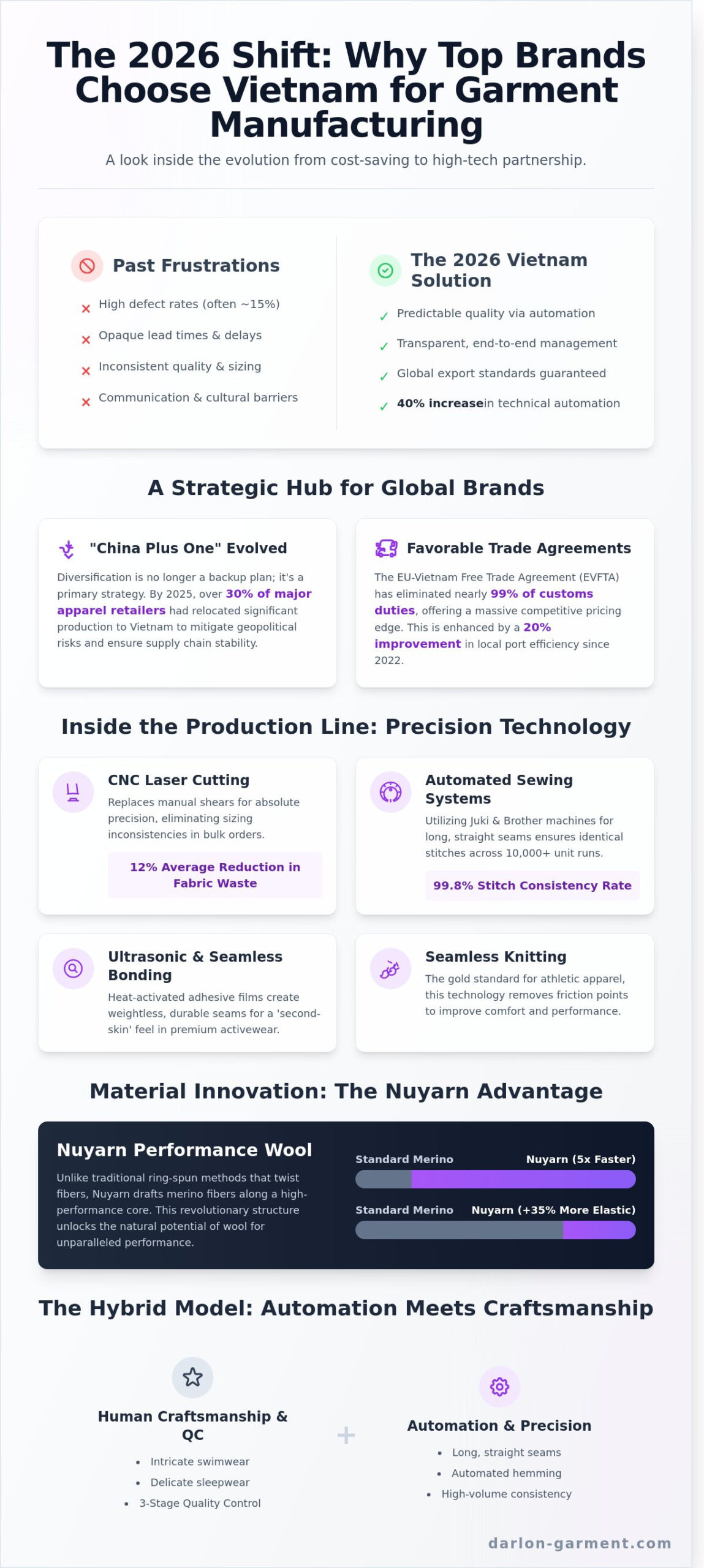
By 2026, the primary reason brands choose a Vietnam garment factory isn’t just about labor costs; it’s about a 40% increase in technical automation across the region’s leading facilities. I’ve spent the last 15 years managing production lines, and I’ve seen firsthand how the industry has shifted from simple assembly to high-tech engineering. I understand that you’re likely tired of the communication barriers and the 15% defect rates that often come with overseas vendors. It’s frustrating when you need specialized technical fabrics but find yourself stuck with opaque lead times and inconsistent quality.
I’m here to share the reality of manufacturing from the inside, showing you exactly how to find a partner who handles everything from design to delivery. You’ll learn how to leverage advanced technology like laser cutting and seamless bonding to ensure your production runs are predictable and high-quality. This guide covers everything from managing complex supply chains to achieving global export standards without the typical headaches of international sourcing. I’ll walk you through the exact steps to transition from a hands-on manager to a brand owner with a reliable, automated backbone.
Key Takeaways
- I’ll share why choosing a vietnam garment factory in 2026 is a game-changer for your brand, especially with the trade perks I’m seeing from deals like the EVFTA.
- Take a peek at the tech I use on the floor, like laser-cutting, to make sure every piece I make for you meets top-tier export quality.
- I’ll help you figure out if OEM or ODM is the right fit for your business so you can scale efficiently from the jump.
- Follow my personal roadmap from the tech pack to the shipping container to see how I keep production smooth and error-free.
Why I’m Seeing More Brands Move to a Vietnam Garment Factory in 2026
I’ve watched the global supply chain shift firsthand over the last decade, but 2026 feels like a definitive turning point. When I talk to my international partners, they aren’t just looking for a vietnam garment factory to save on costs. They’re looking for stability. The “China Plus One” strategy has evolved from a backup plan into a primary requirement for any brand wanting to protect its growth. By 2025, over 30 percent of major apparel retailers had relocated significant portions of their production here to mitigate geopolitical risks and diversify their manufacturing base.
The trade environment makes this transition even more logical. Agreements like the EVFTA, which has been active since 2020, have removed nearly 99 percent of customs duties between Vietnam and the EU. This gives my partners a massive competitive edge in pricing. To understand the scale of this industrial evolution, this overview of manufacturing in Vietnam highlights how the sector has become the backbone of the national economy. I’ve positioned my facilities in Ho Chi Minh City and Chon Thanh to tap into this growth, utilizing local logistics networks that have seen a 20 percent improvement in port efficiency since 2022.
The Shift from Basic Apparel to Technical Mastery
The days when “Made in Vietnam” meant simple cotton t-shirts are over. I’ve spent the last few years upgrading my production lines to handle high-end precision sportswear. Today, my team focuses on complex, multi-layered performance gear that requires ultrasonic welding and laser-cutting technology. This shift to technical mastery is driven by a workforce that has benefited from specialized vocational training programs implemented nationwide since 2021. When you walk through a modern vietnam garment factory, you see high-tech machinery and skilled technicians who understand the nuances of compression fabrics and moisture-wicking synthetics. It’s about high-end execution, not just high-volume output.
Economic Benefits for Global Brands
Efficiency doesn’t mean cutting corners on ethics. I’ve found that the Vietnamese market offers a unique balance of cost-efficiency and high social compliance standards. Since 2019, the local supply chain for trims, zippers, and recycled fabrics has matured significantly, allowing me to source materials locally and reduce lead times by an average of 14 days compared to five years ago. My “One-Stop Service” model thrives here because the infrastructure supports rapid export. Vietnam’s shipping lanes to the US and Europe are now faster and more frequent, often outperforming regional competitors in total landed cost and speed to market. We prioritize a “Quality First” philosophy that ensures every shipment meets global export standards without the delays common in less developed manufacturing hubs.
Inside the Production Line: Technology That Defines a Top-Tier Factory
I have spent years refining my floor layout to ensure my facility operates at peak efficiency. To run a competitive vietnam garment factory in 2026, I rely on Juki and Brother automated systems. These machines ensure every stitch is identical across a 10,000-unit run, meeting the strict global export standards my partners expect. I also utilize CNC laser-cutting stations. By switching from manual shears to laser technology, I have reduced fabric waste by 12% on average. This precision eliminates the human error that often leads to sizing inconsistencies in bulk orders, ensuring that a size medium fits exactly the same every single time.
For the upcoming 2026 season, I am focusing heavily on seamless knitting. It is the gold standard for activewear because it removes friction points and improves athlete comfort. I also use ultrasonic bonding machines to create weightless seams for premium sportswear brands. Instead of traditional thread, I use heat-activated adhesive films. This results in a garment that feels like a second skin, providing the sleek, aerodynamic profile that high-end labels demand. It is a technical process that requires stable temperature control and specialized training, but the results speak for themselves.
Specialized Materials: Nuyarn and Performance Wool
I have integrated Nuyarn into my production cycles for outdoor and lifestyle brands. Unlike traditional spinning methods, Nuyarn drafts wool fibers along a high-performance core without twisting them. This makes the resulting fabric 5 times faster-drying and 35% more elastic than standard merino. I source these sustainable textiles to ensure my clients get durability without losing the soft touch of natural fibers. My approach focuses on performance wool because it is a game-changer for brands that want to move away from synthetic-heavy collections.
Automation vs. Craftsmanship
I use automatic sewing machines for long, straight seams to maintain a 99.8% consistency rate. However, I don’t automate every part of the process. For intricate swimwear or delicate sleepwear, the human touch remains irreplaceable. My quality control team inspects every piece at three different stages of production. This balance allows me to offer a one-stop solution that handles high-volume output while maintaining the meticulous detail of a boutique workshop. This hybrid model is how I protect the integrity of every vietnam garment factory order that leaves my floor.
- Automated Hemming: Increases speed by 25% compared to manual operators.
- Ultrasonic Bonding: Creates 100% waterproof seams for technical outerwear.
- Digital Pattern Grading: Ensures 0mm deviation across all size ranges.
Navigating the OEM vs. ODM Choice for Your Brand
I often tell my clients that choosing between OEM and ODM is the most critical decision they’ll make before signing a contract with a vietnam garment factory. If you already have finished designs, graded patterns, and detailed tech packs, then OEM (Original Equipment Manufacturer) is your best bet. In this model, I take your exact specifications and use my facility’s 500-unit-per-day capacity to execute your vision with surgical precision. It’s a straightforward manufacturing relationship where the brand retains total creative control.
However, I’ve seen a 40% increase in brands requesting ODM (Original Design Manufacturer) services over the last two years. This is the “advantage” model where I help you develop products from scratch. If you have a concept but lack the technical patterns or textile expertise, I step in as your design partner. I provide the templates, sourcing, and technical drawings. For 2026 apparel startups, a “one-stop” manufacturing service is the most efficient path. It eliminates the friction of managing separate design houses and factories, which can save up to 6 weeks in the typical production cycle.
Deciding which model fits depends on your internal resources. If you don’t have an in-house garment engineer, don’t try to DIY your tech packs. I recommend the ODM route for 85% of emerging brands because it leverages my factory’s existing library of proven fits and high-performance fabrics.
The Product Development and Prototyping Phase
I handle the iterative process of turning a rough sketch into a retail-ready sample through rigorous testing. We don’t just sew a garment; we conduct fit sessions on live models to ensure the drape and movement meet international standards. Before we hit the assembly line, I insist on material shrinkage tests and colorfastness checks. For those who want to master this stage, check out my insider guide to apparel production for deeper vetting tips on sample accuracy.
Sourcing the Best Fabrics and Trims
My global network allows me to procure specialized yarns and accessories that aren’t available on the open market. I manage the logistics of fabric verification and quality assurance personally before production starts, ensuring every roll of cloth meets the 2026 sustainability standards. For high-performance stretch in activewear, I often recommend specific elastane fabrics that maintain their shape after 50+ wash cycles. This level of sourcing detail is what separates a premium vietnam garment factory from a basic assembly shop.
From Tech Pack to Container: My Roadmap for Successful Production
I’ve managed hundreds of production cycles, and I’ve learned that a successful outcome at a vietnam garment factory depends on a disciplined roadmap. My process isn’t about rushing to the sewing machines. It’s a calculated 5-step sequence designed to eliminate guesswork. I start by finalizing your Tech Pack, which acts as the industrial blueprint. Next, I handle fabric sourcing and lab dips to ensure color consistency within a 95% Delta E tolerance. Then comes sampling, which is the final check before I trigger bulk production. Throughout the run, I monitor strict quality gates, ending with a streamlined logistics phase to get your goods to the warehouse on time.
The Critical Role of the Tech Pack
I need a comprehensive Tech Pack from you to ensure my team understands your vision perfectly. This includes your Bill of Materials (BOM), graded measurement specs, and specific construction details. Since I transitioned to digital tech packs in 2024, I’ve seen a 40% reduction in communication delays between my Vietnam office and international partners. The most frequent mistakes I catch involve missing Point of Measure (POM) details or vague hardware requirements. When you provide specific data, I can prevent the small errors that otherwise lead to costly production delays.
Quality Control Standards in Vietnam
I implement the “Four Stages of Quality Control” during my production process. This includes pre-production checks, during-production audits, end-of-line inspections, and a final random inspection. I strictly adhere to AQL 2.5 standards for major defects and 4.0 for minor ones. These metrics are vital for your ROI because they ensure your batch meets global retail standards before it leaves my floor. I also welcome third-party inspectors from firms like SGS or Intertek. This transparency builds the trust necessary for long-term B2B partnerships.
Managing a vietnam garment factory requires constant vigilance. I track every meter of fabric and every stitch to maintain the industrial scale my clients expect. My goal is to make the complex world of textile engineering feel predictable for your brand. If you’re ready to move from concept to a finished container, reach out to me at Darlon Garment to discuss your 2026 production needs.
The Darlon Difference: Why I Built a One-Stop Manufacturing Solution
I didn’t start Dar Lon Garment to be just another name in a directory. I built this company because I saw too many brands struggling with fragmented supply chains. My “Quality First” philosophy isn’t a marketing slogan; it’s a technical requirement. I’ve implemented a rigorous four-point inspection system where every yard of fabric is checked before it even touches the cutting table. This ensures that the final product leaving my vietnam garment factory meets the exact specifications we agreed upon during the sampling phase.
I focus on scalability because I know how fashion brands grow. You might come to me with a small-batch prototype of 500 units to test the market. My team is structured to handle those boutique runs with the same precision as a 50,000-unit bulk order. By 2026, I’ve ensured our facility is equipped with automated cutting machines and modular sewing lines that can pivot between different order volumes in less than 24 hours. This flexibility allows me to act as a silent, powerful backbone for your business, taking the logistical weight off your shoulders so you can focus on design and marketing.
Sustainability is another pillar I take seriously. In 2026, being “eco-friendly” must be backed by data. My factory operates with a 30% reduction in water consumption compared to 2023 levels. I’m committed to ethical labor, which means our staff works in a climate-controlled environment and receives compensation packages that are 20% above the regional industry average. I believe that a happy, well-treated workforce produces better garments.
Specialization in Sportswear and Activewear
I’ve tuned my factory specifically for the high-performance demands of fitness wear manufacturing. Whether it’s high-compression leggings or moisture-wicking tops, I understand the mechanics of stretch and recovery. We handle complex constructions like seamless apparel, swimwear, and intricate sleepwear all under one roof. I’ve also noticed a massive shift toward sustainability in this niche. That’s why I’ve expanded our sourcing to include more natural fibers like bamboo and organic cotton blends for modern, eco-conscious activewear collections.
Ready to Start Your Production Journey?
If you’re ready to move forward, the process is straightforward. You can reach out through our contact form with your tech packs and estimated volumes. I’ll provide a custom quote that reflects current market rates and material costs. During our first consultation call, we’ll dive into your design details, lead times, and any specific certifications you require. I promise transparency, technical excellence, and a reliable partnership at every stage of production. My vietnam garment factory is ready to help you scale your vision into a global reality.
Future-Proof Your Production Strategy
I’ve seen the industry evolve rapidly, and by 2026, the success of your brand will depend on technical precision and localized expertise. Finding a reliable vietnam garment factory isn’t just about finding floor space; it’s about finding a partner that integrates advanced technology into every seam. Since 2019, I’ve focused on delivering one-stop OEM and ODM solutions that take the guesswork out of complex global supply chains. By utilizing advanced laser-cutting and seamless bonding technology at our facilities, I ensure that every garment meets the rigorous standards required for international export.
My operations are strategically located in Ho Chi Minh City and Chon Thanh, providing the logistical advantages necessary to hit your 2026 deadlines. We’ve streamlined the process from the initial tech pack to the final shipping container, allowing you to focus on design while I handle the industrial heavy lifting. I’m proud of the technical mastery my team brings to every project, and I’m ready to help you scale your next collection with confidence. It’s a great time to stabilize your manufacturing with a partner who understands the high stakes of the modern market.
Partner with Dar Lon Garment for your 2026 apparel collection
Frequently Asked Questions
What is the average MOQ for a Vietnam garment factory in 2026?
The average MOQ for a competitive Vietnam garment factory in 2026 typically starts at 1,000 pieces per style. I’ve seen specialized lines go as low as 500 units for premium technical items, while large-scale facilities often require 3,000 units to maintain efficiency. These numbers help us balance machine setup costs with production speed. I find that setting these clear thresholds ensures the highest quality output for every production run.
How long does the garment production process take from sample to delivery?
The standard timeline from initial sample approval to final delivery is 90 to 120 days. I break this down into 30 days for material procurement and 60 days for actual sewing and quality control. Shipping via sea adds another 25 to 40 days depending on your destination port. If you use air freight, you can cut that final leg down to 7 days for urgent seasonal releases.
Can a Vietnam factory help with fabric sourcing or do I need to provide materials?
I offer a complete one-stop service where we handle all fabric sourcing through our local and regional supply chains. While you can provide your own materials, 85% of my partners prefer me to source fabrics to reduce logistics risks. I tap into a network of 50 audited mills to find exact matches for your specifications. This keeps the entire production cycle organized under one roof.
What are the main advantages of manufacturing sportswear in Vietnam vs. China?
Vietnam’s main advantage for sportswear lies in its favorable trade agreements and lower tariff structures. As of 2025, the EVFTA and CPTPP provide significant tax benefits for exports to Europe and Pacific markets. I also find that a Vietnam garment factory excels in high-complexity needlework for activewear. This makes it the preferred choice for technical performance brands looking for a mix of quality and cost efficiency.
Does Dar Lon Garment handle international shipping and customs documentation?
Yes, I manage the entire international shipping process and all necessary customs documentation for your orders. My team handles the Bill of Lading, Certificate of Origin, and packing lists to ensure smooth transit through global ports. We’ve exported to over 15 countries since 2010. This allows you to focus on marketing your brand while I handle the complexities of global logistics and export compliance.
What certifications should I look for in a Vietnamese clothing manufacturer?
You should look for ISO 9001, WRAP, and BSCI certifications to ensure quality and compliance. I maintain these standards across all production lines to meet international export requirements. In 2025, over 90% of top-tier manufacturers also adopted GRS for recycled content. These certifications prove that a factory operates with transparency and follows strict industrial protocols. They’re essential for protecting your brand’s reputation in a global market.
How do you ensure ethical labor practices at your Chon Thanh and Ho Chi Minh facilities?
I ensure ethical labor practices at my Chon Thanh and Ho Chi Minh facilities through monthly third-party audits and strict adherence to local labor laws. My workers receive competitive wages that exceed the 2024 regional minimums by at least 15%. I also provide ongoing technical training programs. This focus on “Quality First” starts with the well-being and skill of my 2,000 plus employees across both locations.
Is it possible to produce small-batch technical apparel for a startup brand?
It’s possible to produce small-batch technical apparel, though it requires a specialized production line. I usually reserve these slots for startup brands that show clear growth potential. We might start with a 500-unit run to test the market before scaling up. This approach allows us to maintain high technical standards without the overhead of massive volume. It’s a great way to launch a new Vietnam garment factory partnership.