

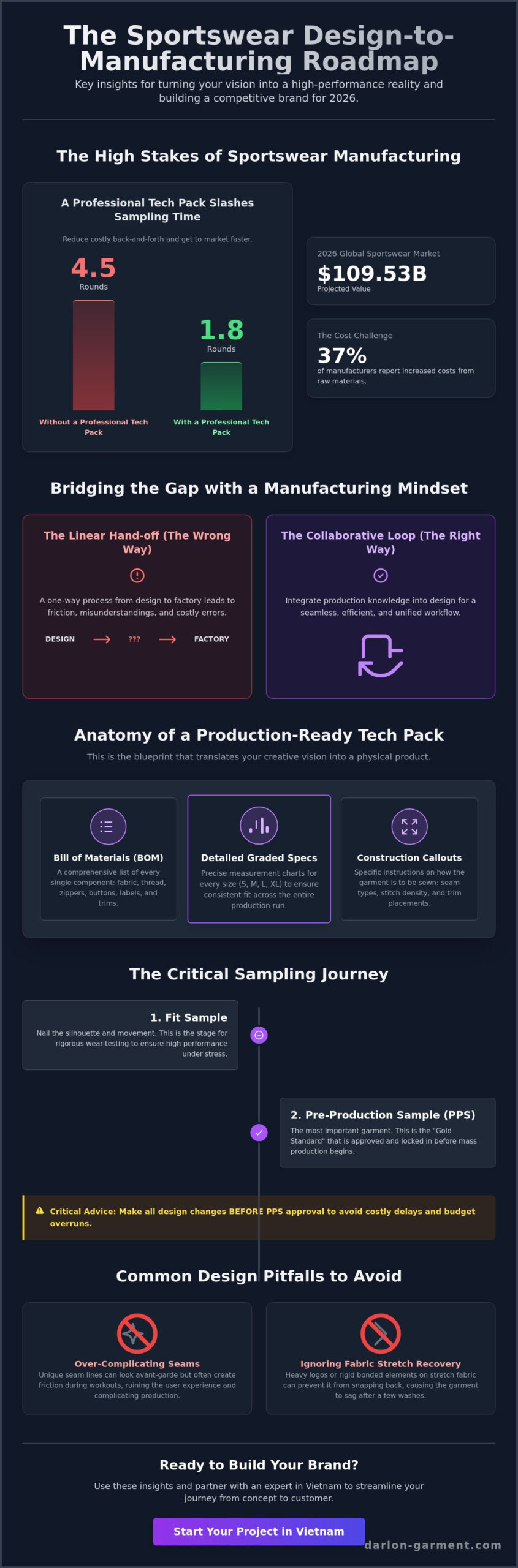
Did you know that a professional tech pack can slash your sampling rounds from an average of 4.5 down to just 1.8? In 2026, with the global sportswear market projected to reach $109.53 billion, you can’t afford to waste time on prototypes that fail to translate from the screen to the sewing line. I’ve seen many brands struggle with the complex journey of sportswear design to manufacturing because they lack a clear roadmap or a reliable partner on the ground here in Vietnam.
I understand the frustration of receiving samples that look nothing like your vision or failing to source the high-performance fabrics your customers demand. It’s a significant hurdle, especially since 37% of manufacturers are currently reporting increased production costs due to raw material prices. I’ll walk you through the entire journey of turning your concept into a high-performance reality using my years of industrial experience. You’ll learn how to leverage advanced technologies like laser cutting and navigate new 2026 standards, such as the EU Ecodesign for Sustainable Products Regulation, to build a brand that is both compliant and competitive.
Key Takeaways
- Understand why I believe a manufacturing mindset is the secret to preventing designs that look great on paper but fail on the production line.
- Master the essential components of a fluent tech pack to ensure your vision is translated perfectly by overseas factories.
- Learn why engineering at the fiber level with materials like Nuyarn wool is critical for performance brands in 2026.
- Streamline your sportswear design to manufacturing journey by utilizing advanced technologies like laser cutting for unmatched precision.
- Use my veteran vetting tips to find a reliable OEM partner in Vietnam who can act as the silent, powerful backbone of your brand.
Bridging the Gap: Why Sportswear Design Needs a Manufacturing Mindset
I’ve spent years on the factory floor here in Vietnam, and I can tell you that the biggest bottleneck in our industry isn’t the speed of the machines. It’s the gap between a designer’s creative vision and the hard reality of mass production. I’ve seen countless brands struggle because their designers don’t understand how a garment actually comes together under a needle. The transition from sportswear design to manufacturing is where most brands either find their footing or lose their investment. When looking at the history of sportswear design, it’s clear that the industry has shifted from basic utility to complex textile engineering; your process must reflect that evolution.
In my experience, the most successful brands treat this journey as a collaborative loop rather than a linear hand-off. You shouldn’t just toss a sketch over the wall and hope for the best. My “One-Stop Service” approach in Vietnam is built on this philosophy. By integrating production knowledge into the early design stages, I help partners save months of back-and-forth communication. When we treat sportswear design to manufacturing as a single, unified workflow, we eliminate the technical friction that usually delays seasonal launches. This is critical in 2026, as Vietnam targets an export revenue of $50 billion and the competition for factory space is tighter than ever.
The Reality of Scaling Your Activewear Brand
Scaling is where the technical cracks start to show. Moving from 50 hand-cut samples to a 5,000-unit production run changes everything about the construction. I’ve seen designs that look beautiful in a small batch fall apart during high-speed sewing because the seam allowances weren’t calculated for industrial machinery. During our initial consultations, I prioritize “manufacturability” above all else. As your OEM partner, I act as a technical consultant to ensure your graded specs are realistic for the fabric’s weight and tension. We aren’t just vendors; we’re the silent backbone that ensures your 5,000th unit is as perfect as your first.
Common Design Mistakes I See Every Day
I frequently see designers over-complicating seam placements. While a unique seam line might look avant-garde, it often leads to unnecessary friction during high-intensity workouts, which ruins the user experience. Another common error is ignoring fabric stretch recovery when choosing heavy embellishments or bonded elements. If the fabric can’t snap back because of a rigid logo, the garment will sag after three washes. Designing with a deep understanding of manufacturing constraints is the secret to maintaining high profitability and 2026 market relevance.
The Technical Bridge: Turning Your Vision into a Production-Ready Tech Pack
I’ve learned that a tech pack is the only language a factory truly speaks fluently. If your design is the “what,” the tech pack is the “how.” It’s the blueprint that translates your creative vision into a physical product. Without a professional tech pack, you’re essentially playing a game of telephone with your manufacturer. This document is the foundation of the entire sportswear design to manufacturing process. It bridges the gap between a creative concept and a functional, scalable garment.
When I review a tech pack, I look for three critical pillars: a comprehensive Bill of Materials (BOM), detailed graded specs, and specific construction callouts. The BOM tells me every single thread, zipper, and button needed. Graded specs ensure your size Medium fits exactly like the prototype, while the rest of the range scales correctly. I also rely on digital pattern making. It’s a game changer for reducing fabric waste and ensuring fit consistency across thousands of units. According to 2026 data from ExploreTex, a high-quality tech pack can reduce sampling rounds from an average of 4.5 to just 1.8. That’s a massive saving in both time and money for your brand.
What I Need in Your Tech Pack to Start Production
I need detailed measurement charts for every size you plan to offer. Vague descriptions like “oversized” don’t work on the factory floor. I need to know the exact distance for trim placement, zippers, and drawstrings. To see how these details translate to the sewing line, you can read more about How Garments Are Made: A Behind-the-Scenes Look at My Production Process. Having these specifics ready allows us to move much faster through the initial setup and avoid costly misunderstandings.
From Prototype to Pre-Production Sample (PPS)
My workflow involves multiple stages of sampling. First, we create a “fit sample” to nail the silhouette and movement. I insist on multiple rounds of wear-testing here because high-performance gear has to function under stress. Then, we move toward the Pre-Production Sample (PPS). The PPS is the most important garment we’ll ever make. It’s the “gold standard” that we lock in before the machines start running at full capacity. I always tell my clients that if you want to make design changes, do it during the fit sample stage. Changing a pocket placement mid-production is a recipe for blowing your budget and delaying your launch. If you’re unsure about your technical specs, I’m always happy to help you review your production readiness before we cut the first piece of fabric.
Material Sourcing: Engineering Performance at the Fiber Level
I spend a huge amount of my time sourcing because the fabric is 70% of a product’s success. If the textile fails, the design is irrelevant. Industry data from April 2026 confirms that fabric is the largest cost component in activewear, accounting for 40% to 60% of the total unit cost. Getting the material right is the most critical technical decision in the sportswear design to manufacturing cycle. I don’t just look for what’s available; I look for what’s next.
For 2026, I’m seeing a massive pivot toward Nuyarn performance wool. This isn’t your standard merino. It’s a technical breakthrough that offers 35% more volume and significantly higher durability without using synthetic reinforcements. It’s the kind of innovation that sets a premium brand apart. When I’m not working with wool, I’m obsessed with the science of stretch. Balancing elastane is an art form. You need enough for compression but not so much that it compromises comfort or breathability. For a technical breakdown on this, you can read my Elastane Fabric: A Manufacturer’s Guide to Mastering Stretch in 2026.
Synthetics vs. Natural Fibers in 2026
I often recommend recycled polyester over virgin polyamide for brands focused on sustainability. This is a smart move, especially since over 50% of Gen Z consumers are now willing to pay a premium for eco-friendly apparel. However, the premium market is moving toward “performance naturals.” These blends offer the tactile “quiet luxury” feel that’s trending right now while maintaining high-intensity performance. I’ve detailed this shift in The Manufacturer’s Guide to Natural Fibers.
My Global Sourcing Network in Vietnam
My network in Vietnam allows me to navigate the global supply chain to find the best trims and high-tech textiles. I don’t just take a supplier’s word for it. I verify every fabric through GRS or OEKO-TEX certifications to ensure your brand stays compliant with 2026 global standards. In the current market, moisture-wicking is a baseline requirement for every garment, not a marketing feature. My job is to find the fibers that go beyond that baseline to offer true thermal regulation and antimicrobial properties. This level of detail ensures your sportswear design to manufacturing journey results in a product that actually performs under pressure.
The Manufacturing Floor: From Laser Cutting to Quality Assurance
Welcome to the heart of the operation. This is where the technical “magic” of laser cutting and automatic sewing happens. I’ve spent decades refining this environment because I know that even the best tech pack can’t survive a disorganized factory floor. When you’re navigating the journey of sportswear design to manufacturing, the physical hardware I use is just as important as the software used to design it. I’ve invested heavily in laser cutting technology because manual shears simply can’t provide the level of precision required for modern, high-performance gear. Laser cutting doesn’t just cut; it cauterizes the edges of synthetic fabrics, preventing fraying and ensuring a clean finish that lasts through hundreds of wash cycles.
For elite athletes and premium brands, I often recommend the art of bonded seams. By using high-strength adhesive films and heat presses instead of traditional thread, we create “weightless” garments. This technique removes the bulk and potential chafing of a standard seam; it provides a sleek, aerodynamic silhouette that’s essential for 2026 activewear trends. If you’re ready to see how these technologies can elevate your brand, you can discuss your production roadmap with me today.
Advanced Construction Techniques I Use
Seamless garment technology is currently the gold standard for yoga and high-intensity gym wear. By knitting the garment in a single tube, we eliminate side seams entirely, which maximizes comfort and stretch. However, I also utilize bonding when I want a sharp, modern aesthetic that stitching can’t achieve. Choosing between these methods depends on your specific performance goals. To help you decide, I’ve put together a guide on Choosing the Right Fitness Wear Manufacturer which breaks down these technical trade-offs in detail.
My 4-Stage Quality Control Protocol
I don’t leave quality to chance. My factory operates on a strict 4-stage protocol to ensure every unit meets global export standards. We start with in-line inspections, where my team catches errors while the garment is still on the machine. This prevents a small mistake from becoming a 5,000-unit disaster. After assembly, we conduct a final AQL (Acceptable Quality Level) check before anything is packed. This disciplined approach is why Vietnam is targeting an export revenue of $50 billion in 2026; we prioritize objective, institutional excellence over short-term speed. Once the quality is locked, I handle the logistics of global export directly from Ho Chi Minh City, ensuring your order arrives exactly as promised.
Choosing Your Partner: Scaling Your Sportswear Brand in Vietnam
I believe Vietnam is the world’s best hub for sportswear manufacturing in 2026. If I were in your shoes, I’d ask a potential partner: “How do you handle the transition from my initial sportswear design to manufacturing when I’m ready to double my order volume?” You need a partner who understands the technical nuances I’ve discussed in previous sections, like laser cutting precision and Nuyarn sourcing. My “One-Stop” advantage means I handle everything from the first tech pack review to the final global delivery; this reduces the risk of miscommunication that often happens when you split your production across multiple vendors. I’ve helped brands grow from their first small collection to global distribution by providing a stable, scalable production environment.
Choosing a partner isn’t just about finding a factory; it’s about finding a technical consultant who can help you navigate 2026 market challenges. With global production costs rising for 37% of manufacturers, having an efficient, reliable backbone is the only way to protect your margins. I focus on long-term cooperation because I know that your success as a brand is the only way my factory continues to thrive. We move together from the drawing board to the shipping container with total transparency.
Why I Call Vietnam the ‘Sportswear Capital’
The skilled labor force and high-tech infrastructure I’ve built here are designed for the complexities of modern activewear. Vietnam’s textile industry is targeting an export revenue of $48 billion to $50 billion in 2026, proving our dominance in the global supply chain. Trade agreements also make shipping from Vietnam more cost-effective for you. While U.S. tariffs on Vietnamese apparel range from 20% to 40% as of January 2026, our focus on speed and quality assurance often provides a better return on investment than lower-cost, lower-quality regions. For a deeper look at the landscape, see my guide on Choosing a Sportswear Factory in Vietnam: A Brand’s Guide for 2026.
Let’s Build Something Together
Getting started with Dar Lon Garment is a methodical process. We begin with your initial inquiry and a thorough tech pack review to ensure your sportswear design to manufacturing journey starts on solid ground. My commitment to “Quality First” protects your brand’s reputation in a global market projected to reach $444.5 billion by 2026. I don’t just sew garments; I engineer products that help your brand lead the industry. Ready to start your production? Reach out to me today.
Engineering Your Brand’s Future in 2026
Scaling a brand in this fast-moving market requires more than just good sketches. It demands a technical partnership that understands the friction between creative vision and factory floor reality. We’ve covered why a professional tech pack is your most valuable asset and how choosing the right fibers, like Nuyarn performance wool, can define your brand’s premium status. By mastering the sportswear design to manufacturing loop, you ensure that your products don’t just look right on a screen; they perform at an elite level for the end user.
I’ve built my strategic manufacturing hubs in Ho Chi Minh City and Chon Thanh to give you a competitive edge. My team utilizes advanced laser-cutting and bonding technology to create the weightless, high-precision garments that 2026 consumers demand. You don’t have to navigate these technical complexities alone. Whether you’re refining your first collection or expanding global distribution, I’m here to provide the industrial backbone your business needs to thrive. Start your sportswear manufacturing journey with me today and let’s turn your high-performance concepts into a commercial reality. I’m excited to see what we can build together.
Frequently Asked Questions
How long does the sportswear design to manufacturing process take?
The standard timeline for a full production cycle is 12 to 24 weeks. This period includes approximately 4 weeks for tech pack finalization, 6 to 8 weeks for iterative sampling and wear-testing, and 8 to 12 weeks for bulk assembly. I always advise my partners to begin the process 6 months ahead of their desired launch date to allow for fabric lead times and international shipping logistics.
What are the minimum order quantities (MOQs) for sportswear in Vietnam?
My factory typically requires a minimum of 500 to 1,000 units per style. For technically demanding products like seamless garments or bonded apparel, MOQs might be higher because of the intensive setup time required for specialized machinery. I work with brands to balance these quantities against their growth projections to ensure we maintain a cost-effective production environment for everyone involved.
Can I manufacture sustainable or eco-friendly sportswear with Dar Lon Garment?
I offer a comprehensive range of eco-friendly options, including recycled polyester and Nuyarn performance wool. I ensure all sustainable materials meet GOTS or OEKO-TEX standards, which are essential for staying ahead of global regulations. For brands targeting the European market in 2026, I also help integrate Digital Product Passports into the labeling process to meet the latest traceability requirements for just a small additional cost per unit.
What is the difference between OEM and ODM in sportswear manufacturing?
OEM (Original Equipment Manufacturer) is when I produce garments based entirely on your unique designs and tech packs. ODM (Original Design Manufacturer) is when you select and brand styles that I’ve already developed in my own catalog. Most of my clients prefer the OEM model because it allows for total creative control throughout the sportswear design to manufacturing journey, resulting in a product that is truly unique to their brand.
How do I protect my designs when working with a factory in Vietnam?
I protect your intellectual property through strict non-disclosure agreements and clear manufacturing contracts. My facility in Ho Chi Minh City operates with a disciplined, institutional culture where your proprietary patterns and technical specifications are kept strictly confidential. I value long-term cooperation over short-term gains; this means your designs are never shared with other clients or third-party vendors under any circumstances.
What are the typical shipping times from Vietnam to the US or Europe in 2026?
Sea freight from Vietnam usually takes 25 to 35 days to reach major ports in the US or Europe. If your launch schedule is tight, air freight can deliver your order in 5 to 7 business days. I handle the export documentation and logistics directly to ensure your shipment clears customs without delays, which is a key part of my “One-Stop Service” promise to international partners.
Do I need to provide my own fabric, or can you source it for me?
I prefer to source the fabric for you through my vetted global network to ensure it’s compatible with my high-speed production lines. This is a critical step in the sportswear design to manufacturing process because it allows me to verify certifications and performance specs before we cut any material. Managing the sourcing in-house helps me maintain the strict quality standards that my B2B partners expect from a high-capacity manufacturer.
What happens if there is a quality issue with my bulk order?
If a quality issue occurs, I resolve it based on the Acceptable Quality Level (AQL) standards we establish before production begins. My 4-stage inspection protocol is designed to catch errors early, but I stand by my work if a defect slips through to the final shipment. I offer rework services or credits to ensure your brand’s reputation remains protected and your customers receive the high-performance gear they were promised.