
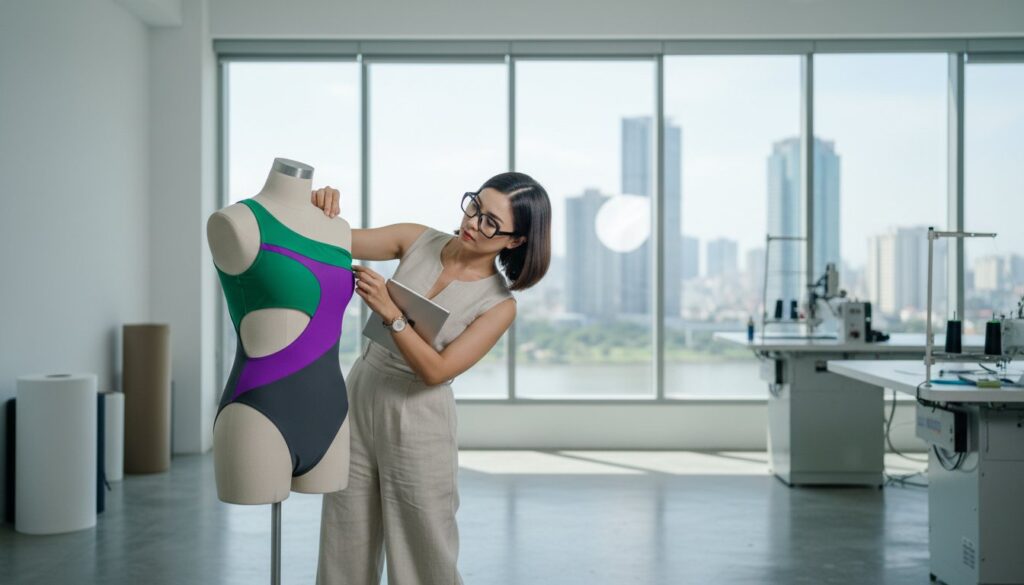
Imagine spending $500 on a single sample only to find the fabric sags after one lap in the pool or the fit pinches in all the wrong places. It’s a frustrating reality for many brand owners, especially when you’re trying to capture a piece of the $29.2 billion global swimwear market projected for 2026. I’ve seen many designers struggle with communication gaps and high costs during the early stages of development. Finding the right swimwear prototyping services is the difference between a retail-ready hit and a box of expensive mistakes.
I know you want a partner who understands the technical nuances of stretch fabrics and the pressure of meeting the new 2026 EU Ecodesign for Sustainable Products Regulation. I’ll walk you through the essential steps of swimwear prototyping, showing you how to refine your designs for perfect fit and performance before you hit the production line. We’ll explore how to create clear technical blueprints and select materials that actually perform in the water so your brand can launch with total confidence.
Key Takeaways
- Understand why physical prototyping is the only way to ensure your designs fit real bodies before you commit to mass production.
- I’ll guide you through using professional swimwear prototyping services to turn technical sketches into perfectly graded patterns.
- Learn how specialized techniques like laser cutting and bonding create the seamless, high-performance finish that modern athletes expect.
- Avoid expensive setbacks by mastering fabric stretch calculations and focusing on fit before adding complex aesthetic details.
- Discover the benefits of a “One-Stop Service” that connects your design vision directly to high-capacity manufacturing in Vietnam.
Why I believe prototyping is the soul of your swimwear brand
I’ve spent years in the factory trenches, and I’ve learned that a sketch is just a dream until it hits the water. Prototyping is the process of creating a functional, physical version of your design to test fit and fabric. It’s the most critical stage of the fashion design process because it transforms a flat 2D idea into a 3D garment that actually works. In 2026, I’ve seen too many brands rush this phase. They want to hit the market fast to capture a piece of the $29.2 billion global industry, but they end up with bulk stock that doesn’t fit real bodies. That’s a disaster for your bottom line.
I use professional swimwear prototyping services to act as your technical insurance policy. It’s much cheaper to fix a pattern error now than to realize your entire production run has a saggy bottom after you’ve paid for thousands of units. This phase is where I help you see how your chosen materials react to salt, chlorine, and intense movement. If you want to understand the full journey from the first stitch to the final box, check out my guide on how garments are made to see how these samples evolve into final products.
The difference between a sample and a prototype
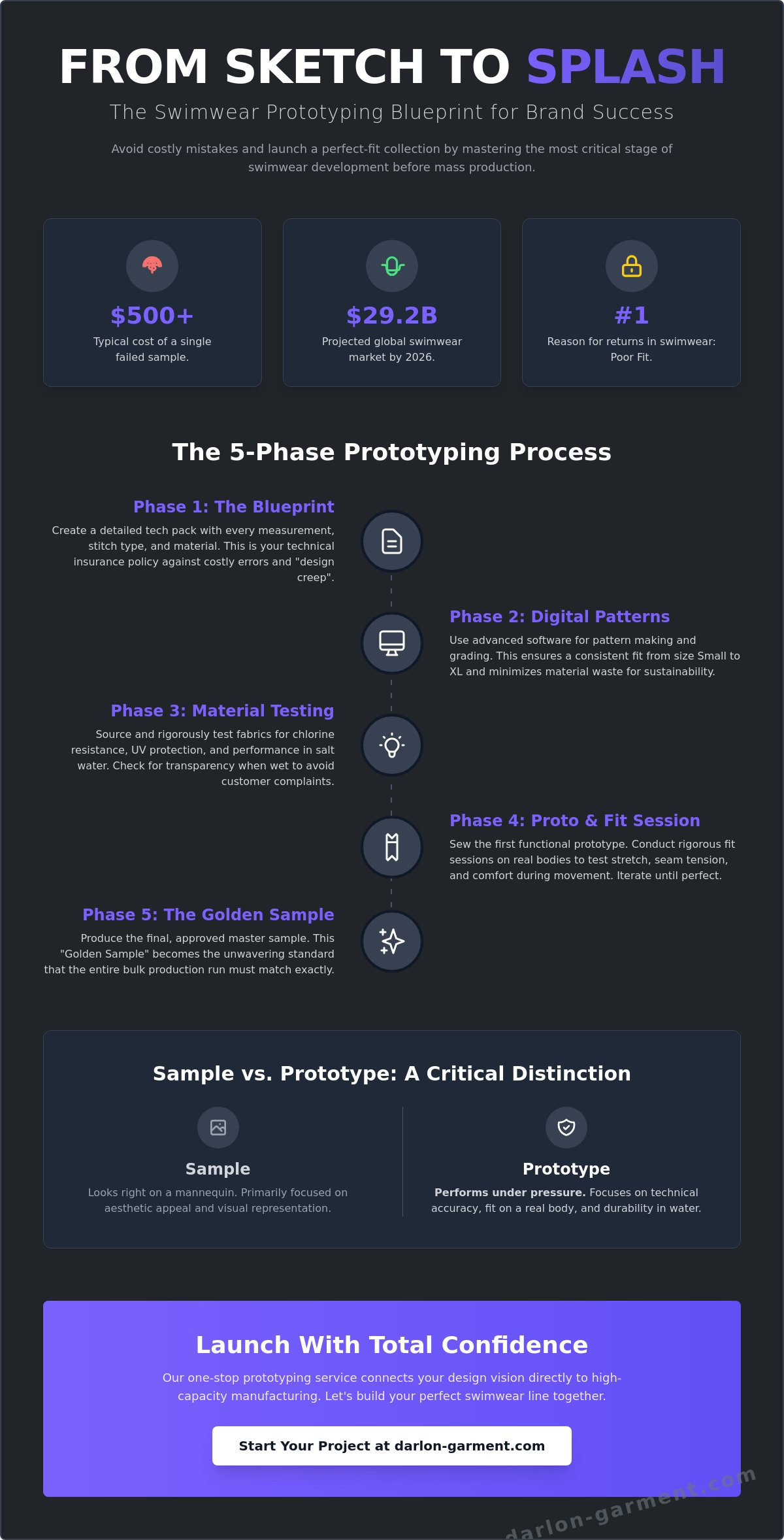
A lot of people use these terms interchangeably, but they aren’t the same. A sample might just look right on a mannequin. A prototype must perform under pressure. I focus on technical accuracy over just aesthetic appeal in the early rounds. I prioritize rigorous wear-testing during this stage to check for sagging or transparency when the fabric gets wet. If a suit looks beautiful on a hanger but turns see-through in the pool, it’s a failure. My goal is to find those flaws before your customers do. Using dedicated swimwear prototyping services allows us to iterate on the tension of the seams and the recovery of the fabric until the garment is indestructible.
Why fit is the #1 reason swimwear brands fail
Swimwear has the highest return rate in fashion, and it’s almost always due to poor fit. It’s a psychological game. If a customer feels insecure in your suit because a cheeky cut won’t stay put, they won’t buy from you again. I use prototyping to solve these common issues. We adjust the tension of the elastics and the curve of the leg openings until the fit is perfect. A suit that stays in place builds incredible customer loyalty. When someone finds a brand that actually fits their body, they become a fan for life. This technical mastery is what separates a hobbyist from a professional brand.
My step-by-step process for turning your sketches into perfect samples
I’ve developed a methodical five-phase system to ensure your vision translates perfectly into a physical product. My swimwear prototyping services are designed to catch errors early, saving you both time and capital. We start with the tech pack. If you don’t have one, I help you build it. This document defines every measurement, from the strap length to the gusset width. Without it, we’re just guessing, and guesswork leads to expensive mistakes during mass production.
Next, we move to digital pattern making and grading. I use advanced software that ensures your design looks just as stunning in an XL as it does in a Small. This digital approach also helps me reduce material waste, which is vital for meeting the 2026 EU Ecodesign standards. Once the pattern is set, I source the perfect elastane fabric that matches your specific stretch requirements. We then sew the first “proto” and put it through a rigorous fit session. We tweak the details, repeat if necessary, and finally produce the “Golden Sample.” This is the master version that serves as the final blueprint for your entire production run.
Creating the ‘Blueprints’: Tech Packs and Patterns
I can’t emphasize enough that I won’t start a project without a detailed tech pack. If we try to skip this, we end up with “design creep” where measurements shift and costs spiral. My approach to pattern grading is about more than just scaling up. I look at how the curves change across different body types. Digital software allows me to visualize these shifts before we ever cut a piece of cloth. It saves time and ensures consistency across your entire collection. If you’re ready to start this process, you can review my full list of manufacturing capabilities to see how we scale from these early samples.
Sourcing and Material Testing
Materials are where most brands fail. I test every fabric for chlorine resistance and UV protection before we even start sewing. In 2026, the nylon/polyester segment holds about 55.8% of the global market share, but I’m seeing a massive shift toward recycled nylons. I help you choose between these based on your brand goals and sustainability targets. I always recommend a “wear-test” in actual salt water for the first sample. Fabric that looks great on a table can behave very differently when it’s wet and heavy. Finding these issues during the prototype phase is much better than finding them after a customer makes a return.
Beyond the basics: specialized techniques I use for high-performance swimwear
I’ve noticed that the difference between a mid-market swimsuit and a premium, high-performance piece often comes down to the machinery used during the sampling phase. In 2026, simply having a good pattern isn’t enough to stand out in a market projected to hit $29.2 billion. I integrate advanced manufacturing technology directly into my swimwear prototyping services to ensure your brand offers more than just a pretty print. We’re talking about technical features that improve hydrodynamics and wearer comfort, which are essential for both competitive athletes and luxury consumers who demand a “second skin” feel.
Utilizing specialized machinery allows me to push the boundaries of what’s possible with high-stretch fabrics. When I work on your prototypes, I’m not just looking at the shape; I’m evaluating how technical construction can elevate your brand to a premium price point. These advanced methods require a level of precision that traditional cut-and-sew shops simply can’t match. By testing these techniques during the prototyping stage, I help you finalize a product that justifies a higher retail margin because the quality is visible and felt the moment it’s put on.
Laser Cutting for Precision
I prefer laser cutting over traditional die-cutting because it offers a level of intricacy that’s impossible to achieve by hand. This technology is a game-changer for creating unique cut-outs or specific ventilation zones that improve breathability in activewear-hybrid swim pieces. Laser cutting provides a clean, cauterized edge on synthetic fibers, which prevents thin fabrics from rolling or fraying without the need for bulky hems. This precision ensures that every piece in your production run matches the “Golden Sample” exactly, reducing the 2% to 5% variance often seen with manual cutting methods.
Bonding and Seamless Technology
The shift toward “stitchless” swimwear is one of the most significant trends I’ve seen heading into 2026. I use industrial heat-sealing and ultrasonic welding to create bonded seams that are flatter and more durable than traditional stitching. This is particularly relevant now because the National Federation of State High School Associations (NFHS) approved rule changes for the 2026-27 school year that align with World Aquatics standards. Bonded or taped seams on suits are no longer subject to permeability requirements, opening up huge opportunities for brands targeting the competitive market. This technology creates a sleek, hydrodynamic profile that reduces drag and eliminates the chafing often caused by thread. It’s a high-tech solution that makes your swimwear prototyping services investment pay off by delivering a truly modern, elite product.
How I help you avoid common (and expensive) prototyping mistakes
I’ve seen brands lose thousands of dollars because they treated the sample phase as a formality. In 2026, a single swimwear prototype can cost between $100 and $500 depending on its complexity. If you make a technical error here, it compounds quickly during bulk production. My role as your technical consultant is to act as a filter for these risks. I use my swimwear prototyping services to catch flaws in the pattern or fabric behavior before you commit your hard-earned capital. One of the most frequent mistakes I see is over-designing. Many brands try to add complex hardware or intricate strap systems before they’ve mastered the basic fit. If the base block isn’t solid, the entire garment will fail regardless of how many bells and whistles you add.
Another critical oversight is failing to account for “wet-weight.” A suit that fits perfectly in a dry fitting room can sag or become heavy once it’s saturated with water. This is why I insist on testing samples in actual pool or salt water environments. I help you adjust the tension of the elastics and the density of the fabric to ensure the garment maintains its shape. By catching these issues early, I help you protect your initial startup investment, which for a professional collection in 2026 typically ranges from $5,000 to $25,000. If you’re ready to avoid these pitfalls, you can contact me to discuss your project requirements today.
The ‘Stretch and Recovery’ Trap
A fabric might feel incredible on the rack, but if it lacks “power,” it will lose its shape after just two swims. During the prototyping phase, I verify the modulus of your chosen material. This is the amount of force required to stretch the fabric and, more importantly, how well it snaps back. With the nylon and polyester segment projected to hold 55.8% of the market in 2026, understanding these nuances is vital. I also ensure that your thread elasticity matches your fabric’s four-way stretch. If the thread is too rigid, the seams will simply pop the first time a customer puts the suit on.
Balancing Aesthetics with Production Reality
I often see beautiful sketches that are a nightmare to produce at scale. A design that takes three hours to sew as a one-off sample will be too expensive for mass production. I suggest small design tweaks, like moving a seam or simplifying a closure, that can save you several dollars per unit. Simple designs are often the most difficult to get right because there’s nowhere to hide a poor fit. I focus on refining these “simple” elements until they are perfect, ensuring your production run is efficient and your retail price remains competitive.
Let’s build your collection together: Why Dar Lon Garment is your ideal partner
I know that finding a reliable manufacturer is the biggest hurdle for any emerging brand. That’s why I’ve built my business at Dar Lon Garment around a “One-Stop Service” model. I don’t just sew fabric; I take your initial vision from the first technical sketch all the way to the final shipping container. My swimwear prototyping services are the foundation of this partnership. By refining your designs in-house, I ensure that the transition from a single sample to a bulk production run is seamless and error-free. I take pride in being the silent backbone for fashion brands, providing the technical mastery you need to compete in the 2026 market.
My commitment to a “Quality First” philosophy means I won’t push a design into bulk production until the prototype is perfect. I act as your technical consultant on the factory floor, catching potential issues with fabric recovery or seam strength long before they reach your customers. Whether you are looking for a dedicated sportswear factory vietnam or a specialist who understands the intricacies of performance swimwear, Dar Lon Garment has the infrastructure to deliver. I value long-term cooperation over short-term gains, which is why I focus on creating retail-ready samples that build your brand’s reputation for excellence.
The Vietnam Advantage in 2026
In 2026, more brands are moving their production to my facility in Ho Chi Minh City because of our unique blend of high-tech capability and logistical efficiency. My factory is equipped with the advanced machinery needed for complex bonded and laser-cut garments, which are becoming the standard for premium swimwear. I’ve also implemented strict sustainability practices to ensure every piece we produce meets the 2026 EU Ecodesign for Sustainable Products Regulation (ESPR) and REACH chemical restrictions. This means your collection is ready for global export from day one, meeting the highest international standards for quality and environmental responsibility.
Ready to Start Your Sampling?
Getting your collection started is a straightforward process. The easiest way to get an accurate quote is to send me your tech pack or a physical reference sample that represents the fit you want to achieve. Once I review your requirements, I’ll provide a clear timeline for your first prototype. While lead times can vary based on design complexity, I prioritize efficiency without ever compromising on the technical details. My promise at Dar Lon Garment is simple: I treat your brand’s vision with the same care and discipline as if it were my own. Let’s turn your 2026 swimwear concepts into a physical reality that performs as well as it looks.
Launch your 2026 swimwear collection with total confidence
Building a successful brand requires more than just a great aesthetic; it demands a deep understanding of technical construction and material performance. We’ve explored how professional swimwear prototyping services act as your insurance policy against the common fit issues that lead to high return rates. By focusing on the “Golden Sample” and utilizing my one-stop OEM/ODM solution, you can move from a flat sketch to a retail-ready product without the typical manufacturing headaches. I’m here to ensure your designs are optimized for both the wearer’s comfort and the efficiency of the production line.
I utilize advanced laser-cutting and bonding technology to give your pieces that premium, seamless finish that stands out in a crowded market. My expertise in global export standards ensures that your collection is compliant with the latest 2026 regulations, allowing you to scale internationally with ease. I treat your vision with the same discipline and precision that I apply to every garment on my factory floor. Let’s start your swimwear journey; send me your design ideas today! I can’t wait to see what we can create together and help you turn your vision into a physical reality.
Frequently Asked Questions
How much do swimwear prototyping services cost?
Prototyping costs for a single swimwear style typically range from $100 to $500 in 2026, depending on the complexity of the construction. This investment covers the specialized labor and technical materials required to create a functional sample. If you require the creation of a professional tech pack, that service usually costs between $200 and $500 per style. These figures ensure that your technical blueprints are perfect before you commit to the larger costs of mass production.
How long does it take to get a swimwear sample made?
It usually takes between 14 and 21 days to produce your first high-quality prototype once we have finalized your design specifications. This timeframe allows me to source the specific elastane fabrics required and perform initial technical tests for stretch and recovery. While some providers promise 3 to 7 day turnarounds, I prioritize technical accuracy to ensure the sample is actually retail-ready and performs correctly in the water.
Do I need a tech pack before I contact you for prototyping?
You don’t need a completed tech pack to start, because I can help you develop one through my “One-Stop Service.” However, having your measurements and fabric preferences ready will speed up the swimwear prototyping services significantly. A detailed tech pack acts as the master blueprint for your brand, ensuring that every measurement is followed exactly to avoid expensive errors during the grading process.
Can you help me source sustainable swimwear fabrics?
I can certainly help you source sustainable materials like regenerated nylon and recycled polyester to meet 2026 global standards. With the EU Ecodesign for Sustainable Products Regulation now in effect, choosing eco-friendly fabrics is a strategic necessity for brands exporting to international markets. I maintain a library of certified sustainable materials that offer the same chlorine resistance and UV protection as traditional synthetic fabrics.
What is the Minimum Order Quantity (MOQ) after the prototyping phase?
My minimum order quantity for bulk production generally starts at 500 pieces per style, which allows me to maintain competitive pricing for professional brands. As a high-capacity B2B manufacturer, these volumes ensure that we can utilize advanced machinery like laser cutters and bonding stations efficiently. We discuss these logistics during the prototyping phase to ensure your collection is scalable and profitable from the first run.
Can I see a sample of your previous swimwear work before I commit?
I can provide a reference sample pack of my previous work so you can inspect the seam quality and fabric performance firsthand. This allows you to see the difference that industrial bonding and specialized machinery make in high-performance swimwear. It’s the best way to verify my technical mastery and “Quality First” commitment before we begin working on your specific custom designs.
What happens if I’m not happy with the first prototype?
If the first prototype doesn’t meet your expectations, we enter an iteration phase to refine the fit and technical details. I use your feedback to adjust the pattern grading or elastic tension until we achieve the “Golden Sample” that meets your brand standards. This process is a standard part of professional swimwear prototyping services, ensuring that any issues are resolved long before we start bulk production.
How do you protect my designs from being copied?
I protect your intellectual property through formal Non-Disclosure Agreements (NDAs) and strict internal security protocols. Your designs are treated as confidential technical assets within my facility, and I only share them with the specific team members involved in your production. This professional approach has allowed me to build long-term trust with international partners who require absolute design exclusivity for their seasonal collections.