

What if moving your supply chain wasn’t just a desperate escape from unpredictable tariff hikes, but a calculated leap into the future of technical apparel? I understand the pressure you’re under. You’ve likely spent years building a rhythm elsewhere, but with the 15% global tariff under legal challenge in the U.S. and innovation stalling in older hubs, the risk of staying put is starting to outweigh the risk of change. I’ve spent years helping brands navigate the complexities of moving apparel production to vietnam, and I’ve seen firsthand that it doesn’t have to mean missing a single delivery deadline.
In this guide, I’ll show you why the world’s most successful brands are choosing Vietnam in 2026. I’ll break down how to capitalize on the 0% import duties under the EVFTA and access specialized capabilities like Nuyarn performance wool and laser-cut bonding. You’ll learn my exact process for establishing a stable manufacturing partnership that reduces your landed costs while actually upgrading your product quality. We’re going to move past the “why” and get straight into the “how” of building a resilient, tech-forward supply chain for your sportswear and activewear lines.
Key Takeaways
- I’ll explain why moving apparel production to vietnam is now a strategic necessity for brands that need to escape tariff volatility while securing a more stable supply chain.
- See how you can use the latest Free Trade Agreements to drop your import duties to 0% and keep your landed costs predictable.
- Explore the technical shift toward high-performance sportswear and swimwear, including the specialized machinery needed for Nuyarn and seamless garments.
- Follow my step-by-step roadmap for transitioning your lines without missing a single ship date, starting with a comprehensive production audit.
- Learn how to identify a manufacturing partner that works as your silent backbone, prioritizing technical mastery and long-term cooperation over short-term gains.
The 2026 Landscape: Why I’m Seeing a Massive Shift to Vietnam
I’ve spent years on factory floors, and the shift I’m seeing in 2026 is unlike anything in the last decade. The ‘China+1’ strategy used to be a luxury for large corporations, but today, it’s a survival tactic for brands of all sizes. I’m noticing that my clients aren’t just looking for lower costs; they’re looking for a sanctuary from the volatility that has defined global trade recently. Vietnam offers a level of political and social stability that is increasingly rare, making it the ideal base for long-term growth. It’s a country that has positioned itself as a reliable backbone for the global fashion industry.
When we talk about moving apparel production to vietnam, we’re talking about more than just a change in geography. It’s about building a resilient supply chain that sits right next to the world’s major raw material hubs. This proximity, combined with the rapid maturation of Vietnam’s manufacturing sector, has turned the country into the preferred partner for performance brands in the U.S., EU, and Australia. I’ve seen firsthand how this shift allows brands to react faster to market trends without the baggage of geopolitical friction.
The Tariff Pressure Cooker of 2026
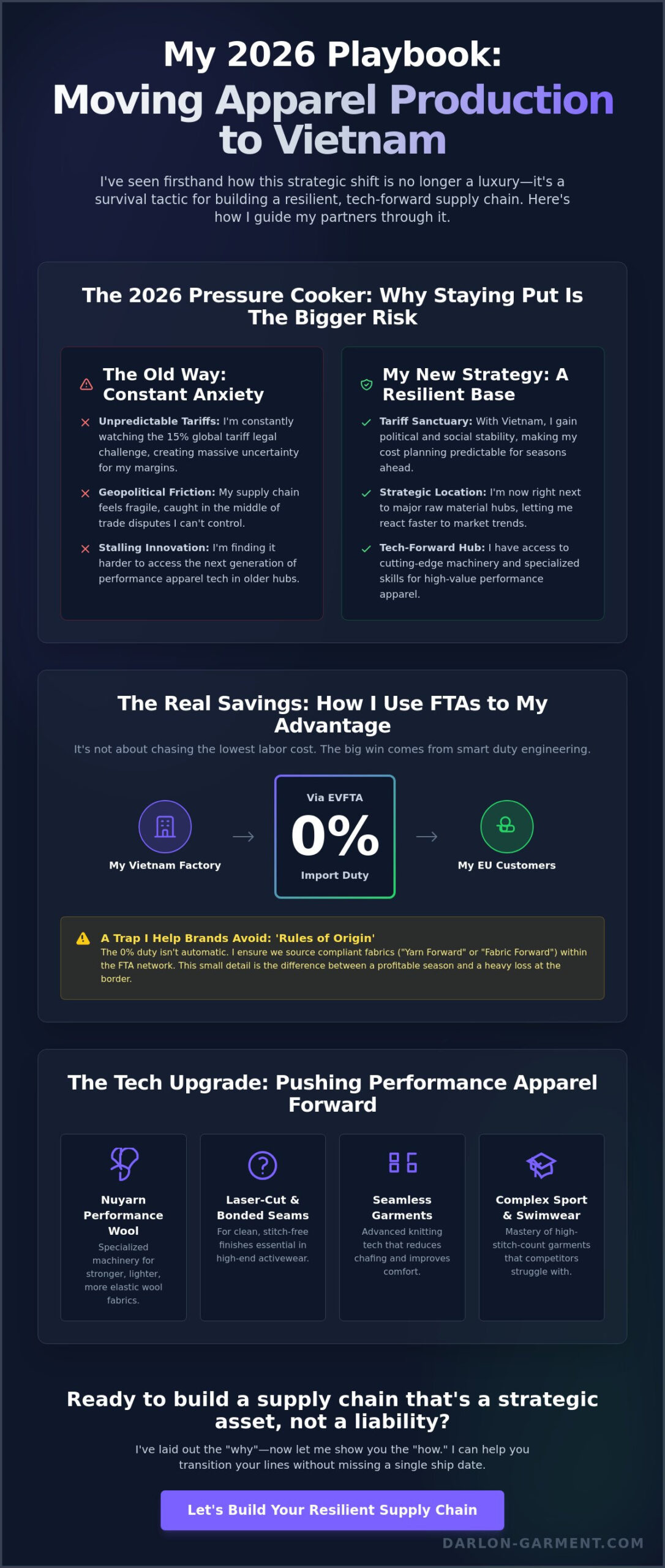
The financial math for staying in China simply doesn’t add up anymore. With the 15% global tariff under Section 122 currently tied up in legal challenges, many brands are operating in a state of constant anxiety. I tell my partners that waiting for “certainty” is the biggest risk to their 2026 margins. While other regions face shifting trade barriers, Vietnam remains a safe harbor. For my EU clients, the EVFTA has already brought import duties down to 0% for most apparel categories as of 2026. Even with the standard MFN rates for the U.S., the predictability here is what allows us to plan three seasons ahead without fear of a sudden 20% spike in landed costs.
Vietnam as the New Hub for Performance Apparel
I’ve watched Vietnam evolve from a producer of basic tees to the undisputed leader in complex, high-stitch-count garments. My factory specializes in the kind of technical engineering required for high-end activewear and swimwear. This transition didn’t happen by accident. The Vietnamese government has been proactive with incentives to modernize factories and invest in advanced machinery. Local infrastructure, from deep-water ports to specialized industrial zones, has finally caught up to the massive global demand. We aren’t just sewing clothes here; we’re utilizing bonded and laser-cut technologies to push the boundaries of what performance apparel can be. I’ve seen Vietnam overtake its regional competitors by focusing on these high-value, technical categories that demand precision.
Navigating the Financials: Tariffs, FTAs, and the Real Cost of Moving
When I talk to brand owners about moving apparel production to vietnam, the conversation usually starts with labor costs. But I’m always quick to tell my clients that the real savings aren’t found in the payroll; they start with the Free Trade Agreements (FTAs). In 2026, the global trade map is a mess of shifting duties, but Vietnam has built a fortress of agreements that keep your costs predictable. It’s about looking at the long game rather than just the next quarter.
Understanding Vietnam’s Free Trade Agreements is essential if you want to make the math work for your landed costs. For instance, the EVFTA now allows for 0% import duties on most apparel categories entering the European Union. However, I often see brands fall into the ‘Rules of Origin’ trap. If your factory doesn’t understand how to source compliant fabrics within the FTA network, you’ll end up paying full price at the border. I make sure my partners understand that ‘Yarn Forward’ or ‘Fabric Forward’ rules aren’t just technicalities; they’re the difference between a profitable season and a heavy loss.
Leveraging Vietnam’s Web of Trade Agreements
I help brands utilize the EVFTA to gain a massive edge in the European market. By sourcing materials correctly, we can bypass the standard duties that eat into your margins elsewhere. I also keep a close eye on the RCEP, which streamlines how I bring in raw materials from across Asia. Vietnam’s trade status is remarkably stable compared to its neighbors. This stability means I can help you plan your sportswear or swimwear lines with confidence, knowing the rules won’t change overnight.
Calculating Your Total Landed Cost (TLC)
I’ve seen too many brands focus solely on the per-unit price. To see the real picture, you have to look at the Total Landed Cost (TLC). This includes everything from duty engineering to compliance audits. Shipping times from Ho Chi Minh City to the U.S. West Coast are comparable to Shanghai, but the efficiency of our local ports has improved significantly. If you’re looking for a partner who understands these financial nuances, you might want to learn more about how a sportswear factory vietnam operates at a strategic level.
In 2026, labor costs in Vietnam have risen by an average of 7.2% due to the latest regional minimum wage adjustments. Even with this increase, the overall financial benefit remains strong because we focus on high-efficiency production. When I manage a transition, I account for these variables:
- Duty savings through specific FTA compliance.
- Reduced lead times by utilizing localized material hubs.
- Lower compliance risks through established international standards.
It’s about finding the sweet spot where technical mastery meets fiscal logic. I don’t just provide a price; I provide a pathway to a more profitable supply chain.
Beyond the Basics: My Insider Look at Vietnam’s Technical Edge
I’ve always believed that a factory should be more than just a place with sewing machines. In my facility, we approach every project as an engineering challenge. When I talk to clients about moving apparel production to vietnam, I emphasize that they aren’t just buying labor; they’re buying into a technical ecosystem that has become a world leader in activewear and swimwear. The level of complexity we can handle now is lightyears ahead of where we were even five years ago. I’ve seen how how garments are made has evolved through the integration of robotics and smart automation. We’re no longer relying solely on manual precision. Instead, we use computerized systems to ensure every stitch in a high-performance legging or a technical swim piece is identical across thousands of units.
Specialized Tech: Laser Cutting and Seamless Bonding
I’m a big advocate for laser cutting because it’s essential for the clean, sharp aesthetic that 2026 consumers demand. It’s not just about looks, though. Laser-cut edges prevent fraying and allow us to use bonded seams. These seams are a game changer for high-performance sportswear. They reduce friction against the skin and create a streamlined silhouette that traditional sewing just can’t match. My team utilizes automatic sewing machines for the structural parts of the garment, which allows us to maintain 100% precision even at industrial scales. This level of detail is exactly why moving apparel production to vietnam has become the standard for brands that refuse to compromise on technical specifications.
Material Innovation: From Nuyarn to Recycled Synthetics
I’m particularly excited about our work with Nuyarn performance wool for our 2026 collections. It offers incredible strength and stretch without the weight of traditional wool. Mastering elastane fabric is another area where we’ve focused our energy. Getting that perfect 4-way stretch requires a deep understanding of tension and heat settings during the bonding process. I’m also seeing a significant shift in global apparel sourcing toward sustainable options. We’re now sourcing recycled trims and fabrics that meet the Global Recycled Standard (GRS) to help our partners meet their environmental goals. It’s this combination of material science and manufacturing mastery that keeps us at the forefront of the industry.
The Roadmap: How I Help Brands Transition Production Without the Drama
I’ve helped dozens of brands move their lines, and I can tell you that the difference between a nightmare and a success is the roadmap. When you’re moving apparel production to vietnam, you can’t just send an email and hope for the best. You need a methodical sequence that protects your inventory and your reputation. I’ve developed a four-phase transition process that I use for every new partner, ensuring that we don’t just replicate your current production, but actually improve it.
It starts with Phase 1: The Audit. I take a hard look at your current production and identify the gaps. Are you struggling with seam strength? Is your current factory missing the mark on technical tolerances? Once we know the weaknesses, we move to Phase 2: Sampling and Prototyping. My goal here is simple: the first Vietnamese sample we produce must beat your current production in every metric. Phase 3 is the Pilot Run, where we start small to test the logistics and quality control systems. Only after the ‘Golden Sample’ is approved and the pilot run passes inspection do we move to Phase 4: Scaling into full bulk production. This staged approach is how I keep the drama out of your supply chain.
Perfecting Your Tech Pack for a New Factory
I’ve learned that a ‘good enough’ tech pack is a recipe for disaster when you’re changing countries. To ensure a seamless transition, I need to see the fine details. This includes precise Points of Measure (POMs), a comprehensive Bill of Materials (BOM), and clearly defined tolerance levels. My product development team doesn’t just take what you give us; we help you refine those designs for better manufacturability. If we can simplify a seam or improve a bonding technique without changing the look, we’ll suggest it to make your production more efficient and durable.
Managing the Timeline: From First Meeting to First Shipment
In 2026, a realistic timeline for a full production move is typically three to five months, depending on the complexity of your sportswear or swimwear. One of the biggest mistakes I see brands make is ignoring the seasonal bottlenecks. For example, the Lunar New Year (Tet) in January or February can halt production for weeks across the country. I work with my clients to plan around these dates well in advance. Communication is the backbone of this timeline. I use real-time reporting to keep you in the loop, so you never have to guess where your goods are in the production cycle. If you’re ready to see how my team can handle your transition, let’s start your production audit today and build your 2026 roadmap.
Finding Your Long-Term Partner: Why Dar Lon Garment is the Backbone You Need
I don’t want to be just another name on your vendor list. My goal is to be your brand’s silent partner, the reliable backbone that handles the heavy lifting of manufacturing so you can focus on growth. When I founded Dar Lon Garment in 2019, I built it on a simple idea: being a sportswear factory vietnam that actually listens to the client’s needs. I’ve seen too many factories dictate terms to brands; I prefer a collaborative approach where our technical mastery supports your creative vision. Moving apparel production to vietnam is a big step, and you deserve a partner who is as invested in your delivery deadlines as you are.
Acting as a one-stop-shop for your fitness wear manufacturer needs is how I help you save both time and money. By consolidating your sportswear, activewear, and swimwear production under one roof, we eliminate the logistical headaches of managing multiple facilities. My personal commitment to quality is non-negotiable. I insist on a rigorous four-stage quality control process for every single run. We inspect raw materials, conduct in-line checks, perform end-of-line audits, and finish with a final pre-shipment inspection. This level of scrutiny ensures that when your goods arrive, they meet the exact standards we established during the sampling phase.
Our Specialized Production Lines: Sportswear to Sleepwear
My facility is engineered for high-capacity output across several specialized categories. We have dedicated lines for activewear and swimwear, utilizing the latest bonding and laser-cutting technology I mentioned earlier. I’ve also invested heavily in specialized machinery for seamless garments and high-end sleepwear. This diversity allows us to handle your entire lifestyle apparel range with consistent quality. When it comes to bulk manufacturing fees, I maintain a transparent structure. My goal is to keep your margins healthy by optimizing our production efficiency, ensuring that moving apparel production to vietnam remains your most profitable strategic move in 2026.
Let’s Start a Conversation
I’m ready to take a look at your tech packs and give you an honest, professional assessment of how we can improve your current production. If you want to see the scale of our operations for yourself, I always welcome partners to visit my factory in Vietnam. There is no substitute for seeing the process in person and meeting the team that will be handling your brand. My final thought is simple: the best time to move your production was last year. The second best time is today. Let’s build something stable together.
Securing Your Supply Chain for 2026 and Beyond
Transitioning your manufacturing isn’t just about avoiding a 15% global tariff or finding lower labor rates. It’s about positioning your brand within a tech-forward ecosystem that prioritizes stability and technical mastery. We’ve looked at how moving apparel production to vietnam allows you to leverage the EVFTA for 0% duties and access specialized engineering like laser-cutting and seamless bonding. Whether you’re looking for specialists in Nuyarn performance wool or a comprehensive OEM/ODM one-stop service for your next swimwear line, the infrastructure is here and ready for you.
I’ve built my facility to be the silent backbone for brands that demand precision. I’m personally inviting you to take the first step toward a more resilient 2026. Send me your tech pack for a free 2026 production assessment, and I’ll give you an honest look at how we can optimize your designs for our advanced production lines. Let’s stop reacting to supply chain drama and start building a long-term partnership that actually scales with your vision. I look forward to seeing what we can create together.
Frequently Asked Questions
Is Vietnam’s apparel production cheaper than China’s in 2026?
Vietnam’s direct labor costs remain highly competitive even after the 7.2% regional minimum wage increase that took effect on January 1, 2026. While China has a very mature ecosystem, the total landed cost in Vietnam is frequently lower because you bypass the heavy tariffs and trade volatility currently impacting Chinese exports. I focus on high-efficiency production and technical mastery to ensure your cost-to-quality ratio stays ahead of the competition.
How long does it take to move my production line to a Vietnamese factory?
A successful transition generally takes between three and five months from the first tech pack review to your first bulk shipment. This window allows me to conduct a thorough production audit, refine your prototypes, and complete a pilot run to verify our quality control systems. I always advise my clients to account for the Lunar New Year holiday, which can pause operations nationwide for several weeks.
Do I need to find my own fabric suppliers when moving to Vietnam?
You don’t need to manage your own sourcing because I offer a comprehensive service that includes fabric and trim procurement. I maintain a deep network of regional mills that specialize in performance textiles, including Nuyarn wool and high-stretch elastane. If you already have a nominated supplier you trust, I can easily coordinate with them to ensure the materials meet our factory’s technical standards.
What are the minimum order quantities (MOQs) for high-end sportswear in Vietnam?
Minimum order quantities vary based on the garment’s complexity and the specific fabric requirements. For technical items like seamless activewear or bonded swimwear, MOQs are usually higher because the specialized machinery requires significant setup time. I’ll work with you during the initial assessment to find a production volume that balances manufacturing efficiency with your brand’s inventory goals.
Can I produce sustainable or recycled apparel in Vietnam?
Sustainable production is a major focus for me, and I regularly source GRS-certified recycled synthetics and natural fibers for my partners. Vietnam’s manufacturing sector has seen a surge in “green” infrastructure investment throughout early 2026. I ensure that every sustainable component, from the main fabric to the recycled trims, meets the strict environmental standards required by global markets.
How does the EVFTA benefit my brand if I move production to Vietnam?
The EVFTA is a massive financial advantage because it allows for 0% import duties on most apparel categories entering the European Union as of 2026. This agreement makes moving apparel production to vietnam a strategic priority for brands targeting European consumers. I help my clients navigate the specific “Rules of Origin” so they can fully capitalize on these duty-free benefits without any compliance issues.
What is the difference between CMT and FOB production models in Vietnam?
CMT stands for Cut, Make, and Trim, which means you provide the fabric and I handle the labor; FOB is a more comprehensive model where I manage the entire process from sourcing to shipping. Most of my international partners choose the FOB model because it simplifies their logistics and places the sourcing responsibility on my team. It’s the most efficient way to handle complex sportswear and swimwear production.
How do I ensure quality control when I’m thousands of miles away?
I maintain quality through a rigorous four-stage inspection process that covers raw materials, in-line assembly, and final pre-shipment audits. You don’t have to be on-site because I provide digital documentation and real-time reporting at every critical milestone. My factory operates under strict industrial standards, ensuring the final product matches the ‘Golden Sample’ we approved at the start of the project.