
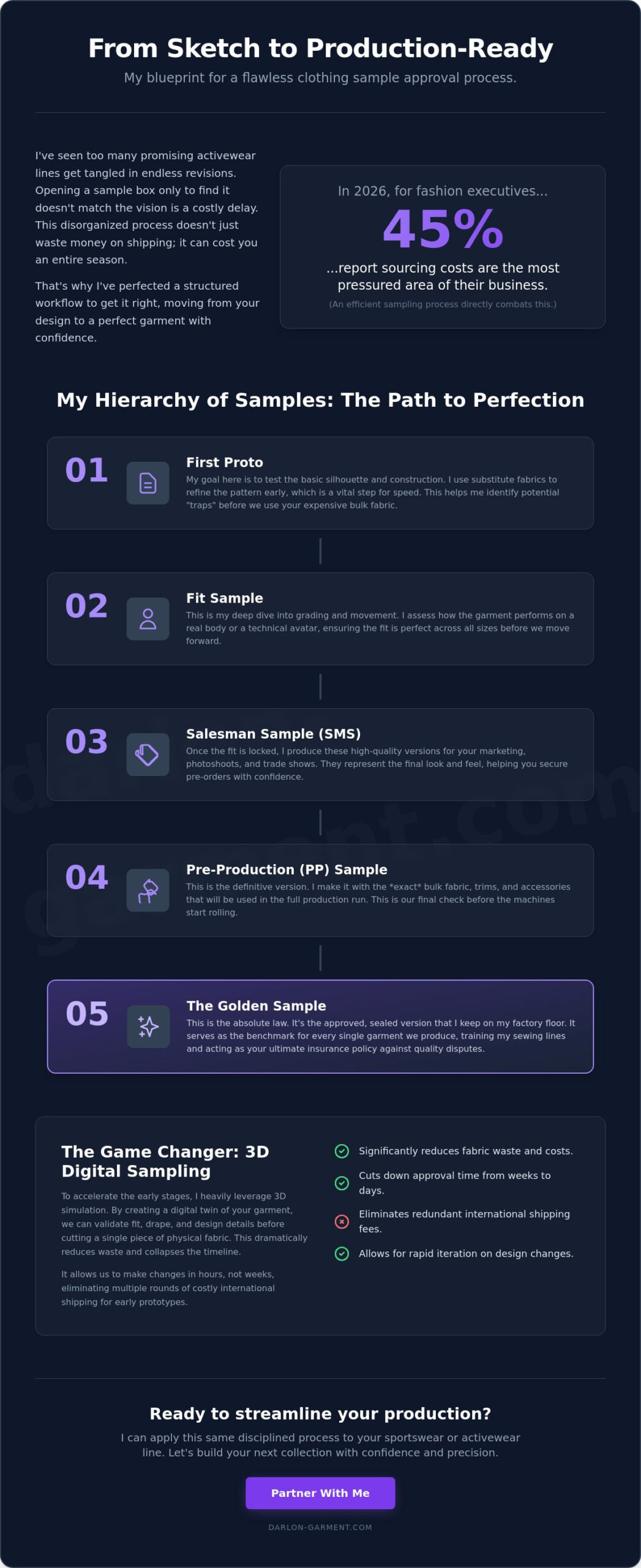
In 2026, 45 percent of fashion executives report that sourcing costs are the most pressured area of their economic model, yet many brands still lose thousands of dollars on redundant international shipping for rejected prototypes. I’ve seen firsthand how a disorganized clothing sample approval process can stall a promising sportswear or activewear line before it even hits the water. It’s exhausting to deal with multiple rounds of revisions and miscommunications regarding fit or fabric feel, especially when you’re trying to meet tight seasonal windows and new EU transparency requirements.
I understand the anxiety of opening a sample box only to realize the technical execution doesn’t match your creative vision. That’s why I’m sharing the exact workflow I use to transition from a design sketch to a perfect, production-ready garment without the typical industrial headaches. We’ll explore how to leverage 3D simulation to reduce physical rounds and ensure your technical packs align with current ISO 2859-1:2026 AQL standards. By the end of this guide, you’ll have a streamlined roadmap to move into bulk production with absolute confidence in your quality and compliance.
Key Takeaways
- Learn why a structured clothing sample approval process is the essential bridge between your creative design sketches and a successful industrial production run.
- Discover how I use the hierarchy of samples, from initial prototypes to the final golden sample, to lock in every detail before we start manufacturing.
- Understand the critical difference between fit corrections and design changes so you can evaluate your sportswear and activewear samples with technical precision.
- See how I use 3D digital sampling to eliminate fabric waste and significantly cut down the time it takes to reach your final approval.
- Identify the red flags in factory communication and learn why a comprehensive manufacturing approach provides the stability your international brand needs.
What is the Clothing Sample Approval Process and Why Does It Matter?
I define the clothing sample approval process as the series of physical and digital checkpoints that validate a design for mass production. It’s the critical bridge where your creative vision meets my factory’s technical reality. In my years of manufacturing, I’ve come to consider this the “make or break” phase of our partnership. If we align here, the rest of the production cycle is predictable. If we don’t, we risk expensive errors that can’t be easily fixed once the machines are running at full capacity.
This rigorous vetting isn’t unique to the apparel industry. In high-stakes engineering, professionals rely on a formal Production Part Approval Process (PPAP) to ensure that a supplier can consistently meet the design requirements during an actual production run. I apply that same disciplined logic to your sportswear or swimwear. In 2026, speed-to-market is the primary driver of success. An efficient approval workflow isn’t just about quality; it’s about protecting your brand’s reputation and ensuring your bottom line isn’t eroded by avoidable delays.
The Financial Stakes of Sampling
I often talk to clients about the hidden costs of “sample churn.” This occurs when we go through four or five rounds of physical prototypes because the initial requirements weren’t clear. Every rejected sample involves international shipping fees and specialized labor costs. However, the biggest financial hit isn’t the shipping; it’s the lost time. If an approval is delayed, you might lose your scheduled production slot. In a high-capacity facility, we have to keep the lines moving. If your garments aren’t ready for the floor, another client’s order takes that space. I’ve seen brands lose entire seasonal windows because they got stuck in an endless fitting phase.
Setting the Stage for Success
Getting the first sample right starts with a comprehensive tech pack. This document is my blueprint. It tells me everything from the stitch density to the exact placement of a bonded pocket. Before we start, I need you to identify your “must-haves” versus your “nice-to-haves.” For example, is the specific hand-feel of your performance wool more critical than a minor decorative topstitch? Knowing your priorities allows me to make better technical decisions during the first proto round. We’ll also establish a clear Time and Action (T&A) calendar. This schedule maps out every deadline for both of us, ensuring that the clothing sample approval process stays on track for your launch date.
The Hierarchy of Samples: From First Proto to the Golden Sample
The clothing sample approval process moves through a specific sequence of physical iterations, each designed to answer a different technical question. I begin with the First Proto, where I test the basic silhouette. At this stage, I often use available “substitute” fabrics that mimic the weight and drape of your final material. This allows us to finalize the shape without waiting for bulk fabric shipments to arrive. It’s a vital step for speed, as it lets us refine the pattern early.
Next is the Fit Sample. This is where I perform a deep dive into grading. I need to see how the garment moves on a real body or a technical avatar. Following fit approval, I produce the Salesman Sample (SMS). These are the high-quality versions you need for marketing and trade shows. Once the bulk materials arrive, I create the Pre-Production (PP) Sample. This is the definitive version made with the exact bulk fabric and trims. Finally, we reach the Golden Sample, which is the approved version I keep on my factory floor as the absolute law for the production run.
Why You Can’t Skip the Proto Phase
I use the proto phase to identify construction “traps” that could slow down bulk production later. For instance, testing how specific elastane fabric behaves during complex sewing is vital for activewear. High-stretch materials can pucker or shift under the needle, so I often suggest creating “mock-ups” for difficult details like laser-cut pockets or bonded collars. This ensures the machinery is calibrated correctly before we touch the expensive bulk yardage. Skipping this phase often leads to expensive re-works when the real fabric is on the line.
The Legal Weight of the Golden Sample
I treat the Golden Sample as your best insurance policy against quality disputes. In my sportswear factory in Vietnam, I use this sample to train my sewing lines. It serves as a visual and physical reference for every operator. We follow a “sealed sample” protocol, keeping the approved version in a secure, dust-free environment. This is a key part of any comprehensive guide to garment quality control. If a dispute arises regarding seam strength or logo placement, the Golden Sample provides the objective evidence needed to resolve the issue. If you’re looking for a partner who values this level of technical discipline, I invite you to explore our production capabilities. This sample is more than a reference; it’s the standard that protects both your brand and my factory’s reputation.
The ‘Fit vs. Construction’ Debate: How I Evaluate Your Prototypes
I’ve found that many brands obsess over whether a garment is a “Medium” or “Large,” but during the clothing sample approval process, I’m looking for technical balance. I evaluate how the fabric sits on the body. Does it have the right drape? Is there unnecessary tension at the seams? To understand the technical foundations of how fabric is shaped to a form, you can find out more from Marlo Bespoke. A garment can match every measurement in your tech pack and still look wrong if the balance is off. My goal is to ensure the weight of the garment is distributed correctly so it doesn’t shift or pull during wear.
It’s vital to distinguish between a fit correction and a design change. A fit correction addresses an error where the prototype doesn’t match the intended specifications. A design change is a pivot in your creative vision, such as moving a seam line or changing a pocket shape after the sample is in your hands. I charge for design changes because they require a complete pattern reset and new markers. This clarity helps keep our timeline on track and prevents your budget from ballooning due to creative indecision.
In my experience as a fitness wear manufacturer, I see specific issues with high-performance fabrics. Often, a sample might look perfect on a mannequin but fail during a squat test because the fabric lacks sufficient recovery or becomes transparent. These are technical construction failures. To help my pattern makers, please provide feedback that is actionable. Instead of saying a garment “feels tight,” tell us exactly where the restriction is, like “the bicep circumference needs 1cm of ease.”
The Art of the Fit Session
I always insist on using a professional fit model. Their bodies are consistent, and they can provide verbal feedback on how a garment feels during movement. When sending me feedback, take clear photos from the front, side, and back. I also recommend using short video clips. Seeing an activewear piece in motion helps me identify if a waistband is rolling or if a gusset is pulling. This visual data is much more useful than a long email of vague descriptions.
Construction Checkpoints
I also use this stage to run through a construction checklist. We evaluate seam strength and the choice of finish, such as flatlock versus overlock stitching for seamless garments. We check the hand feel of the trims and the smoothness of the zippers in a real-world scenario. During the PP sample stage, I pay close attention to labels and care tags. These small details ensure your brand meets international regulatory standards before we move to the cutting table.
Streamlining Approval in 2026: 3D Samples and Tech Pack Precision
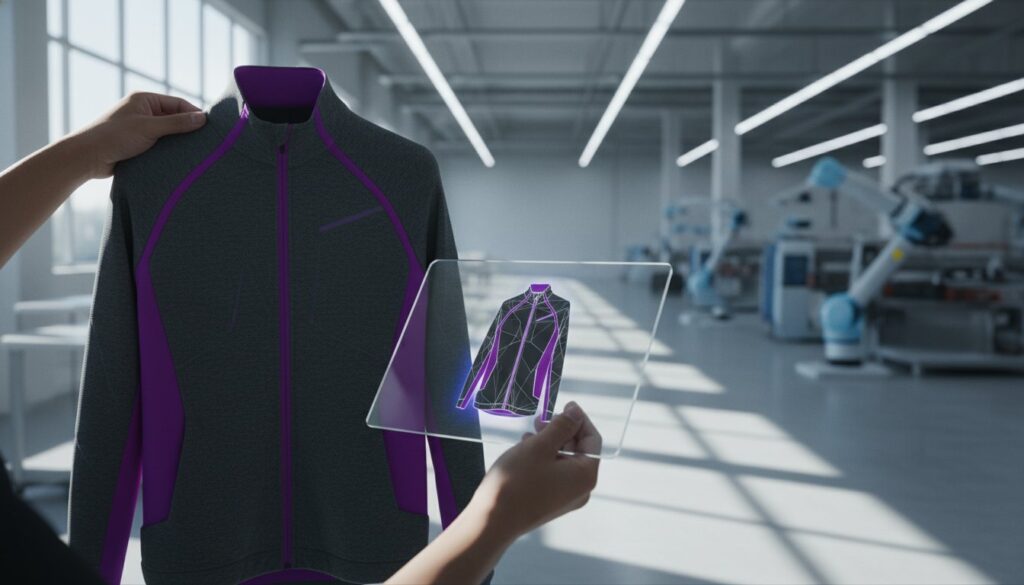
I’ve moved my factory toward a digital-first workflow because the traditional clothing sample approval process was simply too slow for the 2026 market. By replacing the “First Proto” round with 3D digital sampling, I can visualize your design in a virtual environment before we ever touch a sewing machine. This shift is transformative. Industry data shows that a quality tech pack combined with 3D sampling can reduce the number of physical sampling rounds from an average of 4.5 down to just 1.8. It’s a massive leap in efficiency that lets us focus our physical resources on the final execution rather than basic silhouette adjustments.
I also use AI-powered fabric simulation to predict how different weights of performance wool or activewear blends will drape on a 3D avatar. These AI tools can reduce digital pattern creation time from 8 hours down to just 10 minutes, representing a 70 percent improvement in development speed. While these digital tools are incredibly accurate, I still insist on producing at least one physical pre-production sample. There’s no digital substitute for the tactile “hand feel” of a finished seam or the specific tension of a bonded hem. We use the digital phase to solve 90 percent of the problems, leaving the physical sample to confirm the final sensory details.
The Digital Revolution in Vietnam
I’ve integrated advanced 3D software into the workflow of my clothing manufacturers operations to serve my international partners more effectively. This digital approach significantly reduces your brand’s carbon footprint by eliminating multiple rounds of international courier shipping. Instead of waiting days for a package to clear customs, you can approve a digital twin in minutes. This speed also makes it much easier for me to spot potential grading errors across your entire size run, ensuring that every size from Small to XXL maintains the same visual balance.
Mastering the Digital Tech Pack
The 2026 industry standard has moved toward interactive tech packs that offer 360-degree views of every construction detail. I require your Bill of Materials (BOM) to be 100 percent finalized before we move to the PP sample stage to avoid logistical bottlenecks. Digital pattern-making software ensures that the mathematical foundations of your design are flawless before a single inch of fabric is cut. If you’re ready to modernize your production cycle, reach out to our team to discuss how we can implement these digital efficiencies for your next sportswear or activewear line.
Partnering for Perfection: How We Handle Approvals at Dar Lon Garment
I’ve spent years refining my “One-Stop” model because I’ve seen the frustration that occurs when a sourcing agent and a factory don’t communicate well. When I handle your sourcing, sampling, and production under one roof, the clothing sample approval process becomes a cohesive conversation rather than a series of disjointed hand-offs. This integration ensures that the performance fabrics I source are technically compatible with the high-speed machinery on my factory floor. It eliminates the “blame game” that often happens between fabric suppliers and garment makers.
One major red flag I always tell brands to watch for is a factory that approves your sample too quickly. If a manufacturer doesn’t ask technical questions or suggest minor adjustments for production efficiency, they likely aren’t scrutinizing your design. A factory that says “yes” to everything often encounters major quality issues during bulk production. I prefer to be honest about technical constraints early. I manage a vast network of sub-suppliers for trims, zippers, and technical fabrics to ensure the Pre-Production (PP) sample is an honest representation of the final product. Every component must be identical to what we’ll use in the bulk run.
Vetting My Sampling Department
I encourage you to ask about my pattern makers’ specific experience with performance wool and seamless garments. I’m proud of my dedicated sampling line, which operates independently of our bulk production floor. This setup means your prototypes get the focused attention they deserve without being rushed by the demands of a high-volume order. Being a Vietnamese partner allows me to combine deep local sourcing knowledge with an understanding of global fit standards. We ensure that the technical grading is consistent across your entire size range before we cut a single yard of bulk fabric.
Your Sample Approval Checklist for 2026
I recommend following a disciplined sequence once you receive your sample package. This process creates the necessary paper trail for quality assurance and helps us stay on schedule:
- Inspect the package: Check for transit damage and verify that all requested colorways and sizes are included.
- Perform a fit session: Use a professional fit model and record video clips of the garment in motion to check for rolling or pulling.
- Validate the BOM: Compare the sample against your tech pack’s Bill of Materials, checking every zipper, button, and label placement.
- Document feedback: Centralize your comments in a single file to avoid miscommunication through multiple, scattered email threads.
- Seal the Golden Sample: Once you are satisfied, send the formal approval. This physical sample becomes the legal standard for your production contract.
Finalizing your strategy means moving from this approval to the “green light” for bulk production. Transparency about your launch date helps me manage our factory capacity, ensuring we hit your delivery windows. Once that Golden Sample is approved and sealed, it serves as the ultimate insurance policy for your brand. It’s the physical contract that protects your investment and ensures my team delivers exactly what you envisioned for your sportswear or activewear line.
Ready to Secure Your 2026 Production?
I’ve seen how the right clothing sample approval process can transform a chaotic development cycle into a predictable, high-yield production run. By integrating automated 3D sampling and maintaining a dedicated sampling line, I ensure that your activewear designs move from digital avatars to physical reality with absolute precision. We’ve explored why the Golden Sample is your ultimate insurance policy and how digital fit testing eliminates the waste that used to plague international shipping cycles.
My factory is equipped with advanced laser-cutting technology and specialized machinery for handling Nuyarn performance wool and high-stretch elastane fabrics. I take pride in being the silent, powerful backbone for international brands that value technical mastery and long-term stability. If you’re tired of the sample churn and want a partner who understands the logistical priorities of a professional buyer, I’m here to help. Let’s discuss how I can secure your next collection at Dar Lon Garment and move your brand into bulk production with total confidence. I look forward to building a successful partnership together.
Frequently Asked Questions
How many rounds of sampling are normal in the clothing industry?
The standard clothing sample approval process historically required 4 to 5 rounds of physical iterations. However, by using 3D design software like CLO 3D or Style3D, we’ve reduced this to an average of 1.8 rounds. This digital-first approach allows us to finalize the silhouette before we ever cut fabric, which saves time and significantly reduces material waste.
What is the difference between a proto sample and a fit sample?
I use the proto sample to test the basic silhouette and construction using available substitute fabrics. The fit sample is a deeper technical dive into grading and how the garment moves on a real body or technical avatar. While the proto checks the “look,” the fit sample ensures the garment performs correctly across your entire size range.
Who pays for the shipping of samples between the factory and the brand?
In international manufacturing, the brand typically covers the cost of shipping samples via couriers like DHL or FedEx. While I provide the labor and technical expertise to create the sample, the logistical fees for international transit are the responsibility of the buyer. This is a standard practice that helps keep our production metrics focused on manufacturing efficiency.
How long does the average garment sampling process take in 2026?
The average sampling cycle in 2026 takes about 2 to 3 weeks per physical iteration. If we integrate 3D sampling, we can often compress the initial development phase by 70 percent. Total lead times from the first approved sample to finished goods generally range from 8 to 12 weeks, depending on the complexity of the sportswear or activewear design.
Can I use 3D samples for my final production approval?
I don’t recommend using 3D samples for the final “green light” on bulk production. While digital simulation is incredibly accurate for fit, it can’t replicate the physical “hand feel” of a finished seam or the specific stretch recovery of a bonded hem. I always require a physical Pre-Production (PP) sample to serve as the Golden Sample for our quality control team.
What happens if I reject a pre-production (PP) sample?
If a Pre-Production (PP) sample is rejected, the production line remains idle until we resolve the discrepancy. We compare the rejected sample against your tech pack and the ISO 2859-1:2026 AQL standards to identify the failure point. I then produce a corrected sample for your final signature to ensure that the bulk run meets your exact requirements.
What should I include in a fit comment report for my manufacturer?
Your fit comment report should include high-resolution photos from the front, back, and side, along with short video clips of the garment in motion. I need specific, quantitative feedback rather than subjective descriptions. For example, telling my pattern makers to “increase the leg opening by 1.5cm” is much more effective than saying the sample “feels tight.”
Why does the fabric on my first proto feel different than the final product?
I use available substitute fabrics for the first proto to avoid waiting for bulk fabric shipments, which can take weeks to arrive. This allows us to finalize the pattern and construction details early in the clothing sample approval process. You won’t see the final fabric and trim quality until we reach the Pre-Production (PP) sample stage when the bulk materials are in-house.