
If you’re still relying on traditional mechanical blades for high-performance activewear in 2026, you’re essentially leaving your brand’s reputation to chance. I’ve seen too many promising labels struggle with fraying edges on high-stretch fabrics or inconsistent sizing that ruins bulk production. It’s a massive headache when high material waste drives up your costs, especially when the technology to prevent it is already standard in top-tier facilities. I’ve spent years refining how we use laser cutting in sportswear manufacturing to solve these exact problems for my partners.
I want to show you how this technology delivers the clean, professional finish your customers expect while making your production more sustainable. In this guide, I’ll explain how I leverage high-precision tools to improve garment durability and breathability. We’ll look at how our Vietnam-based operations achieve up to 30% better production efficiency and use digital nesting to cut material waste by 15%. I’ll also cover the importance of ISO 11553-1:2020 safety standards and why choosing a reliable partner in Ho Chi Minh City or Binh Phuoc is the smartest move for your 2026 collections.
Key Takeaways
- Learn why I’ve moved away from physical blades to concentrated light beams to achieve absolute accuracy on modern, high-stretch fabrics.
- Understand how I optimize laser cutting in sportswear manufacturing to seal edges on synthetic blends, preventing the fraying common in lower-quality activewear.
- Discover the role of digital nesting in my production process and how I arrange patterns to maximize every inch of your fabric rolls.
- Explore how I use laser precision to prepare panels for bonded, seamless assembly and complex ventilation details that elevate your brand’s aesthetic.
- Find out why I’ve integrated these high-tech capabilities into my Vietnam facility to offer a comprehensive, one-stop manufacturing solution.
The Evolution of Precision: Why Laser Cutting is My Go-To for Performance Wear
I remember when we relied almost exclusively on traditional die-cutting for every order. It worked well enough for basic cotton tees, but as my clients started demanding high-stretch, technical fabrics, those old physical blades just couldn’t keep up. Modern textiles are slippery and prone to shifting. When you press a heavy metal die onto a four-way stretch elastane blend, the fabric distorts. By the time the blade finishes its cut, the panel shape is already slightly off. This is exactly why I’ve made laser cutting in sportswear manufacturing the core of my production strategy.
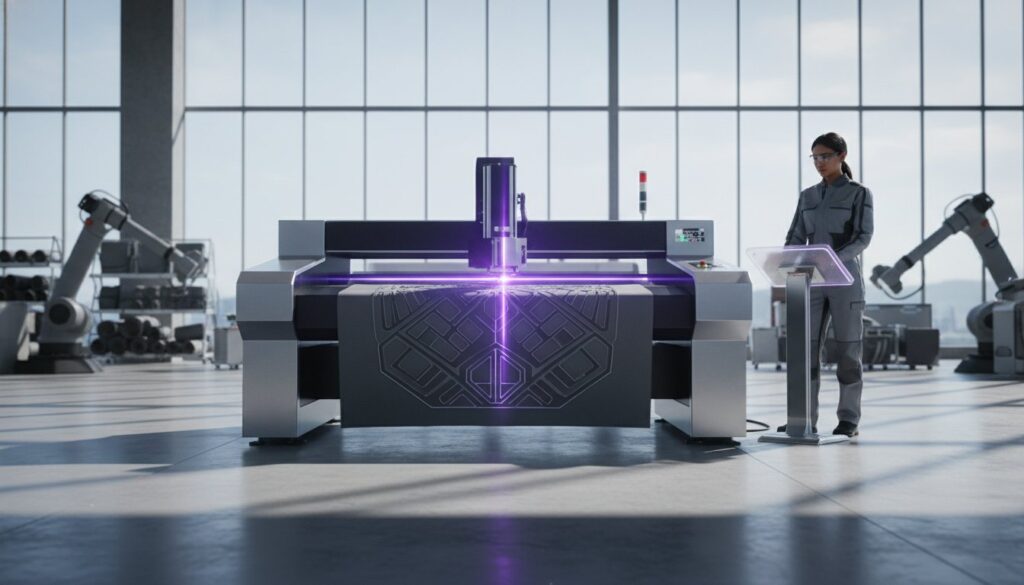
Instead of relying on a physical edge that dulls with every use, I use a concentrated beam of light. This advanced laser technology allows me to cut through technical layers with zero physical contact. Because there’s no pressure applied to the fabric, the material stays perfectly flat and relaxed throughout the process. This results in an absolute accuracy that you simply cannot achieve with a mechanical press or manual shears. It’s the difference between a garment that almost fits and one that feels like a second skin.
Precision That Manual Cutting Simply Can’t Match
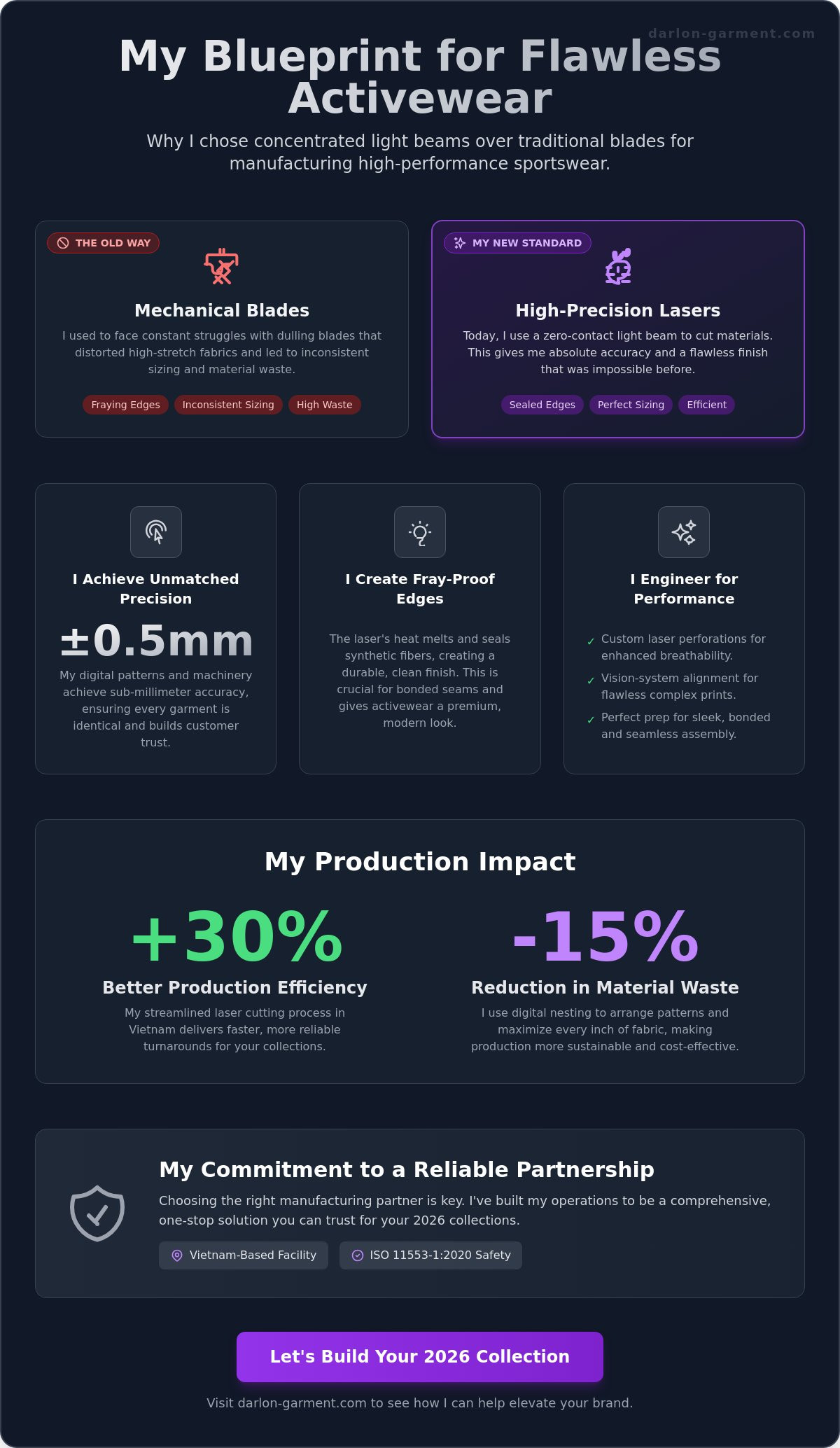
I’ve moved away from manual templates because they introduce too much room for human error. In my facility, every project starts with a digital pattern that talks directly to the machinery. This allows me to achieve sub-millimetre accuracy, typically within a tolerance of ±0.5mm. When you’re producing thousands of units in a bulk run, this level of detail is the secret to perfect sizing. Every size small is identical to every other size small. I’ve found that this consistency is what builds long-term trust between a brand and its customers. If a pair of leggings fits perfectly once, your customer wants that exact same fit every time they reorder.
The End of Fraying: Heat-Sealing Technology
One of the biggest headaches in activewear is the fraying edge, especially on high-performance synthetics like polyester and nylon. When I use a laser, the heat actually melts the very edge of the synthetic fibres as it passes through. This creates a “sealed edge” effect that is incredibly durable. It’s a game-changer because it often eliminates the need for bulky overlock stitching.
The Technical Edge: How Laser Technology Transforms Synthetic Fabrics
I focus my laser cutting in sportswear manufacturing primarily on synthetic fabrics like polyester, nylon, and elastane blends. These materials are essentially plastics, which means they respond beautifully to the heat of the laser beam. While natural fibers like cotton or organic wool tend to char or discolour under the beam, synthetics melt and fuse. This reaction is the “secret sauce” behind the high-end finish I provide. When I’m working with innovative textile fabrics, I’m always looking at how the laser power interacts with the specific material weight to ensure the cut is crisp without being brittle.
I also use this technology to solve the “alignment nightmare” of sublimated prints. In the past, if your artwork shifted by a few millimetres during the heat press stage, the manual cut would be ruined. Now, I use vision-system lasers equipped with high-resolution cameras. These cameras scan the fabric in real-time, identifying the registration marks of your artwork. The software then recalibrates the cutting path to match the print exactly. It’s a level of precision that makes complex, all-over prints much more viable for bulk production.
Mastering Stretch: Working with Spandex and Lycra
I’ve learned that the biggest enemy of precision in activewear is fabric tension. If a high-stretch material is pulled even slightly while it’s being cut, the resulting panel will be the wrong size once it’s released. To prevent this, I use a tension-free conveyor system that lets the fabric sit in its natural, relaxed state. If you want to see how I manage these technical challenges across different materials, you can read my guide on elastane fabric. It’s all about keeping the stretch in the garment, not in the cutting room.
Laser Perforation for Enhanced Breathability
One of the most effective ways I use this tech is for custom perforation. I can program the laser to cut intricate ventilation patterns into high-heat zones like the back, underarms, or chest. This creates immediate breathability without the need for sewing in heavy mesh panels. Because the laser seals each tiny hole as it cuts, the fabric won’t rip even under extreme athletic stress. It’s a sleek, durable design element that adds massive value to gym shirts and leggings. If you’re ready to see these details on your next collection, you can explore our technical apparel options to see what’s possible in our 2026 production lines.
Efficiency and Sustainability: Why Digital Nesting is a Game-Changer
I’m constantly looking for ways to cut costs for my clients without cutting corners on quality. In 2026, the most effective tool I have for this isn’t just the laser itself, but the software that controls it. While I’ve already discussed the precision of the beam, the real financial magic happens before the first cut is even made. By using laser cutting in sportswear manufacturing, I can leverage advanced digital nesting to ensure we’re using every possible inch of your fabric roll. It’s a level of efficiency that traditional manual layouts simply can’t touch.
Every centimetre of high-performance fabric saved is money back in your pocket. When I’m handling expensive technical textiles or specialized recycled blends, reducing waste is my top priority. Because the laser doesn’t require the same “buffer zone” between panels that a physical blade needs, I can pack the pattern pieces much tighter together. This isn’t just about being “green” for the sake of marketing; it’s about a smarter, more fiscally responsible way to manage high-capacity production runs.
Maximising Yield with Digital Nesting
In my facility, I’ve replaced manual template placement with automated digital nesting software. This system uses complex algorithms to arrange your garment panels in the most efficient configuration possible. I’ve found that this shift consistently allows me to get 10% to 15% more garments out of the same fabric roll compared to older methods. If you’re curious about how this fits into the bigger picture, you can see how garments are made throughout my entire production line. This automated approach ensures that your fabric yield is maximized from the very first yard.
Reducing Your Brand’s Environmental Footprint
Sustainability is no longer a niche request. It’s a baseline expectation in the 2026 market. I’ve seen recycled polyester (rPET) grow to make up over 30% of our fabric orders recently, and these eco-friendly materials deserve a production process that respects their value. By minimizing offcuts through precision cutting, I help your brand meet the strict “zero-waste” requirements that major international retailers now demand.
Precision cutting also plays a hidden role in long-term durability. Because the laser seals the edges of these recycled synthetics perfectly, the seams are less likely to fail over time. This extends the life of the garment, which is the ultimate form of sustainability. When I reduce your waste, I’m not just lowering your costs; I’m helping you build a brand that stands for quality and environmental responsibility. It’s a win for your bottom line and the planet.
Designing for the Future: Incorporating Laser-Cut Details
I’ve spent a lot of time talking about the “how” and “why” of laser cutting in sportswear manufacturing from a technical perspective. But what really gets me excited is the “what.” I love seeing designers push the limits of my machines to create garments that were physically impossible to make just a few years ago. We’ve moved far beyond basic panel cutting. Today, I’m using lasers to add intricate branding, functional ventilation, and the structural foundations for the most advanced bonded apparel on the market.
I’m also seeing a huge rise in intricate logos and branding etched directly into the fabric. Unlike traditional screen printing or heat transfers that can crack or peel over time, laser etching creates a permanent, tonal mark that doesn’t affect the fabric’s breathability or stretch. It’s a sophisticated way to handle branding for 2026 collections, offering a subtle, premium feel that resonates with modern consumers who are moving away from loud, plastic-heavy logos.
The Shift Toward Bonded and Seamless Apparel
I often recommend laser cutting for brands looking to achieve that high-end, “no-stitch” aesthetic. Traditional sewing creates bulk at the seams, which can cause chafing during intense workouts. By using a laser to cut panels, I create a perfectly clean edge that is ready for heat-activated adhesives. This precision is vital for the technical requirements of bonding; if the cut is even slightly jagged, the bond won’t be uniform, and the seam will eventually peel. This technology is a cornerstone for anyone choosing the right fitness wear manufacturer for their next collection. It allows me to deliver garments that are lighter, sleeker, and more comfortable than anything made with a standard needle and thread.
Adding Functional and Aesthetic Details
Beyond the main seams, I use lasers to add functional features like pocket openings, zip garages, and even decorative scalloped edges. These small details are where the precision of laser cutting in sportswear manufacturing really shines. I can also create “mapped” ventilation zones that follow the body’s natural heat maps. Instead of just a generic mesh panel, I can cut a series of varying-sized holes or slits that provide targeted cooling where the athlete needs it most.
If you’re preparing your next tech pack, my best advice is to keep your digital files organized. I need clean vector paths for everything. When you specify your laser-cut zones, make sure they are on a separate layer from your print or stitch lines. This helps my software interpret your vision exactly as you intended. If you’re unsure about how to set these up, you can contact me to review your design files before we start the sampling phase. By getting these details right in the design stage, we ensure a smooth transition into bulk production.
Partnering with Dar Lon: Scaling Your Vision in Vietnam
I’ve built my facility in Vietnam to be more than just a production line; it’s a hub where technical mastery meets high-capacity industrial scale. While I’ve spent the previous sections detailing the mechanics of laser cutting in sportswear manufacturing, the true value for your brand lies in how I integrate these tools into a complete supply chain. I offer a comprehensive one-stop solution that takes your project from initial fabric sourcing all the way to a finished, retail-ready garment. This model is designed specifically for international partners who need reliability without the logistical friction of managing multiple vendors.
My OEM and ODM capabilities are structured to help you scale rapidly as we move through 2026. Whether you’re looking to launch a technical fitness line or a high-end swimwear collection, I provide the physical infrastructure and operational history to back your vision. I maintain rigorous quality control at every stage, ensuring that the precision we achieve during the cutting phase is preserved through assembly and final packaging. By adhering to international safety standards like ISO 11553-1:2020, I guarantee a disciplined production environment that values long-term cooperation over short-term gains.
Why Vietnam is the Strategic Choice for Sportswear
Choosing a sportswear factory in Vietnam is one of the most effective moves you can make for your brand’s global strategy. My facilities in Ho Chi Minh City and Binh Phuoc are positioned to take advantage of Vietnam’s highly developed garment infrastructure and competitive tariff structures. This geographic advantage, combined with my commitment to ethical manufacturing practices, makes Dar Lon a silent, powerful backbone for your brand. I handle the complexities of international trade and logistics so you can focus on design and marketing.
Your Next Steps with Dar Lon Garment
I’m ready to help you bring your most ambitious designs to life. The process is straightforward. You can send me your tech packs for a detailed laser-cutting feasibility review. I’ll look at your vector paths and material choices to ensure they’re optimized for our machinery. From there, I move into the prototyping phase, creating physical samples that allow you to feel the quality and test the fit before we commit to a bulk run. This methodical approach prevents costly errors and ensures that the final product meets your exact specifications. If you’re looking for a dependable partner to elevate your brand’s performance and sustainability, let’s start the conversation.
Building a More Precise Future for Your Brand
I’ve shown you how moving beyond traditional cutting methods can transform your production quality. By embracing laser cutting in sportswear manufacturing, you’re not just getting cleaner edges; you’re investing in a more sustainable, high-yield process that respects your material costs. Whether it’s mastering complex elastane blends or creating intricate ventilation zones, this technology is the foundation for any high-performance collection in 2026. The shift toward bonded and seamless apparel isn’t just a trend, it’s a technical evolution that requires the absolute accuracy only a laser can provide.
Since 2019, I’ve focused on building a facility that combines these advanced laser tools with automatic sewing and specialized expertise in Nuyarn and bonded apparel. My goal is to provide a comprehensive OEM/ODM solution that makes scaling your brand in Vietnam as seamless as the garments we produce. I take pride in the technical mastery we’ve achieved, and I’m ready to share that reliability with your team to ensure your next run is your best one yet.
Ready to elevate your sportswear? Contact me at Dar Lon Garment today for a custom quote.
I’m excited to see how we can use these precision tools to bring your next design vision to life. Let’s build something exceptional together.
Frequently Asked Questions
What is the primary benefit of laser cutting over traditional die-cutting in sportswear?
The primary benefit is the combination of sub-millimetre precision and the immediate heat-sealing of the fabric edge. Unlike traditional die-cutting, which uses physical pressure that can distort stretchy activewear fabrics, the laser beam never touches the material. This ensures that every panel is cut to the exact dimensions of your digital pattern without any fraying or jagged edges.
Can laser cutting be used on all types of activewear fabrics?
I find that laser cutting works best on synthetic fabrics like polyester, nylon, and elastane blends because they melt and seal. While I can use it on natural fibres like cotton, they don’t seal the same way and can sometimes show slight charring. I always recommend testing a sample of your specific fabric blend to find the perfect power settings for a clean finish.
Does laser cutting increase the cost of my garment production?
While the hourly rate for laser machinery is higher than manual cutting, it often reduces your total production cost by maximizing fabric yield. My use of digital nesting allows me to fit more pieces onto every roll, which offsets the machine time. You also save money by eliminating the need for extra overlock stitching to prevent fraying on the final garment.
Is laser cutting suitable for sustainable or recycled performance materials?
It’s actually one of the most sustainable choices you can make for your brand. Using laser cutting in sportswear manufacturing is ideal for recycled polyester because it handles the material’s specific melting point perfectly. It also helps meet the zero-waste requirements of major retailers by significantly reducing the amount of fabric that ends up as floor waste during a bulk run.
How do I include laser-cutting instructions in my apparel tech pack?
You should provide your designs as vector files, such as AI or DXF formats, with cutting lines on a dedicated layer. I need you to clearly distinguish between external cut lines, internal perforations, and any decorative etching. Including a 1:1 scale reference in your file ensures that my software interprets your sizing exactly as you intended during the production phase.
What is the difference between laser cutting and laser engraving on fabric?
Laser cutting uses a high-power beam to slice completely through the fabric, while engraving uses a lower-power setting to only etch the surface. I use engraving for permanent, tonal branding and logos that won’t peel or fade like traditional prints. Both processes use the same precision technology but achieve very different functional and aesthetic results for your collection.
How does laser cutting help with ‘seamless’ or bonded garment construction?
It creates the perfectly flat, fray-free edge that is essential for a secure adhesive bond. In “seamless” or bonded construction, any loose fibres or uneven edges will cause the glue to fail over time. By using a laser, I ensure the panels fit together with zero gaps, allowing the bonding tape to create a smooth, durable seam that holds up under athletic stress.
Why should I choose a manufacturer in Vietnam for laser-cut sportswear?
Vietnam offers a unique combination of advanced infrastructure and strategic trade advantages. By choosing a manufacturer here, you benefit from a highly skilled workforce that understands laser cutting in sportswear manufacturing alongside competitive tariff structures for international shipping. My facility provides the high-tech backbone you need to scale your brand while maintaining strict quality control at every stage.