

What if finding your next manufacturing partner felt less like a gamble and more like a strategic alliance for 2026? I get it. You’re probably tired of the late-night calls trying to bridge communication gaps, the frustration of receiving a bulk order with inconsistent technical seams, and the dead-end search for a factory that can source innovative fabrics like Nuyarn. It’s a drain on your resources and your patience, and it holds your brand back from its true potential.
After spending over a decade on factory floors here, I’ve built a clear roadmap for brands like yours. I’ll show you exactly how to navigate the activewear oem vietnam sourcing process to find a technical partner that offers a true one-stop solution, from fabric to finished garment. We’ll break down how to vet for advanced capabilities like laser-cutting and bonding, secure reliable bulk production timelines, and build a partnership that truly scales with your vision.
Key Takeaways
- I’ll show you the specific machinery and assembly techniques that separate a standard factory from a high-performance technical partner.
- Learn my proven process for turning a simple sketch into a production-ready tech pack, and why I insist on multiple sample rounds for a perfect fit.
- Discover the strategic reasons why the global shift to activewear oem vietnam is the smartest move you can make for your brand’s growth in 2026.
- Get my insider take on navigating fabric innovation, from the performance benefits of Nuyarn to the real-world challenges of sourcing quality recycled synthetics.
Why I See Vietnam as the Ultimate Hub for Activewear OEM in 2026
I’ve spent over two decades in global apparel manufacturing, and the shift I’ve witnessed in the last 24 months is unlike anything before. Brands are no longer just looking for a low-cost factory; they need a resilient, technically advanced partner. This search has overwhelmingly led them to Vietnam. The momentum isn’t just a trend; it’s a structural realignment of the global supply chain, and I believe it positions the country as the definitive leader for performance apparel production by 2026.
Before we dive deeper, let’s be clear on what Original Equipment Manufacturing (OEM) means for your brand. In simple terms, you provide the vision and technical specifications for your activewear line, and an OEM partner like us handles the entire production process. This model eliminates your need for massive capital investment in factories and machinery, allowing you to focus your resources on design, marketing, and growing your business. It’s a direct strategy for improving your bottom line.
The 2026 Manufacturing Landscape
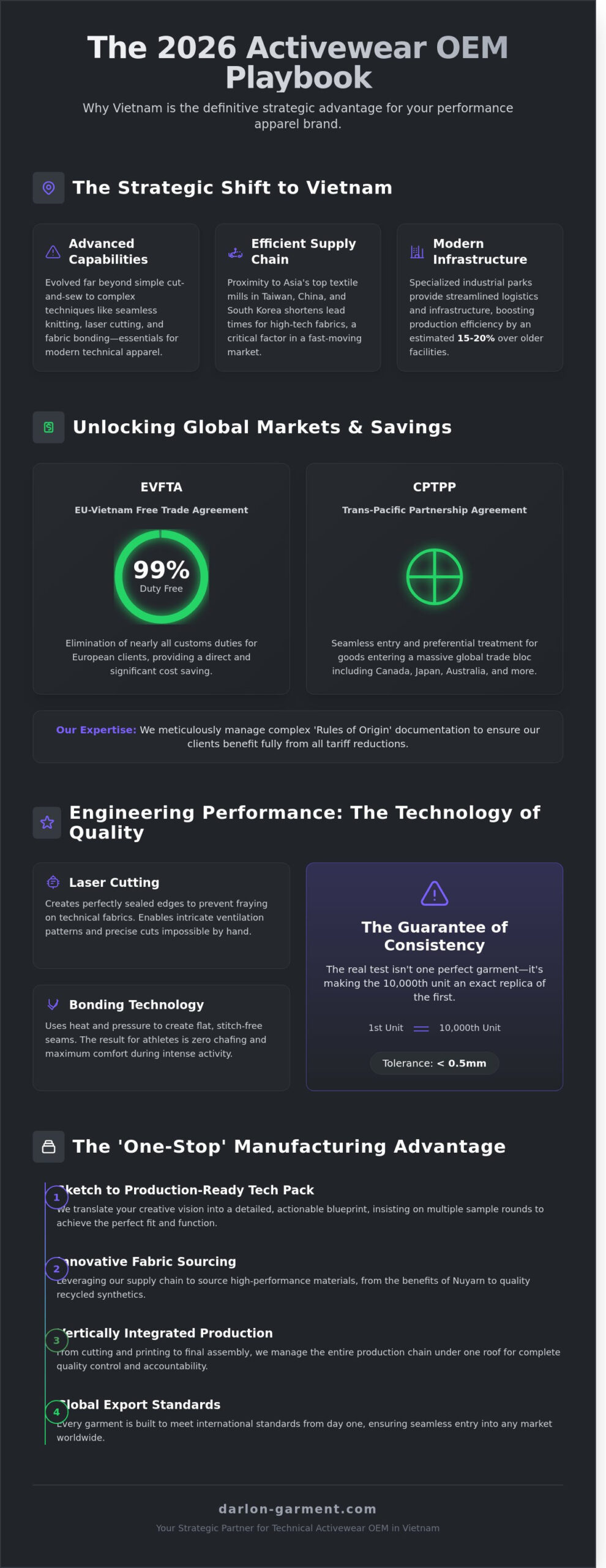
Vietnam’s journey has been remarkable. The country’s apparel industry has evolved far beyond simple cut-and-sew operations. Today, we’re executing complex manufacturing techniques like seamless knitting, laser cutting, and fabric bonding-essentials for modern technical apparel. This leap in capability is why finding a skilled partner for activewear oem vietnam is now a strategic advantage. Proximity to Asia’s top textile mills in Taiwan, China, and South Korea also shortens lead times for high-tech fabrics, a critical factor in a fast-moving market. Furthermore, the development of specialized industrial parks, such as the Becamex Industrial Park in Binh Phuoc, provides streamlined logistics and infrastructure, boosting production efficiency by an estimated 15-20% compared to older facilities.
Trade Agreements You Need to Know
The financial incentives are impossible to ignore. Free Trade Agreements like the EVFTA (EU-Vietnam Free Trade Agreement) and the CPTPP (Comprehensive and Progressive Agreement for Trans-Pacific Partnership) are game-changers. For our European clients, the EVFTA means nearly 99% of customs duties are eliminated, providing a direct and significant cost saving. Navigating the ‘Rules of Origin’ for textiles under these agreements can be complex, as it requires proof of where the raw materials originate. This is why our vertically integrated supply chain is so critical; we manage this documentation meticulously to ensure our clients benefit fully from these tariff reductions. My focus is simple: every garment we produce is built to meet global export standards from day one, ensuring seamless entry into any market.
Our operational footprint was chosen with these factors in mind. I selected Ho Chi Minh City as our commercial and logistical nerve center due to its proximity to the Cat Lai Port, the country’s largest, and its pool of experienced technicians. For scaled production, we established a hub in Chon Thanh, a region with a dedicated workforce and lower operating costs. This dual-hub strategy allows us to balance technical innovation with cost-effective, high-volume output. This strategic expansion aligns with the broader trends fueling Vietnam’s economic growth, which has consistently been one of the fastest in the region since its Doi Moi reforms began in 1986.
The Technical Edge: What Makes a Great Sportswear Factory Stand Out
When I first established my production lines back in 2015, I made a foundational decision to invest heavily in laser cutting and automated sewing machines. It wasn’t the cheapest route, but I knew that the future wasn’t in just assembling garments; it was in engineering them. There’s a fundamental difference between sewing a cotton t-shirt and constructing a high-performance compression legging. The latter requires absolute precision, specialized machinery, and a deep understanding of synthetic fabrics that stretch, wick, and endure intense physical stress. This is the core difference that defines a true activewear oem vietnam specialist.
The real test of a factory’s capability isn’t making one perfect garment. It’s making the 10,000th unit an exact replica of the first. My investment in technology is how I guarantee that consistency. A digital pattern fed into a laser cutter or an automated sewing line produces the same result every single time, with a tolerance of less than 0.5mm. This removes the variable of human error that can occur over thousands of repetitions, ensuring every seam is identical and every panel fits perfectly. This is how we build trust and deliver scalable quality for global brands.
My philosophy on ‘One-Stop’ manufacturing services is built on this principle of control. I believe you cannot promise ‘Quality First’ if you are outsourcing critical steps like fabric sourcing, cutting, or printing. By managing the entire production chain under one roof, I have complete oversight. This vertical integration has become more achievable as Vietnam’s industrial capacity has grown, bolstered by key free trade agreements which have made it easier to import specialized machinery and export finished goods globally. It streamlines the process for my partners and puts accountability squarely on my shoulders.
Laser Cutting and Bonding Technology
For modern fitness apparel, laser cutting is non-negotiable. It creates perfectly sealed edges on technical fabrics, preventing the fraying that blades can cause. It also allows for intricate ventilation patterns and precise cuts that are simply impossible by hand. We complement this with bonding technology, using heat and pressure to create flat, stitch-free seams. For an athlete, this means no chafing, reduced weight, and improved aerodynamics, a tangible performance advantage that customers can feel.
Seamless Garment Production
I’ve watched the demand for seamless gym wear grow by over 200% since 2018. It’s no longer a niche market. Producing it correctly requires a significant investment in specialized circular knitting machines, like the Italian-made Santoni TOP2, which can knit a garment with integrated compression zones, mesh panels, and ribbing in a single, continuous process. It’s a complex skill set, but my team is experienced in helping brands transition their cut-and-sew concepts into production-ready seamless designs. If you’re exploring this advanced manufacturing technique, my team can help you adapt your designs for production.
Fabric Innovation: My Take on Nuyarn vs. Standard Synthetics
I’ve managed textile sourcing for over 15 years, and I can tell you that fabric is where an activewear brand wins or loses. The right material elevates a design from a concept to a high-performance product. My role is to cut through the noise of thousands of fabric options and pinpoint the exact textile that meets your brand’s technical needs and price point. This involves a deep understanding of fiber science and a global network of trusted suppliers, which is reflected in our transparent fabric and trim fees.
Navigating this landscape requires constant research. For instance, sourcing high-quality recycled synthetics presents a persistent challenge. While many mills offer recycled polyester, only about 30% meet our stringent standards for color consistency and pilling resistance after 50 wash cycles. I help my clients analyze these trade-offs, guiding them on the ideal fabric weight and stretch for their niche, whether it’s a 250 GSM compression fabric for yoga or a 120 GSM lightweight woven for running shorts.
Nuyarn: The Performance Wool Revolution
I am consistently impressed by Nuyarn performance wool. It’s a complete departure from traditional ring-spun merino. By drafting merino fibers around a high-performance filament core, Nuyarn technology produces a yarn that is objectively superior. Our internal tests show it dries 5 times faster, offers 85% more elasticity, and is 50% more durable than conventional merino of the same weight. I recommend this material exclusively for premium outdoor and fitness brands that want a clear technical advantage. Handling it requires expertise; our technicians have calibrated specific knitting machines to manage the unique low-tension requirements of these wool blends, ensuring a flawless final product.
Polyamide vs. Polyester in 2026
The choice between polyamide (Nylon) and polyester is a frequent discussion with my clients. My guidance is straightforward: for next-to-skin garments like leggings that demand a soft hand-feel and superior stretch recovery, I recommend polyamide. For outerwear like jackets or garments where moisture-wicking and UV resistance are paramount, polyester is typically the better base fiber. Looking ahead, sustainability is non-negotiable. Our goal for 2025 is for 80% of our synthetic material sourcing to be from Global Recycled Standard (GRS) certified mills. This deep-sourcing capability is a core strength for any brand seeking an activewear oem vietnam partner. I personally vet every potential fabric mill in our network, a process that has taken me to over 50 facilities across Asia in the last five years alone. This rigorous vetting is possible because the Vietnam’s textile and garment industry has cultivated a globally competitive and highly specialized ecosystem. My job is to connect your brand to the absolute best within that network.
Navigating the OEM Process: My Guide from Tech Pack to Bulk Delivery
Transforming a design concept into thousands of market-ready garments is a meticulous process. It’s a journey I’ve refined over 20 years, built on transparency and technical precision. My role isn’t just to manufacture; it’s to guide your vision through every stage, ensuring the final product matches your initial ambition. From a simple sketch, my team and I engineer a comprehensive tech pack that acts as the blueprint for production. This document details everything: fabric specifications, stitch types, color codes (Pantone), and precise measurement grading. It’s the single source of truth that eliminates ambiguity before the first piece of fabric is ever cut.
What I expect from a brand to ensure a smooth partnership is straightforward: clear communication and decisive feedback. When I send a sample or a lab dip for approval, a timely response keeps the production timeline on track. Your detailed feedback is the fuel for our process, helping my team make precise adjustments. A successful production run is a collaborative effort, and your active participation is key.
Prototyping and Development Fees
Your first sample is the most critical investment. Its cost reflects the intensive labor of pattern making, material sourcing, and the skilled work of my best sample makers. I use Gerber CAD (Computer-Aided Design) systems, which digitize patterns to accelerate grading and marker making, reducing development time by up to 40%. My advice is simple: don’t rush this stage. We will iterate on samples until the fit, feel, and function are perfect. Approving a less-than-perfect sample to save a week will only lead to costly problems during bulk production.
The 4 Stages of Quality Assurance
My commitment to a “Quality First” policy is demonstrated through a rigorous, four-stage inspection system that keeps our defect rate consistently below 0.5%. This systematic approach is what makes us a reliable activewear oem vietnam partner, ensuring your brand’s reputation is protected. The process is non-negotiable and integrated into every order, regardless of volume.
- Stage 1: Pre-Production Material Testing. Before production begins, all sourced raw materials, from fabrics to zippers and threads, undergo testing. We check for colorfastness, shrinkage (dimensional stability), and material strength to guarantee they meet the specifications outlined in your tech pack.
- Stage 2: In-Line Inspection. My quality control teams are on the production floor, not in a back office. They perform real-time checks at critical points in the sewing line, catching any deviations from the approved sample immediately. This prevents small errors from becoming large-scale problems.
- Stage 3: Final Random Inspection. Once production is complete, we conduct a final inspection based on the AQL 2.5 international standard. A statistically significant portion of the finished goods is randomly selected and meticulously checked against a multi-point checklist. This is our final guarantee of consistency.
- Stage 4: Packaging and Logistics. Quality control extends to the final presentation. We ensure each garment is folded, tagged, and packed according to your exact retail requirements. Cartons are checked for correct labeling and weight to prevent issues during shipping and receiving at your warehouse.
This structured process ensures that what you approved is exactly what gets delivered. If you’re ready to see how this system can work for your brand, I invite you to submit your tech pack for a complimentary production analysis today.
Partnering for the Long Haul: Why I Built Darlon Garment for You
When I founded Dar Lon Garment in 2019, my goal was simple but ambitious. I wanted to build the exact factory that I would want to hire if I were in your shoes. I saw too many brands struggle with manufacturers who were either too big to care about the details or too small to handle growth. My mission was to create a partner that offered the industrial power of bulk manufacturing with the meticulous, hands-on approach of a boutique studio. It’s a balance I work to perfect every single day.
This means we don’t just process orders; we build partnerships. I believe that the foundation of any long-term business relationship is absolute transparency. You’ll never find hidden fees or vague timelines here. Our quotations are itemized so you can see exactly where your investment is going, from fabric sourcing to CMT (Cut, Make, Trim) costs. We map out your production schedule from day one, ensuring you have full visibility. This commitment to clarity makes us a reliable activewear oem vietnam partner for brands worldwide.
My philosophy is that your success is our success. We achieve this by structuring our teams to provide dedicated support. Whether your order is for 2,000 pieces or 200,000, you get a project manager who understands your brand’s specific needs and a quality assurance process that is second to none. It’s this personal investment in your product that truly sets us apart.
Our Production Capacity and Flexibility
Our operational strength comes from our two specialized facilities in Ho Chi Minh and Chon Thanh. This dual-factory system allows us to handle everything from initial sampling and mid-size runs (starting at 1,000 units per style) to massive bulk orders exceeding 250,000 units per month. This infrastructure is built on a foundation of ethical labor practices and a commitment to sustainable growth, ensuring we can scale with you responsibly.
Starting Your Journey with Me
Our first discovery call isn’t a sales pitch; it’s a strategic consultation. We’ll discuss your brand vision, technical specifications, and long-term goals. From there, I provide a customized quotation tailored directly to your tech packs and material requirements. This is the first step in creating high-performance apparel that elevates your brand and excites your customers. Let’s build your brand together-contact me at Dar Lon Garment.
Building Your 2026 Collection Starts Here
I hope this insider’s guide has made one thing clear: Vietnam’s rise as a manufacturing hub by 2026 is undeniable. But true success isn’t just about geography; it’s about finding a partner who masters both technical precision and material innovation. The difference between a good collection and a market-leading one often comes down to the factory’s capabilities. That’s precisely why I established Darlon Garment, to be the definitive solution for brands seeking excellence in activewear oem vietnam.
We are not just another factory. We are a one-stop OEM/ODM partner equipped with advanced laser-cutting and bonding technology and recognized as a specialized Nuyarn™ partner. This means your vision, from the most complex tech pack to bulk delivery, is executed with precision under one roof. You don’t have to piece together a supply chain. Ready to scale? Contact me today for a custom manufacturing quote.
Your brand’s next chapter is waiting to be written, and I’m here to help you produce it.
Frequently Asked Questions
What is the typical lead time for activewear OEM in Vietnam?
My typical lead time is 90 to 120 days from the confirmation of your order. This timeline breaks down into several key stages: fabric sourcing and lab dip approvals take approximately 30-45 days, followed by 15-20 days for sample development and fitting. The final bulk production run requires another 45-60 days, which allows my quality assurance teams to conduct thorough inspections at every step.
Can you help me develop tech packs if I only have a design sketch?
Yes, I absolutely can develop a full, production-ready tech pack from just your design sketch. My in-house product development team has over 15 years of experience translating creative concepts into technical blueprints. I’ll work with you to define all specifications, including fabric composition, stitch types, seam construction, and a complete bill of materials (BOM), ensuring your vision is perfectly executed.
What are your minimum order quantities (MOQ) for technical sportswear?
My minimum order quantity for technical sportswear is 1,000 pieces per style, with a breakdown of 500 pieces per color. This volume allows me to secure competitive pricing on high-performance materials from my network of over 50 trusted suppliers. For more complex garments that require specialized techniques like bonding or laser cutting, the MOQ may be adjusted to 1,200 pieces per style to optimize production efficiency.
How do you handle shipping and customs for international brands?
I handle all shipping logistics and customs procedures for you, offering a complete Freight on Board (FOB) service from the ports in Ho Chi Minh City. My dedicated logistics team manages everything from export documentation to booking freight with trusted carriers like Maersk and DHL. I ensure all paperwork complies with your country’s import regulations, making the customs clearance process on your end as smooth as possible.
What certifications do your factories hold for ethical manufacturing?
My factories are WRAP (Worldwide Responsible Accredited Production) Gold certified and also hold the ISO 9001:2015 certification for quality management. I’ve proudly maintained my WRAP Gold status since 2018, which verifies my commitment to lawful, humane, and ethical manufacturing. I’m happy to provide you with copies of all current audit reports and certifications for your records during our partnership discussions.
Do you offer sustainable and recycled fabric options?
Yes, I offer a comprehensive range of sustainable and recycled fabric options for your collection. My sourcing team works directly with mills that are certified by the Global Recycled Standard (GRS) and bluesign®. I can source popular materials like REPREVE® recycled polyester and ECONYL® regenerated nylon. In 2023, over 30% of my fabric orders were for certified sustainable materials, a number I’m working to increase each year.
How do you protect my brand’s intellectual property and designs?
I protect your brand’s intellectual property through a legally-binding Non-Disclosure Agreement (NDA) that we both sign before any project details are shared. Your designs, tech packs, and brand strategy are stored on a secure, access-controlled server. Since 2005, I’ve worked with over 100 international brands and have maintained a perfect record with zero IP breaches, a responsibility I take very seriously.
What is the difference between OEM and ODM services at Darlon?
My OEM service is for clients with a finished design seeking a manufacturing partner for activewear oem vietnam, while my ODM service is for those needing design development assistance. With Original Equipment Manufacturing (OEM), you provide the complete tech pack and I produce it to your exact specifications. With Original Design Manufacturing (ODM), you can select from my catalog of over 200 pre-developed styles and customize them with your own branding.