

Your $7.00 unit price is a fiction if you haven’t accounted for the 12.5% duty rate or the $0.45 per piece fuel surcharge currently hitting West Coast ports. Last month, I watched a new partner realize their “affordable” production run was actually 18% over budget because they missed a single documentation fee. It’s a common headache. You likely already know that a low factory quote doesn’t guarantee a healthy bottom line when calculating landed cost for garments, especially when hidden logistics fees and surprise customs duties suddenly appear.
I’m going to show you exactly how to stop the guesswork by using my tested 2026 framework. We’ll move beyond simple factory prices to determine the total cost of bringing apparel from my Vietnam production line to your warehouse. I’ll provide a clear formula to protect your profit margins and explain how to leverage Vietnam’s specific trade benefits to your advantage. By the end of this guide, you’ll have the data needed to make sourcing decisions with absolute confidence.
Key Takeaways
- I’ll explain why the factory price is just the tip of the iceberg and how to identify the “Total Truth” of your apparel investment.
- I provide my proven, step-by-step formula for calculating landed cost for garments so you can account for shipping, customs, and hidden overhead.
- You’ll learn how I use Vietnam’s strategic trade deals, including the EVFTA, to help my partners achieve 0% duty potential.
- I’ll show you how to navigate the complexities of HTS codes to ensure your customs math is accurate from the start.
- I share my professional methods for optimizing packaging and consolidating shipments to significantly reduce your total cost per unit.
What is Landed Cost and Why I See Brands Ignore It (To Their Peril)
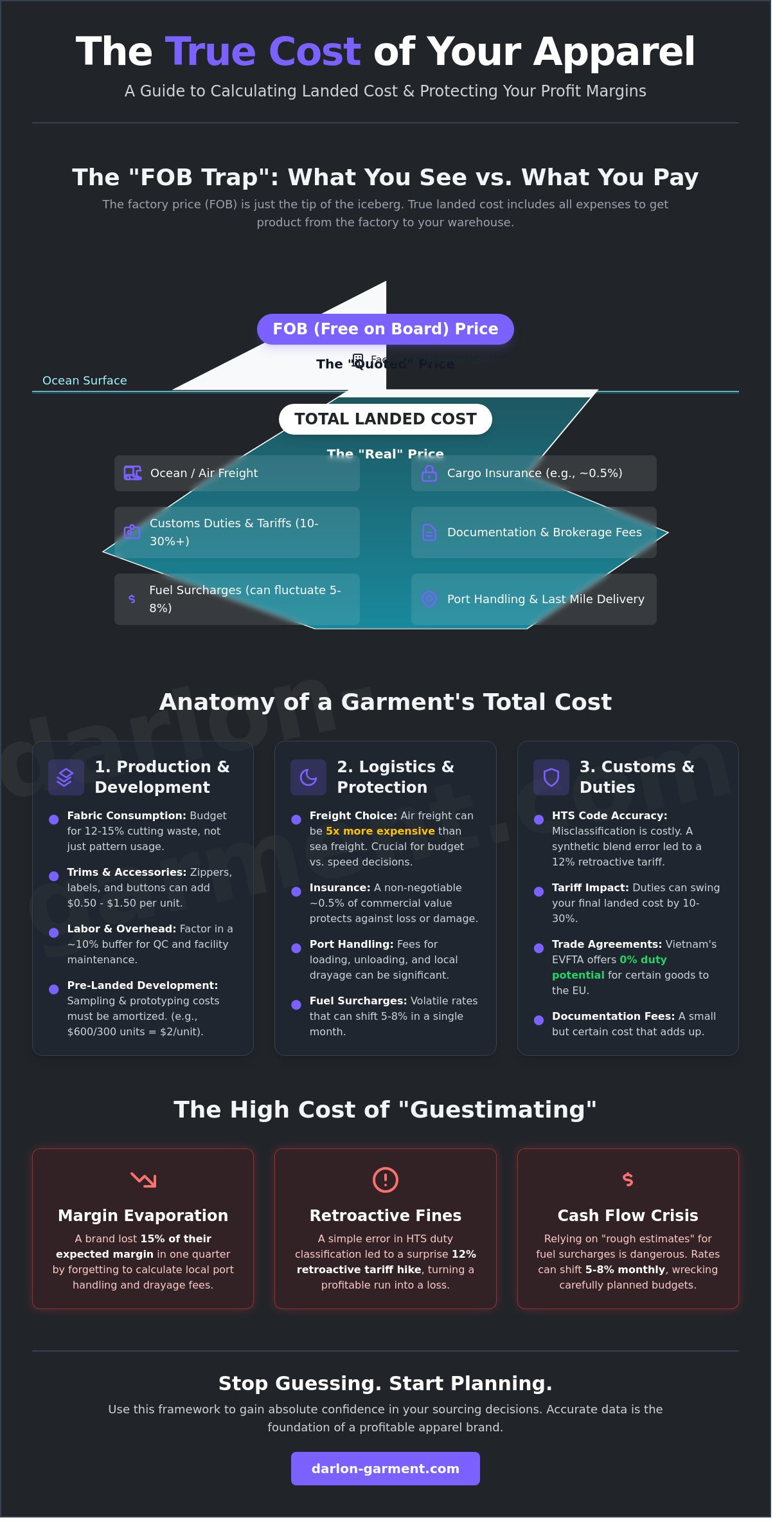
When I sit down with new apparel partners, I often ask for their projected margins. Most point to a spreadsheet showing the factory price and the retail price. I call this the “FOB Trap.” In my 15 years of manufacturing, I have defined the landed cost as the total truth of your garment investment. It is the only metric that actually matters because it represents every cent spent to get a product from our sewing lines to your warehouse shelf.
The Free on Board (FOB) price is just the tip of the iceberg. I recently consulted for a label that lost 15% of their expected margin in a single quarter. They hit their production targets perfectly, but they completely forgot to calculate port handling and local drayage fees. By the time the goods arrived, their profit had evaporated into logistics overhead. For your 2026 retail pricing strategy, calculating landed cost for garments must happen before you ever commit to a purchase order. If you don’t know the final cost, you don’t know your price point.
FOB vs. Landed Cost: The Critical Difference
FOB covers the garment until it is loaded onto the vessel in Ho Chi Minh City. Once that container clears the rail of the ship, the financial responsibility shifts to you. Landed cost follows the garment through the entire journey; it includes ocean freight, insurance, customs duties, and the final truck delivery to your facility. I always recommend calculating these variables before signing a bulk contract. It’s better to realize a project is financially unviable in the planning stage than to find out after 5,000 units are already at sea.
The Hidden Dangers of “Guestimating”
I’ve seen how small errors in duty classification lead to massive fines. In 2024, a client misclassified a synthetic blend and faced a 12% retroactive tariff hike. You also have to watch the fluctuating 2026 fuel surcharges. These rates can shift by 5% to 8% in a single month based on global energy markets. I provide transparent sourcing fees and detailed breakdowns for my clients to help them avoid these specific traps. Accurate data prevents the “sticker shock” that ruins small and mid-sized brands during the peak shipping season. Relying on “rough estimates” is a recipe for a cash flow crisis that most brands can’t survive.
The Anatomy of a Garment Cost: What Goes into the Math?
I’ve spent over 15 years on factory floors, and I’ve seen that calculating landed cost for garments is where most brands lose their margins before a single box leaves the dock. It isn’t just about the price on the invoice; it’s about the invisible math that happens during production. I always tell my partners that the unit price is just the tip of the iceberg. To get an accurate figure, I break costs down into manufacturing, pre-landed development, and the final logistical push.
In Vietnam, factory overhead and labor costs are influenced by technical efficiency. While labor remains competitive in 2026, the complexity of your design directly dictates the minutes spent on the sewing line. I factor in a 10% buffer for factory overhead to cover quality control and facility maintenance. I also treat sampling and prototyping as a “pre-landed” expense. If I spend $600 on three rounds of samples for a small 300-unit run, that’s an additional $2 per garment that must be accounted for in my final math.
Material and Production Fees
Fabric consumption is never a 1:1 ratio. If a pattern requires 1.5 meters of silk, I actually budget for 1.7 meters to account for marker efficiency and cutting waste. This 12% to 15% loss is a standard reality in textile engineering. Trims and accessories, like YKK zippers or custom recycled polyester labels, often add $0.50 to $1.50 per unit. Understanding how garments are made helps you see why a complex pocket or reinforced seam increases the labor minutes and the final bill.
Logistics and Protection
Moving goods in the 2026 market requires a strategic choice between speed and cost. I generally see air freight costing five times more than sea freight, though it’s necessary for tight seasonal launches. Beyond the freight, I never recommend skipping the 0.5% insurance fee; it’s a tiny price to pay for peace of mind during transshipment. You also need to account for port handling and the “last mile” delivery from the port to your specific warehouse, which can fluctuate based on local fuel surcharges.
Trade policy is the final piece of the puzzle. As global trade shifts, brands must adapt to US tariffs to maintain profitability. Whether it’s utilizing specific trade agreements or adjusting sourcing origins, these duties can swing your landed cost by 10% to 30%.
If you’re looking for a partner to simplify this process, you can request a detailed cost breakdown from my team to see exactly how we optimize these variables for our B2B partners.
My Step-by-Step Formula for Calculating Landed Cost
I’ve learned that the secret to a profitable brand isn’t just a high retail price; it’s the precision used when calculating landed cost for garments before the first stitch is even sewn. I use a simple additive formula to keep things transparent: Product + Shipping + Customs + Risk + Overhead. This ensures that no hidden fee surprises me when the shipment arrives at my warehouse. To get this right, I follow a disciplined four-step process that accounts for the volatile nature of global logistics in 2026.
- Step 1: Identify your HTS Code. I never guess on the Harmonized Tariff Schedule code for my garment type. For a 2026 production run of synthetic activewear, for instance, you might use code 6114.30.30. This code dictates your duty rate, which can range from 0% to over 30% depending on the country of origin and current trade agreements.
- Step 2: Calculate volumetric weight. Sportswear and activewear are often lightweight but bulky. I calculate the volume of the cartons and divide by a standard factor, usually 5,000 for international air freight. Carriers charge you for the space you take up, not just the weight of the fabric.
- Step 3: Add hidden percentages. I always include a 2.5% buffer for currency conversion and bank transfer fees. If you’re paying a factory in USD but your business operates in another currency, these small leaks can drain your margins quickly.
- Step 4: Divide by sellable units. Finally, I take the sum of all expenses and divide it by the number of units that actually pass quality control. I don’t divide by the order quantity, but by the final “A-grade” yield.
The Master Formula Explained
I define the core math as: (Unit Price + Freight + Duties + Insurance + Handling) / Total Units. When I calculate the unit price, I make sure to amortize any “Product Development Fees,” such as tech pack creation or sample revisions, across the entire first production run. I’ve also started adjusting my 2026 projections for a 5.2% inflation rate in global shipping lanes. This buffer protects me from sudden fuel surcharges or port congestion fees that have become more common in major trade routes recently. Understanding your total landed cost is the only way to set a retail price that guarantees a healthy 60% or 70% gross margin.
A Practical Example: 1,000 Pairs of Leggings
Let’s look at a real-world scenario for 1,000 pairs of high-compression leggings. I might start with a $10.00 FOB (Free on Board) price from the factory. By the time those leggings reach my door, the cost has climbed to $14.50 per unit. That extra $4.50 isn’t just “shipping.” It breaks down into $1.20 for customs duties, $2.00 for sea freight and local trucking, and $1.30 for miscellaneous costs like insurance and warehouse handling. I’ve found that my choice of fitness wear manufacturer significantly changes these variables. A factory that optimizes carton dimensions can drop that $2.00 freight cost down to $1.60, which adds $400 straight back to my bottom line on a single small order. When calculating landed cost for garments, every centimeter of packaging matters.
The Vietnam Advantage: How Local Trade Deals Lower Your Cost
I’ve spent years refining how my factory operates in Vietnam to give my partners a financial edge. When you’re calculating landed cost for garments, the import duty is often the most volatile variable in your spreadsheet. Vietnam holds a massive lead over other Southeast Asian hubs because of its aggressive trade network. By 2026, the maturity of these deals means the savings are no longer theoretical; they’re substantial and predictable.
For my European partners, the EVFTA is the primary tool I use to protect your margins. Most apparel categories now qualify for 0% duty, provided we follow the strict protocols I’ve established in my production line. Similarly, the CPTPP provides duty-free access to markets in Australia, Canada, and Japan. I don’t just sew your clothes; I act as a consultant to ensure your order meets the specific value-added criteria required by these 11 member nations.
Navigating Trade Agreements
The “Yarn Forward” rule is the most common reason brands fail to get their duty exemptions. It dictates that every stage of production, starting from the yarn spinning, must happen within the trade bloc. I manage this complexity by sourcing thread and textiles from certified local partners. This strategy also helps my US-based clients bypass the 7.5% to 25% Section 301 tariffs that still affect goods coming out of China. I personally oversee the preparation of the Form EUR.1 or Form CPTPP documents, so your customs broker has everything needed to claim your 0% rate without delays.
Local Sourcing and Vertical Integration
I focus on vertical integration to strip out hidden logistics fees. Sourcing elastane fabric locally within Vietnam is a key part of this. When I buy fabric from a mill in the next province instead of importing it from overseas, we save on the 3% to 5% freight cost typically added to raw materials. This also slashes our production lead times by up to 20 days.
Reducing lead time is a direct way to lower your “cost of capital.” If your money is tied up in a production cycle for 90 days instead of 110, you’re paying less interest to your bank. My factory in Chon Thanh is located approximately 80 kilometers from the Cat Lai port in Ho Chi Minh City. This proximity allows me to move finished goods from our quality control floor to a departing vessel in less than a day, ensuring your calculating landed cost for garments remains as low as possible.
Ready to see how Vietnam’s trade deals can improve your bottom line? Request a detailed quote from my team today.
How I Help You Optimize and Lower Your Total Costs
I don’t just manufacture garments; I manage the financial efficiency of your entire supply chain. When calculating landed cost for garments, most brands overlook the hidden expenses that creep in during transit and quality checks. My approach targets these areas directly to ensure your margins remain protected. I’ve seen brands lose 15% of their projected profit because they failed to account for volume inefficiencies, and I make it my mission to prevent that.
Consolidation is one of the most effective tools I use. Bigger is almost always cheaper in global logistics. By consolidating multiple styles or smaller orders into a single shipment, I’ve helped partners reduce their per-unit freight costs by up to 18%. I also focus heavily on optimizing packaging. I design custom boxes that maximize every cubic meter (CBM) of container space. If I can fit 48 units in a box instead of 40 by adjusting the folding method or carton dimensions, your total shipping bill drops significantly over a 10,000-unit production run.
My One-Stop Service model is designed to eliminate the 5% to 10% commission typically taken by sourcing agents or third-party logistics coordinators. You deal directly with me, which simplifies communication and removes unnecessary markups. I also believe that a “Quality First” mindset is a financial strategy. In 2025, I helped a client reduce their return-related losses by 22% by implementing stricter mid-line inspection protocols. When your landed cost includes the price of defects and returns, high quality becomes your cheapest option.
Strategic Sourcing Decisions
I help you decide between CMT and FOB based on your internal team’s strengths. If you don’t have a dedicated logistics department, my FOB services often save you 12% in administrative overhead. I also suggest using natural fibers whenever possible. These materials can sometimes qualify for different duty brackets under specific trade agreements, which I monitor closely. Long-term partnerships are the best cost-saving tool I offer. Stability allows me to lock in raw material prices 6 months in advance, protecting you from market volatility.
Your Next Steps
To move forward, I recommend you take these specific actions to refine your budget:
- Review your current tech packs for weight and volume optimization to ensure we aren’t shipping excess air.
- Request a detailed quote from me that provides a clear breakdown of sourcing versus manufacturing fees.
- Analyze your historical defect rates to see how my quality control standards can lower your total landed expenses.
Accurately calculating landed cost for garments is the difference between a scaling brand and one that’s struggling to stay afloat. Let me help you calculate your next project’s landed cost and find the efficiencies your current factory might be missing.
Secure Your Brand’s Financial Future in 2026
I’ve seen many brands struggle because they treat shipping and duties as an afterthought. Mastering the process of calculating landed cost for garments is more than just a math exercise; it’s the primary way you protect your margins. Since I established Dar Lon Garment in 2019, I’ve helped partners navigate the technical details of global trade to avoid costly surprises. We leverage our specific expertise in EVFTA and CPTPP regulations to help you capitalize on duty-free advantages that many competitors miss. By switching to a one-stop OEM/ODM solution in Vietnam, you simplify your logistics and gain full visibility into every cent spent. I’ve helped brands streamline their production cycles while maintaining the high quality standards required for global export. It’s about making your supply chain work for you rather than against you. I’m here to ensure your next collection is as profitable as it is beautiful.
Ready to get a transparent quote for your next collection? Contact me at Dar Lon Garment today.
I look forward to building a successful partnership with you.
Frequently Asked Questions
What is the most common mistake when calculating landed cost for garments?
The most common mistake I see is overlooking local port surcharges and bank processing fees. These costs often add 3% to 5% to the final price. Failing to account for a $500 port congestion fee can ruin your margins. I always recommend adding a 2% buffer for these unexpected line items when calculating landed cost for garments. It’s better to be safe than sorry.
How do Vietnam trade agreements like EVFTA affect my landed cost?
Trade agreements like the EVFTA can reduce your import duties to 0% over a 7-year phase-out period. For my European partners, this means a 12% saving on most knitted apparel compared to non-treaty countries. You’ll need a Certificate of Origin to qualify. I’ve seen brands save $1.20 per unit just by utilizing these specific trade benefits correctly. It makes Vietnam a very competitive hub.
Does the type of fabric (like polyester vs. cotton) change my customs duties?
Yes, the fiber content changes your HTS classification and duty rate. For example, a 100% cotton T-shirt might carry a 16.5% duty rate, while a polyester version could be taxed at 32% under certain US classifications. I check the exact blend percentages because even a 5% difference in synthetic content can trigger a higher tax bracket. Always double check your fabric composition before finalizing tech packs.
Should I include the cost of samples in my bulk production landed cost?
I don’t include sample costs in the bulk production landed cost because it distorts the per-unit price for repeat orders. Sampling is a fixed R&D expense that I track separately in the initial brand budget. If I spend $1,500 on 5 prototypes, adding that to a 1,000-unit run adds $1.50 per garment. This isn’t an accurate reflection of long-term production costs when you scale up.
How much should I budget for shipping insurance for apparel?
You should budget between 0.3% and 0.7% of your total invoice value for shipping insurance. For a $50,000 shipment, this usually costs around $250. I find it’s a small price to pay for peace of mind. Most of my clients use “All Risk” coverage to ensure they’re protected against theft or damage during the 30-day transit from Vietnam. It’s a non-negotiable step for my shipments.
Can a manufacturer in Vietnam help me find the correct HTS code?
I provide a suggested 6-digit HS code for every garment I manufacture, but you must verify the final 10-digit HTS code with your customs broker. While I know the technical construction of the fabric, the legal responsibility for classification rests with the importer of record. I’ve helped brands navigate these codes for 15 years to ensure they don’t overpay or face penalties from customs.
What is the difference between landed cost and COGS (Cost of Goods Sold)?
Landed cost is the total price of the product once it hits your warehouse, while COGS includes additional business expenses like storage and packaging. I think of landed cost as the delivered price of the inventory. COGS is a broader accounting term that includes your $5,000 monthly warehouse rent and labor costs. These aren’t part of the calculating landed cost for garments process but are vital for your P&L.