

For international brands, the process of selecting a manufacturing partner is often fraught with uncertainty. Verifying quality and ethical standards from afar, navigating complex supply chains, and ensuring a factory possesses the technical mastery for modern performance fabrics can feel overwhelming. The decision to partner with a sportswear factory vietnam represents a strategic move toward a competitive advantage, but only when founded on rigorous evaluation and clear criteria. This guide is designed to eliminate that uncertainty and provide a clear path forward.
Drawing on decades of industry experience, we present a comprehensive framework for 2026 and beyond. Here, you will discover the key benefits of producing in Vietnam, a detailed checklist for vetting potential partners, and critical insights into the production technologies that define superior activewear. Our objective is to equip your brand with the knowledge needed to secure a reliable, long-term manufacturing partner-one committed to the principles of quality, consistency, and on-time delivery.
Key Takeaways
- Learn how Vietnam’s evolution into a high-quality manufacturing hub, supported by key Free Trade Agreements, provides a strategic advantage beyond simple cost savings.
- Implement a structured 5-point vetting process to assess the technical capabilities, quality control, and compliance of any potential sportswear factory in Vietnam.
- Discover the advanced manufacturing technologies, from automated cutting to specialized stitching, that are essential for producing modern, high-performance activewear.
- Gain a clear understanding of the end-to-end production journey, starting with the critical importance of a detailed tech pack to ensure product accuracy.
The Strategic Case for Manufacturing Sportswear in Vietnam
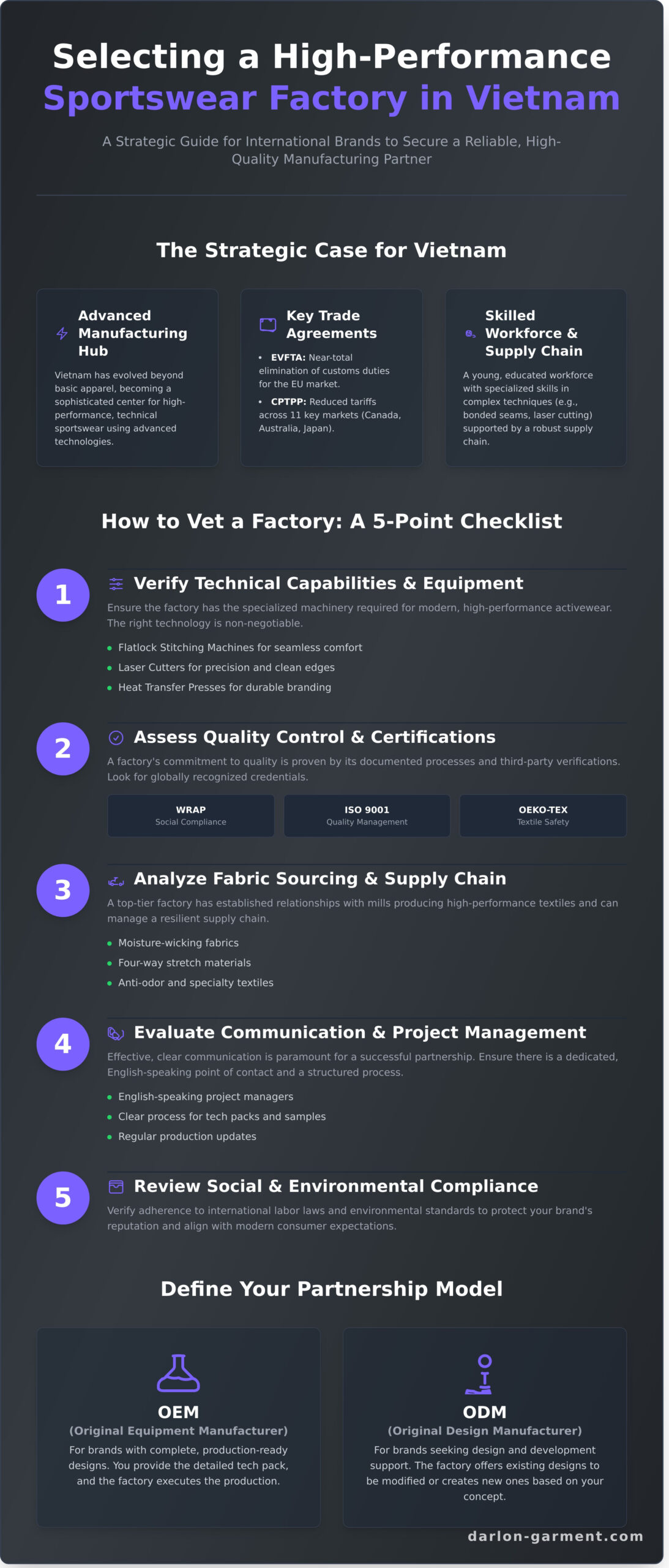
For global brands, the decision to select a sportswear factory in Vietnam has evolved from a cost-reduction tactic to a strategic imperative. The nation has decisively moved beyond its reputation for basic apparel, establishing itself as a sophisticated manufacturing hub for high-performance, technical sportswear. This transition is underpinned by a stable political climate, consistent government investment in infrastructure, and a mature ecosystem built for complex garment production.
Vietnam’s competitive advantage is significantly amplified by its strategic integration into the global economy through key Free Trade Agreements (FTAs). These agreements provide tangible financial and logistical benefits:
- EU-Vietnam Free Trade Agreement (EVFTA): Offers near-total elimination of customs duties, granting Vietnamese-made sportswear preferential access to the lucrative European market.
- Comprehensive and Progressive Agreement for Trans-Pacific Partnership (CPTPP): Reduces tariffs and trade barriers across 11 key markets, including Canada, Australia, and Japan, streamlining export operations.
The country’s young, educated workforce possesses specialized skills in complex manufacturing techniques essential for modern activewear, such as bonded seams, laser cutting, and advanced fabric lamination. This human capital is supported by a robust and vertically integrated supply chain for performance textiles, trims, and accessories. The industry’s scale is demonstrated by major players like the Vietnam National Textile and Garment Group (Vinatex), which anchors a network of specialized suppliers capable of meeting demanding international standards.
Vietnam vs. Other Manufacturing Hubs
While China remains a dominant force, Vietnam offers a critical “China+1” solution for risk diversification and specialization in technical niches. Compared to other Southeast Asian hubs like Bangladesh or Cambodia-which excel in high-volume cotton basics-Vietnam’s infrastructure and workforce are optimized for higher-value synthetic and blended performance fabrics. Vietnam has decisively pivoted from high-volume, low-margin production to becoming the nexus for complex, value-added technical garments.
Key Industrial Zones for Apparel
Strategic manufacturing clusters in southern Vietnam, particularly around Ho Chi Minh City and Binh Phuoc Province, form the country’s industrial core. These zones offer immense logistical advantages, including dense networks of textile mills, trim suppliers, and finishing facilities. Their proximity to major ports like Cat Lai Port ensures streamlined customs clearance and efficient export timelines, reducing lead times for international brands seeking a reliable sportswear factory in Vietnam.
How to Vet a Sportswear Factory: A 5-Point Checklist
Selecting a manufacturing partner is a critical strategic decision. A systematic vetting process ensures your chosen factory possesses the technical mastery and operational integrity required to produce high-quality performance apparel. This 5-point checklist provides a structured framework for evaluating any potential sportswear factory vietnam and mitigating production risks.
- Verify Technical Capabilities and Equipment: Assess the factory’s machinery. Do they have specialized equipment like flatlock stitching machines for seamless comfort, laser cutters for precision, and heat transfer presses for durable branding? The right technology is non-negotiable for modern activewear.
- Assess Quality Control Systems and Certifications: A factory’s commitment to quality is demonstrated through its documented processes and third-party verifications. This is a foundational pillar of a successful partnership.
- Analyze Fabric Sourcing and Supply Chain Management: Inquire about their network of fabric suppliers. A top-tier factory will have established relationships with mills that produce performance textiles (e.g., moisture-wicking, four-way stretch, anti-odor) and can manage a resilient supply chain.
- Evaluate Communication and Project Management: Effective communication is paramount. Confirm they have English-speaking project managers and a clear process for handling tech packs, samples, and production updates. A dedicated point of contact is essential for seamless collaboration.
- Review Social and Environmental Compliance: Verify the factory’s adherence to international labor laws and environmental standards. Ethical and sustainable manufacturing practices protect your brand’s reputation and align with modern consumer expectations.
Certifications and Quality Assurance
Certifications serve as an objective measure of a factory’s operational standards. Look for globally recognized credentials like WRAP (Worldwide Responsible Accredited Production) for social compliance, ISO 9001 for quality management systems, and OEKO-TEX for textile safety. A robust Quality Control (QC) process should include multiple inspection points-from raw material checks to in-line production monitoring and a final AQL (Acceptable Quality Limit) inspection before shipment.
OEM vs. ODM: Defining Your Partnership Model
Understanding service models is key to finding the right fit. Original Equipment Manufacturer (OEM) services are for brands with complete technical designs; the factory acts as a pure production partner. In contrast, Original Design Manufacturer (ODM) services are ideal for brands seeking design support, where the factory provides market-ready styles that can be customized with your branding. Your choice depends on your in-house design capabilities and speed-to-market goals.
Minimum Order Quantities (MOQs) and Pricing
Minimum Order Quantities (MOQs) represent the smallest order a factory will accept per style or colorway. These vary based on the factory’s scale and fabric sourcing requirements. Pricing is a function of multiple variables: fabric composition, garment complexity, order volume, and finishing details. While emerging brands may face higher per-unit costs for smaller batches, an established factory will offer a transparent pricing structure that reflects their commitment to quality and value.
The Production Journey: From Tech Pack to Final Shipment
Understanding the end-to-end manufacturing process is fundamental to building trust and ensuring a successful partnership with a remote factory. The journey from a design concept to a finished garment is a highly structured, multi-stage operation where precision and communication are paramount. It all begins with a detailed technical package, or “tech pack”-the master blueprint that dictates every specification, from fabric composition and color codes (Pantone) to stitch types and measurement tolerances.
Once the tech pack is approved, the key production phases commence, with rigorous quality assurance integrated at every step:
- Material Sourcing & Inspection: Fabrics and trims are procured and subjected to laboratory testing to verify performance, colorfastness, and compliance with brand standards.
- Cutting: Automated and manual cutting processes are used to precisely shape pattern pieces, minimizing material waste and ensuring uniformity.
- Sewing: Garments are assembled on specialized production lines, with inline quality checks performed by supervisors to identify and correct deviations in real-time.
- Finishing & Final QC: The final stage includes trimming loose threads, pressing, attaching labels, and a comprehensive final inspection before garments are individually packed for export.
The Critical Role of Sampling
The sampling stage is the most crucial risk-mitigation phase, preventing costly errors before bulk production is initiated. Each sample serves a distinct purpose, moving from initial concept to a final, approved standard. This iterative process ensures perfect alignment between your vision and the factory’s execution. A typical cycle includes:
- Proto Sample: The first physical interpretation of your design.
- Fit Sample: To confirm and adjust sizing and garment drape.
- Salesman Sample (SMS): A high-quality version for marketing purposes.
- Pre-Production Sample (PPS): The final, perfected sample from which bulk production will be benchmarked.
Navigating Logistics and Export
A proficient sportswear factory vietnam manages not only production but also the complexities of global export. Most transactions are conducted under FOB (Free On Board) terms, where the factory is responsible for transporting goods to the designated Vietnamese port. From there, your freight forwarder manages ocean or air transit, customs clearance, and final delivery. Typical lead times from PPS approval to shipment range from 90 to 120 days, depending on order volume and complexity.
Advanced Technologies in Modern Sportswear Manufacturing
The performance of modern activewear is directly determined by the manufacturing technology behind it. For brands seeking a competitive edge, partnering with a sportswear factory vietnam that has invested in advanced production systems is a non-negotiable requirement. Precision, comfort, and durability are no longer aspirational goals but baseline expectations achieved through technical mastery. Foundational processes like automated and laser cutting ensure absolute accuracy from the first pattern piece to the last, minimizing material waste and guaranteeing design integrity across high-volume production runs.
At the forefront of innovation are construction methods that redefine garment comfort and function. These technologies are central to producing high-value activewear that consumers demand.
Seamless and Bonded Construction
Seamless knitting technology constructs garments from a single, continuous thread, virtually eliminating bulky and irritating seams. This process allows for the integration of different knit structures-such as ventilation zones or compression panels-directly into the fabric. For the end-user, this translates to a superior, second-skin fit with reduced chafing. Similarly, ultrasonic bonding uses high-frequency vibrations to fuse fabric edges, creating flat, flexible, and highly durable seams that are ideal for performance apparel.
- Garments Benefiting Most: Leggings, base layers, sports bras, and compression wear where close-to-skin comfort is paramount.
Specialty Fabric Sourcing and Development
A technically proficient sportswear factory vietnam must demonstrate deep expertise in textile science. This begins with sourcing high-performance fabrics engineered with specific properties like advanced moisture-wicking, 4-way stretch, UV protection, and thermal regulation. Beyond sourcing, our capability extends to custom fabric development, allowing brands to create proprietary materials tailored to their unique performance and aesthetic requirements. Our technical teams are highly experienced in working with a range of advanced materials, from classic polyamide and spandex blends to innovative textiles like Nuyarn performance wool, which offers exceptional strength-to-weight ratios and natural thermoregulation.
Integrating these advanced manufacturing processes is a hallmark of a premier OEM/ODM partner. It ensures that the final product not only meets but exceeds global standards for quality and performance. To learn more about our technical capabilities, we invite you to contact our engineering team.
Partnering with Dar Lon Garment: Your One-Stop Solution in Vietnam
After navigating the complexities of selecting a manufacturing partner, the final step is choosing a factory that not only meets but exceeds every criterion on your checklist. Dar Lon Garment stands as the logical conclusion to this strategic search. With decades of proven experience, we are a leading sportswear factory in Vietnam dedicated to transforming your designs into market-ready, high-performance apparel. Our foundation is built on a commitment to quality, technological innovation, and true partnership, ensuring your brand’s vision is executed with precision.
We understand that your success depends on a reliable and capable supply chain. That is why we have engineered our operations to provide stability and technical mastery, positioning ourselves as the silent, powerful backbone for ambitious global brands.
Our Core Capabilities
We provide comprehensive, end-to-end OEM/ODM services, functioning as a seamless extension of your own operations. Our state-of-the-art production facilities in Ho Chi Minh City and Binh Phuoc are equipped with advanced machinery, including precision laser cutters and automated sewing systems, to guarantee consistency and efficiency at scale. This technological advantage allows us to master the complexities of modern sportswear, activewear, and swimwear. Our material expertise is extensive, covering a wide range of technical fabrics, including performance-enhancing textiles like Nuyarn, to deliver products that meet the highest global standards.
Initiate Your Project with Us
Starting your production journey with Dar Lon is a straightforward and transparent process. To receive a prompt and accurate quotation, we recommend preparing a detailed project brief. Including the following information allows our team to provide a comprehensive proposal:
- Technical Packs (Tech Packs): Complete design specifications, including measurements and construction details.
- Order Quantity: Your estimated volume per style and color.
- Target Price Point: Your desired cost per unit to ensure alignment with your budget.
- Material Requirements: Specifics on fabric composition, weight, and performance features.
Once your brief is prepared, our team is ready to engage. Ready to elevate your apparel line? Discuss your sportswear project with our experts.
Your Strategic Next Step in Sportswear Production
As this guide has demonstrated, selecting the right manufacturing partner in Vietnam is a critical strategic decision that will define your brand’s trajectory into 2026. Success hinges on a comprehensive vetting process, a clear understanding of the complex production lifecycle from tech pack to final shipment, and partnering with a factory that has invested in advanced technological capabilities. Choosing the right sportswear factory vietnam is not merely a logistical choice; it is a foundational investment in the quality, reliability, and innovative potential of your product line.
At Dar Lon Garment, we embody these principles of operational excellence. As dedicated specialists in high-performance sportswear, we leverage advanced manufacturing technologies-including precision laser cutting and seamless bonding-to meet the most exacting standards of leading global brands. Our comprehensive one-stop OEM/ODM services are meticulously structured to manage every facet of your production, ensuring a seamless, transparent, and efficient supply chain from start to finish.
Take the definitive step toward elevating your production capabilities. Request a consultation to discuss your manufacturing needs.
We are prepared to become the silent, powerful backbone for your brand’s success in 2026 and beyond.
Frequently Asked Questions
What is the typical Minimum Order Quantity (MOQ) for a sportswear factory in Vietnam?
Minimum Order Quantities (MOQs) in Vietnam typically range from 500 to 1,000 units per style, per colorway. This figure is influenced by the factory’s scale and the complexity of the fabric and design specifications. Established, high-capacity facilities may require higher commitments to optimize production line efficiency. For specialized technical garments, MOQs can be subject to negotiation based on material sourcing requirements and the potential for a long-term manufacturing partnership.
Is it cheaper to manufacture sportswear in Vietnam than in China?
While Vietnam’s labor costs are often more competitive, the total landed cost must be carefully evaluated. Factors such as raw material sourcing, logistical infrastructure, and factory efficiency play a significant role. For many brands, Vietnam presents a favorable cost structure, particularly when factoring in benefits from international trade agreements. A comprehensive cost analysis should extend beyond the per-unit price to include all supply chain variables for an accurate comparison.
How long does it take to produce and ship a clothing order from Vietnam?
A standard production and delivery timeline from Vietnam is approximately 12 to 20 weeks. This schedule typically includes 4-6 weeks for sample development and approval, 60-90 days for bulk manufacturing, and 3-5 weeks for sea freight to North America or Europe. Air freight can significantly reduce transit time but at a higher cost. These lead times are contingent upon factors such as order volume, design complexity, and material availability.
What are the main advantages of choosing a Vietnamese garment factory?
Key advantages include access to a highly skilled workforce with a strong tradition in textile craftsmanship, resulting in superior quality for complex sportswear. Vietnam also offers competitive production costs and benefits from numerous free trade agreements (e.g., EVFTA, CPTPP), which can reduce tariffs for global brands. The country’s stable political environment and rapidly developing infrastructure further enhance its position as a reliable manufacturing hub for the global apparel industry.
How do I ensure the quality of my products when manufacturing remotely in Vietnam?
Product quality is ensured through a rigorous, multi-stage quality assurance (QA) protocol. This begins with a comprehensive technical package and the approval of pre-production samples. During manufacturing, in-line inspections are conducted at critical stages to identify and rectify deviations. A final random inspection, often based on AQL standards, is performed before shipment. Partnering with a factory that holds certifications like ISO 9001 and provides transparent reporting is fundamental to maintaining quality control.
What types of sportswear can Vietnamese factories specialize in?
A reputable sportswear factory in Vietnam typically possesses the technical capabilities to produce a wide range of performance apparel. Specializations include cut-and-sew knitted garments like leggings, t-shirts, and polo shirts, as well as more complex items such as seamless activewear, compression garments, and bonded or waterproof outerwear. Many facilities are equipped for advanced fabrications and finishing techniques required for high-performance athletic and outdoor clothing lines.
Do I need to visit the factory in Vietnam before starting production?
While not strictly mandatory, a site visit is highly recommended to conduct due diligence and build a strong supplier relationship. An in-person visit allows you to verify the factory’s production capacity, quality control systems, and ethical standards firsthand. If a physical visit is not feasible, alternatives include engaging a reputable local sourcing agent, requesting a comprehensive factory audit report, or participating in a detailed virtual tour of the facilities.
How is intellectual property (IP) protected when working with Vietnamese manufacturers?
Intellectual property protection is primarily managed through robust legal agreements. It is standard practice to execute a detailed Non-Disclosure Agreement (NDA) before sharing any proprietary designs or technical specifications. Furthermore, a comprehensive Manufacturing Agreement should clearly outline IP ownership, usage restrictions, and consequences for breaches. Partnering with established manufacturers who have a proven track record with international brands significantly mitigates IP risks, as their reputation relies on upholding these commitments.