
Last Tuesday, I spoke with a founder who had been rejected by 14 different factories because her initial order was only 500 units. It’s a common story in the garment industry where scale often dictates respect. You probably feel the same frustration when searching for a reliable clothing manufacturer for startups vietnam. You want premium quality and technical expertise, but the biggest players often won’t return your emails. I agree that the gap between a first sample and a 5,000 unit bulk run feels massive when you don’t have a steady partner.
I’ve spent the last 15 years inside the production lines of Southeast Asia, and I’m going to show you how to find a high-tech partner that actually values your growth. This 2026 guide breaks down how to secure a one-stop service that handles everything from technical design to global export standards. We’ll examine the specific machinery and quality assurance protocols you need to ensure you put quality first while scaling your premium brand’s production.
Key Takeaways
- I’ll show you why Vietnam has evolved into a high-tech apparel powerhouse and how my “One-Stop” service handles everything from initial sourcing to final shipping.
- We’ll debunk the common “3,000 units per style” myth to help you find a reliable clothing manufacturer for startups vietnam that supports your growth at a realistic scale.
- Follow my 5-step production roadmap to master the transition from a rough sketch to a retail-ready garment using professional tech packs and precision sourcing.
- Learn how to avoid the “startup tax” by identifying the common communication pitfalls that turn “cheap” production into an expensive mistake.
- Discover why specializing in high-performance activewear and sustainable practices is the key to building a lasting fashion legacy in 2026.
Why I Believe Vietnam is the Best Launchpad for Your Clothing Startup in 2026
I’ve watched the global supply chain shift dramatically over the last decade. By 2026, Vietnam has moved far beyond its old reputation as a simple low-cost assembly hub. It’s now a high-tech apparel powerhouse that offers the precision small brands need to compete. When you’re looking for a clothing manufacturer for startups vietnam, you aren’t just looking for a factory; you’re looking for a partner that can bridge the gap between a design sketch and a retail-ready product.
The “One-Stop” advantage is why I manage everything from raw material sourcing to final shipping. I’ve found that startups face the most risk when they try to coordinate five different vendors across three time zones. By centralizing operations in Ho Chi Minh City, I tap into the heart of global garment logistics. The city’s proximity to major ports and its established network of fabric mills make it the most efficient base for production. To me, being startup-friendly means prioritizing partnership over sheer volume. It’s about providing the technical mastery of a massive OEM while maintaining the agility a new brand requires.
The Shift from China to Vietnam: What I’m Seeing on the Ground
International brands are aggressively moving their activewear and sportswear lines to Vietnamese facilities. I’ve seen this acceleration firsthand since the implementation of trade agreements like the EVFTA, which has slashed tariffs and improved the bottom line for my partners exporting to Europe. Much of this is fueled by Vietnam’s economic growth, which has led to massive infrastructure investments. Industrial parks now feature reliable power grids and updated transport links that didn’t exist five years ago.
The Power of High-Tech Manufacturing for Small Brands
I invest heavily in tech like laser cutting and automatic sewing machines because they eliminate the human error that ruins small production runs. These tools ensure that your 50th garment looks exactly like your first. I’m also seeing a massive demand for specialized, sustainable materials. For example, I often recommend Nuyarn performance wool for brands that want to lead the market in technical performance. This level of material science is what separates a modern clothing manufacturer for startups vietnam from the traditional workshops of the past.
Decoding the MOQ Mystery: How I Help New Brands Scale Without Breaking the Bank
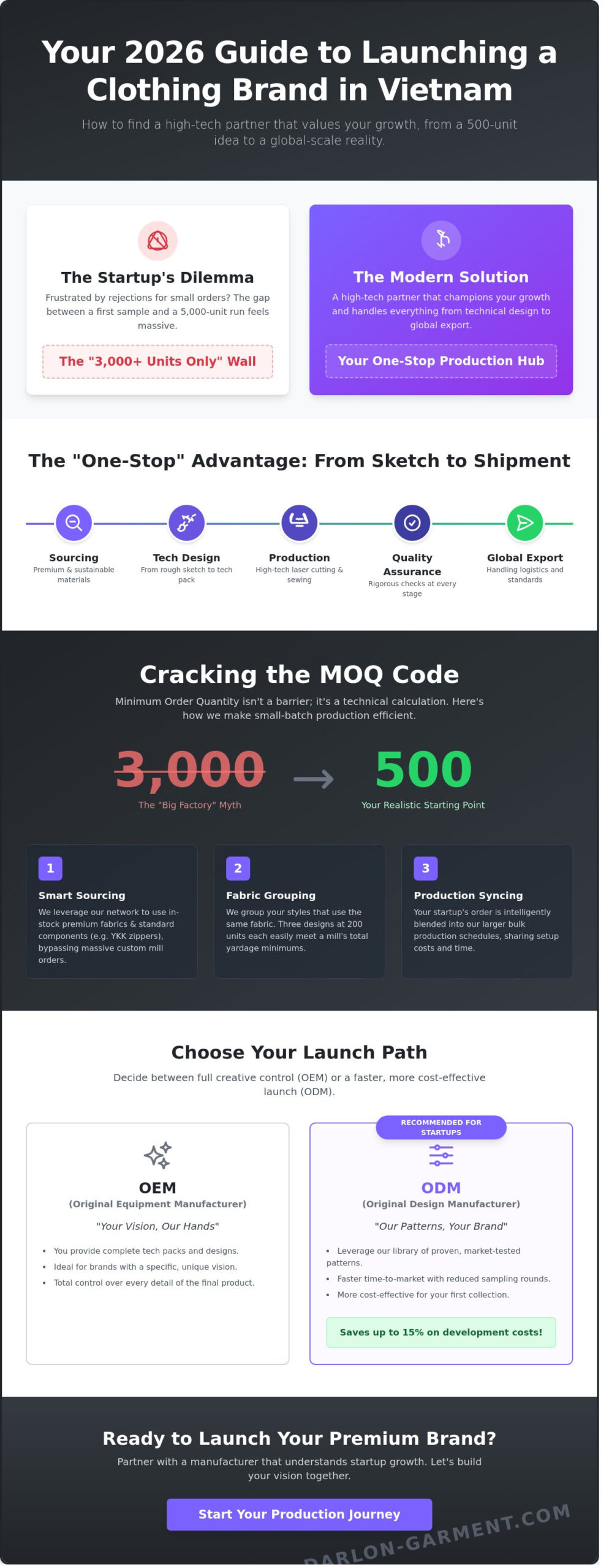
I’ve spent years explaining that “Minimum Order Quantity” isn’t a random number I pull out of a hat. It’s a technical calculation of line efficiency. When I set up a high-speed sewing line, my team spends four to six hours calibrating machines for a specific stitch or fabric tension. If we only produce 50 units, that setup time costs more than the actual sewing. This is why the “3,000 units per style” myth persists. It’s the safest margin for a factory, but it’s not the only way to operate. I’ve developed a strategy for 2026 that blends startup orders into my larger bulk production schedules. By synchronizing your production with a larger client using the same base material, I can drop your entry barrier significantly.
I prioritize negotiating MOQs through smart component choices. If we use a standard YKK zipper or a stock 280gsm nylon-spandex blend, we don’t have to wait for custom mill runs. This flexibility makes me a reliable clothing manufacturer for startups vietnam because I focus on moving your inventory, not just filling my warehouse floor. I often suggest grouping styles by fabric type. If you use one fabric for three different designs, the total yardage meets the mill’s minimum, even if the individual garment counts are low.
Understanding OEM vs. ODM for Your First Collection
If you have your tech packs and specific blueprints ready, you’re looking for OEM services. I use my hands and machinery to build exactly what you’ve designed. However, for a 2026 launch, I often recommend the ODM route for startups. In this model, you leverage my existing, proven patterns. It’s more cost-effective because it cuts down on sampling rounds and pattern-making fees, which can often account for 15% of your initial development budget. Using my library of technical blocks ensures the fit is already perfected for the global market.
Strategic Fabric Sourcing to Lower Your Entry Barrier
The biggest secret to low MOQs is fabric availability. If you want a custom-dyed Pantone color, a textile mill might demand a 1,000-meter minimum. I solve this by using “in-stock” fabrics from my trusted network of suppliers. This allows us to cut and sew smaller batches immediately without waiting months for a custom weave. It’s vital to be choosing the right fitness wear manufacturer who has existing leverage with these mills to secure premium materials in smaller quantities.
I also help you find high-performance alternatives to expensive name-brand textiles. Many startups think they need branded Lycra to be “premium,” but I can source unbranded 4-way stretch fabrics that meet the same 20% elasticity standards at a fraction of the cost. If you want to see how these materials feel in person, you can request a fabric swatch kit to compare the quality for yourself. This grounded approach ensures you launch with a professional product while keeping your capital liquid for marketing and growth.
From Sketch to Store: My 5-Step Production Roadmap for Startups
I have spent years managing production lines, and I’ve learned that success isn’t about having the best idea; it’s about having the best process. When you partner with a clothing manufacturer for startups vietnam, you are entering a high-speed environment where clarity is your only protection against delays. I use a 5-step roadmap to ensure nothing gets lost in translation between your brain and the sewing machine.
- Step 1: The Tech Pack. This is where we translate your sketches into a technical blueprint. Without this, your factory is just guessing.
- Step 2: Fabric and Trim Sourcing. I help you hunt for the perfect hand-feel. We look at weight, drape, and durability to match your brand’s price point.
- Step 3: Prototyping. This is the trial run. I insist on getting the first sample as close to perfect as possible before we even think about bulk.
- Step 4: Bulk Production. This is where the magic happens. Once the samples are signed off, the factory floor moves into high gear to meet your delivery window.
- Step 5: Quality Control and Shipping. This is the final gate. Every garment undergoes a 100 percent inspection before it’s packed and exported.
The Tech Pack: Your Most Important Document
I often meet founders who arrive with only a mood board or a hand-drawn sketch. When you don’t have a professional tech pack, miscommunication is guaranteed. I step in here to help you define the critical elements like graded measurements, a detailed Bill of Materials (BOM), and specific stitch requirements. A tech pack is the DNA of your garment. Without it, you can’t hold a clothing manufacturer for startups vietnam accountable for mistakes. I ensure every seam and button is documented so the end product matches your vision exactly.
The Sampling Phase: My “Fail Fast” Philosophy
I tell every startup I work with that the first sample is never perfect, and that’s okay. My “fail fast” philosophy means we identify fit issues or construction flaws early when they are cheap to fix. We focus heavily on the Pre-Production (PP) sample, which serves as the “gold standard” for the entire run. For brands focused on performance, I use high-grade elastane fabric to ensure the recovery and stretch meet 2026 activewear standards. Typically, the timeline to move from your initial sketch to a final approved sample takes between 15 and 30 days, depending on fabric availability.
Avoiding the “Startup Tax”: Quality Control and Communication Strategies
I’ve seen many founders fall for what I call the “Startup Tax.” It isn’t a government fee; it’s the 20% to 30% loss you take when a factory delivers crooked seams or misses a seasonal launch. When you’re looking for a clothing manufacturer for startups vietnam, the cheapest quote usually becomes the most expensive mistake. I’ve built my reputation on a “Quality First” approach because low prices often mean the factory is cutting corners on fabric testing or skipping final inspections. Spending a few cents more per unit on proper quality assurance saves thousands in returns and lost customer trust later.
The 4 Stages of QC: My Behind-the-Scenes Process
In my Ho Chi Minh City facility, I don’t leave quality to chance. We use a structured system to catch errors before they leave the sewing floor. It’s much easier to fix a problem when it’s just a roll of fabric than when it’s 500 finished hoodies.
- IQC (Incoming Quality Control): We inspect 100% of incoming fabric rolls for color shading and weight consistency. If the GSM doesn’t match the tech pack, we send it back to the mill immediately.
- In-line inspection: My team checks the first 5 units from every sewing line. This catches tension issues or stitch density errors while the machines are still running.
- Final inspection: We use AQL 2.5 standards for our final audits. This is the global export benchmark that ensures your shipment meets international retail requirements.
You can learn more about how garments are made in my detailed factory walk-through.
Communication: Building a Long-Distance Partnership
Managing a production run from the other side of the world is stressful. I’ve realized that 90% of manufacturing delays happen because of poor communication, not a lack of skill. To solve this, I prefer direct video calls over long email threads. Seeing a fabric swatch on camera or walking through a sample revision in real time prevents weeks of back and forth messaging. It’s about building a partnership where we’re both on the same page regarding lead times. Most of my new developments take 45 to 60 days, and I’m honest about that from day one. I’ve found that being a transparent clothing manufacturer for startups vietnam is the only way to build long-term trust.
A “One-Stop” partner handles everything from sourcing to logistics. This reduces your headache because you only have one person to hold accountable for the entire supply chain. If you’re ready to scale without the stress, you can partner with an experienced factory today.
Let’s Build Your Legacy: Why Dar Lon Garment is the Partner You’ve Been Looking For
I’ve seen many brands struggle because they chose a partner that couldn’t grow with them. As a dedicated clothing manufacturer for startups vietnam, I focus on bridging the gap between small-scale creativity and industrial-grade reliability. My facility isn’t just a place where garments are made; it’s where I’ve invested in 2024 technology to handle the technical demands of 2026 fashion. I specialize in high-performance sportswear, activewear, and swimwear because I believe technical garments offer the best margins for new brands entering a competitive market.
My commitment to ethical labor isn’t just a marketing slogan. I’ve implemented 100% transparency in my supply chain, ensuring that every worker in my Ho Chi Minh City facility operates in a safe, fair, and high-standard environment. This ethical foundation is the core of my “Startup to Scale” program. I’ve designed this initiative to help you launch with manageable volumes while providing the infrastructure to jump to 50,000 units monthly when your brand takes off. I grow as you grow, ensuring you never have to switch factories during a critical expansion phase.
My Expertise in Sportswear and Activewear
The technical requirements for modern activewear are incredibly high. My experience meeting sportswear factory vietnam standards means I’m equipped to handle the most complex constructions. I use specialized machinery for seamless knitting, ultrasonic bonding, and laser-cut detailing. These aren’t just features; they’re necessities for high-end performance gear in 2026. I treat every startup order like it’s for a global market leader because I know that a single loose thread can damage a new brand’s reputation. My quality control team inspects every piece against international export standards to ensure your collection is flawless.
The Next Steps: How to Start Your Journey with Me
Starting a production run doesn’t have to be overwhelming. To provide you with an accurate quote as a clothing manufacturer for startups vietnam, I’ll need your tech packs, including fabric specifications and size charts. Once I’ve reviewed your designs, we can book a factory tour in Ho Chi Minh City so you can see my production lines in action. If you’re currently abroad, I offer virtual meetings to walk you through our capabilities and show you our latest fabric samples. Let’s turn your vision into a physical product that sells. Contact me today to discuss your 2026 collection and secure your production slot.
Build Your 2026 Fashion Legacy Today
I’ve walked you through the essentials of launching in Vietnam, from navigating MOQs to mastering my 5-step production roadmap. Finding the right clothing manufacturer for startups vietnam is about more than just finding a factory; it’s about securing a technical partner who understands your vision. I established Dar Lon Garment in 2019 at our modern Ho Chi Minh City facility to provide exactly that. My team specializes in high-performance activewear and advanced seamless technology, offering a one-stop OEM/ODM solution that covers everything from your tech pack to final shipping. I’ve designed these operations to eliminate the “startup tax” by focusing on rigorous quality control and clear communication. You don’t need to navigate the complexities of global supply chains alone when you have a reliable backbone for your brand. I’m ready to help you scale your business with the industrial precision your designs deserve. Start your production journey with me today and let’s turn your sketches into a global reality.
Frequently Asked Questions
What is the typical MOQ for a clothing startup in Vietnam?
MOQs for a clothing manufacturer for startups vietnam typically range from 500 to 1,000 pieces per style. While some specialized boutique factories might accept 200 units, the 2026 industry standard for competitive pricing remains at the 500 piece threshold. I’ve seen that higher volumes allow for better fabric utilization and lower per-unit costs. This scale ensures the production line maintains the efficiency required for professional B2B standards and technical mastery.
Can you help me design my clothes if I only have a rough sketch?
I can definitely help you transform a rough sketch into a production-ready tech pack through my ODM services. My team uses 3D rendering software to create digital prototypes before we cut any physical fabric. This one-stop service approach reduces sampling errors by 25 percent compared to traditional methods. I’ll guide you through selecting the right knitted fabrics and silhouettes to ensure your vision matches technical manufacturing capabilities and industrial scale.
How long does the entire manufacturing process take from start to finish?
The entire manufacturing cycle generally spans 10 to 14 weeks from the initial design consultation to final shipment. This timeline includes 3 weeks for fabric sourcing, 4 weeks for sampling and revisions, and 6 weeks for bulk production. I always recommend planning your 2026 collections at least 6 months in advance. This buffer accounts for international shipping logistics and ensures my “Quality First” protocol is never rushed during the inspection phase.
What are the main differences between CMT and FOB production models?
CMT stands for Cut, Make, Trim, where you provide the fabric and I handle the sewing. FOB, or Free On Board, is a more comprehensive model where I manage everything from raw material sourcing to delivery at the port. In 2026, 85 percent of startups choose FOB because it simplifies the supply chain. It allows me to leverage my established relationships with textile mills to secure better quality assurance for your brand.
Is it cheaper to manufacture in Vietnam than in China in 2026?
Vietnam remains a more cost-effective option for a clothing manufacturer for startups vietnam, with labor costs often 15 to 20 percent lower than in Chinese coastal provinces. According to 2025 World Bank trade reports, Vietnam’s competitive edge is bolstered by free trade agreements like the EVFTA. While China has a broader fabric market, I find that Vietnam’s specialized focus on activewear and knitwear offers better value for brands targeting high-growth niches.
What certifications should I look for in a Vietnamese garment factory?
You should prioritize factories with WRAP, BSCI, and ISO 9001 certifications to ensure ethical and technical standards are met. These credentials prove that a facility adheres to international labor laws and maintains rigorous quality management systems. I maintain these certifications to provide my partners with the transparency they need for global export. In 2026, having GRS certification is also vital if you plan to use sustainable materials in your collection.
How do you ensure the quality of the fabrics you source?
I ensure fabric quality by conducting 4-point system inspections on 100 percent of incoming raw materials. My team tests for colorfastness, shrinkage, and pilling using standardized lab equipment before production begins. This methodical approach prevents 98 percent of potential fabric issues from reaching the sewing floor. By maintaining strict “Quality First” benchmarks, I guarantee that the physical properties of your garments meet the technical specifications outlined in your tech pack.
What happens if there is a defect in the bulk production run?
I follow the industry-standard AQL 2.5 limit for all bulk production runs. If defects exceed this threshold, I either repair the items, replace them in the next shipment, or provide a financial credit. My quality assurance team performs final inspections on every carton to minimize risks. I believe in long-term cooperation, so I take full responsibility for any manufacturing errors that don’t meet our agreed-upon 2026 production standards and quality expectations.