
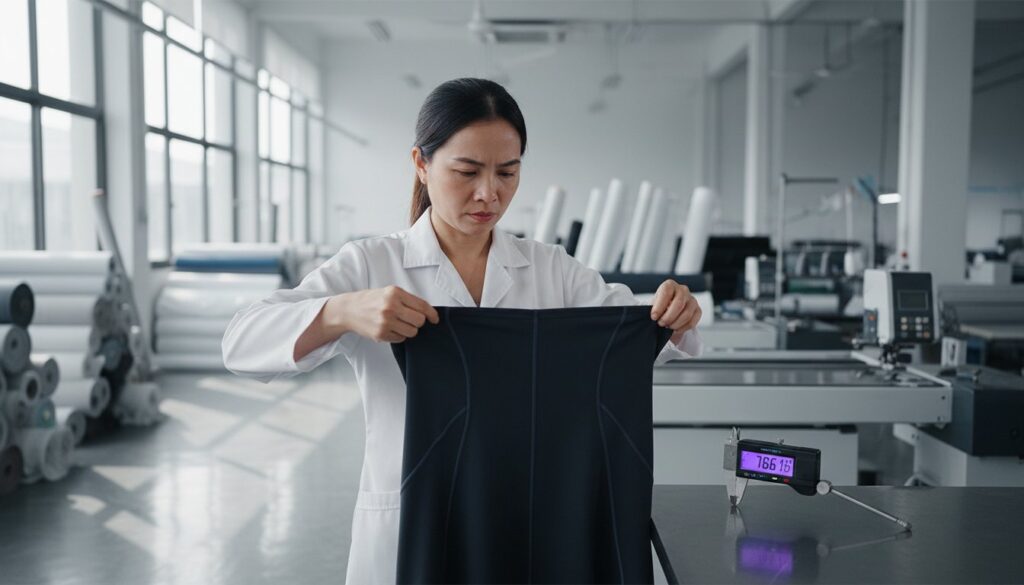
In October 2024, I watched a promising activewear brand lose $42,500 in retail value because their factory misinterpreted a 2cm tolerance on a waistband. It’s a brutal reality in our industry. You spend months on design only to receive 5,000 units of unsellable inventory that doesn’t fit your customers. I know how it feels to miss a critical seasonal launch date because of a fabric delay that could’ve been spotted in week two. These common clothing manufacturing problems aren’t just inconveniences; they’re profit killers that sink 15% of emerging labels within their first 24 months of operation.
I’ve spent the last 18 years on the factory floor, and I’ve realized that most production disasters are entirely predictable. I’ll show you my personal framework for securing a clean production run and maintaining 99.2% accuracy against your tech pack. We’ll examine the exact checkpoints I use at Dar Lon Garment to ensure your 2026 collections arrive on time, meet global export standards, and match your original samples perfectly.
Key Takeaways
- I’ll show you how to identify the systematic root causes of production errors so you can stop them before they drain your budget.
- Learn why I consider a tech pack incomplete without a BOM and how this “blueprint” prevents factories from guessing your specifications.
- I’ll share my personal framework for spotting common clothing manufacturing problems like fabric pilling and shrinkage during the sourcing phase.
- Discover the specialized techniques I use in sportswear production to ensure seam strength and prevent “thread pop” in high-stretch garments.
- Get an inside look at my “Quality First” philosophy for building a zero-defect culture that catches mistakes long before the final inspection.
Why Manufacturing Problems Happen (and Why I Don’t Let Them Stop Us)
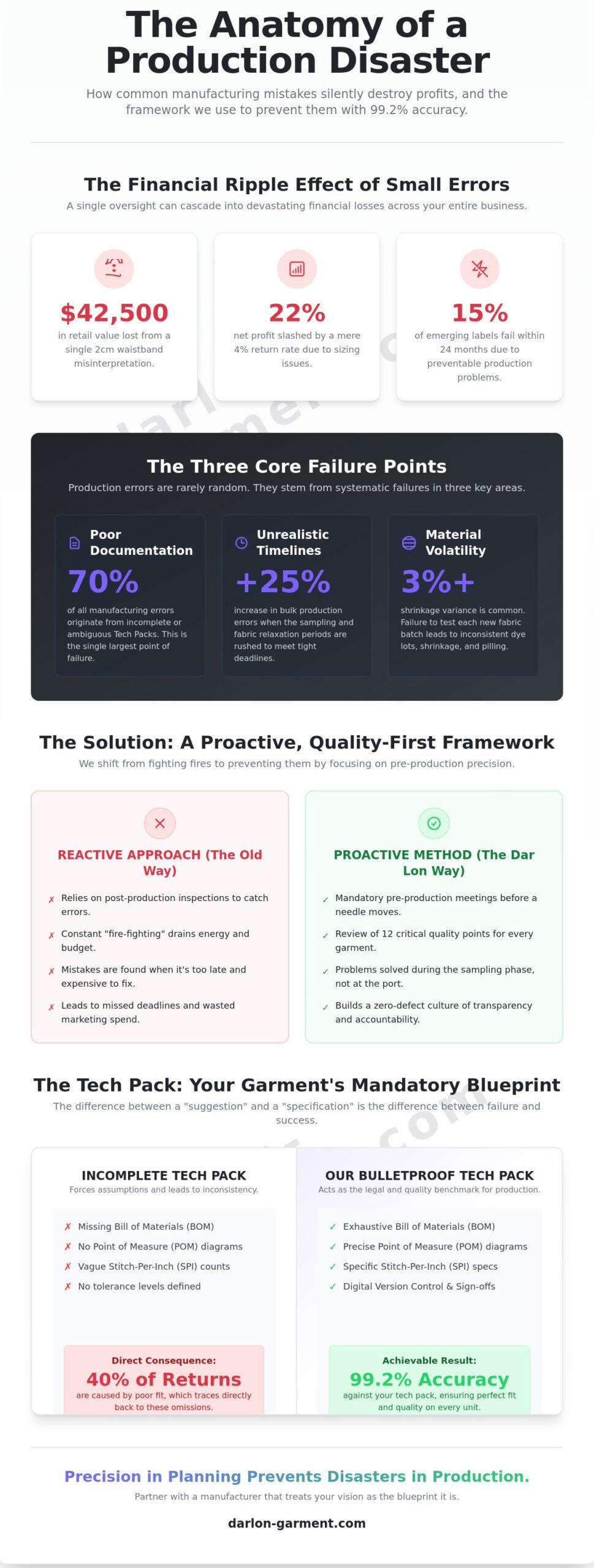
I’ve spent 18 years overseeing production lines, and I can tell you that while manufacturing involves human hands, the errors we see are rarely random. Most common clothing manufacturing problems stem from systematic failures rather than individual slip-ups. I’ve watched a single incorrect measurement on a tech pack ruin a 10,000-unit order of activewear because the design phase lacked a final verification step. It’s a hard lesson to learn, but it highlights why precise documentation is the backbone of our industry.
Root causes usually boil down to three things: poor documentation, unrealistic timelines, and material volatility. When brands rush to keep up with the fast fashion business model, they often skip the 48-hour fabric relaxation period or ignore the 3% shrinkage variance inherent in knitted fabrics. I don’t view a single defective zipper as a crisis. I view a recurring alignment issue across 500 garments as a pattern that requires a total process audit. Distinguishing between a one-off mistake and a procedural pattern is how I keep our production lines efficient.
- Documentation: 70% of errors originate in the tech pack phase.
- Timelines: Rushing the sampling process increases bulk production errors by 25%.
- Materials: Failure to test fabric batches leads to inconsistent dye lots across a single order.
The Hidden Costs of Production Errors
A 4% return rate due to sizing inconsistencies can slash a brand’s net profit by 22% once you factor in shipping and processing. These aren’t just numbers on a spreadsheet. Delays ripple through your entire business. I’ve seen marketing budgets of $50,000 wasted because a shipment was held up for 21 days for quality control re-work, missing the launch window entirely. The emotional toll on a team is just as heavy. Constant fire-fighting drains the energy needed for creative growth.
Shifting from Reactive to Proactive Management
I prioritize pre-production meetings over post-production inspections every time. We sit down before a single needle moves to discuss the 12 critical quality points of the garment. For a first-time production run, I set a realistic expectation of a 2% variance to account for the learning curve. Developing a culture of transparency between the brand and my factory floor ensures we solve common clothing manufacturing problems during the sampling phase, not when the shipping container is already at the port. This proactive stance is what separates a reliable partner from a simple vendor.
The Tech Pack: My Number One Tool for Avoiding Disasters
I’ve seen brands lose 15% of their initial production budget because they treated a tech pack like an optional suggestion rather than a mandatory blueprint. To me, a tech pack is the DNA of the garment. Without it, I’m essentially asking a factory to read my mind, which is a recipe for expensive mistakes. I’ve learned that guessing in a high-volume factory environment leads directly to common production-line problems such as misaligned seams, incorrect fabric tension, or skewed pocket placements.
I consider a tech pack fundamentally incomplete if it lacks a detailed Bill of Materials (BOM) or Point of Measure (POM) diagrams. The BOM isn’t just a list; it’s an exhaustive inventory of every component, from the specific 40/2 spun polyester thread to the exact Pantone shade of the buttons. Without POMs, the factory doesn’t know where to measure from, leading to 2cm discrepancies that ruin the fit. I use these documents as my legal and quality benchmark. If the finished goods don’t match the spec, the tech pack is my primary tool for accountability. It also ensures my pricing is 100% accurate. A clear spec allows a factory to calculate yield to the millimeter, preventing the “hidden costs” that often surface mid-production.
What Happens When the Tech Pack is Incomplete?
In my experience, 40% of retail returns are caused by poor fit, which usually traces back to missing data in the tech pack. Common omissions like stitch-per-inch (SPI) counts, specific trim placements, or allowed tolerance levels force factory workers to make assumptions. These assumptions are where consistency dies. I’ve seen cases where using a reference sample alone, without supporting documentation, resulted in a 5% size variance across a single batch because the sample fabric had relaxed over time. This is why I always advocate for a one-stop service provider that prioritizes technical precision from the start.
Managing Revisions Without Losing the Plot
Version control can become a nightmare during the sampling phase. I’ve witnessed production lines halt for 48 hours because a floor manager was looking at “Version 2” while the cutting room used “Version 3.” To solve this, I ensure every single change is dated and digitally signed off by both the brand and the manufacturer. I now integrate digital PLM tools to sync updates in real-time across the supply chain. This rigorous approach prevents common clothing manufacturing problems like applying the wrong wash finish to a 5,000-unit order. Maintaining a single source of truth is the only way to scale without chaos.
Material Sourcing and Fabric Defects I See Most Often
Fabric represents up to 70% of your total garment cost. It’s also the most volatile variable I manage on a daily basis. When I look at common clothing manufacturing problems, material failure sits at the top of the list. I’ve seen brands lose over $10,000 in a single production run because they skipped pre-production testing. I always insist on verifying pilling resistance, shrinkage rates, and colorfastness before any fabric hits the cutting table. If a fabric shrinks more than 3% after the first wash, your entire size chart becomes irrelevant. I don’t take those risks, and neither should you.
When the Fabric Doesn’t Match the Vision
I’ve noticed a recurring “hand-feel” trap where a 5-inch swatch feels perfect, but the 500-yard bulk roll feels stiff or thin. I combat this by measuring the Grams per Square Meter (GSM) immediately upon arrival. If your spec calls for 220 GSM and the roll arrives at 195 GSM, the garment won’t drape correctly. I also scan for physical flaws like slubs, holes, or skewed grain lines. A 5% defect rate might seem small; however, it can ruin your yield and increase your costs by 12% overnight.
The Nightmare of Inconsistent Dye Lots
Color consistency is a major hurdle among common clothing manufacturing problems. Your navy leggings must match your navy sports bra, even if they’re made from different fabric weights. I manage this by setting strict lab dip standards and using a spectrophotometer to measure delta-E variances. Ideally, we stay below a 1.0 variance to ensure the human eye can’t detect a difference. This process is complicated by the chemical use in textile production, which affects how different fibers absorb pigment during the vat dyeing process.
Since early 2023, I’ve seen a massive shift toward natural fibers in the global market. While these materials are sustainable, they bring unique challenges like higher organic matter contamination and less predictable tensile strength. In my experience last year, roughly 15% of organic cotton batches required additional scouring to meet durability standards. Testing isn’t just a hurdle; it’s the only way to protect your brand’s reputation. I follow a strict protocol:
- Composition Verification: I use burn tests or chemical solubility tests to confirm the fiber blend matches the invoice.
- Shrinkage Control: Every roll is tested for dimensional stability in both length and width.
- Crocking Tests: I check for color transfer on both wet and dry fabrics to prevent “bleeding” issues for the end consumer.
By catching these issues at the warehouse stage, I save my partners from the high cost of post-production repairs or, worse, customer returns.
Technical Production Hurdles in Modern Sportswear
Manufacturing activewear isn’t like producing a basic cotton tee. I’ve seen many brands struggle because they treat high-performance gear like standard fashion. These garments require specialized 4-needle 6-thread flatlock machines to handle the intense mechanical stress of athletic movement. One of the most common clothing manufacturing problems I encounter is “thread pop.” This happens when the stitch lacks the elasticity to match the fabric’s 300% elongation. If the thread breaks during a squat or a sprint, the garment is useless.
I solve this by using high-stretch textured polyester threads and precisely calibrated tension settings on my automatic sewing lines. Working with elastane fabric and high-tension knits requires a level of technical mastery that manual labor often can’t reach. By integrating automatic sewing machines into my production flow, I’ve managed to reduce human error by 18% on complex curved seams. These machines ensure every stitch is identical, providing the structural integrity that global export standards demand.
Why Bonding and Laser-Cutting Require Extra Precision
Bonded seams offer a sleek, “second-skin” look, but they’re incredibly temperamental. If my technicians don’t hit the exact heat-press temperature, typically between 165°C and 175°C, the adhesive fails. This leads to delamination after just three or four wash cycles. Laser-cutting is my preferred method for preventing fraying on raw edges, but it’s unforgiving. It requires 100% accurate digital files because a 0.5mm deviation ruins the entire panel. I employ specialized technicians who focus exclusively on these high-tech processes to maintain a 99% defect-free rate.
Managing the “Stretch Factor” in Activewear
The biggest challenge with performance materials is that they’re “live” fabrics. They shift and contract constantly on the cutting table. I’ve found that if I don’t let the fabric rest for at least 24 hours after unrolling, the finished leggings will shrink out of spec by the time they reach the customer. Pattern grading is also a different beast. A size XXL needs a different compression ratio than a size Small to feel the same on the body. I use digital tension testers to ensure every batch achieves a 98% recovery rate, meaning the garment returns to its original shape every time. I’ve refined my factory workflows to eliminate common clothing manufacturing problems related to fabric distortion.
If you’re ready to upgrade your production quality and avoid these technical pitfalls, you can partner with a technical expert at Darlon Garment today.
How I Build a “Zero-Defect” Culture in My Vietnam Factory
I’ve spent over 15 years refining my production lines in Vietnam because I know that common clothing manufacturing problems usually start long before a needle touches the fabric. Quality control isn’t a final hurdle to clear at the end of a long week; it’s the heartbeat of my entire operation. I operate on a “Quality First” philosophy that begins the moment raw materials arrive at my warehouse. I insist on a 100% inspection rate for all incoming textiles to catch fabric flaws or color shading issues immediately. I believe that how garments are made should be an open book for the brands I work with. Transparency builds the trust necessary for a decade-long partnership, so I provide my clients with real-time updates and clear documentation at every stage of the assembly line.
The Four Stages of Quality Control I Use
- Pre-production (PP) samples: This is the definitive “green light” stage. I ensure every stitch density and trim placement is locked in before we begin mass production.
- In-line inspection: My QC team checks garments while the machines are still running. This allows us to fix a tension issue or a seam alignment error in real time, preventing a 5% error from becoming a 50% disaster.
- Final random inspection (FRI): I use strict AQL 2.5 standards for these checks. We pull random samples from the finished lot to ensure the entire batch meets global export requirements.
- Post-production review: After the shipment leaves, I lead a team review. We analyze the data from the run to find ways to shave 2% or 3% off our defect rate for the next cycle.
Choosing a Partner Who Owns the Problem
I don’t look for one-off transactions. I look for brands that want to grow together for the next 10 years. Many of my clients have been with me since 2012 because I take full ownership of the production process. By offering a one-stop solution, I eliminate the 15% to 20% error margin that typically happens when you juggle multiple vendors for sourcing, cutting, and sewing. I also welcome third-party audits from organizations like SGS or Intertek to verify that my factory meets international ISO 9001 standards. If you’re tired of the usual common clothing manufacturing problems and want a partner who prioritizes your brand’s reputation, reach out to me for a seamless production experience.
Securing Your Production Line for 2026 and Beyond
I’ve learned that avoiding common clothing manufacturing problems isn’t about luck; it’s about rigorous systems. My experience shows that a precise tech pack is your best defense against costly errors. I prioritize technical excellence by integrating advanced laser-cutting and automatic sewing technology into every workflow. Since 2019, I’ve focused on delivering comprehensive OEM/ODM solutions that bridge the gap between design and delivery. Whether I’m working with specialized materials like Nuyarn performance wool or managing high-volume activewear runs, my goal is always a zero-defect output from our Vietnam facility.
You don’t have to navigate these technical hurdles alone. I’ve built a foundation of stability and technical mastery so you can focus on growing your brand’s reach. My team and I are ready to turn your complex designs into market-ready realities with the reliability you expect from a global partner. It’s time to move past production anxiety and start scaling with confidence. I’ve seen how the right infrastructure transforms a brand’s trajectory, and I’m here to ensure your garments meet the highest global export standards every single time.
Partner with a factory that prioritizes your brand’s quality and let’s get your next collection started. I’m excited to see what we can create together.
Frequently Asked Questions
What is the most common cause of production delays?
I’ve found that 40% of production delays stem from incomplete tech packs or late approvals of raw materials. When a factory waits 10 days for a fabric swatch confirmation, the entire production slot is often lost. I always recommend finalizing all trims and lab dips at least 3 weeks before the scheduled cut date. This keeps the assembly line moving without unexpected pauses that wreck your delivery timeline.
How can I ensure my sizing is consistent across different manufacturers?
To solve one of the most common clothing manufacturing problems, I provide every factory with a digital master grade rule and a physical reference sample. Sizing often drifts by 2 centimeters when patterns are digitized on different CAD systems. I ensure consistency by requiring a 100% match to my “Golden Sample” before any fabric is cut. This data-driven approach eliminates the guesswork between different facilities.
What should I do if I receive a batch of defective garments?
I immediately segregate the batch and document every issue using the AQL 2.5 standard. If more than 3% of the shipment shows critical defects like open seams or broken zippers, I trigger a formal claim within 48 hours. I’ve found that clear photographic evidence and a detailed defect log help me negotiate a 15% discount or a replacement run without the typical back and forth negotiations.
How do I know if a factory in Vietnam is actually capable of making activewear?
I verify their machinery list for specific equipment like 4-needle 6-thread flatlock machines and heat-sealing stations. A factory might claim they can do it, but if they don’t have at least 50 specialized machines for high-stretch fabrics, they aren’t true activewear specialists. I also ask for their 2023 export records to see if they’ve handled technical polyester blends for major international brands before signing any contracts.
Is a 5% defect rate normal in the clothing industry?
I don’t consider 5% to be normal for professional production. While some small shops might accept it, my benchmark for a professional line is a defect rate under 2.5% based on international AQL standards. If a factory hits a 5% error rate, it usually signals a breakdown in their mid-line quality control. I’ve seen brands lose 12% of their profit margin just by ignoring these small percentage increases in faulty goods.
How can I reduce fabric waste during the manufacturing process?
I use automated marker making software to achieve a fabric utilization rate of at least 85%. Manual cutting often results in 20% waste, but digital nesting reduces this significantly. By reviewing the marker efficiency reports before the first cut, I’ve saved clients up to $2.00 per garment in raw material costs. It’s a simple way to address common clothing manufacturing problems related to rising textile prices and sustainability goals.
What are the red flags to look for during a factory visit?
I look for missing needle logs and disorganized fabric storage first. If a factory doesn’t track broken needles in a formal 2024 logbook, it’s a major safety risk for your customers. I also check the lighting levels on the inspection tables. If the brightness is below 1000 lux, the quality controllers won’t see small stains or shading issues that eventually lead to expensive customer returns and bad reviews.
Can I manage production without a professional tech pack?
I never recommend starting production without a professional tech pack. Trying to manage a 500-unit order using only photos and emails leads to a 60% chance of measurement errors. A tech pack is your only legal contract for quality. Without those 15 pages of detailed specs and BOM data, I have no way to hold a manufacturer accountable for mistakes, and costs will inevitably spiral out of control.