

What if I told you that treating your emails like technical specifications is the only way to survive the manufacturing shifts of 2026? I have seen too many brands lose thousands of dollars because a simple instruction was lost in translation, leading to sample errors that could have been avoided. Mastering communication best practices with manufacturers is no longer a soft skill; it’s a critical operational requirement for anyone producing high-performance activewear or seamless garments. When input costs are rising and supply chains are tightening, you cannot afford a single day of communication lag or a lack of transparency on the production floor.
I understand the stress of waiting for a status update while a launch date looms. It’s a pain I’ve helped many partners navigate by shifting from reactive messages to a structured, data-driven dialogue. In this guide, I’ll teach you how to bridge the gap between your design studio and the factory floor to ensure precision and reduce lead times. I will provide a clear framework for daily communication that eliminates costly production errors and builds a relationship rooted in technical accuracy. By the end of this article, you’ll have the tools to turn your manufacturer into the silent, powerful backbone your brand deserves.
Key Takeaways
- Understand why I treat your Tech Pack as the ultimate source of truth to prevent sample errors before the first stitch is even made.
- Explore my five-step production framework, designed to keep you updated on fabric lead times and material sourcing without the constant back-and-forth.
- I’ll explain how to apply communication best practices with manufacturers to bridge the gap between your office and my factory floor in Vietnam.
- Learn how my “one-stop” approach simplifies your workflow, especially when dealing with complex items like Nuyarn wool or bonded garments.
- Find out how I use video calls and digital transparency to eliminate the “black hole” of production status and keep your launch on track.
Why Communication is the Secret Ingredient in My Production Line
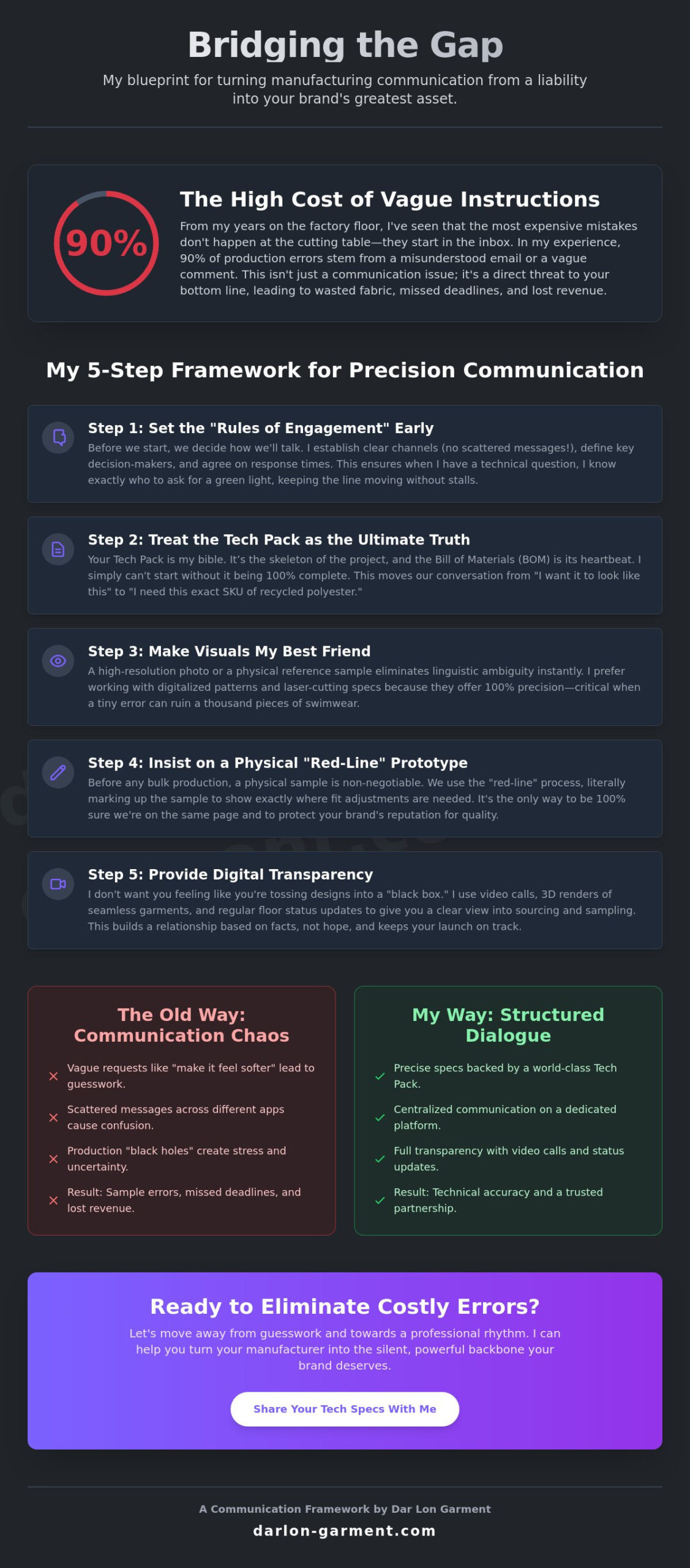
After years of overseeing high-capacity production lines, I’ve realized that the most expensive mistakes don’t happen at the cutting table. They happen in the inbox. In my experience, 90% of production errors start with a misunderstood email or a vague comment. I view my job as more than just operating machinery. I am building a technical bridge between your brand’s vision and my factory’s physical output. When we focus on supply chain collaboration, we’re doing more than just talking; we’re aligning our technical metrics to ensure the final product matches your exact intent.
The cost of vague instructions is incredibly high. I’ve seen brands lose entire seasons because a request for a “softer feel” wasn’t backed by a specific material composition or wash requirement. This lack of clarity leads to wasted fabric, missed deadlines, and lost revenue. By mastering communication best practices with manufacturers, you move away from guesswork and toward a professional rhythm. This consistency is what builds the trust needed for a long-term OEM partnership. It’s about being as precise with your words as I am with a laser-cutter.
Moving Beyond the ‘Black Box’ Mentality
I don’t want you to feel like you’re tossing your designs into a black box and hoping for the best. A true manufacturing partner provides transparency into the early stages of sourcing and sampling. This prevents that “panic mode” that usually hits right before bulk production. When I share floor status updates, it’s about building a relationship based on facts, not hope. You aren’t just buying a product; you’re gaining an extension of your own team. This transparency is the difference between a simple vendor and a dedicated manufacturing partner.
Setting Expectations Early
Every successful project I’ve managed started with a clear “rules of engagement” talk. We need to decide how we’ll talk before we start the work. I prefer using structured project management tools or clear email threads rather than scattered messages across different apps. We also need to define who the key decision-makers are on both sides. If I have a technical question about a seamless garment construction, I need to know exactly who can give me the “green light” so we don’t stall the line. Establishing these communication best practices with manufacturers from day one ensures our rhythm stays methodical, disciplined, and efficient.
The Language of Garments: Mastering Technical Documentation
I often tell my clients that if the Tech Pack is the skeleton of a project, the Bill of Materials (BOM) is its heartbeat. I simply can’t start a sample without a complete BOM. It needs to list every thread, button, and zipper. Without it, I’m just guessing, and guesswork is the enemy of efficiency. Using precise documentation is one of the most effective communication best practices with manufacturers I can recommend. It moves our conversation away from “I want it to look like this” and toward “I need this exact SKU of recycled polyester.”
Visual aids are my best friend on the factory floor. If you send me a high-resolution photo or a physical reference sample, it eliminates linguistic ambiguity immediately. I prefer working with digitalized patterns and laser-cutting specs because they offer 100% precision for items like bonded apparel. In high-capacity manufacturing, a tiny error in a pattern can ruin a thousand pieces of swimwear. Forbes recently highlighted The Power Of Communication in leadership, and I believe that technical clarity is where that leadership begins. It’s how we ensure your vision survives the transition from a screen to a shipping container.
What I Look For in a World-Class Tech Pack
When I open your file, I’m looking for detailed measurement charts with clear tolerances. I need to know exactly how much stretch you expect in your activewear. Tell me the fabric weight, composition, and stretch percentage. I also need placement instructions for logos, labels, and specialized trims. You can check out my guide on how garments are made to see how I translate these specs into reality. If you’re currently developing a new line, you can share your technical specs with me to get a professional assessment of your project’s feasibility.
The Role of Prototyping in Communication
I always insist on a physical sample before we move to bulk apparel manufacturing. It’s the only way to be sure we’re on the same page. We use the “red-line” process to communicate fit changes. This means we literally mark up the sample to show where adjustments are needed. In 2026, digital prototyping is changing the way I work. I can now share 3D renders of seamless garments before we even cut fabric. This saves significant time, but the physical fit session remains my gold standard for quality. Applying these communication best practices with manufacturers ensures your brand’s reputation stays protected through every iteration.
5 Steps to a Seamless Production Cycle
I’ve found that a predictable rhythm is the best defense against production delays. When you follow a structured sequence, you remove the emotional weight of “hoping” things are on track. This process is how I apply communication best practices with manufacturers to move from a design concept to a finished shipment. It’s a methodical flow that mirrors my factory’s logical production line. By following these steps, we ensure that every detail is captured before bulk assembly begins.
Step 1: The Kickoff Meeting. we start by aligning on timelines and material sourcing. I need to know your hard launch dates so I can work backward from the shipping port. Step 2: Sourcing Updates. I’ll keep you informed on fabric lead times. If a specific yarn is delayed, you’ll know immediately. Step 3: The Pre-Production (PP) Sample. This is our final green light. Once you sign off on this sample, the machines start. Step 4: Bulk Production Milestones. I provide weekly reports on sewing and assembly progress. Step 5: Quality Control. I share final inspection reports before a single box leaves my floor.
Communicating During Material Sourcing
Procuring specialized textiles, like Nuyarn performance wool, requires constant dialogue. These materials have specific lead times that don’t always align with standard cotton. If a specific trim is out of stock, I need your feedback right away. I can’t let the line sit idle while we wait for a zipper choice. Verifying raw materials before they hit the cutting table is a critical step I never skip. It’s about catching discrepancies at the source rather than in the finished garment. This proactive approach is a core part of my service model.
The Feedback Loop in Quality Control
I use the 4-point system to communicate fabric defects to my clients. This industry standard provides a quantitative way to discuss quality without being vague. I’ve learned that over-communicating during the inline inspection saves weeks of time. If I spot a tension issue on a seamless garment, I tell you immediately. We fix it on the spot rather than waiting for the final audit. For more on my standards, you can read about how to choose clothing manufacturers in 2026 to see why these protocols matter. My goal is to ensure that your communication best practices with manufacturers lead to a relationship built on technical mastery and mutual trust.
Overcoming Cultural and Logistical Barriers in Vietnam
Working across borders requires more than just a translator. It requires a deep understanding of local business etiquette. In Vietnam, we often deal with what I call the “Yes” culture. Sometimes, a “yes” from a factory floor supervisor means “I hear you,” rather than “I can meet that deadline.” I’ve learned that one of the most vital communication best practices with manufacturers is to verify understanding through open-ended questions. Instead of asking if a shipment will be ready Friday, I ask my team to explain the current assembly status. This shift in dialogue ensures that we’re both looking at the same reality, not just a polite agreement.
I use video calls to bridge the gap between my facility in Vietnam and your headquarters. Seeing a sample of a seamless garment over a high-definition stream is far more effective than a dozen emails. I also manage the 24-hour cycle by setting clear response windows that respect our 12 to 15-hour time difference. While I’m sleeping, your team is reviewing; when I wake up, I have your feedback ready to implement. I also strongly recommend visiting the factory at least once. If you can’t fly to Vietnam, I can provide a virtual tour. Seeing the scale of our industrial machinery helps you understand our operational constraints and capabilities.
Bridging the Language Gap
I always prefer written communication for technical specifications. Verbal instructions can easily be lost in a noisy factory environment. My team uses industry-standard English terminology to ensure every stitch is placed correctly. I’ve found that the power of annotated photos is unmatched. Showing a specific tension issue on a performance wool sample is always better than trying to describe it. We use digital tools to mark up images in real-time, which keeps our technical mastery high and our error rate low.
Managing Global Logistics
Logistics in 2026 require a proactive approach. With the new customs procedures under Circular No. 121/2025/TT-BTC effective since February 1, 2026, documentation must be flawless. I handle the complex paperwork for international customs as a standard part of my service to avoid any port delays. Whether we are working on FOB or CMT terms, I provide tracking and delivery updates so you never have to guess where your inventory is. If you’re ready to scale your production with a team that understands these nuances, you can partner with an expert manufacturer in Vietnam to streamline your entire supply chain.
Building a Partnership: How I Work with Brands at Dar Lon
I believe the most successful brand-manufacturer relationships are built on simplicity and technical trust. My “One-Stop” philosophy is designed to reduce the number of people you need to talk to, ensuring your vision doesn’t get diluted by multiple layers of middle management. When you work with me, you’re getting a direct line to the factory floor. This streamlined approach is one of the most effective communication best practices with manufacturers because it eliminates the “broken telephone” effect that often leads to sample errors and missed deadlines. I value long-term cooperation over one-off orders, aiming to be the silent, powerful backbone for your brand as you grow.
Innovation is another area where I integrate deep technical dialogue into our daily routine. Whether we’re discussing the latest in seamless technology or bonded apparel, I make sure you understand the operational milestones required to bring these complex designs to life. I’m also committed to verifiable sustainability. In 2026, I provide measurable outcomes through digital reporting, ensuring your brand can back up its environmental claims with hard data. This transparency isn’t just about compliance; it’s about building a relationship where you feel confident in every piece of sportswear or swimwear we produce together.
Specialized Communication for Performance Wear
Performance wear requires a specialized vocabulary. When we discuss the technical nuances of elastane fabric and stretch recovery, I provide the metrics your marketing team needs to communicate value to your customers. I’m seeing a clear shift toward natural fibers in global sourcing, and I help you bridge the gap between these materials and high-performance requirements. We’ll talk through the benefits of laser-cut apparel and bonded seams, ensuring your collection stays at the cutting edge of the industry while remaining physically possible to produce at scale.
Next Steps: Starting Our Conversation
I’m ready to help you build your next collection, but a great partnership starts with a great inquiry. To get the most accurate quote from me, please include a complete tech pack, your estimated order quantities, and your target delivery dates in your first message. This allows me to assess the fiscal value and logistical feasibility of your project right away. Applying these communication best practices with manufacturers from our very first meeting ensures we avoid costly delays down the line. Before our first discovery call, I recommend having your reference samples and material preferences ready. Let’s talk about how my factory can support your vision in 2026.
Building Your Production Legacy in 2026
The manufacturing landscape is moving fast. Success in 2026 depends on how well you can translate your creative vision into technical reality. I’ve shown you that precision in your Tech Packs and a disciplined approach to feedback loops are the only ways to avoid the “black hole” of production delays. By mastering communication best practices with manufacturers, you turn a simple vendor relationship into a silent, powerful backbone for your brand.
At Dar Lon, I’ve built a one-stop manufacturing service that handles everything from initial sourcing to final delivery. I specialize in the technical nuances of high-performance Nuyarn and seamless technology, using advanced laser-cutting and automatic sewing infrastructure to ensure every piece is perfect. I’m here to manage the logistical heavy lifting so you don’t have to worry about the details.
This focus on detail extends to every part of your brand’s physical presence; for example, you can explore Direct Mail to ensure your printed marketing materials are as meticulously crafted as your apparel.
Partner with a manufacturer who speaks your language—contact Dar Lon Garment today.
I’m ready to help you bring your next collection to life. Let’s build something extraordinary together.
Frequently Asked Questions
What is the best way to send design feedback to a manufacturer?
The most effective method for sending design feedback is using annotated photos or “red-lining” directly on a physical sample. Visual marks leave no room for interpretation. I always ask my partners to be as specific as possible; instead of saying “make it tighter,” show me exactly where the seam should move. This technical clarity ensures my team can adjust the machinery settings for your next prototype without any guesswork.
How often should I expect updates from my factory during production?
You should expect structured weekly reports during bulk production milestones. These updates usually cover sewing progress, assembly status, and any quality control checks. During the sampling phase, I often communicate daily to ensure the fit and material feel meet your expectations. Establishing these communication best practices with manufacturers early on prevents the “black hole” feeling where you’re left wondering about your inventory status.
What should I do if my manufacturer doesn’t understand my tech pack?
If a manufacturer struggles with your tech pack, you should immediately schedule a video call to walk through the technical specs together. Sometimes a complex construction, like a bonded seam or a laser-cut pattern, is easier to explain visually. I also find that providing a physical reference sample alongside the digital file helps my production team understand the intended hand-feel and finish that a PDF might not fully convey.
Is it better to use email or a project management tool for manufacturing?
I prefer using project management tools because they create a searchable, chronological history of every decision made. It’s much harder to lose a comment in a dedicated thread than in a cluttered inbox. However, I still use email for formal documents like the Bill of Materials or final inspection reports. The key is to pick one primary channel and stick to it so information doesn’t get scattered across different platforms.
How do I handle a situation where a production deadline is missed?
When a deadline is missed, you should first ask for a root-cause analysis and a revised, realistic timeline. I focus on finding the bottleneck, whether it’s a material delay or a machine maintenance issue, so we can solve it together. Transparency is crucial here; a disciplined partner will tell you the truth about the delay rather than making excuses. We then work to adjust the logistics to minimize the impact on your launch.
Can I communicate directly with the production floor workers?
It’s generally not advisable to communicate directly with floor workers, as it can cause confusion and disrupt the methodical flow of the line. I provide a dedicated account manager who acts as your technical bridge to the production team. This person understands both your brand’s vision and the factory’s operational constraints. This structure ensures that instructions are filtered correctly and implemented with industrial precision across the entire sewing team.
How do I ensure my brand’s quality standards are communicated clearly?
To ensure your quality standards are met, you must provide quantitative metrics and a “Golden Sample” for the factory to match. I use the 4-point system for fabric inspections to give us a shared language for defects. By implementing these communication best practices with manufacturers, you move away from subjective opinions. We rely on measurable data to ensure every piece of activewear or swimwear meets your specific requirements before shipping.
What are the signs of a manufacturer with poor communication?
The biggest red flags are vague answers to technical questions and response lags that exceed 48 hours. If I see a manufacturer repeating the same error after it’s been corrected in a tech pack, it’s a sign of a broken internal feedback loop. A dependable partner should be proactive, flagging potential sourcing issues or technical constraints before they become costly production errors. Clarity and consistency are the hallmarks of a professional manufacturer.