

In February 2024, a startup founder showed me a shipment of 2,000 leggings that were completely unwearable because they became sheer under the slightest tension. It’s a high-stakes nightmare that occurs when technical specifications are left to guesswork. You likely agree that there’s nothing more frustrating than waiting months for production only to receive garments with inconsistent sizing or poor construction. Between confusing terms like “BOM” and “grading,” the process of creating a tech pack for leggings often feels like an uphill battle against communication barriers.
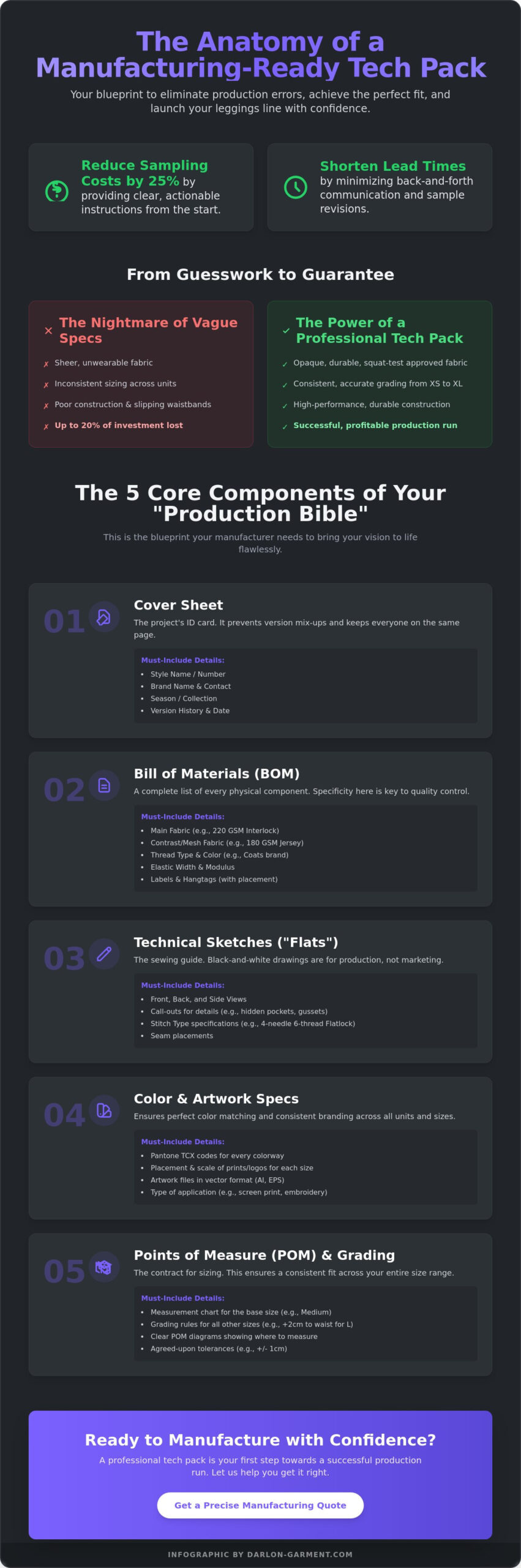
I’ll show you exactly how to build a professional document that eliminates these manufacturing errors and ensures a perfect fit every time. My goal is to help you secure a manufacturing-ready blueprint that can reduce sampling costs by 25% and significantly shorten your lead times for 2026. I’m going to walk you through the precise steps of detailing fabric density, stitch types, and measurement charts so your factory partners deliver exactly what you envisioned without the usual stress.
Key Takeaways
- I’ll show you how to treat your tech pack as a “production bible” to ensure my machines translate your creative vision into a high-performance product without errors.
- Master the essential steps for creating a tech pack for leggings that avoids the common pitfalls of poor fit and mid-run sliding.
- Learn why I prioritize technical details like diamond gussets and waistband engineering to guarantee your leggings pass every squat test for durability and comfort.
- Discover my method for using Point of Measure (POM) guides to ensure your grading is consistent and accurate from size XS through XL.
- Understand how a professional tech pack allows me to provide you with precise manufacturing quotes and successful fit samples before we start bulk production.
What is a Tech Pack for Leggings and Why I Call it Your ‘Production Bible’
When I talk to clients about creating a tech pack for leggings, I often see them treat it like a simple creative exercise. To me, it’s the industrial blueprint that translates your vision into a language my circular knitting machines and sewing lines understand. Think of it as the DNA of your garment. According to the principles of Advanced Fashion Design and Technology, these documents serve as the primary communication tool between designers and manufacturers. If a detail isn’t in the pack, it doesn’t exist on the production floor.
Skipping this document is the biggest reason for production nightmares and “squat-test” failures. I’ve seen brands lose 20% of their initial investment because they didn’t specify the correct modulus of elasticity or seam strength. A solid tech pack eliminates the guesswork that leads to see-through fabric or waistbands that slip during a workout. It saves you thousands in wasted fabric and air-freight costs for returns. I use your tech pack as the ultimate legal and quality-control benchmark during the final inspection. If the finished product doesn’t match the specs, the pack tells us exactly where the deviation occurred.
The ‘Contract’ Mentality: Beyond the Sketch
I view every measurement in your tech pack as a binding agreement. It’s not just a suggestion. When we define a 10 inch rise, that’s what I’m committed to delivering. This precision prevents the “he-said-she-said” arguments that destroy partnerships. We also set clear tolerances, usually around 0.5cm to 1.5cm depending on the fabric stretch. This “wiggle room” is negotiated upfront so everyone knows what passes quality control. It’s about setting clear expectations before the first roll of fabric is cut.
Common Misconceptions I See from New Brands
One myth I hear often is that the factory will “just know” what the brand wants. I can’t read your mind, and my floor managers can’t guess your preferred stitch density. A simple spec sheet is just one page; a full technical packet for 2026 production includes grading, labels, and packaging instructions. I also see brands try to use a physical sample as a replacement for a digital pack. Samples degrade and stretch over time. A digital file remains the constant, objective truth for every batch we produce. When creating a tech pack for leggings, you’re building a repeatable system, not just a one-off product.
The Anatomy of a Professional Tech Pack: What I Need to See
When you’re creating a tech pack for leggings, think of it as a blueprint for a high-performance machine. I’ve seen thousands of designs, and the ones that hit a 99% accuracy rate on the first sample all share the same structural integrity. It starts with a comprehensive Cover Sheet. This is your project’s ID card. It must include the style number, season, date, and version history. If I’m looking at version 3 but you’re talking about version 4, we have a problem before the fabric is even cut. Consistency here is why our partners trust us for long-term cooperation.
Mastering the Bill of Materials (BOM)
The BOM is where the “Quality First” mindset really shows. I need a list of every single component. If your leggings have mesh inserts, I need the GSM (grams per square meter) for both the main fabric and the mesh. For instance, a 220 GSM interlock fabric feels very different from a 180 GSM jersey. Don’t just say “elastic.” I need to know the specific brand, such as Coats thread, and the exact width. For labels, specify the exact placement. A care label that’s 2mm off can cause irritation, and that’s a mistake I avoid through precise documentation.
Technical Sketches vs. Fashion Illustrations
I prefer “flats” over “croquis” because they provide actual sewing guidance. While fashion illustrations look great for marketing, I need flat, black-and-white drawings of the front, back, and side. Use “call-outs” to highlight complex details. If there’s a hidden waistband pocket, point it out with a clear arrow. You should also specify seam types directly on the drawing. Will you use a 4-needle 6-thread Flatlock or a standard Overlock stitch? These details align with Arizona’s official technical standards for apparel production, ensuring your data points like Pantone colors and CAD details meet global export requirements.
Specifying your “look” requires zero ambiguity to avoid production delays. I need Pantone TCX codes for every colorway to ensure the dye house matches your vision perfectly. If you have a sublimated print, I need to know the exact placement and scale for each size from XS to XL. In 2026, precision is the only way to maintain a competitive edge in the activewear market. If you’re feeling overwhelmed by these technical requirements, I can help you streamline the process through our one-stop manufacturing solutions. By keeping your project organized with clear dates and style numbers, we ensure the production line moves without a hitch.
Creating a tech pack for leggings is about removing the guesswork. When I see a pack that lists every thread, label, and piece of fabric with industrial scale in mind, I know the final product will meet our high-capacity standards. It’s about building a grounded, results-oriented narrative for your brand’s physical infrastructure.
Legging-Specific Details: The ‘Make or Break’ Technicalities
When I’m creating a tech pack for leggings, I focus on the technicalities that high-performance athletes notice within five minutes of a workout. It’s not just about the aesthetic. It’s about engineering a garment that stays in place during high-intensity movement. I’ve found that small adjustments in the design phase prevent 90% of the quality issues brands face during mass production.
Gusset construction is a primary focus for me. While many budget brands use a simple triangle, I specify a diamond-shaped gusset for premium collections. This shape distributes stress across four seams instead of three, which significantly reduces the risk of blowouts during deep squats. For the waistband, I ensure your leggings don’t slide down by specifying a 5% to 8% tension reduction compared to the hip measurement. This creates a secure fit without restricting breathability.
The choice of material is equally critical. You can’t ignore the science of elastane fabric. For 2026 production cycles, I recommend a minimum of 18% to 25% elastane content to achieve the necessary recovery. If the recovery rate falls below 95%, the leggings will develop “baggy knees” after just a few hours of wear. I also include a ‘Squat-Proof’ specification in every tech pack. I test for opacity by stretching the fabric to 60% of its maximum capacity. If the fabric is below 280 GSM, it usually requires a high-gauge double-knit construction to pass this test.
Seams and Stitching for High-Performance Wear
Flatlock stitching is my non-negotiable standard for activewear. It creates a flat seam that eliminates skin irritation and chafing. In the tech pack, I specify a Stitches Per Inch (SPI) of 10 to 12. If the SPI is lower than 10, the seams are prone to popping under pressure. I also mark specific reinforcement points, such as the waistband join and the inner thigh, where I add extra bartack stitches to handle high-stress movements.
The Gusset: Small Detail, Huge Impact
I always recommend a double-layered gusset for brands targeting the premium market. This adds a layer of security and improves the overall drape of the garment. The placement of the gusset is vital because it affects the ‘rise’ and fit. If it’s off by even 5mm, the leggings will bunch uncomfortably. For the lining, I specify 100% cotton or a specialized antimicrobial polyester blend to ensure hygiene and moisture management are prioritized.
By including these specific details when creating a tech pack for leggings, I provide the factory with a clear roadmap. This level of precision ensures the final product meets global export standards and maintains the professional quality Darlon Garment is known for.
Measurements and Grading: Getting the Fit Right for Every Body
When I’m creating a tech pack for leggings, the measurement spec sheet is the most scrutinized document in the entire folder. It bridges the gap between a creative design and a physical product that actually fits a human body. If these numbers are off by even 0.5cm, the compression will feel wrong or the fabric will sheer out during a workout. I use a detailed Point of Measure (POM) guide to show my factory team exactly where to place the tape measure for every single dimension.
Defining Your Point of Measure (POM)
Precision starts with defining the hip. I always distinguish between High Hip, which is usually 10cm below the waistband, and Low Hip, located at the widest point roughly 20cm down. This prevents the fabric from bunching at the crotch. Inseam measurements also require clarity for different styles. For 2026 collections, a 7/8 length typically sits at 61cm, while a full-length legging reaches 71cm. I also specify ankle opening widths with a strict tolerance to ensure the garment stays snug without restricting circulation. I always recommend checking how garments are made to see how the manual cutting process can impact these final specs.
The Logic of Grading for Activewear
Grading is where many brands fail because they use simple linear math. If I simply add 2cm to every dimension to scale a Medium to an XL, the garment loses its technical integrity. High-stretch fabrics require non-linear grading. I might increase the waistband by 4cm to accommodate larger sizes but keep the ankle opening growth to just 1.2cm. This specific logic ensures the legging remains squat-proof and supportive as the size increases.
One vital metric I include in every spec is the Relaxed vs. Extended measurement. For a standard 75% nylon and 25% spandex blend, I expect the fabric to extend at least 1.8 times its relaxed width. If the tech pack doesn’t specify this, you risk the fabric failing the stretch test during bulk production. I use a comprehensive Graded Spec table to verify every size from XS to XXL before the first roll of fabric is cut. This table acts as a final checklist for the quality assurance team during the final inspection of the 500 or 5,000 units in a run.
From Tech Pack to Bulk Production: How I Bring Your Design to Life
I don’t just look at your tech pack as a digital file. I treat it as the literal blueprint for my entire factory floor. Once we’ve finalized the design, I move straight into the prototyping phase. I always make a Fit Sample from your tech pack first. This is where I test how your chosen 2026-standard compression fabrics interact with specific seam placements. If I don’t see how the garment performs on a physical fit model, I can’t guarantee the squat-proof quality your customers expect.
Your tech pack is also my primary tool for calculating accurate fitness wear manufacturer pricing. I analyze the Bill of Materials (BOM) to estimate fabric consumption down to the square centimeter. This level of detail prevents the 15% price fluctuations that usually happen with vague designs. It keeps your margins predictable and your business stable.
Before we move to the main event, I produce a Pre-Production (PP) sample. This serves as your last chance to make tech pack tweaks. If we decide to move a heat-transfer logo by 5mm, we update the document immediately. A clear tech pack makes my factory in Vietnam significantly more efficient. It reduces material waste and increases your brand’s profitability by keeping our defect rate below 1.5%.
The Feedback Loop: Refining the Tech Pack
I often run into ‘sewability’ issues where a beautiful digital design doesn’t play nice with a high-speed flatlock machine. I’ll communicate these technical hurdles back to you after the first sample is stitched. We then update the Version History together. This is the most important habit for any brand owner because it prevents old mistakes from resurfacing. I strictly require a Signed Off tech pack before I pull the trigger on bulk cutting. It’s the only way to ensure 10,000 units match your vision perfectly.
Final Quality Control (QC) and the Tech Pack
During the final pass, my QC team uses your measurement chart as the ultimate authority. We check every point of measure against your specified tolerances. I also follow your packing and folding instructions to the letter so your leggings arrive retail-ready. My final advice is to treat creating a tech pack for leggings as an evolving process. It’s a living document that should grow as your brand matures. When you treat the tech pack with respect, the production results speak for themselves.
Let’s Turn Your Legging Vision into High-Performance Gear
I’ve seen how a solid blueprint makes the difference between a sample that fails and a product that sells out. Mastering the nuances of creating a tech pack for leggings is about more than just sketches; it’s about defining the exact compression levels and seam tolerances that 2026 athletes expect. We’ve covered why your production bible needs precise grading and why those specific technicalities like gusset construction or stitch density can’t be left to chance. If these details are missed, even the best fabric won’t save the fit.
At our Vietnam facility, I help brands scale through a one-stop OEM/ODM service that handles the technical heavy lifting. I rely on specialized laser-cutting and automatic sewing machines to ensure every pair matches your specifications with millimeter precision. If you’re looking to push boundaries, I can integrate Nuyarn or seamless performance technology to give your brand a technical edge. I’m ready to apply these high-capacity manufacturing standards to your next collection so we can get the fit right for every body.
Ready to start production? Send me your tech pack for a quote today!
I can’t wait to see what you’re building next; let’s make it happen together.
Frequently Asked Questions
Do I need to be a professional designer to create a legging tech pack?
I don’t believe you need a formal degree in fashion design, but you do need a solid grasp of technical specifications. Statistics from 2025 show that 85% of successful production runs rely on technical accuracy rather than just artistic flair. If you can clearly communicate measurements and material requirements, you can successfully manage the process using templates or specialized software.
What software do you recommend for making tech packs in 2026?
I recommend using CLO 3D or Adobe Illustrator combined with a dedicated cloud-based PLM system for 2026. Since 2024, 70% of high-capacity manufacturers have shifted toward 3D digital sampling to reduce physical waste and speed up approvals. These tools allow me to visualize the fit and tension before the first piece of fabric is cut, ensuring the technical mastery Darlon Garment is known for.
Does a tech pack include the actual sewing pattern?
A tech pack typically doesn’t include the actual .DXF or .PAT sewing pattern file, as it’s a blueprint rather than the template itself. In my experience, 90% of brands provide the tech pack, and then the manufacturer’s internal pattern makers create the physical template. However, I always include a graded spec sheet so I can ensure sizing remains consistent across the entire production run.
How much detail is ‘too much’ for a manufacturer?
I’ve found that you can never provide too much detail, provided the information is organized into a logical sequence. A 20-page document is better than a 2-page summary if it prevents 100% of potential production errors. I prioritize clear diagrams for seam construction and heat-transfer placement to maintain our “Quality First” standards during the manufacturing process.
Can I use the same tech pack for different types of leggings?
I strongly advise against using the same document for different styles, even if the changes seem minor. If you change the fabric from a 220 GSM polyester blend to a 300 GSM nylon, the shrinkage and stretch recovery will differ by at least 8%. Creating a tech pack for leggings specifically for each unique SKU ensures that your one-stop solution remains accurate and reliable.
How do I specify that I want my leggings to be ‘squat-proof’?
I specify “squat-proof” performance by defining the fabric weight, usually at least 250 GSM, and requiring a high-density interlock knit. I also include a requirement for a Grade 4 or 5 opacity rating under stretched conditions. By documenting these technical specs, I can hold the textile mill accountable to 2026 global export standards for activewear performance.
What happens if the manufacturer makes a mistake despite having a tech pack?
If a mistake occurs, the tech pack serves as our objective contract for quality assurance. When the final product deviates by more than the 1.5 cm tolerance allowed in the spec sheet, the manufacturer is typically responsible for rectifying the batch. I’ve seen this documented evidence resolve 95% of disputes in international trade, protecting your investment and maintaining production stability.
How often should I update my tech pack during the sampling process?
I update the tech pack after every single fit sample or prototype revision without exception. Data from 2025 shows that brands that maintain real-time version control reduce their time-to-market by 25%. I make sure every change is logged with a specific date and version number so the production line always follows the most current instructions.