

The secret to finding a factory with low moq in 2026 isn’t hunting for a tiny garage workshop; it’s actually about partnering with a high-capacity manufacturer that uses digital transformation to make small batches efficient. You’ve likely felt the sting of the February 24, 2026, 10% import surcharge or struggled with the August 2025 suspension of the $800 de minimis rule. I know how it feels to have a vision for a performance wear line but get ghosted by big players because you only need 50 hoodies per color. It’s frustrating to face 40% tariffs while trying to keep your startup costs between $2,000 and $5,000.
I’m going to show you exactly how to find, vet, and negotiate with clothing factories that offer low minimums without sacrificing the quality your brand needs to scale. We’ll dive into the real math of apparel production, including why a $300 tech pack is your best investment. You’ll learn how to launch a professional looking line with minimal risk while building a manufacturing foundation that grows with you.
Key Takeaways
- Learn why “Low MOQ” in 2026 usually means 50 to 300 pieces and how to spot marketing traps that hide high color or size requirements.
- I’ll show you why a professional Tech Pack is your most powerful tool when finding a factory with low moq and how it prevents being ghosted by high-quality partners.
- Discover the design hacks I use, like choosing stock colors and limiting size curves, to drop your production minimums from 500 units to just 50 overnight.
- Understand the “Factory Math” behind production line changeovers so you can negotiate better terms and avoid the common pitfalls of custom fabric sourcing.
- Find out how to transition from small sample runs to bulk production using a one-stop service model that scales with your brand’s growth.
What Does “Low MOQ” Actually Mean in 2026? (It’s Not Just One Number)
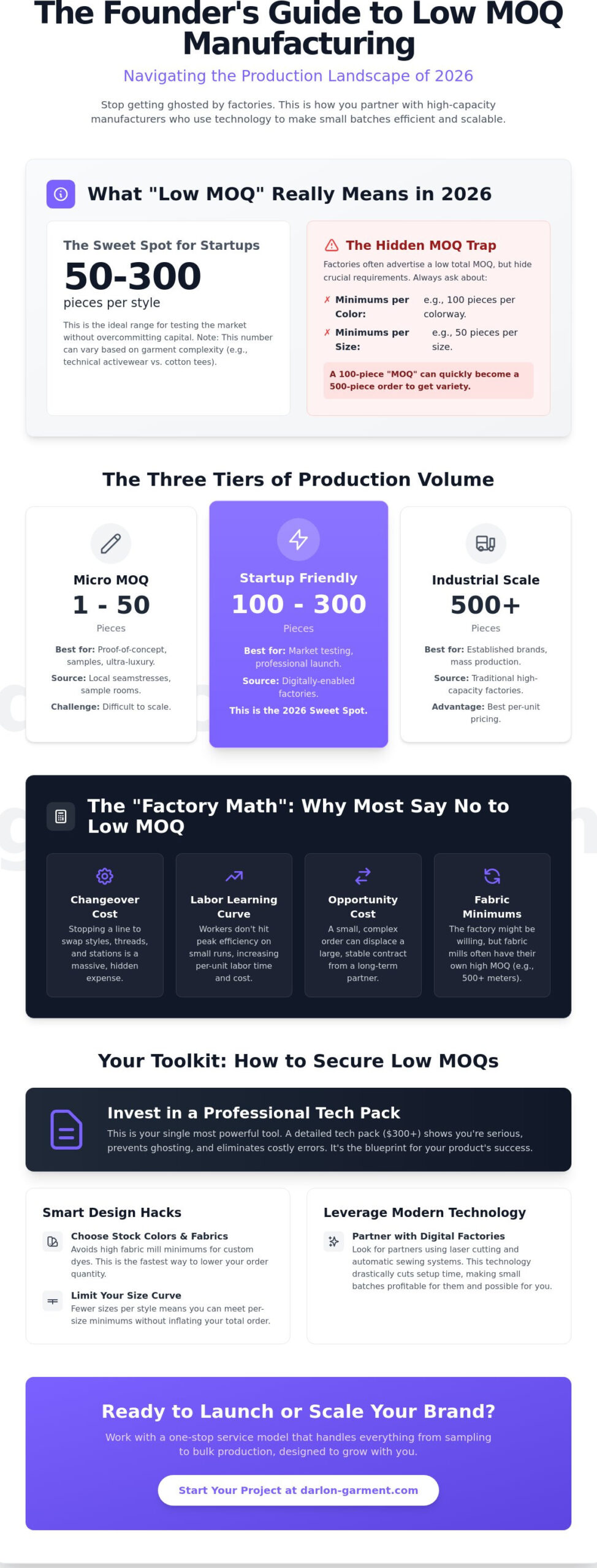
When I talk to new brand owners, the first question is always about the minimum. The reality is that “low” is a moving target. In 2026, finding a factory with low moq means looking for a partner who understands the current shift toward manufacturing agility. I generally define a low minimum as anything between 50 and 300 pieces per style. However, if you’re producing technical activewear or bonded apparel, those numbers look very different than they would for a standard cotton tee. My experience has shown that the more complex the garment, the higher the “floor” for production usually sits.
You have to watch out for the “low MOQ trap.” Many factories will advertise a low number to get you in the door, but they don’t mention the splits. If a factory says their MOQ is 100 pieces, but they require 100 pieces per color and a minimum of 50 per size, you’re suddenly very limited in your variety. It’s all based on the Economic Order Quantity (EOQ), which is the formula factories use to balance their setup costs against the order size. I always distinguish between a “sampling” MOQ, which is usually just one or two pieces for fit testing, and a “production” MOQ, which is the smallest batch I can actually run through the industrial machines efficiently.
The Three Levels of Minimums I See Most Often
I categorize the sourcing landscape into three distinct tiers based on volume and capability. First are Micro-MOQs of 1 to 50 pieces. This is usually the territory of local seamstresses or specialized sample rooms. It’s great for ultra-luxury or proof-of-concept, but it’s hard to scale. Second is the Startup-Friendly tier of 100 to 300 pieces. This is the 2026 “sweet spot.” it allows you to test the market with a professional-looking line without overcommitting your capital. Finally, Industrial Scale starts at 500 pieces or more. This is where traditional high-capacity factories start. At this level, you get the best per-unit pricing because the fixed setup costs are spread across more garments.
Why 2026 Technology is Shrinking Minimums
The reason I can offer lower minimums today than I could five years ago comes down to physical infrastructure and digital tools. I use laser cutting and automatic sewing systems to slash the time it takes to set up a new production run. In the past, manual cutting took hours of labor regardless of the order size. Now, digital pattern making allows me to transition from a size Small to an Extra Large in seconds. These advancements make finding a factory with low moq much easier for brands that need technical precision, like seamless garments or performance swimwear, without the old-school industrial hurdles that used to kill small batches.
The “Factory Math”: Why Most Manufacturers Say No to Low MOQ
Most people think factories demand high minimums just to be difficult or maximize profit. I’ve spent years on the factory floor, and I can tell you it’s actually about the math. When you’re finding the right factory, you’re essentially asking them to pause a high-speed engine to change a spark plug. It’s not just about the sewing; it’s about the “changeover.” Every time I switch a production line from one style to another, the machines stop, the thread colors are swapped, and the workers have to reset their stations. This downtime is a massive cost killer.
Think about the labor involved. If I have a line of 30 specialized workers, they have a “learning curve” for every new design. On a run of 5,000 pieces, they hit peak efficiency by piece 500. If your order is only 100 pieces, they never reach that speed. I’m essentially paying for 30 people to work at half-speed while they figure out your specific seam placement or pocket detail. This is why finding a factory with low moq can be so tough. Most manufacturers would rather take one order for 10,000 units than manage 100 orders of 100 units because the administrative and setup overhead is nearly the same for both.
There is also the “Opportunity Cost” to consider. If my capacity is full, taking on a small, complex project means I might have to say no to a massive, long-term partner. In the manufacturing world, stability is king. A factory chooses the big client because it guarantees their machines will run for months without a single stop. To win over a factory for a small run, you have to prove that your brand has the potential to become that big, stable partner in the future.
The Setup Time Trap
In my production process, every new style requires a trial run. Even with a perfect tech pack, my team has to calibrate machines for specific fabric tensions, especially with technical sportswear or swimwear. If I’m setting up a line for seamless garments, the programming time for the knitting machines alone can take hours. For a small run, that setup time might actually exceed the actual sewing time. I minimize this friction by using dedicated lines for specific categories, but the “math” remains a hurdle for most traditional setups.
Fabric Minimums vs. Factory Minimums
This is the secret hurdle many brands don’t see coming. I might be perfectly willing to sew 100 units of a high-end sleepwear set, but the fabric mill might have a 500-meter minimum for custom-dyed silk or Nuyarn performance wool. If your design requires 1.5 meters per garment, 100 pieces only uses 150 meters. I’m then left with 350 meters of dead stock. I navigate this for my clients by keeping a library of “stock” fabrics in popular colors, allowing us to bypass the mill’s high thresholds and keep your initial investment low.
My 5-Step Strategy for Finding and Vetting Low MOQ Partners
I’ve refined my sourcing process over years of trial and error. Finding a factory with low moq in 2026 requires a more surgical approach than just scrolling through generic B2B platforms. You need a partner that treats your 100-piece run as a serious business venture rather than a nuisance. My strategy focuses on identifying manufacturers who have invested in the right infrastructure to make small runs profitable for everyone involved.
Step 1: Focus on specialized hubs. I start my search in Southeast Asian hubs, specifically Vietnam. While China remains a powerhouse, the 20-40% tariffs on apparel imported from China and Vietnam in 2026 make the choice more about technical capability and ethical transparency than just raw price. I look for factories that specialize in specific categories like seamless garments or swimwear. A specialist already has the right machine settings and workflow for your product type, which reduces the chance of quality errors.
Step 2: The “Tech Pack” Test. I never initiate a serious conversation with a factory without a professional tech pack. A quality pack usually costs between $300 and $800, but it’s your ticket to being taken seriously. If you approach me with just a photo, I know we’ll waste hours on sampling. A tech pack proves you understand the production math I discussed earlier and that you’re ready for professional-grade manufacturing.
Step 3: Verify In-House Production. I always ask if they own their machines. Many “low MOQ” agents are actually middle-men who outsource to tiny, unregulated workshops. I prefer factories that manage everything in-house because it ensures quality control and timeline reliability. If I’m producing bonded and laser-cut apparel, I need to know the machines are on-site and maintained to international standards.
Step 4: The Development Sample. Before I commit to a full production run, I always request a development sample. This isn’t just to check the fit; it’s a test of the factory’s communication and technical execution. If they can’t get the sample right, they certainly won’t get the bulk order right.
Step 5: Negotiate Total Value. Don’t just haggle over the per-unit price. I negotiate based on the total value, including lead times, quality assurance, and the ability to scale. A factory that charges a few dollars more per shirt but delivers on time with zero defects is always cheaper than a budget factory that misses your launch date.
Why I Recommend Vietnam for Your 2026 Sourcing
Vietnam has become my top recommendation for technical sportswear factory Vietnam options. The balance of quality and ethical standards is hard to beat. Following the ISO 14001:2026 update, many Vietnamese factories have integrated real-time data to prove their environmental impact, which is a massive plus for modern brands. They’ve moved beyond basic assembly to mastering complex Nuyarn performance wool apparel and high-stretch activewear.
Vetting Questions I Always Ask
- “Do you handle fabric sourcing in-house or do I need to provide the raw materials?”
- “What is your MOQ per color and per size specifically?” (I’ve seen brands get stuck with 100 pieces per size, which ruins a startup budget).
- “Can I see your quality control reports from a recent production run under 200 pieces?”
Design Hacks: How I Help Brands Lower Their MOQs Through Choice
I often see brands sabotage their own growth by designing too custom too soon. Finding a factory with low moq is significantly easier if you understand that your design choices are the primary drivers of those minimums. If you insist on a custom-dyed Pantone of the Year for your first run of 100 leggings, you’re going to hit a wall. Most mills won’t even look at a custom dye order for less than 500 meters of fabric. However, if you choose a stock black or navy from my available library, I can often start production at just 50 pieces because the fabric is already sitting in my warehouse.
I also advise startups to be ruthless with their size curve. While inclusivity is vital, launching with eight sizes for a first run of 100 pieces means you only have 12 pieces per size. That’s a logistical nightmare for any production manager. I suggest focusing on the core 75% of your demographic, usually Small through Large, to keep the batch manageable and the quality consistent. This helps you hit the sweet spot for 2026 startup budgets, which typically range from $2,000 to $5,000 for a lean first production run.
Another strategy I use is the “Shared Component” approach. If you’re launching a collection, use the same high-performance fabric for your leggings, sports bras, and shorts. By consolidating your fabric needs into one material, you hit the mill’s minimums much faster. This allows you to offer variety to your customers without increasing your inventory risk. I’ve seen this strategy drop a brand’s total fabric commitment by 60% while still looking like a complete, professional line.
The “Stock Fabric” Advantage
I keep a curated selection of high-quality polyester and elastane fabrics ready for immediate production. This “market sourcing” approach is the fastest way to lower your MOQ. Custom dyeing adds weeks to your timeline and requires hundreds of meters of commitment. By using my stock library, you bypass the mill’s high thresholds entirely. This is particularly effective for activewear and swimwear, where standard performance blacks and greys are always in high demand.
Simplifying Your Construction
Complex details like bonded seams or laser-cut vents are impressive, but they require specialized machinery and longer setup times. For a first launch, I often recommend keeping the construction straightforward. You can still use high-value materials like Nuyarn performance wool to stand out, but stick to proven stitching methods to keep the labor costs low. Once you’ve proven the market with your first 100 units, we can introduce those high-tech features in your second run. If you’re ready to see how these design choices can work for your brand, view our technical sportswear capabilities to start your low-MOQ journey.
Scaling Up: How I Move Brands from Samples to Bulk Production
Finding a factory with low moq is only the initial step of your brand’s journey. The real test occurs when your first batch of 100 units sells out in a week and you suddenly need 5,000 more to keep up with demand. If you started with a small, manual workshop, you will likely hit a scaling wall because they don’t have the industrial machinery or management systems to handle that volume. I’ve seen many brands forced to factory hop right when they should be focusing on marketing. I prefer to act as a high-capacity partner that welcomes small starts, ensuring you never have to move your production just because you became successful.
My One-Stop Service promise means I handle everything from the first technical sketch to the final shipping container. I don’t just sew garments; I manage the entire technical lifecycle of your product. This includes navigating the 2026 trade complexities, such as the formal customs entry requirements that replaced the old de minimis rule. By managing these logistical hurdles, I allow you to focus on building your community while I serve as the silent, powerful backbone of your operations. It’s a partnership built on technical mastery and the reliability you’d expect from a seasoned industry veteran.
The secret to finding a factory with low moq that can actually scale is looking at their investment in technology. With the discrete manufacturing sector expected to lead global spending on digital transformation by surpassing $700 billion by 2027, I’ve already integrated AI and smart technologies into my lines. These tools allow me to anticipate maintenance issues and optimize production flows, making me a much more dependable partner than a workshop that relies on outdated manual processes.
From Prototype to Assembly Line
The transition from a single sample to an industrial run of 10,000 units is a technical feat. I use an iterative process to refine the fit through multiple sample stages before we ever touch the bulk fabric. Because I use the same digital pattern-making and laser-cutting tools for both the initial prototype and the bulk run, the quality stays identical. I ensure that the 5,000th piece of activewear or seamless garments is as perfect as the first approved sample.
Building a Long-Term Partnership
I value long-term cooperation over a single, one-and-done order. A quick transaction doesn’t build a sustainable business, but a decade of reliable production does. As you expand your collection into swimwear or sleepwear, I support you with rigorous material testing and supply chain resilience. In a 2026 market defined by geopolitical uncertainty and rising costs, having a partner who understands your brand’s DNA and meets the latest ISO 14001:2026 environmental standards is your greatest competitive advantage.
Ready to Launch Your 2026 Collection?
Finding a factory with low moq doesn’t have to be a source of stress if you approach it with the right technical mindset. We’ve covered how the old “all or nothing” manufacturing model is fading and why 2026 technologies like laser cutting have made 50 piece runs a reality. By focusing on stock fabrics, simplifying your size curves, and preparing professional tech packs, you can launch a world class line without the massive inventory risks that used to sink startups.
Since 2019, I’ve used my global export experience to help brands navigate these exact hurdles. My one-stop OEM/ODM solution is built on advanced laser cutting and automatic sewing technology. This ensures that your small batches meet the same industrial standards as our high volume orders. I’m here to serve as the silent backbone of your brand while you focus on your community and growth.
Let’s talk about your project—I’d love to help you scale your brand. Your vision deserves a manufacturing partner that values long term cooperation as much as you do. Let’s build something great together.
Frequently Asked Questions
Is it possible to find a factory with an MOQ of 10 pieces?
Finding a factory with low moq for just 10 pieces is possible, but you’ll likely be working with a sample room or a local seamstress rather than an industrial facility. I call this a “Micro-MOQ.” While it’s great for testing a single fit, you won’t get the benefits of specialized machinery like laser cutting or heat bonding that I use for professional-grade activewear and swimwear.
How much more does it cost to produce a low MOQ order?
You should expect a higher per-unit cost because my fixed expenses, like machine setup and pattern digitizing, are spread over fewer garments. A lean startup budget for a first production run in April 2026 usually ranges from $2,000 to $5,000 according to AKCN reports. While the price per shirt is higher, your total inventory risk is significantly lower.
Can I get custom labels and tags with a low MOQ order?
Yes, you can get custom branding, but I often suggest heat-transfer labels for orders under 100 pieces. Woven label suppliers typically demand their own minimums of 500 to 1,000 units. If you want a fully custom look, I can apply heat-press logos in-house to keep your branding professional without the high overhead of bulk label orders.
What happens if the quality of my small batch is poor?
Quality issues usually stem from choosing unregulated workshops instead of high-capacity partners with specialized production lines. If you receive a poor batch, it’s often because a middle-man outsourced your work to save money. This is why I insist on a development sample first. It’s your insurance policy to ensure the bulk run matches your technical standards.
Do I need a tech pack for a low MOQ factory?
I won’t start a production run without a professional tech pack because it’s the only way to guarantee accuracy. Finding a factory with low moq that is willing to work without one is a red flag for poor quality control. A tech pack, which typically costs between $300 and $800, acts as the blueprint that ensures my team knows every exact measurement before the first cut.
How long does a typical low MOQ production run take in 2026?
A typical small-batch run in 2026 takes between 4 and 8 weeks from the time we finalize the sample. This timeline accounts for the 150-day temporary import surcharge period currently affecting US shipments as of February 24, 2026. Using stock fabrics from my library can often shave two weeks off this estimate because we don’t have to wait for custom milling.
Can I use sustainable fabrics for small production runs?
You can definitely use sustainable fabrics if they are part of a factory’s existing stock program. Following the ISO 14001:2026 update, I’ve integrated real-time data to track the environmental impact of our materials. For small runs, I recommend using certified recycled polyesters that I already have in-house to avoid the high minimums of custom sustainable weaving.
Why do some factories charge a “surcharge” for small orders?
Factories charge a surcharge to compensate for the downtime required to reset a high-speed production line. Every time I stop a machine to change thread colors or needle settings for a 100-piece order, I’m losing the capacity to run thousands of units. This fee covers that lost efficiency and ensures your project is financially viable for a professional facility.