

If your current factory thinks ‘tight’ is a synonym for ‘graduated compression,’ you aren’t just losing money. You’re risking your brand’s reputation on outdated engineering. Finding a reliable compression wear supplier is a challenge that goes far beyond simple stitching. It requires a partner who treats the production line like a technical laboratory. I’ve seen too many brands struggle with see-through fabrics or poor stretch recovery because their manufacturer didn’t understand the physics of high-performance textiles.
I know how exhausting it is to manage communication barriers while worrying about whether your next shipment will meet international standards. It’s a high-stakes environment, especially with the global compression market projected to reach 5.93 billion dollars in 2026. In this guide, I’ll walk you through my personal process for sourcing technical apparel in Vietnam. I’ll share what I’ve learned about fabric science, from Graphene knits to 4-way stretch recovery. We’ll also look at how to navigate the 10 percent tariff surcharge currently affecting imports so you can build a stable, long-term manufacturing partnership that scales.
Key Takeaways
- Understand the engineering difference between a tight fit and graduated compression so you don’t risk your brand’s reputation.
- Discover why the choice of yarn and elastane is the most critical step in preventing common “see-through” fabric failures.
- Learn why I rely on a compression wear supplier in Vietnam to balance world-class technical infrastructure with a competitive cost-to-quality ratio.
- Find out how advanced manufacturing techniques like laser cutting can streamline your development process and ensure consistent bulk quality.
- Master the essential components of a technical tech pack to guarantee your factory delivers exactly what your athletes need.
Why Finding the Right Compression Wear Supplier is My Top Priority for You
I’ve seen so many brands fail because they chose a supplier that treated a technical compression garment like a standard t-shirt. They assume that if the fabric is stretchy and the fit is snug, they’ve checked the box. This is a fundamental mistake. In my experience, finding a specialized compression wear supplier is the single most important decision for your product line’s longevity. It isn’t just about finding a factory with sewing machines; it’s about finding a partner who understands the engineering behind the fabric.
In 2026, the industry has moved toward “intelligent” textiles that do more than just sit on the skin. We are seeing fabrics that actively manage heat and moisture while providing specific physiological benefits. If your manufacturer is just following a pattern without understanding why the tension needs to be precise, your brand is already at a disadvantage. I always tell my partners that their manufacturer should be their technical consultant. You need someone who can look at a tech pack and tell you if the fabric recovery won’t hold up under real-world stress or if the seam placement will cause chafing during high-intensity movement.
The Difference Between ‘Tight’ and ‘Technical’ Garments
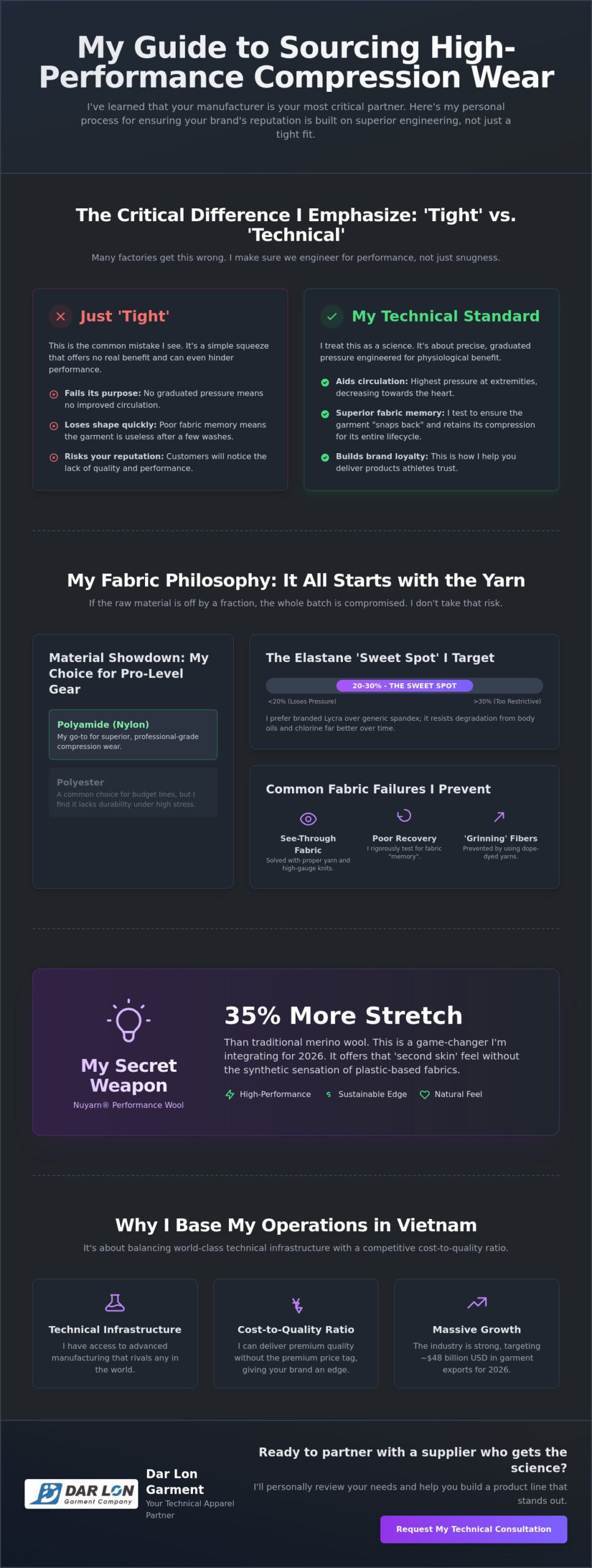
I often explain to my clients that if a piece of clothing just feels tight, it’s probably not providing any actual performance benefits. A true technical garment relies on the science of graduated pressure. This means the pressure is highest at the extremities and decreases toward the heart to aid circulation. It’s a precise calculation that requires specialized knitting. In my facility, I test for fabric “memory” constantly. We need to ensure those leggings don’t lose their shape after three washes. If the fabric doesn’t snap back to its original state, the compression is gone, and the product has failed its primary purpose.
The Growing Demand for High-Performance Activewear
I’m noticing a massive shift in how people use these products. It’s not just about the gym anymore. Recovery has become a huge focus, with people wearing technical gear for hours after their workout or even during long-haul travel. This trend has led lifestyle brands to integrate technical compression into everyday athleisure lines. To keep up, you need high-capacity manufacturing that doesn’t sacrifice precision for volume. The global market is surging, and having a reliable compression wear supplier who can scale with you while maintaining strict quality control is the only way to stay competitive in this evolving landscape.
The Fabric Science Behind My Compression Garments
In my factory, the process always starts with the yarn. If the raw material is off by even a fraction of a percentage, the whole batch is ruined. I’ve seen brands lose thousands because they didn’t realize their yarn had inconsistent tension before it hit the knitting machines. This is why I lean so heavily on high-quality elastane fabric to achieve that essential 4-way stretch. While polyester is a common choice for budget lines, I almost always recommend Polyamide (Nylon) for professional compression. It provides a premium hand-feel and superior durability that polyester just can’t match under high stress.
I also spend a lot of time verifying moisture-wicking and anti-microbial properties during the sourcing phase. We don’t just take a vendor’s word for it; we run lab tests to ensure that silver-ion or chemical treatments actually survive multiple wash cycles. This level of technical scrutiny is part of why Vietnam’s garment export performance has remained so strong, with the industry targeting approximately 48 billion USD in 2026. As a compression wear supplier, I know that my reputation is only as good as the raw materials I source. If you are looking for a partner who prioritizes these technical details, you can reach out for a technical apparel consultation to see how we handle fabric selection.
Mastering Elastane and Lycra Blends
I’ve found that a 20 to 30 percent elastane blend is the ‘sweet spot’ for high-performance compression. Anything less and you lose the medical-grade pressure; anything more and the garment becomes nearly impossible for an athlete to put on. I also prefer branded Lycra over generic spandex because it resists degradation from body oils and chlorine much better over time. One common headache I solve for my clients is ‘grinning,’ which is when the white elastic fibers show through dark fabric when stretched. I prevent this by using dope-dyed yarns or specific high-gauge knit structures that keep the elastic hidden even at maximum extension.
Nuyarn Performance Wool: The New Frontier
My secret weapon for 2026 is integrating Nuyarn performance wool for natural compression. I am particularly excited about this technology because it offers 35 percent more stretch than traditional merino wool. It provides that “second skin” feel without the synthetic sensation of pure plastic-based fabrics. For brands looking for a sustainable, high-performance edge, this is the future. The technical challenge of sewing high-stretch wool is significant. It requires specialized needle settings and precise thread tension to ensure the seams don’t pop. My team has spent years perfecting these factory settings so your gear performs exactly as the tech pack intended.
Advanced Manufacturing: How I Use Technology to Ensure Precision
I’ve invested heavily in my Vietnam facility because, in my experience, precision is the only way to make compression work effectively. When you’re dealing with graduated pressure, a millimeter of error can ruin the athletic benefit of the garment. I don’t just see myself as a manufacturer; I view our factory as a high-tech lab where engineering meets apparel. With the global compression sportswear market estimated to reach US$ 4.8 billion in 2026, the brands that win will be those that prioritize technical accuracy over cheap, manual labor.
Choosing the right compression wear supplier means looking at their machinery as much as their portfolio. I use automatic sewing machines that are programmed to maintain consistent tension across thousands of units. This eliminates the human error that often leads to “loose” spots in compression gear. If the tension isn’t uniform, the garment won’t provide the circulation benefits your customers expect. I also rely on bonding technology to replace bulky seams that cause chafing during long-distance runs or high-intensity training. These technologies aren’t just “nice to have” anymore; they are the baseline for professional-grade gear.
Seamless Technology for Maximum Comfort
I love seamless garments because they offer targeted compression zones without the need for extra panels or stitching. The machinery behind this is fascinating. The garment is “knit to shape” on circular knitting machines, allowing us to vary the knit density in specific areas, like the quads or calves, to provide extra support. I always suggest this tech for high-intensity gym wear because it eliminates friction points and provides a sleek, second-skin feel that athletes love. It’s an efficient way to manufacture high-performance gear that looks as good as it functions.
Laser Cutting and Bonding for a Zero-Chafe Experience
I use laser cutting to ensure every edge is perfectly sealed. Traditional shears can leave micro-frays that eventually lead to seam failure, but a laser cauterizes the edge of the fabric as it cuts. This is a non-negotiable for me when dealing with technical fabrics. The beauty of bonded seams is that they are flatter and stronger than traditional stitching. My team manages the heat-sealing process with surgical precision to ensure the bond doesn’t fail under high tension. For premium brands, this creates a much more aesthetic, high-end finish that stands out in a crowded market.
Why I Believe Vietnam is the Global Hub for Compression Sourcing
I chose to build my business in Vietnam because the infrastructure here for technical apparel is world-class. When you are looking for a compression wear supplier, you need more than just a sewing line; you need a hub that supports complex engineering and a sophisticated supply chain. Vietnam is currently the world’s third-largest textile and garment exporter. In 2025, our national exports reached nearly 46.2 billion USD. This scale isn’t just about volume. It represents a massive concentration of technical expertise that I haven’t found anywhere else in Southeast Asia.
When I compare Vietnam to other manufacturing giants like China or Bangladesh, the “quality-to-cost” ratio is where we really win. China has the scale, but the rising costs and geopolitical friction make it a risky bet for 2026. Bangladesh is excellent for basics, but they often struggle with the precision required for graduated compression. As a sportswear factory in Vietnam, I have access to deep local material networks that allow me to source everything from specialized zippers to high-gauge knits without relying on long-distance imports. This proximity reduces lead times and keeps my clients’ projects on schedule. If you’re ready to see how our facility can support your next collection, you can view our full manufacturing capabilities here.
The Infrastructure Advantage in 2026
I’ve seen our local supply chain evolve rapidly. High-tech trim and fabric suppliers are now located right in our backyard. This means I can prototype faster and troubleshoot material issues in person rather than over a screen. Our proximity to major shipping ports like Hai Phong and Cat Lai is another huge benefit. It reduces the logistical friction that often delays bulk shipments. My workers are also a major part of the equation. Vietnamese garment workers are highly specialized in complex activewear, which is essential for the intricate stitch work compression gear requires.
Sustainability and Ethical Compliance
I know my clients care about how their clothes are made. That is why my factory maintains rigorous audit standards that go beyond the bare minimum. I’ve implemented water-saving and energy-efficient practices on the production floor because efficiency and sustainability go hand-in-hand. I also believe natural fibers and recycled synthetics like Repreve are the future. With the EU’s Digital Product Passport requirements arriving in 2028, I am already helping my partners track materials and carbon footprints to ensure they stay ahead of global regulations.
Let’s Build Your Brand: My Step-by-Step OEM Process
I want the process to feel like a collaboration, not just a transaction. When you choose me as your compression wear supplier, we are building a technical product together. I’ve seen too many brands send over a vague sketch and hope for the best. That doesn’t work with high-performance gear. I insist on a detailed tech pack before my team even touches a piece of fabric. This document is our roadmap. It defines the exact tension, seam types, and fabric weight needed to meet your performance goals. Without this clarity, you risk inconsistent sizing and failed fabric recovery.
Scaling up is where most manufacturers fail, but it is where my facility shines. My commitment to quality control is visible at every single station on the line. We don’t just check the final product at the end of the day. We monitor the yarn tension during the knitting process, the laser-cut precision at the cutting table, and the strength of the bonded seams before they move to finishing. This rigorous approach ensures that the 10,000th unit in a bulk order is as good as the first sample you approved. Consistency is the backbone of any successful athletic brand.
From Tech Pack to Perfect Prototype
I’ll show you how we take your design and turn it into a physical sample in just a few weeks. This prototyping phase is where we refine the “squeeze” of your garments. I always recommend fit-testing on real athletes during this stage. We need to ensure the compression hits the right muscles and doesn’t restrict movement in the joints. If the tension or stretch recovery isn’t exactly where you want it, I handle those revisions immediately. We adjust the knit density or elastane ratio until the performance is flawless. It’s better to fix a tension issue on one sample than on a thousand bulk units.
Managing Logistics and Final Delivery
I don’t just stop at sewing. Part of being a reliable compression wear supplier is handling the small details that make a brand feel premium to the end consumer. I help manage the sourcing of your labels, tags, and sustainable packaging. We use specific folding and packing techniques to ensure everything survives international shipping without losing its shape or compression properties. My final promise to you is a comprehensive manufacturing service that lets you focus on your marketing strategy while I handle the technical heavy lifting on the factory floor.
Elevating Your Brand Through Technical Precision
Success in the competitive activewear market requires moving far beyond basic manufacturing. I’ve spent years refining my Vietnam facility to handle the specific complexities of graduated pressure and high-performance textile blends. We’ve seen that the difference between a successful brand and a failed one often comes down to the technical details. Whether it’s the 35 percent extra stretch found in Nuyarn performance wool or the zero-chafe finish of our advanced laser cutting and bonding technology, every millimeter matters. Choosing the right compression wear supplier is about finding a partner who values technical mastery and industrial scale as much as you do.
I’m ready to help you navigate the entire OEM process, from the initial tech pack refinement to the final bulk delivery from our Vietnam hub. My comprehensive manufacturing solutions are designed to take the technical burden off your shoulders so you can focus on growing your brand. Let’s discuss your next compression collection—message me today. I’m excited to help you bring your vision to life with the precision your athletes deserve.
Frequently Asked Questions
What is the typical MOQ for a custom compression wear order?
My standard minimum order quantity typically starts at 500 pieces per style. This volume allows us to source specialized technical fabrics and set up the high-precision knitting machines efficiently. If you are using a very unique or custom-dyed material, the requirement might increase to 1,000 units. As a compression wear supplier, I try to be flexible with growing brands, so it’s best to discuss your specific volume needs during our initial consultation.
Can you help me develop a tech pack if I only have a rough sketch?
I can definitely help you turn a rough sketch into a professional tech pack. My team includes experienced technical designers who specialize in activewear engineering. We’ll take your visual ideas and add critical data points like seam specifications, fabric weight, and graduated pressure requirements. Having a precise tech pack is the only way to ensure your compression wear supplier delivers a consistent product during bulk production.
How do you ensure the compression levels are consistent across different sizes?
We ensure consistency by using advanced pattern grading software tailored for high-stretch textiles. I don’t just scale the patterns up or down; I calculate the specific tension needed for each size to maintain the correct pressure gradient. We also use pressure sensors on fit models of different sizes to verify that the compression hits the right muscle groups whether it’s a small or an extra-large.
What are the best fabrics for summer-weight compression gear?
I recommend lightweight Polyamide blends for summer-weight gear because they offer better breathability and heat dissipation than polyester. For 2026, I’m seeing a lot of success with Graphene-infused knits that provide active cooling. We also prioritize open-mesh panels in high-sweat zones to maximize airflow without compromising the structural integrity or the supportive “squeeze” of the garment during high-intensity training sessions.
How long does the sampling process usually take in your Vietnam factory?
The sampling process in my Vietnam facility usually takes between two and four weeks. This timeline depends heavily on whether we have your chosen fabric in stock or if we need to source a custom blend. I always prioritize getting the prototype right the first time, so we spend a few extra days on internal quality checks before shipping the sample to your office for final approval.
Do you offer sustainable fabric options like recycled nylon for compression?
I offer several sustainable options, including GRS-certified recycled nylon and polyester. These materials provide the same high-performance stretch and recovery as virgin fibers but with a much lower environmental footprint. I also work with recycled elastane to ensure the entire garment meets modern sustainability standards. Many of my clients are now switching to these eco-friendly synthetics to prepare for upcoming international transparency regulations.
What kind of quality control tests do you perform on high-stretch garments?
We perform a series of rigorous tests on every batch, including tensile strength and 4-way stretch recovery analysis. I use specialized machinery to stretch the fabric to its limit and measure how quickly it returns to its original shape. We also conduct “squat tests” to check for opacity and run colorfastness trials to ensure the dyes don’t bleed during high-intensity workouts or frequent washing.
Can you handle complex branding like 3D silicone prints or reflective logos?
I have the in-house capability to handle complex branding like 3D silicone prints and high-visibility reflective logos. These elements are applied using heat-press technology that is specifically calibrated for technical fabrics. I make sure the branding doesn’t crack or peel when the garment is stretched to its maximum capacity. This level of detail is essential for creating a premium look that lasts for the life of the product.