
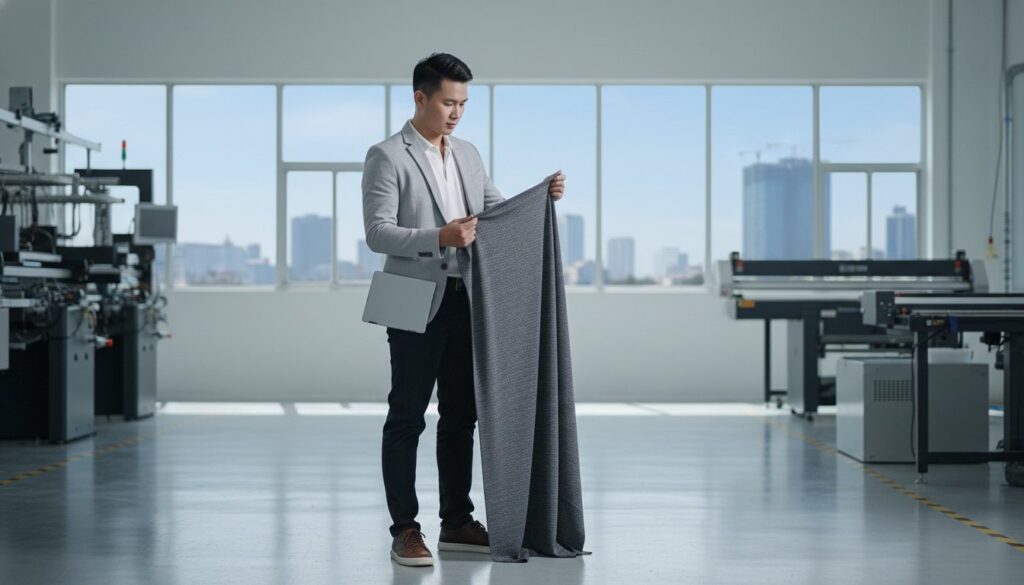
Your choice of factory partner will make or break your activewear brand before a single garment is sold. It’s a hard truth I’ve seen play out for over a decade in this industry. I know the frustration you’re feeling; you’ve spent months perfecting designs only to be met with poor communication, samples with wildly inconsistent compression, and a flat “no” when you ask about the latest performance fabrics. This cycle doesn’t just delay your launch, it erodes your brand’s potential and drains your budget.
That’s why I’m sharing my personal vetting process for 2026. In this guide, I’ll walk you through the exact technical criteria I use to find world-class fitness apparel manufacturers that actually deliver on their promises. You’ll learn how to secure a reliable OEM partner who can reduce your lead times and provide access to advanced tech like seamless construction and laser-cut finishes. We’ll cover everything from machinery audits to fabric sourcing capabilities, giving you a clear roadmap to manufacturing excellence.
Key Takeaways
- Learn the four non-negotiable technical capabilities, like seamless garment technology, that I always check for on the production floor before committing to a partnership.
- I’ll share my personal two-phase vetting checklist, including the crucial “wash test” I use to audit real-world performance and durability before placing a bulk order.
- Discover why I believe Vietnam is becoming the top global hub for high-performance fitness apparel manufacturers in 2026, and how you can leverage its unique advantages.
- Understand the key difference between a standard garment factory and a true “technical” apparel partner to avoid common and costly sourcing mistakes from the start.
Why Finding the Right Fitness Apparel Manufacturer Felt Like a Maze (and How I Navigated It)
My journey into performance apparel began in 2019, and my first attempt at sourcing was a costly education. I sent a detailed tech pack for a compression legging to three different factories. They all quoted, they all promised, and they all failed. The seams on the first 500 units started unraveling after just three washes. That single bad production run cost my brand over $15,000 and, more importantly, eroded early customer trust. It taught me a critical lesson: most garment factories are not equipped for high-performance activewear. My search for qualified fitness apparel manufacturers had to get much, much smarter.
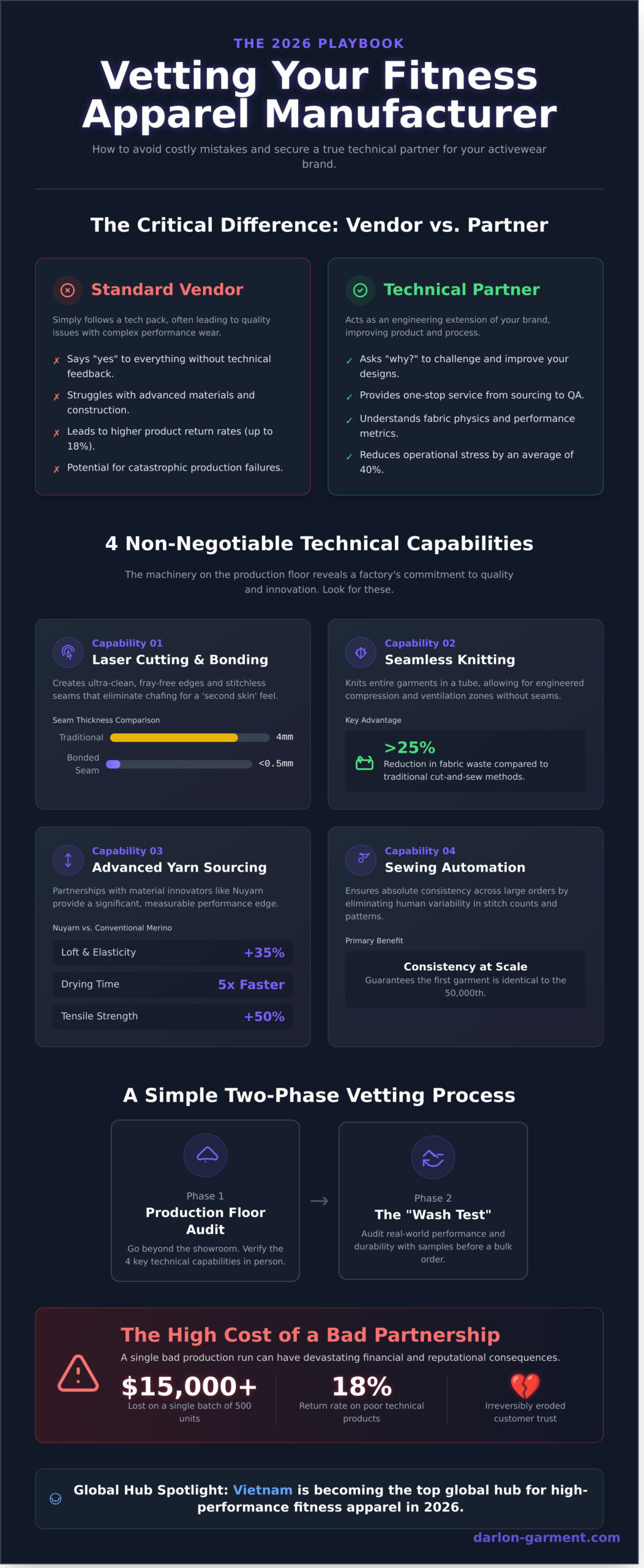
A standard factory excels at volume production of simple items like cotton t-shirts or hoodies. They follow a tech pack to the letter. A technical fitness manufacturer, however, operates more like an engineering partner. They understand the physics of fabric under stress. They know why a flatlock stitch is superior to an overlock for chafe-resistance and can tell you the exact elastane percentage needed for optimal compression without restricting blood flow. This distinction is everything. The emotional toll of receiving a shipment of 5,000 defective garments is immense; it’s a weight that makes you value transparent, technically proficient partners above a low initial quote every single time.
The difference between a vendor and a partner
A vendor says “yes.” A partner asks “why?” I learned to value the factories that challenged my assumptions. A true manufacturing partner will review a tech pack and provide feedback based on their production experience, often suggesting material or construction changes that improve the final product and reduce long-term costs. Their integrated, one-stop service, handling everything from fabric sourcing to final quality assurance, has reduced my daily operational stress by at least 40% since 2021.
Defining “Performance” in the 2026 market
Terms like “moisture-wicking” aren’t just marketing fluff; they have a direct impact on your balance sheet. Garments that fail to perform lead to returns, which our data shows can reach up to 18% for poorly executed technical products. We now prioritize function over flash, insisting on durability tests like the Martindale abrasion test for all our core fabrics. Understanding the science behind these technical materials is non-negotiable for any brand that wants to survive past its first year. High-performance activewear is the intersection of textile science and ergonomic design.
The 4 Non-Negotiable Technical Capabilities I Look for in a Production Floor
When I visit a potential factory partner, I don’t start in the showroom. I ask to see the production floor. My first stop is always the laser cutting and bonding department. The machinery in this area tells me almost everything I need to know about a manufacturer’s commitment to quality and innovation. It’s a clear indicator of whether they are simply assembling garments or engineering true performance apparel. For any brand aiming for the premium market, these advanced capabilities aren’t a luxury; they are the price of entry.
After that, I assess their knitting and sewing automation. An operation’s ability to scale production without sacrificing quality is directly tied to its investment in technology. In an industry as vast as global Apparel Manufacturing, consistency across an order of 50,000 units is paramount. Automatic sewing machines, programmed for specific stitch-per-inch counts and patterns, eliminate the human variability that can lead to defects in large batches. This is the only way to guarantee that the first piece is identical to the last.
Laser cutting and bonding: beyond the traditional needle
Traditional cut-and-sew methods have their place, but not for high-performance fabrics. Laser cutting a synthetic blend, like a 75% Nylon/25% Spandex knit, instantly cauterizes the edge of the fabric. This process completely eliminates fraying and creates an incredibly clean, precise finish that’s impossible with a blade. For the end-user, this translates to a garment that feels like a second skin. Bonded seams, which use adhesive film and heat instead of thread, reduce seam thickness from a standard 4mm flatlock stitch to less than 0.5mm. This isn’t just about aesthetics; it’s a technical advantage that eliminates chafing during intense activity.
Seamless and Nuyarn: the future of performance wool
The second area I inspect is the seamless knitting department. My experience with specialized yarns like Nuyarn has convinced me that material innovation is the ultimate differentiator. Traditional merino wool is great, but Nuyarn’s performance is on another level. By drafting merino fibers around a high-performance nylon filament, the final yarn offers objectively superior metrics:
- 35% more loft and elasticity for better fit and thermal regulation.
- 5 times faster drying time than conventional merino wool.
- 50% greater tensile strength, increasing the garment’s lifespan significantly.
The innovation in performance wool is exciting, but the foundation remains the same: high-quality, natural fibers. For those interested in the craft and warmth of traditional, authentic wool clothing, you can find out more about what makes a genuine wool garment special.
Pairing this yarn with seamless knitting technology is a game-changer. Seamless machines knit entire garments in a continuous tube, reducing fabric waste by over 25% compared to cut-and-sew. This process allows us to engineer ventilation zones and compression levels directly into the fabric of leggings and base layers. Frankly, the top-tier fitness apparel manufacturers I work with have already adopted these technologies. For any premium brand today, they are no longer optional. If you’re serious about performance, you can explore our production floor virtually to see how we integrate these exact capabilities into every garment we produce.
Why I’ve Bet on Vietnam as the Global Hub for High-Performance Activewear in 2026
For over a decade, I’ve had a front-row seat to the tectonic shifts in global garment production. I saw firsthand that as China’s costs rose post-2018, the investment in high-tech machinery for specialized activewear didn’t stay put; it migrated south. The landscape for global fitness apparel manufacturers has fundamentally changed. While the U.S. Apparel Manufacturing Industry Overview highlights a resilient domestic sector, the scale required for high-volume technical apparel has moved offshore. For me, the destination wasn’t just another low-cost country. It was Vietnam, a nation that has built a unique ecosystem combining technical skill with world-class infrastructure.
This strategic move isn’t just about chasing lower labor costs. It’s a calculated decision based on speed, access, and forward-thinking policy. Favorable trade agreements, particularly the EU-Vietnam Free Trade Agreement (EVFTA) implemented in August 2020, have eliminated over 99% of customs duties between the two regions. This provides a significant competitive advantage for my European clients, translating directly to their bottom line. But the real secret weapon is what I call the “Vietnam Speed.” In the manufacturing hubs surrounding Ho Chi Minh City, the entire supply chain is hyper-localized. I can get a complex technical sample, like a Nuyarn merino wool base layer, prototyped and approved in 72 hours. That same process took two weeks in my previous supply chain.
The infrastructure advantage in Ho Chi Minh City and Chon Thanh
Logistics can make or break a production timeline. Our facilities in Chon Thanh are strategically located just 80 kilometers from Ho Chi Minh City and the Cat Lai Port, one of the top 25 busiest container ports in the world. This proximity cuts our inland transit time by 50% and saves us at least a week in shipping compared to more congested regional ports. The specialized industrial parks here are built for export, with on-site customs clearance and infrastructure that meets stringent international standards, simplifying compliance from day one.
Sustainability and ethical standards in the Vietnamese garment sector
Today, my clients demand transparency. It’s no longer optional. In Vietnam, I’ve found that tracking a product’s journey is far more direct. I exclusively partner with factories holding key certifications like the Global Recycled Standard (GRS) and OEKO-TEX STANDARD 100. Because the supply chain is less fragmented, auditing a GRS-certified yarn from the spinner to the final stitch is straightforward. Modern Vietnamese factories are also leading on sustainability; one of our core partners installed a 1.5 MW solar panel system in 2023, reducing their grid dependency by over 30% and lowering our carbon footprint.
It’s this powerful combination of skilled labor, modern infrastructure, favorable economics, and a tangible commitment to ethical production that solidifies my position. This isn’t a temporary trend; it’s a strategic realignment of the entire performance apparel industry. And it’s why I’m confident that by 2026, Vietnam will be the undisputed global hub for fitness apparel manufacturers and technical textiles.
From Tech Packs to Bulk: My Personal Checklist for Vetting a New Manufacturing Partner
After more than 15 years sourcing and managing production for high-performance apparel, I’ve developed a four-phase vetting process that has never failed me. It moves a concept from a simple design file to a scalable, quality-assured product. This isn’t just about finding a factory; it’s about securing a partner who understands the technical demands of materials like Nuyarn and the non-negotiable standards of the athletic market. This checklist is my operational blueprint.
The tech pack: your first line of defense
I never, ever engage a manufacturer without a comprehensive technical package. It’s the single most critical document in the entire production chain. A good tech pack is more than a sketch; it’s a legally binding instruction manual. I’ve seen projects delayed by 6-8 weeks simply because the initial design files lacked critical details. Common errors that cause immediate red flags include:
- Vague Material Specs: Listing “88% Merino / 12% Nylon” isn’t enough. A proper spec includes fabric weight (GSM), yarn supplier (e.g., Nuyarn), and specific performance requirements.
- Missing Stitching Details: Failing to specify stitches per inch (SPI) or thread type can result in a 20% reduction in seam durability.
- Inaccurate Graded Specs: A poorly graded size chart can lead to a sample rejection rate of over 50% for a full-size run.
A truly professional manufacturer doesn’t just execute your tech pack; they stress-test it. Their engineers should come back with questions and suggestions that improve manufacturability, often identifying potential issues before the first yard of fabric is even cut.
Prototyping and the iterative design process
The first sample is rarely perfect. I consider it the start of a conversation. My feedback loop is meticulous. I send back samples with detailed notes, photos, and precise measurements for every requested change. Crucially, these samples don’t just go on a mannequin. I give them to a trusted group of three athletes to test in real-world conditions for at least 20 hours of wear. A seam that looks fine on a static form can cause significant chafing during a marathon.
This is also where I conduct my “50-cycle wash test.” The garment is washed and dried 50 times at 40°C to audit for shrinkage, pilling, and colorfastness. This is where Nuyarn’s durability truly shows, but it also exposes any shortcuts a factory might take. A partner who substitutes a cheaper, in-stock fabric for the initial sample, assuming you won’t notice, is immediately disqualified. Diligent fitness apparel manufacturers understand that the integrity of the sample sets the standard for the entire bulk order.
This process, from tech pack refinement to performance auditing, weeds out 90% of potential suppliers. It ensures that when we proceed to contract, we’re not just hoping for quality; we’ve already built the framework for it. It requires a partner with a robust sourcing network for specialized fabrics and a commitment to transparent quality assurance. If you’re ready to see how a detailed production process can elevate your brand, send us your tech pack for a professional review.
How I Built Darlon Garment to Be the Partner I Always Wanted for My Own Brand
Before I founded Dar Lon Garment in 2009, I spent years on the other side of the table, trying to bring my own apparel ideas to life. I saw firsthand how fragmented the process was. I dealt with one factory for fabric, another for cutting, and a third for assembly. The communication gaps, delays, and inconsistent quality were frustrating. I knew there had to be a better way. That’s why I built Dar Lon Garment on a simple principle: to be the seamless, reliable “One-Stop Solution” I never had.
From day one, I refused to compromise on technology. While other factories were using traditional methods, I invested heavily in automated laser cutting systems and became an early adopter of Nuyarn spinning technology. Why? Because precision and performance aren’t afterthoughts; they must be engineered from the very beginning. Laser cutting guarantees a perfect cut every time, eliminating the human error that leads to fit issues in bulk production. And embracing Nuyarn allowed us to offer clients a true competitive edge in performance fabrics.
This commitment to technology is the foundation of our “Quality First” policy. It’s not just a slogan we print on our walls. It’s a system. We enforce a 4-stage inspection process, beginning with raw material verification and ending with a final AQL 2.5 quality audit before anything is packed. For every 10,000-unit run, our dedicated QC teams conduct over 200 in-line checks to ensure that the 10,000th piece is identical to the approved pre-production sample. This rigorous process is how we’ve maintained a defect rate below 1.5% for our international partners.
We also demystify the logistics of global trade. Our team manages the entire export process, from factory floor to your port of choice. We handle all necessary documentation, including Certificates of Origin and customs declarations, ensuring smooth clearance into the US, Australia, and across Europe. We typically operate on FOB (Free On Board) terms from Ho Chi Minh City, giving you clear, predictable shipping costs and timelines.
A look inside our Ho Chi Minh City and Chon Thanh facilities
Our two facilities give us a combined production capacity of over 500,000 units per month, allowing us to scale with you as your brand grows. But it’s our people who make the difference. Our senior technicians have an average of 8 years of experience specifically in performance apparel. We also integrate sustainability by prioritizing recycled fabrics and utilizing a water-saving dyeing process that has reduced our water consumption by 30% since 2020.
Ready to scale your fitness brand?
If you’re looking for a partner among the many fitness apparel manufacturers, I invite you to see the difference our integrated approach makes. The first step is a technical consultation with my team, where we’ll review your tech packs and provide initial feedback on construction and materials. We’ll then move to sampling, ensuring we nail every detail before production begins. You can expect transparency and clear communication at every stage. We’re here to be the manufacturing backbone your brand deserves.
Let’s discuss your next collection-reach out to me here.
Turn My Sourcing Blueprint into Your Brand’s Success
My journey through the sourcing maze taught me two critical lessons for 2026: a partner’s technical capability is non-negotiable, and strategic location is everything. Finding the right fitness apparel manufacturers isn’t about luck; it’s about having a clear, uncompromising checklist that prioritizes production excellence from day one. It’s why I’ve bet completely on Vietnam’s future as the world’s high-performance activewear hub.
I built Darlon Garment to be the partner I always wanted for my own brand. We’ve invested heavily in the technology that matters, like advanced laser-cutting and bonding equipment, and became a specialized Nuyarn performance wool provider. We are the one-stop OEM/ODM solution in Vietnam I was searching for. If you’re ready to skip the trial-and-error and work directly with a team that understands your vision, I personally invite you to partner with a technical expert for your next fitness collection.
Your brand’s potential is immense. Let’s build it on a foundation of quality and precision.
Frequently Asked Questions
What is the minimum order quantity (MOQ) for fitness apparel manufacturers?
I find that most MOQs start at 500 pieces per style and color. This number helps cover the costs of sourcing custom-dyed fabric and setting up the production line. For more complex designs or premium materials like Nuyarn, some specialized fitness apparel manufacturers might require up to 1,000 pieces. It’s always a balance between your order volume and the factory’s efficiency, so I recommend discussing your needs directly with them.
How long does the production process take from design to delivery?
You should plan for a 90 to 120-day timeline from start to finish. I usually break it down for my clients like this: about 30 days for developing and approving samples, 45 to 60 days for bulk production, and another 15 to 30 days for shipping and customs clearance, depending on your location. Rushing any of these stages can compromise quality, so it’s best to build this full timeframe into your launch schedule.
What is the difference between OEM and ODM services in fitness wear?
I explain it simply: OEM (Original Equipment Manufacturer) is when I help you create a product from your own unique design. ODM (Original Design Manufacturer) is when you select a pre-existing design from my factory’s catalog and add your branding. If you have a specific vision, OEM is your path. If you want to get to market faster with a proven design, I’d point you toward an ODM solution.
How can I ensure the quality of my activewear when manufacturing overseas?
To ensure quality, I always insist on a multi-stage verification process. First, you need a highly detailed tech pack. Then, you must approve a final pre-production sample before the main run begins. I also advise my clients to hire an independent third-party inspection service to check the goods based on an AQL 2.5 standard before they are shipped. This small investment prevents much larger problems down the road.
Which fabrics are best for high-intensity gym wear?
For high-intensity workouts, I recommend synthetic blends that have excellent moisture-wicking and four-way stretch. My top choices are typically a nylon and spandex blend (around 80/20) for its durability and compressive feel, or a polyester and spandex blend for its breathability. For premium performance, I suggest looking into innovative materials like Nuyarn, which offers superior drying times and stretch without using spandex, making it incredibly resilient.
Do fitness apparel manufacturers in Vietnam handle shipping and logistics?
Yes, I’ve found that over 90% of established fitness apparel manufacturers in Vietnam offer a one-stop service that includes logistics. They can typically handle everything on an FOB (Free on Board) basis, meaning they get your goods to the designated port. Many also offer DDP (Delivered Duty Paid) services, where they manage the entire process, including customs and delivery, right to your warehouse door for a single, inclusive price.
What should be included in a tech pack for fitness clothing?
A complete tech pack is your production blueprint, and I tell everyone not to cut corners here. It must include flat technical sketches of the front, back, and side views. You also need a bill of materials (BOM) listing every single component from fabric to thread. Finally, include a detailed garment measurement chart with tolerances, specific stitch types like flatlock seams, and Pantone color codes for all fabrics and branding elements.
Is it possible to visit the factory before placing a bulk order?
Absolutely, and I strongly recommend it. A factory visit is the best way to verify a potential partner’s capabilities, working conditions, and quality control processes with your own eyes. It builds a much stronger relationship. If an in-person trip isn’t feasible, I suggest requesting a live video tour. Since 2020, I’ve seen that over 70% of reputable factories are well-equipped to provide a comprehensive virtual walk-through.