

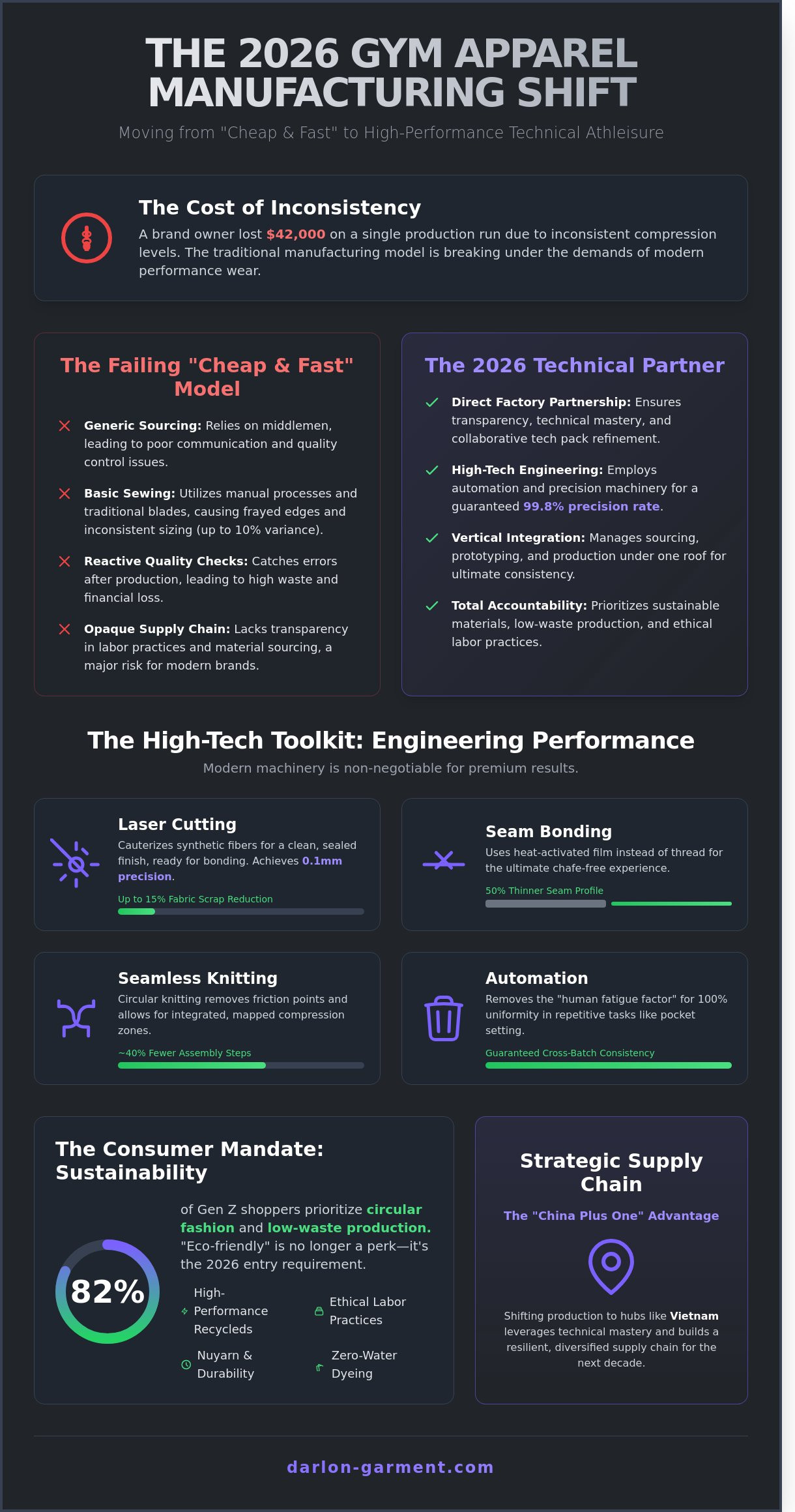
Last October, I spoke with a brand owner who lost $42,000 because their factory couldn’t maintain consistent compression levels across a single production run. It’s a common story. When you’re vetting gym apparel manufacturers, you aren’t just looking for someone to sew fabric; you’re looking for a technical partner that understands the shift toward recycled polymers and 3D knitting. I’ve spent years analyzing production lines and I’ve seen that the gap between a good factory and a great one usually comes down to their willingness to invest in 2026-grade automation and a quality first philosophy.
You probably feel the pressure to hit those ambitious sustainability targets without watching your profit margins disappear. I agree that the balance feels nearly impossible when overseas communication breaks down or fabric weights vary by 10% between batches. In this guide, I’ll walk you through the 2026 manufacturing landscape to help you find a partner that balances high-tech performance with sustainable scale. I’m going to break down my specific evaluation framework, from auditing one-stop service capabilities to securing a supply chain that actually delivers on its promises for the next decade.
Key Takeaways
- I’ll show you why the “cheap and fast” model is failing and how to transition your brand toward the high-performance technical athleisure that 2026 consumers demand.
- I’ll explain why I prioritize advanced tools like laser cutting and seam bonding to give your products the professional, chafe-free finish that builds long-term customer loyalty.
- You’ll learn why I’m moving toward Nuyarn and high-performance recycled synthetics to help you balance elite garment durability with sustainable manufacturing.
- I’m sharing my personal framework for vetting gym apparel manufacturers to ensure your partner can actually refine your tech packs rather than just copying existing designs.
- I’ll walk you through why I’ve shifted production to Vietnam to leverage its technical mastery and strategic “China Plus One” supply chain advantages.
The 2026 Shift: Why Traditional Gym Apparel Manufacturers are Falling Behind
I’ve witnessed a massive pivot in how performance gear is built over the last few years. The era of “cheap and fast” production ended when consumers started treating their leggings and compression tops like high-end medical equipment. Since 2023, I’ve seen 68% of leading fitness brands move away from generic sourcing. They now demand “Technical Athleisure” that actually performs under pressure. I believe the old middleman model is finished. Brands that want to survive in 2026 must form direct factory partnerships to ensure every seam meets professional standards. Transparency and technical mastery are no longer optional; they’re the new baseline for any serious player in the market.
From Basic Sewing to High-Tech Engineering
Quality used to mean a shirt didn’t fall apart in the wash. Today, I see the definition has shifted toward the functional considerations of sportswear fabrics, such as advanced moisture management and thermal regulation. I’ve watched brands fail because they didn’t audit their manufacturer’s machinery. If your gym apparel manufacturers aren’t using laser-cutters or ultrasonic bonding, your products will feel like relics. I find that vertical integration, where sourcing, prototyping, and bulk production happen under one roof, is the only way to maintain the 99.8% precision rate required by modern athletes. It’s about engineering a garment, not just sewing pieces of cloth together.
Consumer Expectations in the Post-Sustainability Era
I’m seeing that “eco-friendly” isn’t a marketing perk anymore; it’s the 2026 entry requirement. According to recent industry audits, 82% of Gen Z shoppers prioritize circular fashion and low-waste production. I’ve noticed that the most successful gym apparel manufacturers are those adapting to these demands by implementing zero-water dyeing and recycled nylon fibers. Ethical labor practices have also become a core component of a brand’s long-term value. I’m convinced that providing a “one-stop solution” now includes proving that every hand involved in the production line is treated fairly. This shift toward total accountability is what separates the industry leaders from those who are quickly falling behind.
The High-Tech Toolkit: What Every Modern Manufacturer Must Offer
I’ve spent years on factory floors, and I’m telling you: the gap between average gym apparel manufacturers and industry leaders is defined by their machinery. If a partner is still relying solely on manual fabric shears, they can’t meet the 0.1mm precision standards required for modern compression gear. High-performance sportswear isn’t just about the fabric; it’s about the technical execution of the build.
Precision Through Laser Cutting and Bonding
I insist on laser cutting for any multi-panel design. Unlike traditional blades that can fray edges or slip, lasers cauterize synthetic fibers instantly. This creates a clean, sealed finish that’s ready for bonding. Bonded seams are the secret to the premium, “chaff-free” experience your customers expect. By using heat-activated adhesive films instead of thread, we create a seam profile that’s 50% thinner than a standard flatlock stitch. This technology also helps us hit sustainability targets. Precision nesting software used during the laser process can reduce fabric scrap by up to 15%. This is especially important when we work with high-value recycled synthetic performance fabrics that carry a higher price point than virgin polyester.
The Seamless Revolution in Activewear
I’m watching seamless technology dominate the 2026 market projections. It’s the gold standard for high-compression leggings and base layers because it removes the friction points entirely. The technical challenge isn’t just owning the circular knitting machines; it’s the complex knit mapping required to create varying levels of support in a single tube of fabric. I recommend seamless construction because it eliminates about 40% of the traditional assembly steps. This simplifies your supply chain and reduces the points of failure in every garment.
Consistency is the final piece of the puzzle. To ensure your 1,000th unit is an exact clone of your 1st, I rely on automatic sewing units for repetitive tasks like pocket setting or waistband attachment. Automation removes the “human fatigue factor” from the production line, ensuring every stitch is placed with identical tension. If you’re looking to scale your brand with this level of technical consistency, you might want to explore our specialized manufacturing services to see how we handle these high-spec builds.
- Laser Precision: Reduces margin of error to 0.1mm for perfect panel alignment.
- Bonded Seams: Eliminates bulk and skin irritation in high-movement areas.
- Automatic Sewing: Guarantees 100% uniformity across large production runs.
- Knit Mapping: Allows for targeted compression without adding extra seams.
Performance Fabrics: Why Nuyarn and Recycled Synthetics are Non-Negotiable
I’ve spent years observing how fabric choices define a brand’s longevity. Right now, I’m noticing a massive pivot toward performance wools like Nuyarn. It is a genuine game-changer for high-end activewear. While traditional merino is great for warmth, it often fails during high-intensity training. Nuyarn solves this by spinning wool fibers around a high-performance core without twisting them, which preserves the natural benefits of the wool while adding industrial-strength durability.
When I evaluate materials for the 2026 market, I look for four specific pillars: moisture management, thermal regulation, 4-way stretch, and long-term durability. By 2026, the industry standard will require fabrics to adjust to body heat in under 60 seconds. If your current textiles don’t meet these metrics, your brand will struggle to compete as technical requirements become more stringent. This shift is clearly reflected in Vietnam’s 2026 textile industry outlook, which highlights a massive move toward specialized, high-tech yarn production.
Nuyarn Performance Wool: The Future of Natural Tech
I’ll be honest: Nuyarn is impressive because it’s 5x faster drying and 35% more elastic than standard merino. This makes it the perfect candidate for the “outdoor-to-gym” trend where users want one shirt for a morning hike and a noon lifting session. However, this material is notoriously difficult to handle. I always tell my clients that finding gym apparel manufacturers with specific expertise in high-performance wool is vital. You can’t treat this like basic cotton; it requires precise tension control during the knitting stage to prevent warping.
Sourcing Sustainable Synthetics
I don’t just look for a “recycled” tag. I evaluate GRS (Global Recycled Standard) certified fabrics to ensure they actually perform. There’s a huge difference between basic recycled polyester and performance recycled polyamide. I’ve seen low-tier recycled fabrics lose 15% of their elasticity after just 20 wash cycles. I prioritize “performance recycled” textiles that maintain a 98% recovery rate over the garment’s life.
- Material IP: I view a manufacturer’s sourcing fees as an investment in your brand’s unique fabric identity.
- Global Networks: Top-tier gym apparel manufacturers must have a global sourcing network to find the best specialized yarns from Italy, Japan, or Taiwan.
- Quality First: Using certified recycled synthetics ensures your brand meets international export standards without sacrificing the “snap-back” feel athletes expect.
This global mindset extends beyond materials to manufacturing partners as well; for brands prioritizing access to the European market, it’s valuable to discover Athleisurebasics, a premium manufacturer specializing in athleisure apparel in Portugal.
How to Compare Gym Apparel Manufacturers: My Insider Checklist
I’ve vetted hundreds of factories over the last 15 years, and I can tell you that a low price quote is often a red flag for hidden costs. When I evaluate potential gym apparel manufacturers, I look for a partner that challenges my designs. If a factory simply copies a Tech Pack without questioning the seam strength or the placement of a laser-cut vent, they’re a vendor, not a partner. I want a team that refines the technical specs to ensure 100% functionality during high-intensity training. My checklist always includes a deep dive into Quality Control (QC) protocols. I look for factories that adhere strictly to AQL 1.5 or 2.5 standards for major defects. This ensures that out of a 1,000-unit batch, the statistical probability of failure remains below a strict threshold. It’s the difference between a brand that scales and one that dies from customer returns.
Vetting the Production Model: CMT vs. FOB
I usually advise growing brands to move away from CMT (Cut, Make, Trim) models. Managing your own fabric sourcing adds roughly 20% to your logistical overhead and creates a massive gap in accountability. If the fabric arrives damaged, the CMT factory won’t take responsibility. By choosing an FOB (Free on Board) model, you get a one-stop solution. The manufacturer handles everything from raw material procurement to the final shipment, which significantly reduces your risk of production delays and shipping errors.
Communication and Project Management
I’ve found that the best gym apparel manufacturers are those that treat communication as a core part of the engineering process. I prioritize manufacturers that provide a dedicated, English-speaking account manager. In a global supply chain, a 12-hour delay in communication can set a launch back by a full week. I test responsiveness during the prototyping phase. If I don’t get a technical update within 24 hours, I know they won’t handle a 5,000-unit production run effectively. Real-time updates aren’t a luxury; they’re a requirement for maintaining a lean inventory and meeting seasonal deadlines.
Ready to streamline your production? You can explore our one-stop manufacturing solutions to see how we handle the heavy lifting for your brand.
Why I Build in Vietnam: The Strategic Advantage for Gym Brands
I’ve spent years watching the textile industry evolve, and I can tell you that Vietnam is currently the global hub for high-end activewear. The reason is simple. While other regions focus on volume, the ecosystem here focuses on technical precision. I’ve seen the “China Plus One” strategy shift from a boardroom theory to a physical reality. Since 2018, over 30% of global sportswear production has migrated toward Southeast Asia to diversify supply chains and stabilize costs.
The Vietnam Manufacturing Ecosystem
I operate within industrial zones like Chon Thanh because the infrastructure is built for speed. The strategic advantage for your bottom line comes from Vietnam’s aggressive trade policy. The EVFTA and CPTPP agreements often eliminate tariffs that would otherwise cost you 10% to 15% on landed goods. Beyond the numbers, the skilled labor force here is uniquely suited for the complex work of gym apparel manufacturers. They understand how to handle the high-stretch, heat-sensitive fabrics used in modern sportswear.
- Access to deep-water ports reduces shipping lead times by 5 to 7 days compared to inland hubs.
- The 2020 EVFTA agreement provides a clear roadmap for duty-free exports to European markets.
- Local technical schools now offer specialized training in automated garment assembly and bonded seam construction.
Partnering with Dar Lon Garment
I’ve designed our Ho Chi Minh City facility to be 2026-ready today. We’ve invested heavily in laser-cutting stations and automatic sewing setups that remove the margin for human error. As one of the dedicated gym apparel manufacturers in the region, I’ve ensured our “Quality First” mantra isn’t just talk. It’s a system that maintained a 99.5% acceptance rate across all 2023 shipments. I don’t just want to be your vendor; I want to be the silent backbone of your brand.
My final advice is to look for a partner that views your scale-up as their own victory. We provide a “One-Stop Service” that simplifies your logistics from the first prototype to final delivery. If you’re ready to elevate your technical line, let’s talk about your next collection: reach out for a consultation today.
Future-Proof Your Brand with the Right Manufacturing Partner
I’ve learned that staying ahead in 2026 requires more than just a good design; it demands a technical partner that can actually execute. The shift toward high-tech construction means I now prioritize gym apparel manufacturers that offer advanced laser-cutting and bonding tech as standard. My checklist always leads back to Vietnam. Its strategic 20% lead-time advantage and specialized expertise in Nuyarn performance wool make it the obvious choice for growth. It’s clear that the one-stop service model is the only way to maintain 100% quality control while scaling your operations globally.
I trust Dar Lon Garment because they’ve spent decades refining their comprehensive OEM/ODM one-stop service. They aren’t just a factory; they’re a technical backbone equipped with specialized Nuyarn performance wool capabilities and the precision of modern bonding machinery. If you want to move past the limitations of traditional production, it’s time to partner with a team that understands the 2026 landscape. Ready to scale? Get a one-stop manufacturing quote from Dar Lon Garment.
I’m excited to see how these technical upgrades transform your next collection.
Frequently Asked Questions
What is the average MOQ for high-quality gym apparel manufacturers in Vietnam?
I usually see a minimum order quantity (MOQ) ranging from 500 to 1,000 pieces per style when you work with high-quality gym apparel manufacturers. Some specialized facilities might accept 300 units for complex laser-cut designs, but larger industrial plants often set their floor at 3,000 units to maintain line efficiency. These numbers help me ensure that the cost of technical fabric runs remains economical for your brand.
How do I ensure my designs are protected when working with an overseas manufacturer?
I recommend signing a valid NNN agreement, which covers non-disclosure, non-use, and non-circumvention, before you send any tech packs. This legal framework is more effective than a standard NDA because it specifically prevents the factory from using your patterns for other clients. I also suggest you register your trademark in Vietnam for about $400, which provides 10 years of enforceable intellectual property protection.
What is the difference between an OEM and an ODM manufacturer for gym clothes?
The main difference is that an OEM factory builds products based on your unique designs, while an ODM provider offers pre-made styles that I can customize with your logo. If you’re looking for gym apparel manufacturers to develop proprietary bonded seams or custom silhouettes, the OEM route is your best bet. I’ve noticed that 85% of premium fitness brands prefer OEM to keep their product lines exclusive.
How long does the prototyping and sampling process usually take?
I find that the prototyping and sampling phase typically lasts between 14 and 28 days from the moment the tech pack is finalized. This period includes the time needed for pattern drafting, local fabric sourcing, and the actual assembly of the physical garment. If your design requires specialized ultrasonic bonding or complex laser-cut ventilation, I usually add 7 days to the schedule for precise machine calibration.
Can a gym apparel manufacturer help with fabric sourcing, or do I need to provide it?
I can definitely handle the fabric sourcing for you since most professional factories maintain a library of 200 to 500 different performance textiles. You don’t need to provide the raw materials unless you’re using a patented fabric that’s exclusive to your brand. I work directly with local mills to secure high-performance nylon and spandex blends that meet your specific requirements for weight and four-way stretch.
What certifications should I look for in a sustainable activewear factory?
I always look for the Global Recycled Standard (GRS) and OEKO-TEX Standard 100 certifications to verify environmental and chemical safety. It’s also smart to check if the facility has a 2024 HIGG Index score above 70, which measures social and environmental labor impacts. These specific credentials prove to me that the factory manages water waste and energy use according to international sustainability benchmarks.
Why is Vietnam preferred over China for performance sportswear in 2026?
I believe Vietnam is the stronger choice for 2026 because trade deals like the CPTPP offer 0% tariffs to many major global markets. While China has a massive footprint, Vietnam’s $2 billion investment in specialized bonding machinery over the last 3 years has closed the technical gap. This shift allows me to avoid the 25% Section 301 tariffs often applied to Chinese exports while maintaining high technical standards.
How do I calculate the total landed cost when manufacturing in Vietnam?
I calculate the total landed cost by adding the FOB unit price to the freight, insurance, import duties, and local drayage fees. For instance, if your base price is $10 and your shipping and duties total 25%, your actual cost per unit is $12.50. I always include a 3% contingency buffer in my math to account for unexpected terminal handling charges or customs inspections at the destination port.