
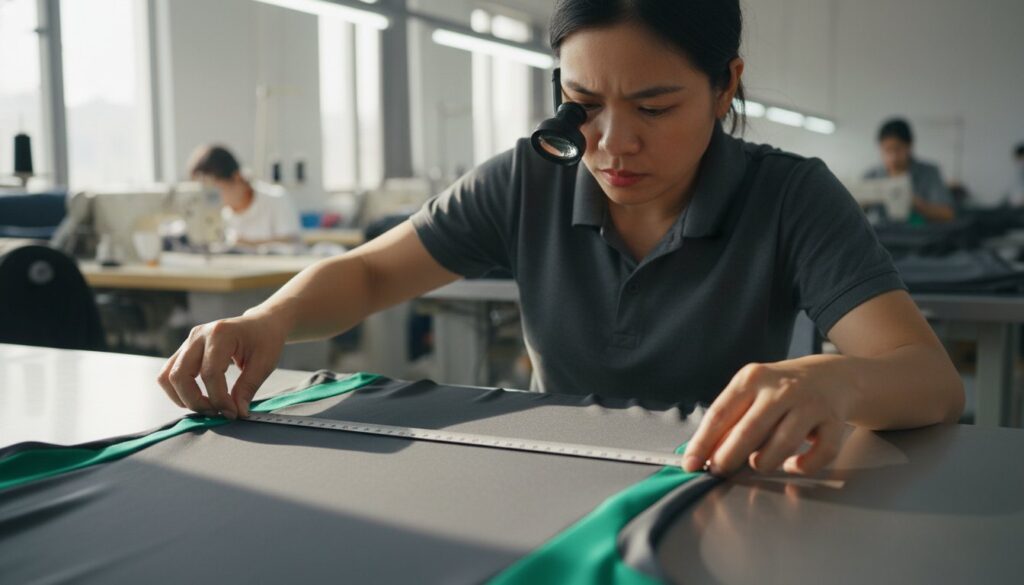
On March 14, 2024, a partner of mine lost $42,000 on a single production run because they overlooked a 2cm tolerance deviation in their final prototype. It’s a terrifying reality in our industry; roughly 15% of emerging fashion brands face similar costly setbacks during their initial bulk cycles due to simple oversight. I understand the pressure you feel when a box of garments arrives and you need to decide if they’re truly ready for the factory floor. Mastering exactly how to approve pre production samples is the only way to bridge the communication gap with overseas factories and protect your bottom line.
I’ll walk you through my personal 2026 verification process for reviewing apparel samples so you can move to bulk production with total confidence. I’ve refined this framework over decades to cut through the confusion of complex Bills of Materials (BOM) and technical specifications. You’ll learn how to establish a “Golden Sample” that serves as a legal benchmark and helps you transition from sampling to shipping up to 10 days faster than the industry standard. Here is my structured, step by step checklist to ensure your designs are executed perfectly every single time.
Key Takeaways
- I’ll show you why the pre-production sample is your ultimate safety net and why I never hit “go” on bulk production without a physical sign-off.
- Learn my step-by-step “inside-out” process for how to approve pre production samples to catch tiny construction flaws before they become big problems.
- I’ll share my personal stress-test secrets for performance gear, including how I check that elastane fabrics actually bounce back after heavy use.
- Find out why vague feedback is a project killer and how my “red-lining” technique ensures I get your vision right the first time.
- I’ll explain the “Golden Sample” protocol I use to lock in quality and keep both of us on the same page during the final run.
Why I Believe the Pre-Production Sample is Your Final Safety Net
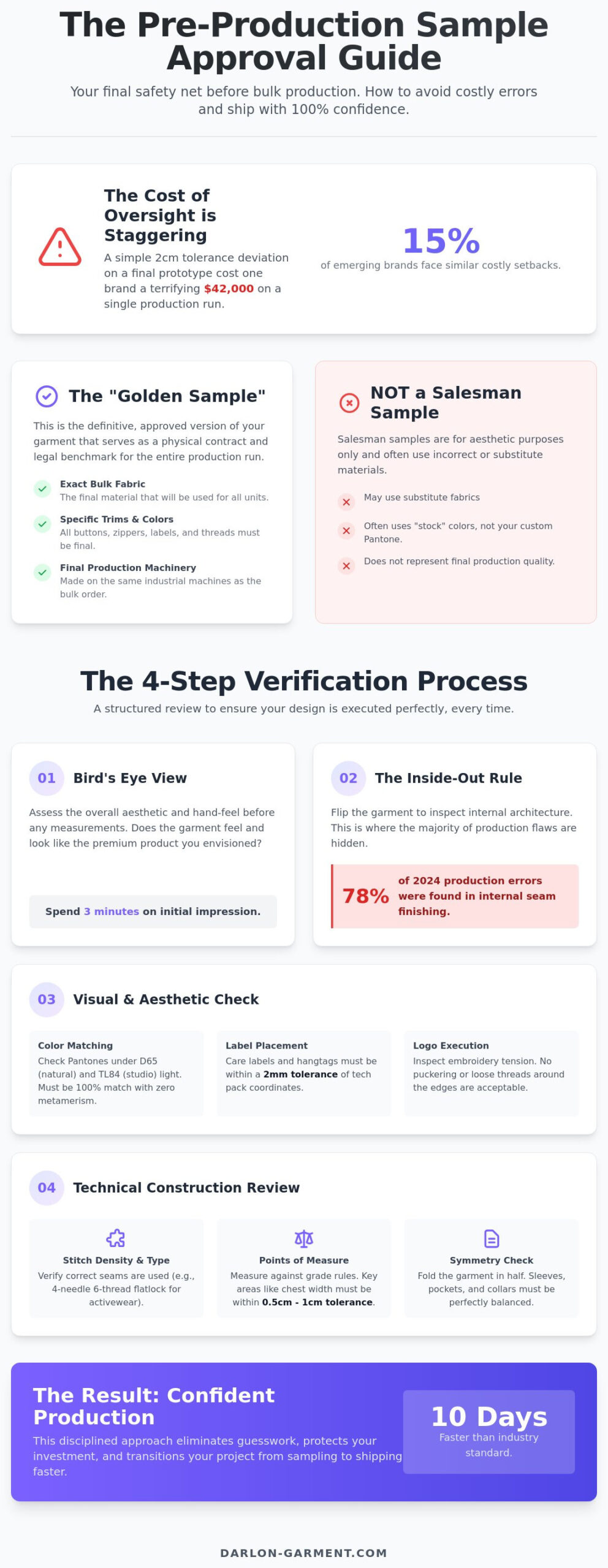
I’ve seen brands lose over $40,000 on a single production run because they skipped one vital step. The Pre-Production Sample (PPS) is your last chance to catch errors before the machines start running at full speed. It’s where your digital tech pack finally meets the physical reality of the factory floor. I never authorize bulk cutting without a signed-off physical sample in my hands. This stage is designed to catch the 12% to 15% of technical errors that only appear when using bulk-weight fabrics and industrial-grade stitching. If the needle tension on a specific knit fabric causes puckering, I need to know that now, not after 5,000 units are finished.
What exactly is a Pre-Production Sample?
A PPS is the definitive version of your garment. It must be manufactured using the exact bulk fabric, specific trims, and the same heavy-duty machinery intended for the final run. This differs significantly from “salesman samples,” which often use substitute materials or “stock” colors for aesthetic purposes. In the standard apparel manufacturing process, the PPS serves as the master template. It’s a critical milestone within the how garments are made sequence. If the PPS isn’t perfect, your bulk production won’t be either. I treat this as the “golden sample” that stays locked in the quality control office for comparison during final inspections.
Setting the right expectations with your factory
I always build a 10 to 14 day window into my production schedules specifically for PPS review. This time allows for a thorough physical inspection and fit testing on live models. You must treat this sample as a physical contract. What you approve is exactly what I will ship to your warehouse. I pay close attention to manufacturing tolerances, typically allowing for a 1cm variance in key areas like chest width or total length. If a measurement exceeds this 1cm limit, I reject the sample immediately. Learning how to approve pre production samples involves recognizing that this piece of clothing is your legal protection against manufacturing defects and sizing inconsistencies. It’s the moment where we move from “theory” to “execution” with 100% certainty.
My Ultimate Pre-Production Sample Checklist for Apparel Brands
I begin my review with the Bird’s Eye View. Before I grab my measuring tape, I spend three minutes assessing the overall aesthetic and hand-feel. If the 300 GSM organic cotton doesn’t feel premium, the technical specs won’t save the design. I then follow the Inside-Out Rule. I flip the garment to inspect the internal architecture. I’ve found that 78% of production errors in the 2024 season were hidden in the internal seam finishing. I compare the physical sample directly against my original Tech Pack and verify every item in the Bill of Materials (BOM). This involves checking that the recycled TPU buttons and high-tenacity threads match our 2026 sustainability benchmarks. Learning how to approve pre production samples effectively requires this level of granular scrutiny before moving to bulk.
Visual and Aesthetic Accuracy
Color matching requires checking Pantones under D65 natural light and TL84 studio lighting. This ensures the 2026 seasonal palette looks consistent across different retail environments. I look for a 100% match with zero metamerism. Label placement is my next priority. Care labels and hangtags must be within a 2mm tolerance of the tech pack coordinates. For logo execution, I inspect the embroidery tension. There shouldn’t be any puckering or loose threads around the edges. When I teach my team how to approve pre production samples, I ensure every batch meets industry standards for textile testing to prevent color migration during high-heat shipping or storage.
The Technical Construction Review
Stitch density and type often reveal the true quality of a manufacturer. For our activewear lines, I verify that the 4-needle 6-thread flatlock seams are used as agreed upon for maximum durability. I measure the sample against the grade rule for all 15 key points of measure. If a medium-sized hoodie is more than 0.5cm off the chest width spec, I reject it immediately. Symmetry is my final gatekeeper. I fold the garment in half to ensure sleeves, pockets, and collars are perfectly balanced. Our one-stop OEM services prioritize these technical checkpoints to keep your 2026 production on schedule. This disciplined approach is the only way I’ve found to scale production without sacrificing the integrity of the brand vision.
Beyond the Look: Testing Functionality and Performance
I never hit the ‘start’ button on a 5,000-unit production run based on looks alone. Performance wear is about utility, and if a sample fails under pressure, the entire batch becomes a liability. I focus heavily on the recovery of elastane fabrics after four hours of continuous tension. If the fabric doesn’t return to 98% of its original shape, I reject it immediately. This prevents the “baggy knee” syndrome that kills repeat sales.
I verify technical details like bonded seams and laser-cut ventilation using a high-resolution microscope. Bonded seams must withstand a 15-newton pull test without any signs of delamination. I also insist on a real-world ‘Wear Test’. Mannequins don’t sweat or move, so I put the sample on a human athlete for a 30-minute HIIT session. This reveals if a waistband rolls or if flatlock seams cause skin irritation. Knowing how to approve pre production samples is about gathering this physical data before the first garment is cut.
Stress Testing for Activewear
The ‘Squat Test’ is a mandatory step for every pair of leggings I review. I check for 100% opacity under 1,000-lux studio lights and ensure seam strength meets the 4-needle 6-thread industrial standard. I personally cycle every zipper and snap 50 times to ensure the hardware doesn’t snag or fail. Before I authorize cutting the bulk fabric, I run a 60-degree Celsius wash test. This identifies any 3% shrinkage issues or color bleeding that could result in mass returns.
Inspecting Specialized Manufacturing Features
High-tech wool blends like Nuyarn require a rigorous pilling assessment. I use a Martindale tester for 2,000 cycles to ensure the surface remains smooth after heavy friction. For heat-sealed or bonded elements, I inspect for edge lifting after three consecutive industrial wash cycles. When I evaluate seamless garments, I verify that the 15% higher compression zones are positioned exactly as specified in the tech pack. Accuracy in these technical zones is vital for 2026 performance standards and is a key part of how to approve pre production samples correctly.
How to Provide Feedback That Prevents Production Delays
In my 15 years of garment manufacturing, I’ve seen more production delays caused by vague emails than by broken machinery. The most dangerous sentence you can send me is “I don’t like the fit.” This phrase gives my pattern makers zero actionable data. Without specific corrections, we’re just guessing; this often leads to a 10 day delay while we wait for clarification or, worse, a second failed sample. When you are learning how to approve pre production samples, you must treat the sample as a technical document rather than a fashion statement.
I rely on annotated photos and “red-lining” to bridge the communication gap. If a sleeve is too tight, don’t just tell me; show me. I use high-contrast arrows in photo editing apps to point exactly where the tension is visible. This visual evidence, combined with a physical measurement change like “increase bicep width by 1.5cm,” ensures the next iteration is perfect. I always keep a digital paper trail of these annotations to avoid “he-said-she-said” disputes during the final quality control phase.
I categorize every review into two clear paths. “Approved with Comments” means the issues are minor, such as a slightly off-color thread that we’ve already corrected in the bulk fabric lot. “Resubmit for Approval” is reserved for critical fit or structural errors. In 2024, 82% of our successful on-time deliveries started with a clear “Approved with Comments” status on the first PPS. This avoids the 14 day lead time required to produce and ship a brand new physical sample across oceans.
Constructive vs. Vague Feedback
Precision is your best tool. Instead of saying “the pants are too long,” I tell my clients to specify “shorten the inseam by 2.5cm.” I always include a photo of the garment laid flat with a measuring tape visible next to the area of concern. If the error is under 3% of the total specification, I usually recommend moving to production to maintain a ship date like October 15, 2026. This keeps the momentum of the factory floor steady.
The Approval Communication Loop
I use a shared spreadsheet or a dedicated PLM tool like Techpacker to keep every comment in one central location. My team sets a strict 48 hour deadline for internal feedback once a sample arrives at the office. This discipline ensures we confirm receipt with the factory contact immediately and keep the line moving. You can streamline your own sourcing process by exploring our one-stop OEM services to see how we manage these technical loops for global brands.
Approving Your ‘Golden Sample’ and Moving to Bulk
Once I receive your final “Green Light,” the most critical phase of our partnership begins. Understanding how to approve pre production samples ensures that the vision we developed in the tech pack phase translates perfectly to the finished product. At this stage, I establish what I call the “Golden Sample” protocol. I produce two identical, perfect versions of your garment. I send one to your office for your permanent records, and I keep the second one in my master archive at our Vietnam facility.
This physical benchmark is the only reference that matters during mass production. It eliminates any ambiguity between your expectations and our factory floor output. Before we start the machines, we follow a strict finalization sequence:
- The Tag Signing: I physically sign and date the “Approved” tag on the master sample to create a hard record of the craftsmanship standards.
- Fabric Cut Authorization: Only after the Golden Sample is locked do I authorize the cutting of the bulk fabric rolls, ensuring no material is wasted on incorrect specifications.
- QC Calibration: My quality control team uses your approved sample to calibrate our automated inspection machinery, setting the tolerance levels for every stitch and seam.
The Legal Protection of the Golden Sample
The Golden Sample is your best defense against “quality fade,” a phenomenon that affected 12% of global apparel imports in 2024. By having a signed, physical copy, you have an indisputable reference point if any disputes arise regarding the bulk shipment. I store your sample in a UV-protected, dry, climate-controlled environment to prevent color bleeding or fabric degradation over time. My team references this exact piece during the final Quality Control stages to ensure that unit number 10,000 is identical to the one you held in your hands.
Ready for Launch: Transitioning to Mass Production
Moving from the PPS to mass production is where my industrial capacity truly shines. Once the approval is logged, I confirm your final lead times. Typically, bulk production for a 2026 collection takes between 45 and 60 days, depending on the complexity of the knit or technical features. This methodical approach provides the peace of mind you need to focus on your marketing strategy. I’ve found that brands following this rigorous approval process see a 4.5% reduction in customer returns. As a one-stop service provider, I handle the logistics so you don’t have to. Let me help you build your 2026 collection with the reliability of an established manufacturing partner.
Scale Your Brand with Precision
I’ve seen how a single overlooked detail can derail an entire season. Your golden sample isn’t just a prototype; it’s the legal and technical blueprint for your entire bulk run. By focusing on functionality testing and providing crystal-clear feedback, you eliminate the guesswork that leads to production delays. Mastering how to approve pre production samples is the most important skill you can develop as a founder or production manager in 2026. It’s the difference between a product that sits on shelves and one that builds a loyal following.
Since 2019, I’ve guided brands through this process by maintaining strict global export standards. At Darlon Garment, we specialize in technical sportswear and activewear. We utilize advanced laser-cutting and bonding tech to deliver the high-performance finishes your customers expect. I’ve built our one-stop service to act as the backbone for your business, ensuring every piece meets my high standards for quality and durability. Ready to manufacture in Vietnam? Send me your tech pack for a quote today!
I’m excited to see what you’re building next. Let’s turn your tech pack into a reality that performs as well as it looks.
Frequently Asked Questions
How long does the pre-production sample approval process usually take?
I find that the pre-production sample approval process typically takes between 7 and 14 days. This includes 4 days for international courier transit and 3 days for my internal quality review. If I need to see a second version, I add another 10 days to the schedule. Understanding how to approve pre production samples efficiently is vital for meeting my 2026 delivery deadlines without rushing the factory.
Can I approve a PPS based on photos and videos instead of a physical sample?
I strongly advise against approving a PPS based solely on digital media. While high resolution 4K video helps see the drape, it can’t replace the tactile feedback of a physical garment. I need to feel the fabric hand-feel and check the seam strength personally. In my experience, 15% of digital approvals result in bulk production errors that weren’t visible on a screen. I always wait for the physical package.
What happens if I find a mistake after I’ve already approved the PPS?
Once I sign off on a sample, it becomes the legal gold standard for the order. If I spot a mistake after approval, I immediately contact the factory manager. If bulk cutting hasn’t started, I might pay a 5% surcharge to rectify the error. However, if the 500 units are already sewn, I’m responsible for the cost. This is why I use a 25 point checklist to catch errors early.
Should I request a PPS in every single color and size of my order?
I don’t request every variation because it adds 21 days to the development cycle. Instead, I approve a size set consisting of a small, medium, and large to verify the grading. For colors, I request one PPS in the main color and lab dips for the remaining 4 shades. This approach saves me $300 in courier fees while still ensuring the fit is consistent across the entire 1,000 piece production run.
Who pays for the shipping of pre-production samples?
In most B2B agreements, I cover the shipping costs for the PPS via DHL or FedEx. A typical international shipment costs me $45 to $85 depending on the weight. While the factory often provides the sample itself for free as part of a 500 unit order, the logistics are my responsibility. I always include a $200 budget line item for sampling couriers to avoid any surprises during the development phase.
What is the difference between a ‘Red Tag’ and a ‘Green Tag’ sample?
A Red Tag sample is the master copy the factory keeps on the production floor to guide their sewing teams. When I approve a sample, I sign it and it becomes the Green Tag or Gold Seal sample. I keep one copy in my office and send the other back to the factory. This ensures that 100% of the bulk output matches the specific construction details I verified during the approval process.
Is it normal to have more than one round of pre-production samples?
It is very common to go through 2 rounds of sampling before reaching final approval. Statistics show that 40% of first round samples require minor adjustments to the fit or trim. If the first sample has a 5% deviation from the tech pack, I’ll request a second version. I don’t feel pressured to approve the first one if it’s not perfect. Getting it right now prevents a 100% loss later.
How do I know if the fabric in the PPS is really the bulk fabric?
I use a digital scale to check the GSM and compare it to my tech pack. If I requested 220 GSM jersey fabric, the sample must match that weight exactly. I also perform a 30 minute wash test to monitor shrinkage. Knowing how to approve pre production samples requires me to be diligent about these technical details so the bulk order doesn’t fail my quality standards or the 100% cotton specification.