

If you think managing four different vendors for a single line of activewear is just part of the job, you are likely bleeding margin and losing sleep for no reason. I have seen too many brands struggle with communication breakdowns between fabric mills and sewing lines, only to end up with bulk orders that don’t match the original samples. It is a cycle of quality inconsistency that high-performance sportswear brands simply cannot afford in 2026.
I will show you how to cut through the noise to find a reliable one stop shop clothing manufacturer vietnam that manages the entire lifecycle of your product. Whether you are producing seamless garments or complex Nuyarn performance wool, having a single point of accountability is the only way to ensure your technical specs are actually met. I’ve learned that a partner who handles the technical heavy lifting is the silent backbone of any successful international brand.
In this guide, I’ll break down how to navigate the current 10% U.S. import surcharge and the January 2026 minimum wage increases. We will look at how Resolution No. 82/NQ-CP is shifting the landscape toward high-value manufacturing, giving you the blueprint to secure a partner that handles everything from technical sourcing to final logistics.
Key Takeaways
- Learn why the Fully Factored (FOB) model is the most efficient way to eliminate lead-time delays and quality drift in your supply chain.
- I’ll show you how technical apparel, such as seamless and bonded garments, requires a partner who focuses on engineering rather than just basic sewing.
- Discover my 5-step process for vetting a one stop shop clothing manufacturer vietnam to ensure they can handle everything from design consultation to fabric sourcing.
- Get insights into a four-stage quality control system that maintains consistent standards from the initial raw materials to the final packed shipment.
- Explore how utilizing advanced construction methods like laser cutting and Nuyarn performance wool can give your brand a competitive edge in 2026.
What Does a One-Stop Shop Clothing Manufacturer in Vietnam Really Do?
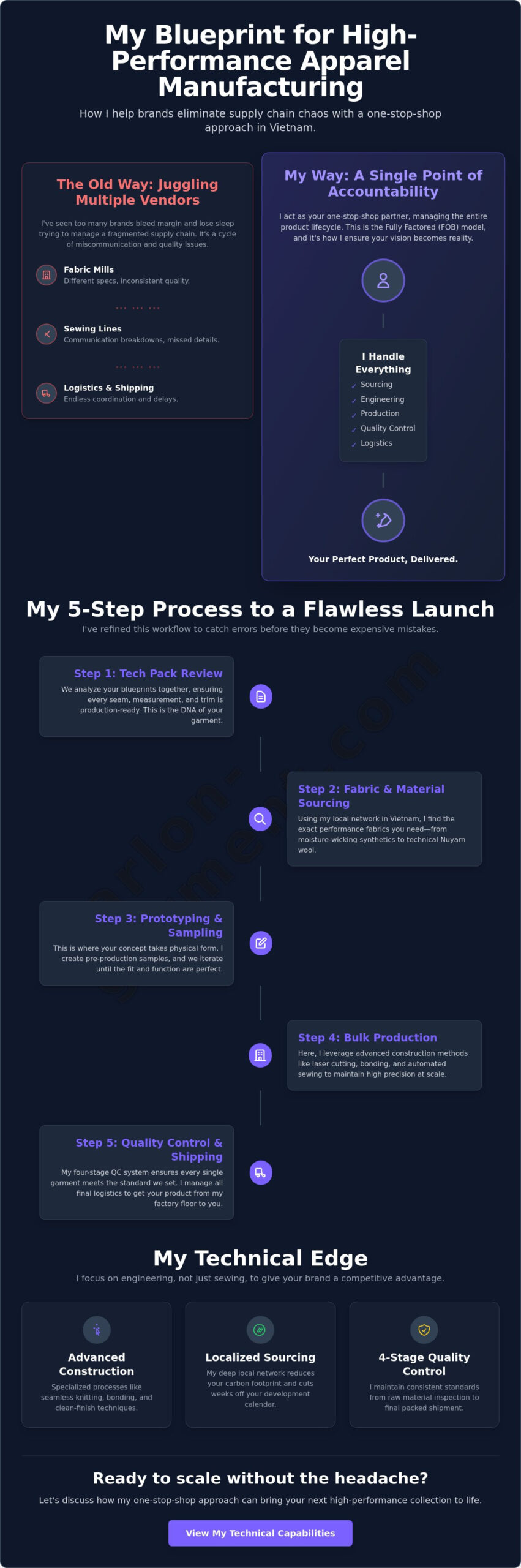
A one stop shop clothing manufacturer vietnam isn’t just a facility with rows of sewing machines. It’s a partner that handles the “Fully Factored” or FOB (Free on Board) model. This means I take responsibility for everything from the initial tech pack review to delivering the final product to the port. When you work with fragmented vendors, you often face lead-time delays because the fabric supplier isn’t talking to the cutting room. I’ve seen quality drift happen simply because a mill sent a slightly different weight of nylon that the sewing team didn’t catch until it was too late.
By centralizing these operations, I eliminate the friction points that usually kill a production schedule. A true one-stop partner manages:
- Technical Material Sourcing: Finding the exact performance fabrics required for activewear.
- Pattern Engineering: Ensuring the fit is consistent across all sizes.
- Advanced Construction: Handling specialized processes like bonding and laser cutting.
- End-to-End Logistics: Managing the movement of goods from the factory floor to the shipping container.
Historically, Vietnam’s manufacturing sector was known for simple assembly. That’s changed. We’ve moved toward high-value, technical production. I personally oversee the integration of design, material sourcing, and final assembly to ensure that the technical specs of your sportswear or swimwear are maintained throughout the entire production line.
CMT vs. FOB: Which Model Fits Your Brand?
In the Cut, Make, Trim (CMT) model, you provide the fabric, trims, and patterns. It sounds cheaper, but the logistics are a nightmare for international brands. I recommend the FOB model for sportswear and activewear. It allows me to control the quality of the technical fibers and ensures that the bonding or laser-cutting machinery is calibrated correctly for the specific materials we’ve sourced together. It’s about scaling without the operational headache.
The Value of Localized Sourcing in Vietnam
I leverage a deep local network to find specialized trims and performance fabrics within the Vietnamese ecosystem. This isn’t just about convenience; it significantly reduces the carbon footprint by minimizing the transport of raw materials. Sourcing locally also gives us a massive speed advantage. I can often cut weeks off your development calendar because we aren’t waiting on international fabric shipments to clear customs before we can start sampling.
My 5-Step Process for Turning Your Idea into a Finished Product
I’ve found that the difference between a successful launch and a warehouse full of dead stock usually comes down to the process. When you partner with a one stop shop clothing manufacturer vietnam, you aren’t just buying labor; you’re buying a managed workflow. I’ve refined my approach into five distinct stages that ensure we catch technical errors before they become expensive mistakes.
- Step 1: Tech Pack Review: We analyze your blueprints to ensure every seam and measurement is production-ready.
- Step 2: Fabric Sourcing: I find the right performance metrics, like moisture-wicking or UV resistance, to match your brand’s requirements.
- Step 3: Prototyping and Sampling: We iterate on the design until the fit and function are perfect.
- Step 4: Bulk Production: This is where I utilize laser-cutting and automated sewing to maintain high precision at scale.
- Step 5: Quality Control and Shipping: We manage the final gate before delivery, ensuring every garment meets the standard.
Given Vietnam’s garment export performance in recent years, the infrastructure for international logistics is robust. This allows me to move goods from the factory floor to global markets with high efficiency. It’s a disciplined way to work, but it’s the only way to guarantee the final result for technical sportswear or activewear.
The Critical Role of the Tech Pack
I can’t stress this enough: your tech pack is the most important document you’ll ever send me. It’s the DNA of your garment. I often see tech packs that lack specific tolerances or omit crucial trim details, like the exact zipper brand or thread weight. These omissions lead to guesswork on the factory floor, which is where quality falls apart. My team works with you to refine these specs. We make sure your designs aren’t just pretty on a screen but are actually ready for a high-speed production line. If you’re ready to see how we translate specs into real garments, you can view our technical capabilities to learn more.
Sampling: The Bridge Between Concept and Reality
The pre-production sample (PPS) is where the concept finally takes physical form. I insist on testing fabrics for shrinkage and colorfastness during this stage because performance wear has to survive more than just a few washes. We look for how the fabric behaves when stretched and how the seams hold up under tension. The fit session is the most important part of this cycle. It’s our chance to see the garment on a real body or a professional fit model. We don’t move to bulk production until every adjustment is documented and confirmed. This step-by-step validation is what keeps your supply chain stable.
Why Technical Apparel Requires a One-Stop Manufacturing Partner
Performance wear is not just about sewing; it’s about engineering. When I work with high-performance fabrics, I’m not just looking at how a needle passes through a textile. I’m looking at how heat, pressure, and chemical adhesives interact with synthetic fibers. As a one stop shop clothing manufacturer vietnam, I’ve found that separating your fabric sourcing from your technical construction is a recipe for failure. If the mill doesn’t understand the specific heat tolerances required for bonding, your seams will delaminate after three washes. Having the sourcing and sewing teams in the same building is vital for these complex interactions.
I use laser cutting and bonding to create seamless garments that traditional factories simply can’t produce. This isn’t just for aesthetics. Laser-cut edges prevent fraying without the bulk of a turned seam, which is crucial for high-performance activewear and swimwear. It requires a controlled environment and a deep understanding of material composition. When we handle everything under one roof, we can calibrate our machinery to the specific roll of fabric we just received, ensuring the precision remains consistent across thousands of units.
Mastering Stretch and Compression
Sewing high-elastane fabrics presents a unique set of challenges, specifically regarding seam puckering and tension control. If the machine’s feed dog isn’t perfectly synchronized with the needle speed, the stretch in the fabric will create waves along the seam line. I’ve spent years perfecting the use of flatlock and four-needle six-thread stitching machines to ensure that compression gear remains functional and comfortable. For a deeper look at how I handle these materials, you can read my Elastane Fabric: A Manufacturer’s Guide. It covers the technical nuances of mastering stretch in the 2026 market.
Sustainable Innovation: Performance Wool and Beyond
I’ve seen a massive shift toward technical natural fibers, specifically Nuyarn performance wool. Unlike traditional merino, Nuyarn is engineered to be stronger and more elastic, but it requires specialized handling during the assembly process. My experience with this technology allows me to produce wool apparel that performs like a synthetic. This is where the one stop shop clothing manufacturer vietnam model adds the most value. We track the sustainability of your raw materials from the source through to the final pack. If you want to understand why I’m seeing this shift in global apparel sourcing, check out The Manufacturer’s Guide to Natural Fibers. It explains how we integrate these innovative textiles into a streamlined production flow.
Navigating Logistics and Quality Control in Vietnam’s Landscape
Managing the movement of goods from a factory floor in Vietnam to a warehouse in Los Angeles or Berlin is where many brands lose their momentum. I’ve seen logistics turn into a nightmare when paperwork is filed incorrectly or when a factory doesn’t understand the nuances of international trade agreements. As a one stop shop clothing manufacturer vietnam, I take the weight of these logistics off your shoulders. I handle the port configurations and customs documentation, ensuring you benefit from agreements like the EVFTA for European shipments. Even with the temporary 10% U.S. surcharge in early 2026, a streamlined logistics path helps keep your landed costs predictable.
Ethical manufacturing is also a core pillar of how I operate. Following the January 2026 minimum wage increases under Decree No. 293/2025/ND-CP, maintaining social responsibility is about more than just legal compliance. It’s about stability. I’ve found that fair wages and safe working conditions lead to lower staff turnover, which directly translates to better quality for your sportswear and activewear. When workers are treated well, they take more pride in the technical details of the garments they produce.
The 4 Stages of Quality Inspection
I don’t wait until the end of production to check for mistakes. My quality control framework is built into the production line itself.
- Pre-production: We inspect every fabric roll for weight, color consistency, and defects before a single cut is made.
- In-line: Quality auditors walk the floor to catch errors while the garments are still on the machines, preventing a small mistake from becoming a bulk disaster.
- End-of-line: Every finished piece of swimwear or sleepwear undergoes a 100% visual and tactile inspection.
- Pre-shipment: I perform a final AQL (Acceptable Quality Level) audit to ensure the entire batch meets international standards before it leaves the port.
Vetting Your Partner: What I Recommend You Ask
If you’re looking for a partner, don’t just look at their website. Ask for a detailed machine list to verify they actually own the bonding or laser-cutting equipment they claim to have. You should also ask for updated certifications like WRAP, BSCI, or Oeko-Tex. These aren’t just badges; they are proof of a disciplined operational history. I always tell my partners that a long-term relationship is built on transparency. If a factory can’t show you their internal QC reports or explain their capacity planning for the next quarter, they aren’t ready to be your silent backbone. If you want to see how a professional setup operates, contact me to discuss your production logistics and see our quality standards firsthand.
Building Your Brand with Dar Lon: My Commitment to Your Vision
I started Dar Lon in 2019 with a specific goal: to bridge the gap between complex global design requirements and the realities of Vietnamese manufacturing. I noticed that many international brands were losing time and quality because they lacked a single point of accountability. As a one stop shop clothing manufacturer vietnam, I built this company to be that missing link. We don’t just sew garments; we provide the technical expertise needed for sportswear, activewear, swimwear, and sleepwear. I’ve structured our operations to handle the technical heavy lifting so you don’t have to.
In 2026, we have implemented several technology upgrades to stay ahead of the industry’s shift toward high-value production. These investments allow us to operate faster and maintain a greener footprint, which is essential for meeting the new EU supply-chain transparency requirements. I’ve always believed that a factory should be more than just a vendor. It should be a disciplined partner that values your brand’s vision as much as you do. I invite you to take a behind-the-scenes look at how garments are made in my facility to see our standards in action.
Our Specialized Production Capabilities
My focus remains on high-volume OEM and ODM contracts for partners who require precision. We’ve developed specialized lines for seamless garments and bonded apparel, utilizing the laser-cutting technology I discussed in previous sections. These capabilities are designed for brands that prioritize performance and durability. If you’re currently evaluating your options, I’ve put together a resource on Choosing the Right Fitness Wear Manufacturer to help you navigate the selection process with confidence.
How to Get Started with Us
The path to a streamlined supply chain starts with a clear exchange of information. When you reach out for an initial inquiry, I’ll need your tech packs, material specifications, and projected order volumes. This allows me to provide an accurate quote and timeline. I don’t believe in hidden costs or short-term gains. My philosophy is rooted in long-term cooperation and transparent pricing. I want to build a partnership where we can grow together, backed by a stable and technically proficient manufacturing base. Reach out to me today, and let’s start the development process for your 2026 collections.
Securing Your Manufacturing Future in Vietnam
Transitioning to a one stop shop clothing manufacturer vietnam is the most reliable way to eliminate the operational friction that often stalls international brands. By consolidating your fabric sourcing, technical engineering, and logistics into a single point of accountability, you gain the predictability needed for 2026. I’ve detailed how a structured 5-step process and integrated quality control serve as the foundation for delivering high-performance activewear and swimwear that stands up to global competition.
I built Dar Lon to be the silent, powerful backbone for your brand’s growth. We support our clients with ISO 9001:2015 Certified Production and advanced laser-cutting and bonding technology. My team specializes in complex materials like Nuyarn performance wool, ensuring that your technical specs are met with industrial precision. Contact me today to discuss your next production run. I am ready to help you navigate the complexities of the Vietnamese landscape and turn your design blueprints into market-ready products.
Frequently Asked Questions
What is the typical lead time for a one-stop shop in Vietnam?
Lead times for a one stop shop clothing manufacturer vietnam typically range from 60 to 90 days for bulk production. This timeframe begins once the final pre-production sample is approved and all raw materials are secured. The development phase, which includes technical sourcing and prototyping, can add another 4 to 6 weeks. I always recommend planning your collections at least six months in advance to account for shipping logistics and seasonal capacity peaks.
Do I need to provide my own fabric when working with a one-stop shop?
You don’t need to provide your own fabric when working with a one-stop manufacturer under the FOB model. I handle the entire sourcing process based on the requirements in your tech pack. This includes finding performance textiles that meet specific metrics for stretch, weight, and durability. If you have a specific mill you prefer, I can coordinate with them, but most of my clients prefer that I manage the local supply chain to reduce lead times.
Can a one-stop manufacturer in Vietnam help with low MOQ orders?
Most one-stop manufacturers in Vietnam focus on high-volume OEM and ODM contracts rather than low MOQ orders. The technical setup for advanced processes like laser cutting and bonding requires significant scale to remain cost-effective. While some boutique facilities exist, a professional one stop shop clothing manufacturer vietnam typically looks for partners ready to produce at an industrial scale. I focus on brands that are scaling their production and need consistent, high-capacity output.
What are the benefits of manufacturing sportswear in Vietnam vs. China?
Vietnam offers a strategic advantage through its network of free trade agreements, including the EVFTA and CPTPP. While China has massive infrastructure, Vietnam has become the primary destination for the “China plus one” strategy. My facility provides technical construction that rivals top-tier Chinese factories. With the current 10% U.S. import surcharge being temporary through July 2026, Vietnam remains a highly competitive and stable alternative for global sportswear and activewear brands.
How do I ensure the quality of my garments without visiting the factory?
I ensure quality through a rigorous four-stage inspection process and transparent digital reporting. You don’t need to be physically present when you have a partner who provides detailed AQL audit reports at every stage of production. We document everything from raw material checks to final pre-shipment inspections. This structured approach allows you to monitor the technical precision of your garments from anywhere in the world, maintaining consistency between samples and bulk production.
What certifications should I look for in a Vietnamese garment manufacturer?
You should look for internationally recognized validations like ISO 9001:2015 for quality management and WRAP or BSCI for social compliance. These certifications prove that a factory operates with a disciplined, professional framework. I also recommend checking for Oeko-Tex Standard 100 if you’re producing activewear or swimwear. These markers are essential for meeting the new EU supply-chain transparency regulations that require full verification of manufacturing partners by the end of 2026.
Does Dar Lon Garment handle the shipping and customs paperwork?
Yes, I handle the international shipping logistics and customs paperwork as part of my comprehensive service model. This includes managing the movement of goods to the port and ensuring all documentation is filed correctly to leverage preferential tariff rates. I understand the logistical and financial priorities of a professional buyer. My goal is to serve as a silent backbone for your brand, taking the technical and administrative heavy lifting off your plate.
What types of clothing does Dar Lon Garment specialize in?
I specialize in high-performance sportswear, activewear, swimwear, and sleepwear. My facility is specifically equipped for advanced construction methods, including seamless garments and bonded, laser-cut apparel. I also have extensive experience working with Nuyarn performance wool. These technical categories require the precision and engineering that my one-stop shop model provides. I focus on producing durable, functional garments that meet the rigorous standards of the international performance apparel market.