
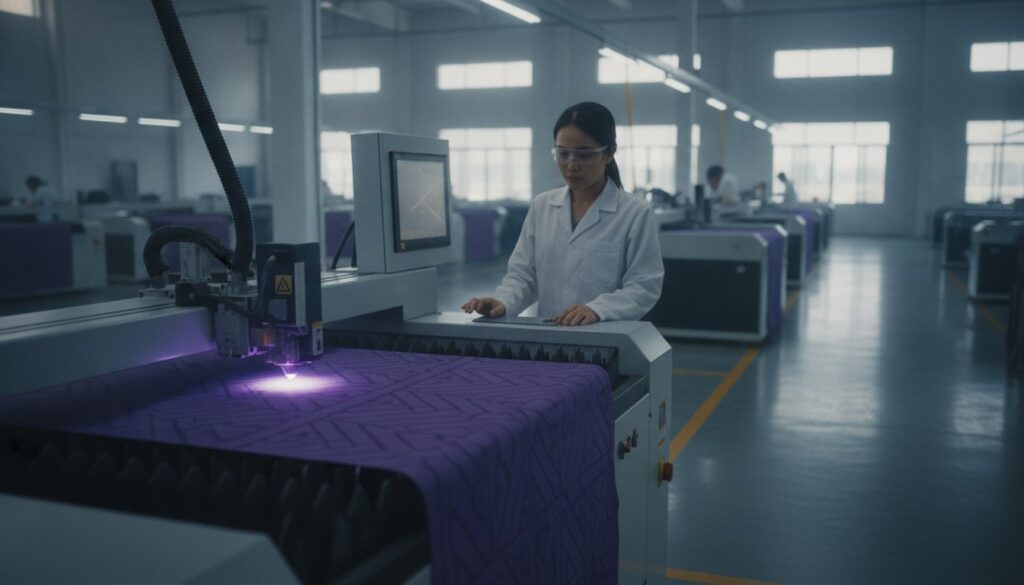
The difference between a viral bikini collection and a warehouse full of deadstock often comes down to a single laser cut. If you are searching for a reliable bikinis and one-piece manufacturer vietnam is likely at the top of your list for 2026. I’ve spent years in the industrial heart of this country, and I’ve seen firsthand how the shift toward smart production has changed the game. It’s no longer just about finding the lowest price. It’s about finding a partner who understands that a millimetre of error in a bonded seam can ruin a high-end design.
I know the anxiety that comes with overseas production. You probably worry about whether your technical sketches will get lost in translation or if quality control will slip during long lead times. I’ll show you why Vietnam is the global hub for swimwear and how my manufacturing process turns your designs into retail-ready collections. We’ll explore the impact of 2026 requirements like the EU Digital Product Passport and see how advanced tech ensures your brand stays competitive in a market where precision is the only standard that matters.
Key Takeaways
- I’ll show you why Vietnam’s expanding textile infrastructure makes it the most reliable base for your swimwear production in 2026.
- Learn my personal recommendations for high-performance fabrics, including why I prioritize Nylon-Elastane for premium collections and Polyester-Spandex for athletic wear.
- Discover how partnering with a specialized bikinis and one-piece manufacturer vietnam gives you access to my precision laser-cutting and bonding technology for a seamless finish.
- I’ll walk you through my step-by-step production journey, from refining your tech packs to getting the perfect fit during the prototyping phase.
- Find out how I build long-term manufacturing partnerships that support the specific scaling needs of both emerging startups and established global brands.
Why I believe Vietnam is the best place for your swimwear production in 2026
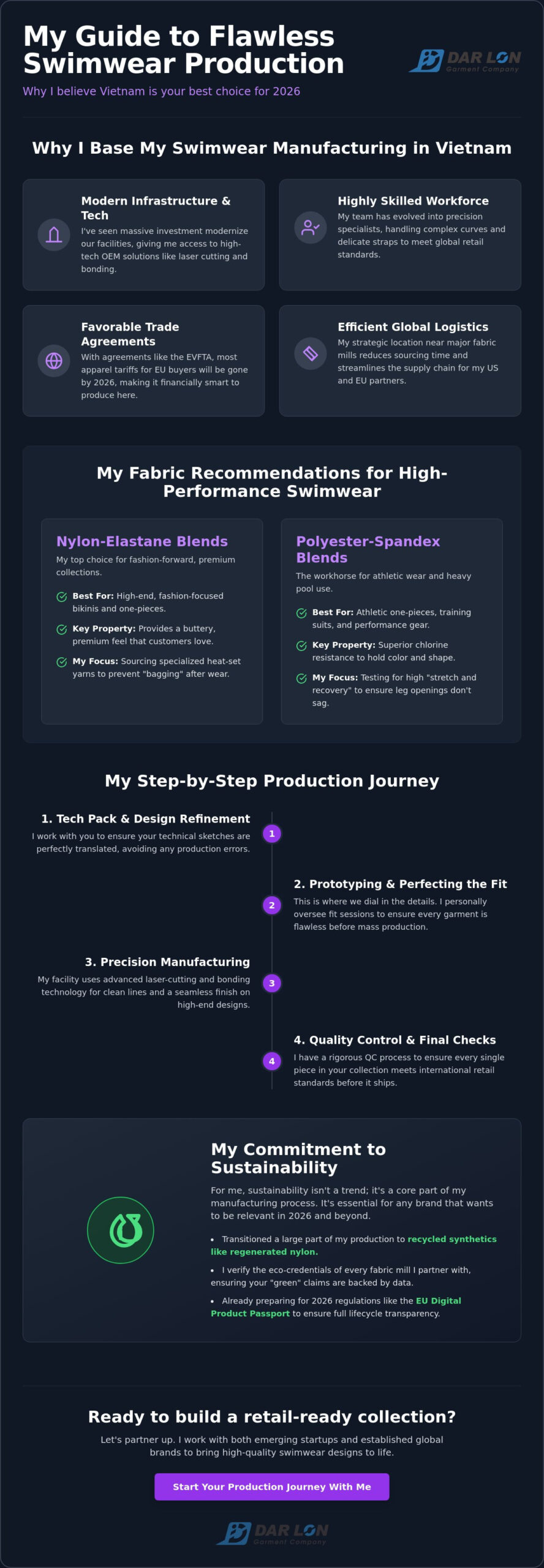
I started Dar Lon Garment in 2019 because I could see the writing on the wall. Vietnam was about to become the world’s powerhouse for technical apparel, and I wanted to be at the center of it. I’ve stayed here because the ecosystem supports high-capacity production without sacrificing the fine details that swimwear requires. When you’re looking for a bikinis and one-piece manufacturer vietnam offers a blend of industrial scale and technical mastery that’s honestly hard to find elsewhere in the region.
The infrastructure I see every day has matured significantly. It’s not just about more factories; it’s about better ones. Vietnam’s economic growth has been fueled by a massive influx of foreign investment, which has modernized our machinery and training programs. I’ve watched our local workforce evolve into some of the most skilled precision sewers in the world. They handle the complex curves of a one-piece or the delicate straps of a bikini with a level of care that ensures every garment meets international retail standards. Plus, with trade agreements like the EVFTA eliminating most apparel tariffs for EU buyers by 2026, the financial logic for manufacturing here is stronger than ever.
The evolution of the Vietnamese garment industry
We’ve moved far beyond basic assembly. My facility now provides high-tech OEM solutions that involve complex bonding and laser cutting. I’ve also noticed a massive shift toward sustainable sourcing. Brands aren’t just asking for recycled fabrics anymore; they’re demanding full transparency. The “Made in Vietnam” label has gained global respect because we’ve embraced these changes, integrating recycled materials like regenerated nylon into our standard workflows to meet the expectations of modern consumers.
The logistical advantages I offer my global partners
Logistics can be a nightmare in overseas production, but I’ve structured my operations to mitigate those risks. My base in Vietnam puts me in a strategic position to manage global supply chains efficiently. We are located close to major fabric mills in East Asia, which drastically reduces the time it takes to source raw materials. Choosing a bikinis and one-piece manufacturer vietnam based is a smart move for brands targeting the US and EU. I’m already preparing for new 2026 regulations, like the EU Digital Product Passport, to ensure my partners have all the lifecycle data they need for their collections.
The fabrics I recommend for high-performance bikinis and one-pieces
Picking the right fabric is where the technical engineering of swimwear really begins. In my experience, the material choice dictates everything from the retail price point to how many seasons a garment lasts. When you work with a bikinis and one-piece manufacturer vietnam, you’ll find that we usually suggest Nylon-Elastane blends for fashion-forward collections. This combination provides that buttery, premium touch that customers expect from high-end labels. However, if I’m producing athletic one-pieces meant for heavy pool use, I’ll steer you toward Polyester-Spandex. It has superior chlorine resistance, which is essential for gear that needs to hold its color and shape under chemical stress.
I focus heavily on the quality of the yarn itself. I source specialized yarns that have been heat-set to prevent “bagging” in the seat or the bust area after a few wears. It’s these small technical choices that separate a professional manufacturer from a generic sewing shop. If you want to see how these materials handle in a real production environment, you can view our factory’s material standards to see what we keep in stock.
Mastering the stretch with Elastane
I’ve put together a specific guide on elastane fabric because mastering stretch is the most difficult variable in swimwear production. At my factory, we don’t just sew fabric; we test its recovery. I personally oversee “stretch and recovery” tests to ensure that after a hundred swims, the leg openings don’t sag. We use different grades of Lycra depending on the compression level needed. A high-compression one-piece for surfing requires a completely different modulus of elasticity than a delicate string bikini meant for sunbathing.
Sustainability in my fabric sourcing
Sustainability is no longer a niche preference. It’s a logistical requirement for any brand wanting to stay relevant. Aligning with 2026 fashion industry trends, I’ve transitioned a large portion of my production to recycled synthetics like regenerated nylon. I also keep a close eye on the shift toward natural fibers in adjacent categories, though for swimwear, recycled synthetics remain the gold standard for durability. I verify the eco-credentials of every mill I work with. This ensures that when you market your collection as “green,” you have the data to back it up. Choosing a bikinis and one-piece manufacturer vietnam that prioritizes these verified supply chains is the only way to protect your brand’s reputation in 2026.
My secret to precision: Bonded and laser-cut swimwear
Precision in swimwear isn’t just about a steady hand; it’s about the machinery that supports it. When I was looking to scale my operations as a bikinis and one-piece manufacturer vietnam, I realized that traditional hand-cutting wasn’t going to cut it for the complex designs coming out in 2026. I invested heavily in laser-cutting technology because it removes the margin of error that ruins a premium silhouette. If you’ve ever seen a bikini with slightly uneven straps or a one-piece that pulls weirdly at the hips, you’ve seen the result of manual cutting. My machines follow digital patterns with sub-millimeter accuracy, ensuring that the first piece of the production run is identical to the thousandth.
One of the biggest challenges I solve for my clients is the replication of intricate cut-outs. Traditional shears simply can’t handle the complex, sharp angles that modern designers love. My laser cutters seal the edges as they cut, which prevents the fabric from fraying later on. This is especially critical for high-stress areas on a one-piece where the fabric is under constant tension. To complement this, I use automatic sewing machines for the structural components. These machines are programmed to maintain consistent stitch density, so the elasticity of the seam remains uniform across the entire size range. This level of technical discipline is why I’ve positioned myself as a leading bikinis and one-piece manufacturer vietnam.
The technical edge of laser cutting
I focus on laser cutting because it drastically reduces fabric waste. By using digital nesting software, I can fit more pattern pieces onto a single meter of fabric than any human cutter could. This efficiency isn’t just about saving money; it’s a key part of my commitment to sustainable production. We also use digital pattern grading to ensure the fit remains perfect as we scale from an XS to an XL. The laser-cut edges remain crisp and clean, which is a hallmark of a high-quality garment that won’t fall apart after a few trips to the beach.
Bonded apparel: The future of luxury swim
I’ve also introduced bonded seams into my production line. This is a game-changer for the luxury market. Instead of traditional stitching, which can be bulky and cause chafing, I use heat-activated adhesives to create a completely flat, “invisible” finish. This tech is what gives high-end swimwear that sleek, second-skin feel. It’s not just about looks, though. I’ve tested these bonds extensively in both saltwater and chlorinated environments to ensure they don’t delaminate. I highly recommend this construction method for brands targeting high-end boutiques where the customer expects a flawless, technical finish that traditional methods can’t match.
How I walk you through the production journey
I don’t believe in keeping my clients in the dark. When you choose a bikinis and one-piece manufacturer vietnam, you deserve a partner who treats the production cycle like a transparent, well-oiled machine. My process is broken down into five distinct phases to ensure nothing is left to chance. We start by refining your designs for the factory floor and end with a collection that is ready for the retail shelf. This structured approach is how I manage to maintain high-capacity output without losing the personal touch that boutique brands need.
The journey begins with Phase 1, where I help you refine your tech pack for maximum manufacturing efficiency. Phase 2 moves into prototyping, where we get the fit exactly right before we cut a single meter of bulk fabric. In Phase 3, I source the specific trims and accessories, like chlorine-resistant elastics and saltwater-safe hardware, that give your brand its premium feel. Phase 4 is the bulk production stage, governed by my rigorous 4-stage quality control protocol. Finally, Phase 5 covers the logistics of packing and shipping your collection directly to your warehouse.
From tech pack to physical sample
I often tell my partners that a tech pack is the most important document you’ll ever send me. It serves as the definitive blueprint for my cutters and sewers. If your technical specs aren’t quite ready, my team can help fill in the blanks. We handle iterative design changes during the sampling phase because I know a perfect fit often requires small adjustments. My best tip for communicating fit issues is to provide high-resolution photos and specific measurements of the sample on a fit model. This allows my technical team to adjust the digital patterns with absolute precision.
Managing bulk apparel manufacturing fees
I’ve built my reputation as a reliable bikinis and one-piece manufacturer vietnam by being completely transparent about my fee structure. I structure my pricing to stay competitive while maintaining the high industrial standards I’ve described in earlier sections. Several factors influence the final cost, including the complexity of the bonded seams, the fabric weight, and the total order volume. I take a direct approach to factory overhead and labor costs so you understand exactly where your investment is going. If you’re ready to see how our capabilities fit your budget, you can request a production quote to get started. I prioritize long-term cooperation, which means I’m always looking for ways to optimize your costs as your brand scales.
Partnering with Dar Lon Garment for your next collection
I don’t look at my clients as just another entry in a production log. When I founded this company, I did so with the belief that a factory should be a partner, not just a vendor. If you are searching for a bikinis and one-piece manufacturer vietnam is a competitive landscape, but the real value lies in finding someone who cares about your brand’s longevity. I prefer long-term cooperation over one-off orders. This allows me to truly understand your aesthetic and your quality requirements, which leads to fewer errors and faster turnarounds as we move from season to season.
My facility is designed to support both established global brands and growing startups. I know that a smaller brand might need more guidance on technical specs, while a larger brand requires the massive industrial scale I’ve built here. I give every swimwear client my personal attention. I want you to feel confident that your designs are in safe hands. That is why I always invite my partners to see how garments are made inside my facility. Seeing the laser cutters in action and meeting the team behind the sewing machines often builds a level of trust that you just can’t get over an email.
Your one-stop manufacturing solution
I’ve expanded my operations to offer a comprehensive service model. While we excel as a bikinis and one-piece manufacturer vietnam, I also combine this with sportswear, activewear, and sleepwear production. This allows you to streamline your entire supply chain under one roof. I believe choosing the right fitness wear manufacturer is about more than just finding the lowest price per unit. It’s about finding a silent backbone for your brand. I handle the complex logistics and technical engineering so you can focus on marketing and growing your business.
Let’s start the conversation
If you’re ready to take the next step, I’d love to hear from you. Reaching out for a custom manufacturing quote is simple. To give you an accurate estimate, I usually need your tech packs, your desired quantities, and your preferred fabric choices. If you don’t have everything finalized yet, don’t worry. We can talk through your ideas and I’ll give you my honest professional feedback on what is feasible for bulk production. My door is always open. I genuinely enjoy meeting my partners in person, so consider this a standing invitation to visit our facility in Vietnam and see our operations firsthand.
Ready to launch your next swimwear collection?
I’ve shared my perspective on why Vietnam has become the definitive choice for brands that refuse to compromise on technical precision. From selecting the right high-performance elastane blends to mastering the art of bonded seams, the manufacturing landscape here is built for the complexity of 2026 fashion. My journey since starting Dar Lon Garment in 2019 has always been about combining industrial scale with the meticulous attention to detail that only a specialized bikinis and one-piece manufacturer vietnam can provide. We aren’t just sewing pieces together; we are engineering garments that survive the elements while maintaining a sleek, retail-ready silhouette.
By leveraging my facility’s advanced laser-cutting technology and comprehensive OEM solutions, you can move from a technical sketch to a finished bulk order with total confidence in the fit and finish. I’m here to act as your brand’s silent backbone, ensuring every piece meets the rigorous quality standards your customers expect. Let’s discuss your 2026 swimwear collection—reach out to me today! I look forward to seeing your designs come to life on the production floor.
Frequently Asked Questions
What is the typical MOQ for bikini manufacturing in Vietnam?
Typical minimum order quantities for export-ready factories in Vietnam generally range from 300 to 1,000 pieces per style and color. While larger Tier-1 plants may require 3,000 units or more to maintain their production lines, I often find that mid-sized facilities offer more flexibility for growing brands. I usually suggest starting with at least 500 units to ensure you get the best balance of production efficiency and fabric sourcing options.
How long does the sampling process take for a one-piece swimsuit?
The sampling phase for a technical one-piece usually takes between two and four weeks. This timeline depends on whether we are using fabrics currently in my warehouse or if we need to source specialized performance textiles from my mill partners. I always advise my clients to leave room for at least one round of fit adjustments to ensure the prototype is perfect before we commit to the bulk production run.
Can you help with fabric sourcing for sustainable swimwear?
I actively assist my partners in sourcing sustainable materials like regenerated nylon and recycled polyester from verified suppliers. As a specialized bikinis and one-piece manufacturer vietnam, I maintain strong ties with mills that provide certified recycled fibers like ECONYL and REPREVE. I make it a priority to verify the eco-credentials of these materials so you can back up your brand’s sustainability claims with real data.
Do you provide private label packaging and branding services?
I offer comprehensive private label solutions that include everything from custom heat-transfer labels to retail-ready packaging. My team can integrate your specific logo hardware, custom-printed hygiene liners, and branded hangtags during the manufacturing process. This ensures that when the shipment leaves my facility, it’s ready for immediate distribution to your retail partners or directly to your customers.
How do you ensure quality control during bulk production runs?
I manage quality control through a rigorous 4-stage protocol that starts with an initial fabric inspection and ends with a final pre-shipment audit. My team uses AQL (Acceptable Quality Limit) standards to perform random sampling throughout the sewing and bonding phases. This systematic approach allows me to catch and correct any deviations from your tech pack before the garments are packed for shipping.
What is the difference between CMT and FOB production models in Vietnam?
The primary difference lies in who manages the raw materials. In a CMT (Cut, Make, Trim) model, you provide the fabric and I handle the labor and assembly. In an FOB (Free on Board) model, I manage the entire supply chain, including sourcing the textiles, trims, and accessories. I generally recommend the FOB model for my international partners because it simplifies the logistics and places the responsibility for material quality on my team.
Can you handle complex designs with laser-cut details?
I’ve invested in high-precision laser-cutting machinery specifically to handle complex cut-outs and intricate silhouettes that traditional sewing can’t achieve. This technology allows me to create sharp, sealed edges that don’t fray, which is essential for the longevity of a high-end one-piece. I use digital pattern nesting to ensure these complex details are replicated perfectly across every size in your collection.
How do you manage shipping and logistics for international clients?
I coordinate with a network of reliable freight forwarders to manage ocean and air shipments from Vietnam’s major industrial ports to your warehouse. For a bikinis and one-piece manufacturer vietnam, being near these hubs is a major advantage for reducing lead times. I provide all the necessary export documentation and commercial invoices to ensure your collection moves through customs smoothly and reaches you on schedule.