

For brand managers navigating the complex global supply chain, the distinction between a general activewear manufacturer and a true technical specialist is critical. A misstep in factory selection can lead to costly errors with complex fabrics, failed quality assurance checks, and a final product that falls short of its performance promise. As the industry’s focus sharpens on Southeast Asia, the challenge of identifying a premier performance apparel factory in Vietnam-one with verifiable technical mastery-becomes a paramount strategic objective for 2026 and beyond.
This guide is engineered to move beyond generic advice. We will provide a definitive framework for evaluating potential partners, detailing the specific criteria that separate elite manufacturers from the rest. You will learn to assess everything from specialized machinery and technical fabric sourcing capabilities to the rigorous quality control protocols required for high-stakes production. Our objective is to equip you with the strategic insight needed to confidently select a long-term partner capable of executing your most demanding designs with precision, securing your brand’s reputation for excellence.
Key Takeaways
- Understand the key technical attributes-moisture management, thermoregulation, and durability-that define high-value performance apparel beyond aesthetics.
- Identify the essential manufacturing technologies that are non-negotiable for producing modern technical garments and separating specialist factories from generalists.
- Utilize a strategic vetting framework to qualify any potential performance apparel factory vietnam, ensuring they possess the required technical capabilities for your brand.
- Grasp the key advantages that position Vietnam as the premier global hub for advanced technical and performance garment production in 2026.
Beyond Leggings: What Defines ‘Performance Apparel’ in 2026?
The term ‘performance apparel’ has evolved far beyond simple athletic wear. In today’s market, it signifies garments engineered for a specific function, where material science and construction directly contribute to the wearer’s comfort, efficiency, and protection. Unlike standard fashion items, the technical specifications of what defines performance apparel are rooted in tangible metrics. For brands, understanding these distinctions is the first step in selecting a capable performance apparel factory in Vietnam that can execute complex designs.
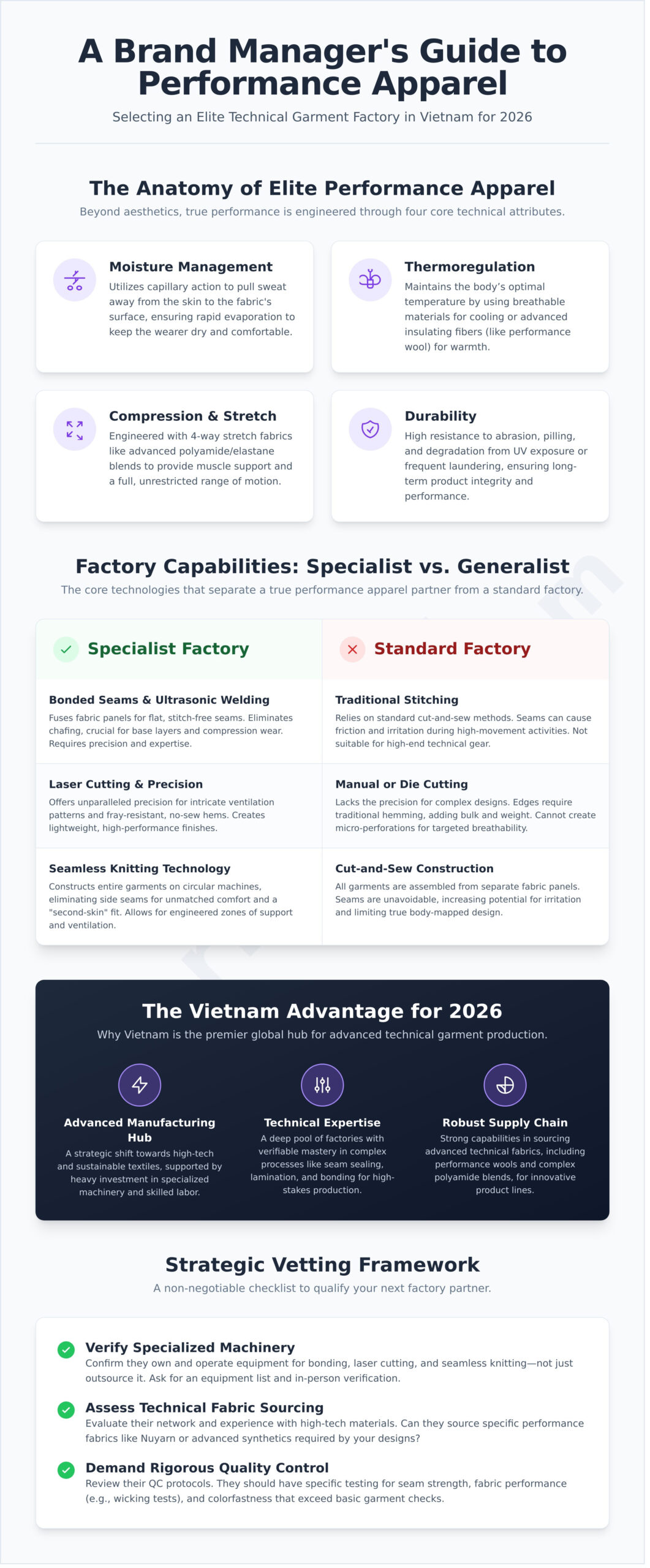
Success is dictated by four core attributes:
- Moisture Management: The ability to pull sweat away from the skin to the fabric’s surface for rapid evaporation.
- Thermoregulation: Maintaining the body’s optimal temperature through breathable or insulating materials.
- Compression & Stretch: Offering muscle support and unrestricted range of motion through advanced fabric blends and construction.
- Durability: Resistance to abrasion, pilling, and degradation from UV rays or frequent washing.
Achieving this requires a deep understanding of technical fabrics-such as advanced polyamide blends or performance wool like Nuyarn-and precision construction methods that far exceed the capabilities needed for basic cotton or polyester garments.
The Science of Performance Fabrics
The foundation of any high-performance garment is its material composition. Moisture-wicking fabrics utilize capillary action to keep athletes dry and prevent chilling. The integration of elastane (spandex) is engineered to provide true 4-way stretch, allowing the garment to move with the body without losing its shape. Furthermore, advanced materials like merino-based Nuyarn offer superior thermoregulation, moisture management, and odor resistance compared to traditional synthetics, showcasing the constant innovation in textile engineering.
From Gym to Trail: Key Product Categories
Performance apparel is not a monolithic category. It encompasses a range of specialized products, each presenting unique manufacturing challenges. Base layers require flatlock seams to prevent chafing, while compression wear demands precise fabric tension control. Technical outerwear involves complex processes like seam sealing and lamination for weatherproofing. This specialization is why a one-size-fits-all factory approach fails; a manufacturer excelling in seamless knitting may lack the machinery for bonded jackets. Recognizing these distinct requirements is critical when vetting a potential performance apparel factory in Vietnam to ensure they possess the right expertise for your specific product line.
The Core Technologies: What Separates a Specialist from a Standard Factory?
The production of high-performance activewear is a technically demanding process that hinges on specialized machinery. Unlike standard cut-and-sew operations, a true performance apparel factory vietnam invests heavily in advanced equipment that enables superior construction and functionality. This commitment to technology is a critical differentiator, as mastery of these processes directly translates to a higher quality end product. The industry-wide shift towards high-tech and sustainable textiles in Vietnam underscores the importance of partnering with a manufacturer that possesses these advanced capabilities. General factories often lack the capital and expertise to operate this equipment, limiting them to basic garment construction.
Bonded Seams and Ultrasonic Welding
These techniques replace traditional stitching with heat, pressure, or high-frequency vibrations to fuse fabric panels together. The result is a completely flat, stitch-free seam that lies smooth against the skin, eliminating the friction and chafing common in high-movement activities. This technology is indispensable for performance swimwear, compression leggings, and base layers, where next-to-skin comfort is paramount. Achieving a durable, long-lasting bond requires precise calibration and operator skill, a hallmark of an experienced production partner.
Laser Cutting and Precision
Laser cutting technology offers unparalleled precision, allowing for the creation of intricate ventilation patterns, complex shapes, and perfectly clean edges that resist fraying. This process is crucial for engineering lightweight running gear with targeted breathability zones or creating no-sew hems and cuffs for a minimalist, high-end finish. The sealed edge produced by the laser ensures garment integrity without the bulk of a traditional hem, contributing directly to a lighter, more comfortable user experience.
Seamless Knitting Technology
Seamless knitting represents one of the most advanced capabilities in modern apparel manufacturing. Garments are constructed in a single, continuous process on circular knitting machines, eliminating the need for side seams entirely. This method provides several distinct advantages for the end-user:
- Unmatched Comfort: The absence of seams reduces potential irritation and creates a second-skin fit.
- Engineered Performance: Different knit structures, such as mesh for ventilation or ribbed textures for support, can be integrated directly into the garment.
- Reduced Waste: By knitting a garment to shape, material waste from cutting fabric panels is significantly minimized.
The ability to produce seamless apparel is a definitive indicator of a factory’s technical leadership and commitment to innovation.
Your Vetting Checklist: 7 Questions to Ask a Performance Apparel Factory
Selecting the right manufacturing partner requires rigorous due diligence. A factory’s website and marketing materials provide a starting point, but the critical details are found in their operational substance. To assess true capability and distinguish a premier performance apparel factory vietnam from a less-equipped alternative, your vetting process must be thorough. These seven questions are designed to probe a factory’s technical mastery, supply chain integrity, and service structure.
Questions About Technology & Equipment
Modern performance apparel relies on advanced construction techniques. A factory’s investment in specialized machinery is a direct indicator of its commitment to quality and innovation.
- 1. Can you show us examples of products made with your bonding/laser-cutting machines? A request for physical samples or high-resolution photos moves beyond claims. It allows you to inspect the precision of cuts and the durability of bonded seams firsthand.
- 2. What is your process for quality control on stretch fabrics and bonded seams? High-stretch materials and bonded constructions require specialized QA protocols, such as elongation tests and bond strength analysis. A detailed, documented process demonstrates technical expertise.
- 3. Do you have in-house expertise in seamless knitting or do you outsource it? In-house seamless production ensures greater control over quality, faster turnaround times, and more integrated product development. Outsourcing can introduce variables and potential delays.
Questions About Sourcing & Supply Chain
The quality of the final garment is inseparable from the quality of its raw materials. A factory’s supply chain management reveals its ability to deliver consistent, reliable, and responsible production.
- 4. What is your network of technical fabric suppliers? An established factory should have long-standing relationships with reputable mills, offering access to a wide range of innovative and certified performance textiles.
- 5. How do you ensure material consistency across large production runs? Ask about their procedures for shade band approval, batch testing, and supplier audits. This is crucial for maintaining brand standards and product uniformity.
- 6. What are your certifications for sustainability and ethical production? Leading factories hold internationally recognized certifications like OEKO-TEX®, bluesign®, or WRAP. These credentials provide third-party validation of their commitment to environmental and social responsibility.
- 7. Can you provide a detailed breakdown of your OEM/ODM one-stop service? A truly comprehensive service should cover every stage from material sourcing and pattern making to bulk production, quality assurance, and logistics. A clear breakdown demonstrates transparency and operational maturity.
Why Vietnam is the Strategic Hub for Advanced Apparel Manufacturing
After identifying the essential capabilities of a manufacturing partner, the next strategic step is determining the optimal location. Vietnam has decisively transitioned from a producer of basic garments to a global powerhouse for complex, technical apparel. The nation’s unique synthesis of specialized labor, advanced infrastructure, and favorable economic policies makes it the premier destination for brands seeking a competitive edge in high-performance wear.
Skilled Workforce and Technical Expertise
Vietnam’s long-standing history in textile production has cultivated a deep-rooted culture of craftsmanship. This foundation has evolved to meet the demanding standards of the global activewear and outdoor markets. A highly skilled labor force, trained in complex sewing techniques like flatlock stitching, seam sealing, and bonding, is now the industry standard. This technical proficiency is complemented by a strong work ethic and an ingrained attention to detail, which are critical for executing the precise construction required for performance garments.
Logistical and Economic Advantages
For global brands, sourcing from the right performance apparel factory vietnam involves more than just production skill; it requires a robust and efficient supply chain. Vietnam offers a compelling set of advantages:
- Strategic Geographic Location: Situated with a long coastline, Vietnam provides direct access to major international shipping lanes. Key ports, such as the Port of Ho Chi Minh City, are among the most efficient in Southeast Asia, ensuring streamlined logistics and reduced lead times.
- Favorable Trade Agreements: The country is a signatory to numerous free trade agreements, including the EU-Vietnam Free Trade Agreement (EVFTA) and the Comprehensive and Progressive Agreement for Trans-Pacific Partnership (CPTPP). These agreements offer significant tariff reductions and preferential market access for brands exporting to Europe, the Americas, and Asia.
- Stable Investment Environment: A stable political climate and government policies that actively encourage foreign direct investment have created a secure and predictable manufacturing environment. This stability fosters long-term partnerships and allows for confident capital investment in factory upgrades and technology.
These factors have spurred the development of specialized industrial zones, such as those in Binh Phuoc Province, which are purpose-built to support large-scale, export-oriented manufacturing. For any brand serious about quality and efficiency, selecting a partner in one of these strategic hubs is a critical step. Discover how Dar Lon Garment leverages these advantages by exploring our one-stop manufacturing solutions.
Dar Lon Garment: Your High-Tech Performance Apparel Partner in Vietnam
Navigating the manufacturing landscape requires identifying a partner that not only meets but exceeds the criteria for quality, technology, and reliability. After exploring the key attributes of a premier supplier, we introduce Dar Lon Garment as the logical conclusion to your search. As a leading performance apparel factory in Vietnam, we have built our reputation on a foundation of technical mastery and an unwavering commitment to our clients’ success, embodying the very principles of excellence your brand deserves.
Our operational philosophy is guided by a simple yet powerful principle: Quality First. This commitment is evident in every seam, fabric, and finished product that leaves our modern facilities. We provide a stable, high-capacity production environment engineered to transform complex designs into market-ready apparel that meets rigorous global standards.
Integrating Advanced Technology and Craftsmanship
True performance apparel is born from the fusion of innovative materials and precision manufacturing. At Dar Lon Garment, we invest heavily in the industry’s most advanced technologies to deliver superior results for our OEM/ODM partners. Our specialized capabilities include:
- Laser Cutting: Ensuring unparalleled accuracy and clean, sealed edges for complex patterns on technical textiles.
- Bonding and Lamination: Creating durable, water-resistant, and low-profile seams essential for high-performance outerwear and activewear.
- Seamless Technology: Producing comfortable, form-fitting garments with reduced chafing and enhanced mobility.
This technological infrastructure, combined with our deep expertise in sourcing and working with advanced materials like Nuyarn performance wool, establishes us as a comprehensive, one-stop solution for brands seeking a competitive edge.
Begin Your Production Journey with Confidence
Choosing a performance apparel factory in Vietnam is a significant decision. We mitigate risk by offering a transparent and highly structured production process. From initial tech pack analysis and material sourcing to in-line quality assurance and final delivery logistics, our expert teams guide your project with precision. Our strategically located factories in Ho Chi Minh City and Chon Thanh Industrial Park provide the scale and efficiency required for demanding production schedules.
We invite you to leverage our decades of experience to bring your next collection to life. Our team is prepared to review your project requirements and build a production strategy tailored to your brand’s vision. Contact our team to discuss your performance apparel manufacturing needs.
Secure Your Brand’s Future with a Specialist Manufacturing Partner
The landscape of performance apparel is defined by technical innovation and precision manufacturing. As this guide has outlined, success in 2026 hinges on two critical factors: leveraging the strategic advantages of Vietnam’s advanced manufacturing ecosystem and partnering with a factory that possesses true technological mastery. The right partner moves beyond standard production, offering expertise in the complex materials and construction methods that today’s consumers demand.
Choosing the right performance apparel factory vietnam is the most critical strategic decision for your brand’s growth. At Dar Lon Garment, we provide the specialized capabilities required to lead the market. Our proficiency in advanced technologies like laser cutting, seamless knitting, and bonded seams, combined with expertise in technical fabrics such as Nuyarn performance wool, sets our partners apart. We deliver a complete one-stop OEM/ODM service, managing every stage from development to global shipping with an unwavering commitment to quality.
Take the next step in elevating your collection. Request a consultation to build your performance apparel line with us and let’s engineer the future of performance wear together.
Frequently Asked Questions
What is the typical Minimum Order Quantity (MOQ) for a performance apparel factory in Vietnam?
The Minimum Order Quantity (MOQ) for performance apparel in Vietnam typically ranges from 500 to 1,000 units per style and colorway. This figure can fluctuate based on the complexity of the garment’s design and the specific technical fabrics required. Factories with larger-scale operations may have higher MOQs, while others might offer some flexibility for long-term partners or simpler designs. It is essential to discuss these requirements directly with your potential manufacturing partner to align capabilities.
How do I ensure the quality of my products when manufacturing in Vietnam?
Quality assurance is managed through a multi-stage process adhering to international standards like AQL 2.5/4.0. This begins with rigorous fabric and trim inspection upon arrival. During production, in-line quality control teams monitor every stage of sewing and assembly to identify issues early. A final, comprehensive inspection is conducted on finished garments before packing. Many brands also engage third-party auditors for objective verification of product quality and compliance before shipment.
What is the difference between an OEM and an ODM factory?
OEM (Original Equipment Manufacturer) means the factory produces garments based on your brand’s specific designs and technical specifications. You provide the complete tech pack. In contrast, ODM (Original Design Manufacturer) involves the factory offering its own pre-developed designs, which your brand can then modify, label, and sell. ODM is often a faster route to market, while OEM provides complete creative control and product exclusivity for your brand’s unique vision.
How long is the typical production lead time for activewear in Vietnam?
The standard production lead time for activewear in Vietnam is approximately 90 to 120 days from order confirmation. This timeline is allocated across several key phases: 30-45 days for fabric sourcing and development, 15-20 days for sampling and approvals, and 45-60 days for bulk production. Shipping time is additional and varies by destination. Proactive communication and prompt feedback on samples are critical to maintaining this schedule and ensuring on-time delivery.
Can Vietnamese factories handle sustainable and recycled performance fabrics?
Yes, leading Vietnamese factories are highly proficient in working with a wide range of sustainable and recycled performance fabrics. This includes popular materials such as rPET (recycled polyester), regenerated nylon like ECONYL®, and organic cotton blends. These facilities often hold certifications like the Global Recycled Standard (GRS) or OEKO-TEX®, ensuring that materials meet stringent environmental and chemical safety standards demanded by global brands and conscious consumers.
What are the key advantages of manufacturing in Vietnam compared to other countries?
Vietnam offers a compelling strategic advantage for apparel manufacturing. Key benefits include a highly skilled workforce with specialized expertise in complex technical garments, competitive labor costs, and robust infrastructure. Furthermore, the country’s participation in numerous free trade agreements, such as the EVFTA and CPTPP, provides significant tariff advantages for exports. This makes choosing a performance apparel factory in Vietnam a financially and logistically sound decision for global brands.
How does the tech pack and sampling process work with a Vietnamese factory?
The tech pack is the critical blueprint provided to the factory, containing all specifications: technical drawings, measurements, fabric details, and construction instructions. Upon its receipt, the factory creates a proto sample for initial review. This is followed by fit samples for confirming sizing and a pre-production sample (PPS) made with final materials for bulk production approval. Each stage requires your sign-off, ensuring the final product precisely matches your vision before mass production commences.