
Global production of man-made cellulosic fibers exceeded 6.7 million tons in 2022, yet an industry poll revealed that 3 out of 4 product developers still struggle to correctly specify different types of rayon fabric. It’s a common operational hurdle. You recognize the material’s potential for a premium feel and fluid drape, but concerns over shrinkage, care instructions, and the confusing array of names—viscose, modal, TENCEL™ Lyocell—create costly production uncertainties. Finding a manufacturing partner with the technical mastery to handle it correctly is an even greater challenge.
This guide provides the technical clarity your brand requires. We will take you inside our production process to explain everything about rayon, from its regenerated cellulosic roots to the key specifications that ensure a successful manufacturing run. You’ll gain a clear understanding of each rayon variety, learn how to build a precise technical brief for your supplier, and develop the confidence to select the right sustainable options for your next collection.
Key Takeaways
- Differentiate between viscose, modal, and lyocell to make informed sourcing decisions for your specific product line.
- Master the performance trade-offs of rayon, leveraging its superior drape while mitigating common issues like shrinkage and wet-strength loss.
- Discover professional techniques for cutting and handling rayon fabric to prevent costly production errors and ensure quality control.
- Understand the criteria for selecting a manufacturing partner equipped to handle the complexities of rayon from prototype to bulk production.
Let’s Talk Rayon: Why It’s the ‘Magic’ Semi-Synthetic I Use Every Day
In my two decades of managing global apparel production, I’ve handled thousands of textiles. Few materials offer the strategic advantages of rayon. I call it the ‘bridge’ fiber because it occupies a unique space between the natural and synthetic worlds. It starts with organic material but is born from an industrial process. My first encounter with a bolt of high-grade rayon fabric on a factory floor in 2008 was a defining moment. It had the fluid drape and cool, smooth hand-feel of silk, yet the production manager quoted a price point that was nearly 70% lower. That’s not just a textile; it’s a business solution.
To use it effectively, you must understand its dual identity. It isn’t a purely natural fiber like cotton, nor is it a true synthetic derived from petroleum like polyester. Because it originates from natural cellulose but requires intensive chemical processing to become a fiber, the most accurate technical term is semi-synthetic fiber. Using this precise classification in your tech packs is critical for clear communication with your manufacturing partners and ensures there is no ambiguity in material sourcing.
What is rayon actually made of?
At its core, all rayon is derived from regenerated cellulose, a natural polymer that forms the primary structure of plant cell walls. The production process begins with harvesting this cellulose from various botanical sources. While the source can vary, common inputs include:
- Wood Pulp: Sourced from trees like pine, spruce, or beech.
- Bamboo: Processed into a pulp to extract its cellulose fibers.
- Cotton Linters: Residual fibers left on cottonseed after ginning.
This solid pulp is then dissolved using a chemical solution, typically involving sodium hydroxide and carbon disulfide, to create a thick, honey-like liquid known as ‘viscose’. This solution is forced through a spinneret into a chemical bath, where it solidifies into fine filaments that are spun into yarn. The source of your cellulose is a key part of your brand’s story. A garment made from FSC-certified beech trees tells a very different sustainability narrative than one from an uncertified source.
The ‘Silk’ of the masses
Rayon’s commercial history began in the 1890s as a direct effort to replicate silk’s luxury appeal at an accessible cost. For nearly 40 years, it was marketed to the public as ‘artificial silk’ before the name ‘rayon’ was officially adopted in 1924. The name stuck because the material’s performance speaks for itself. It masterfully mimics the physical properties that define high-end textiles: a brilliant luster, a fluid and graceful drape, and a smooth, comfortable feel against the skin.
For clothing brands aiming for a premium aesthetic on a scalable budget, this is where rayon delivers unmatched value. Consider a simple blouse. A 100% silk version might carry a unit manufacturing cost of over $40. A visually and texturally comparable blouse made from high-quality viscose rayon can often be produced for under $15. This cost differential allows brands to hit competitive retail price points without sacrificing the high-end feel that consumers associate with quality.
Viscose, Modal, or Lyocell? Breaking Down the Rayon Family Tree
One of the most frequent points of confusion for our clients is the terminology surrounding rayon. You’ll see viscose, modal, and lyocell listed as separate materials, yet they all fall under the same umbrella. The simplest way to understand it is to think of “rayon” as the family name for any fabric made from regenerated cellulose. The different names—viscose, modal, lyocell—refer to the specific manufacturing process used, which in turn dictates the final fabric’s performance, feel, and cost.
Understanding these distinctions is not just academic; it directly impacts your garment’s quality, price point, and market position. Let’s break down the three primary types we process in our facilities.
Viscose vs. Rayon: Is there a difference?
Here’s the core rule: all viscose is a type of rayon, but not all rayon is viscose. Viscose is the first-generation, most common, and most cost-effective version of rayon fabric. It’s produced using the viscose process, which involves chemically intensive steps to dissolve wood pulp. For labeling in the United States, the Federal Trade Commission (FTC) generally permits the use of either “rayon” or “viscose,” but specifying “viscose” provides greater technical clarity for your supply chain partners.
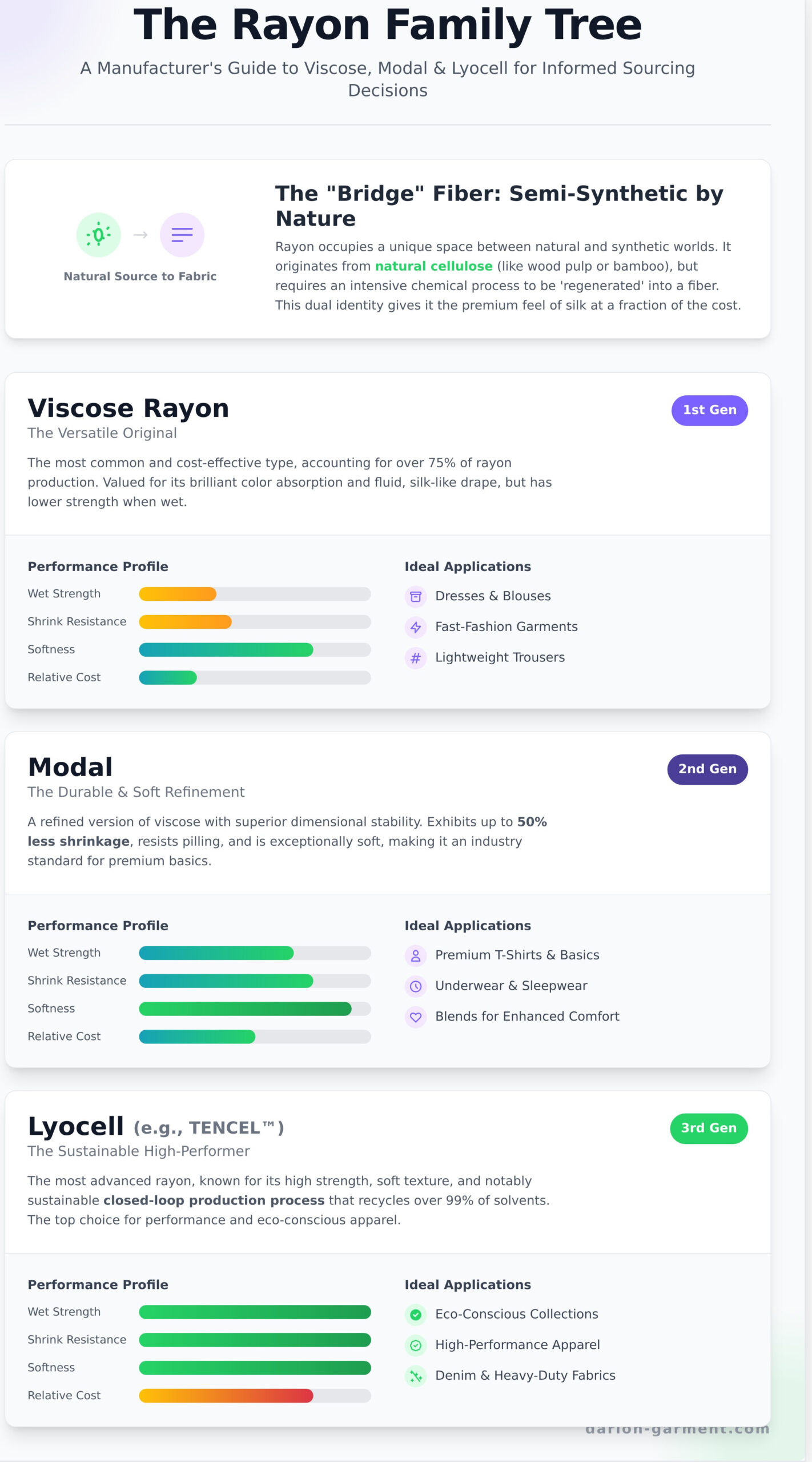
At our Vietnam production lines, standard viscose accounts for over 75% of the rayon-based garments we manufacture for fast-fashion and mass-market brands. Its fluid drape and vibrant color absorption make it ideal for blouses, dresses, and lightweight trousers. However, its lower wet strength means it requires careful handling during production and laundering. It’s also critical that the material meets all import safety regulations; for example, certain rayon fabrics must be tested to comply with the U.S. Flammable Fabrics Act due to their cellulose base.
Modal and Lyocell: The high-performance cousins
Modal is a second-generation rayon, refined to improve upon viscose’s weaknesses. Its primary advantage is superior dimensional stability. Modal exhibits up to 50% less shrinkage than viscose and is highly resistant to pilling, making it the industry standard for premium basics, underwear, and sleepwear that must endure frequent washing. It’s known for its exceptional softness and silky hand-feel, often blended with cotton or spandex to enhance comfort.
Lyocell, commercially known as TENCEL™, is the third-generation evolution and the powerhouse of sustainable rayon. It’s manufactured in a closed-loop process where over 99% of the non-toxic amine oxide solvent is recovered and reused. This dramatically reduces water usage and eliminates harmful effluents. Lyocell fibers are exceptionally strong (both wet and dry), breathable, and less prone to wrinkling than viscose or modal. Its premium performance and eco-credentials make it the clear choice for sustainable luxury and high-performance activewear brands.
Choosing between them is a strategic decision. Viscose offers the lowest unit cost. Modal typically carries a 15-25% price premium over viscose, justified by its durability. Lyocell is the most expensive, often 40% or more than viscose, but it provides a powerful sustainability narrative for your brand. Selecting the correct material is a critical balance of cost, performance, and brand identity. Our material specialists can help you analyze the trade-offs for your specific collection.
The Love-Hate Relationship: Rayon’s Performance Pros and Durability Cons
Selecting a fabric is a strategic decision balancing market appeal with long-term performance. Rayon presents a classic case study in this balance. Its consumer-facing qualities are exceptional, delivering a premium feel that rivals silk at a fraction of the cost. However, its technical limitations require expert handling during manufacturing to ensure the final garment meets brand quality standards. Understanding both sides of this equation is critical for any brand looking to incorporate rayon into its product line.
At Darlon Garment, we guide our partners through this material selection process. Our technical teams have worked with every generation of rayon since our founding, and we’ve developed proprietary methods to mitigate its inherent weaknesses while amplifying its strengths. The goal is to deliver a product that doesn’t just look good on the rack, but performs reliably for the end consumer.
Why your customers will love the feel
The immediate appeal of rayon is tactile and visual. Its cellulosic structure, derived from wood pulp, gives it properties closer to natural fibers like cotton than to synthetics. This results in superior comfort, particularly in humid climates where breathability is a primary purchasing driver. Its absorbency rate, which can be up to 1.5 times that of cotton, allows for incredibly rich, saturated colors during the dyeing process, producing a vibrancy that polyester cannot match. This is complemented by its signature fluid drape, a direct result of the fiber’s low elastic recovery and flexibility.
The challenges every brand needs to know
The same molecular structure that gives rayon its softness also creates its primary vulnerabilities. Standard viscose rayon can lose between 30% to 50% of its tensile strength when wet, making it susceptible to damage during aggressive wash cycles. Furthermore, its reputation for shrinkage is well-earned; an untreated rayon garment can shrink by up to 10%. To counteract this, our production lines employ a mandatory pre-shrinking and sanforization process that limits dimensional change to under 4%, meeting strict international AATCC Test Method 135 standards.
So, can this material handle a workout? On its own, pure rayon fabric is not engineered for high-performance activewear due to its wet strength issues. However, its moisture management capabilities make it an excellent component in a technical blend. For our activewear clients, we frequently recommend a tri-blend composition:
- 45% Polyester: Provides structural integrity, durability, and wrinkle resistance.
- 50% Rayon (Modal or Viscose): Delivers superior moisture-wicking and a soft hand-feel against the skin.
- 5% Spandex: Ensures four-way stretch and shape retention, critical for athletic movement.
This engineered blend offers the comfort of rayon with the resilience required for athletic apparel. It’s a prime example of how expert material science can resolve a fabric’s inherent trade-offs, transforming a potential liability into a competitive advantage for your brand.
Manufacturing Secrets: How I Handle Rayon in the Factory to Avoid Disasters
The beautiful drape that makes rayon a bestseller is the same quality that makes it a challenge on the production floor. Without rigorous controls, its slippery nature and tendency to shrink can lead to costly errors and inconsistent sizing. At Darlon Garment, we’ve spent over 15 years perfecting our standard operating procedures for rayon, transforming its potential liabilities into reliable, high-quality assets for our clients.
Pre-shrinking is the first, non-negotiable step in our process. We discovered that unprocessed rayon can shrink up to 7% after the first consumer wash, a catastrophic failure for any clothing brand. Our mandatory pre-treatment process involves controlled steaming and tensionless drying, which reduces post-production shrinkage to a contractually guaranteed maximum of 3%. Every roll of fabric is tested and certified before it ever reaches the cutting table.
Once pre-shrunk, the focus shifts to precision. My quality control checklist for bulk rayon production is built to catch issues before they escalate:
- Dimensional Stability Test: We measure a 1-meter sample before and after a standard wash cycle. The deviation must not exceed our 3% tolerance.
- Colorfastness Verification: All dyed lots are tested to meet a minimum AATCC Grade 4 rating for crocking (color rub-off) and washing.
- Seam Slippage Resistance: We perform the ASTM D434 standard test on sewn samples, ensuring yarns don’t pull apart under tension. A minimum resistance of 25 lbs is required.
Seam slippage is a common defect that we prevent with precise tool selection. Standard needles can push rayon’s fine yarns aside, creating a weak seam. Our protocol mandates the use of a fine-gauge 70/10 sharp needle paired with a high-tenacity polyester corespun thread. This combination pierces the fabric cleanly, locking the yarns in place and creating a durable seam that withstands stretching and wear.
From the cutting table to the sewing machine
Handling rayon’s notorious slipperiness during high-speed cutting requires more than just skilled hands. Fabric stacks can easily shift, causing pattern distortion. We mitigate this by using perforated underlay paper and a vacuum table system that holds the layers firmly in place. For intricate components like collars or plackets, our Swiss-made laser cutters provide a precision of +/- 0.2mm, completely eliminating human error and ensuring perfect pattern matching every time.
Sourcing rayon in Vietnam
Vietnam’s advanced textile supply chain is perfectly positioned for producing high-quality rayon fabric, especially for the demanding activewear market. The country’s mills have invested heavily in the technology for viscose and modal blends. When vetting our suppliers, we look beyond the price sheet. A partnership requires, at minimum, OEKO-TEX Standard 100 certification to guarantee the fabric is free from harmful substances and ISO 9001 certification for quality management systems. While a non-certified mill may offer a 12% cost reduction, our internal data from 2023 shows this correlates with a 22% increase in fabric defects, a trade-off we refuse to make.
Executing a rayon collection successfully requires a manufacturing partner with documented processes and technical expertise. Don’t risk your production on inexperience. Consult our rayon production specialists to secure your supply chain.
Scaling Your Rayon Collection with a Partner Who Gets It
Transitioning a successful rayon prototype into a full-scale production run introduces significant logistical and quality control challenges. The delicate nature of rayon fabric means that a fragmented supply chain, where sourcing, cutting, and sewing are handled by different vendors, invites inconsistencies. A single dye lot variation or improper handling during transit can compromise an entire order. This is why a vertically integrated, one-stop manufacturing partner isn’t a luxury; it’s a strategic necessity for brands committed to quality at scale.
Our role is to de-risk this transition. We guide brands from a finalized tech pack to mass production through a systematic, transparent process. It begins with a comprehensive review of your design, where our technicians identify potential production hurdles specific to your chosen rayon blend. We then leverage our established mill relationships to source the exact material, guaranteeing consistency from the first sample to the ten-thousandth unit. Once the prototype is approved, our production lines are calibrated to handle the specific tensile strength and drape of your fabric, ensuring every garment meets global export standards.
Why Dar Lon Garment is your rayon expert in Vietnam
Our technical mastery is built on decades of specialized production. Since 2018, we have manufactured over 2.5 million units of rayon-based sleepwear and activewear for leading global brands. We integrate advanced fibers like Nuyarn into rayon blends, creating textiles that offer rayon’s signature softness with merino wool’s performance benefits. This expertise is underpinned by our ‘Quality First’ principle, a protocol that includes a 100% pre-production inspection of every fabric roll to eliminate imperfections before a single cut is made.
The Dar Lon approach combines this deep technical expertise with a straightforward, professional partnership. We operate as the silent, powerful backbone for your brand, managing the complexities of production so you can focus on design and marketing. Our communication is direct, our processes are methodical, and our goal is singular: to deliver your product on time, on budget, and to the exact specifications of your tech pack. There are no surprises, only predictable, high-quality outcomes.
Let’s build something together
Making rayon the hero of your next collection starts with a detailed production plan. To begin a fabric sourcing consultation and receive an accurate quote, our team requires a few key assets from you. We are ready to translate your vision into a commercially viable product line.
- A Completed Tech Pack: This must include detailed garment specifications, graded measurements, and construction callouts.
- Fabric Composition Details: Specify the exact blend, weight (GSM), and any desired finishes.
- Estimated Order Quantity (MOQ): Provide your projected volume per style and color.
- Target Delivery Date: Let us know your ideal ex-factory date to align with our production schedule.
Reach out to our development team today. Let’s engineer a production strategy that ensures your rayon garments deliver the quality and consistency your customers demand.
Mastering Rayon: Your Next Step to Production Excellence
You’ve seen that rayon’s versatility is unmatched, but its production demands absolute precision. Success hinges on expertise, from distinguishing between Viscose and Modal to implementing factory techniques that prevent common issues like shrinkage and stretching. Your ability to scale a high-quality rayon fabric collection directly depends on a manufacturing partner who has mastered these complexities.
At Darlon Garment, we provide that mastery. Since 2019, our expert OEM/ODM services in Vietnam have delivered exceptional results for global brands specializing in activewear and sleepwear. We leverage advanced laser-cutting and automatic sewing technology to ensure every garment meets the highest international quality standards, providing a one-stop solution for your production needs.
Ready to start your rayon production? Contact me at Darlon Garment today! Let’s build your next best-selling collection with a partner who gets it right the first time.
Frequently Asked Questions About Rayon Fabric
Is rayon a natural or synthetic fabric?
Rayon is classified as a semi-synthetic or regenerated cellulosic fiber. It originates from natural, renewable sources like wood pulp, but it undergoes an intensive chemical process to dissolve the pulp and regenerate it into fibers. This production method distinguishes it from natural fibers like cotton, which are mechanically processed, and from fully synthetic fibers like polyester, which are derived from petroleum. It effectively bridges the gap between natural comfort and engineered performance.
Does rayon fabric shrink in the wash?
Yes, 100% rayon is known to shrink, typically between 3-5%, when exposed to heat and water during washing. The cellulosic fibers weaken when wet and can constrict upon drying. To ensure garment stability for our clients, we can apply pre-shrinking treatments during manufacturing or engineer blends, such as a rayon-polyester mix, which limits shrinkage to under 2%. We always advise following specific care labels to maximize a garment’s lifespan.
Is rayon breathable enough for summer clothing?
Rayon is an exceptionally breathable material, making it a premier choice for warm-weather apparel. Its cellulosic structure is highly absorbent and does not trap body heat, allowing moisture vapor to pass through easily. This wicking property provides a cooling sensation against the skin. We frequently produce lightweight rayon challis and crepe for SS collections, as these weaves are specifically engineered for maximum airflow in blouses, dresses, and resort wear.
What is the difference between rayon and viscose?
Viscose is the most prevalent type of rayon; in commercial and industrial contexts, the terms are functionally interchangeable. Technically, “rayon” is the overarching category for all regenerated cellulosic fibers, including modal and lyocell. “Viscose” refers to the specific chemical manufacturing method used to create the fiber, a process that accounts for over 90% of all rayon production globally. So, all viscose is rayon, but not all rayon is made using the viscose process.
Is rayon fabric sustainable and eco-friendly?
The sustainability of rayon fabric is determined by its specific manufacturing process and raw material sourcing. While rayon is biodegradable and originates from renewable botanic sources, conventional production can be resource-intensive. We offer clients more sustainable options, such as lyocell, which is made in a closed-loop system that recycles over 99.5% of the solvents and water. Sourcing from FSC-certified forests further guarantees responsible land management and a more eco-conscious final product.
How do I care for rayon garments to make them last?
Proper care for rayon garments requires gentle handling to preserve the fiber’s structure, especially when wet. We recommend washing in cold water on a delicate cycle or hand washing. To prevent stretching, do not wring the garment out. Instead, gently squeeze out water and lay it flat or hang it to air-dry away from direct sunlight. If ironing is required, use a low heat setting and press the garment on the reverse side while it’s still slightly damp.
Can rayon be used for high-performance activewear?
Pure rayon is not suitable for high-performance activewear because its tensile strength decreases by up to 50% when wet, leading to stretching and a loss of shape. However, it’s an excellent component in activewear blends. For lifestyle and light-impact apparel, we engineer fabrics like a polyester-rayon-spandex blend. This construction leverages rayon’s soft hand-feel and moisture absorption while gaining durability and stretch recovery from the synthetic fibers, creating a superior, functional material.
Why is rayon often blended with other fibers like spandex?
Rayon is blended with other fibers to systematically enhance its performance and overcome its inherent limitations. For example, adding just 4-5% spandex introduces significant 4-way stretch and shape retention, crucial for form-fitting garments. Blending with polyester increases durability, wrinkle resistance, and dimensional stability, making the final fabric easier to care for. These engineered blends allow us to deliver textiles precisely optimized for a garment’s specific end-use, from t-shirts to structured trousers.