
If you still think the lowest landed cost is found in the world’s largest traditional manufacturing hubs, you’re looking at data that expired in 2022. I’ve spent years on factory floors, and I can tell you that the industrial landscape has shifted permanently. I understand the pressure you’re under when labor costs in legacy hubs rise by 10% or more each year. It makes sense that you’re looking for a more stable alternative. That’s why I want to share the real benefits of manufacturing in vietnam for 2026, where we’ve combined competitive pricing with a technical precision that rivals any global competitor.
I’ll show you exactly how Vietnam became the strategic heartbeat of global apparel and why it’s the key to transforming your brand’s production agility. We’ll explore how modernizing your supply chain with advanced textile tech can solve the transparency issues that currently affect 65% of international fashion brands. I’m also going to give you an insider’s look at how our one-stop service model provides the reliable, long-term partnership you need to stay ahead of the market. It’s time to move beyond guesswork and build a foundation based on technical mastery and proven results.
Key Takeaways
- I’ll show you why Vietnam has shifted from a trend to a strategic necessity for apparel brands planning their 2026 production cycles.
- Learn how to look past simple labor costs and leverage Free Trade Agreements to uncover the true financial benefits of manufacturing in vietnam.
- Discover the technical reality of modern Vietnamese factories and why I believe they’ve mastered the complex construction required for high-end activewear.
- I’ll break down how I navigate local logistics and infrastructure to keep your supply chain moving from the industrial park to the global market.
- Get my insider tips on vetting potential partners to ensure you find a factory that values quality and long-term collaboration as much as you do.
Why I Believe Vietnam Has Become the Epicenter of Modern Apparel Manufacturing
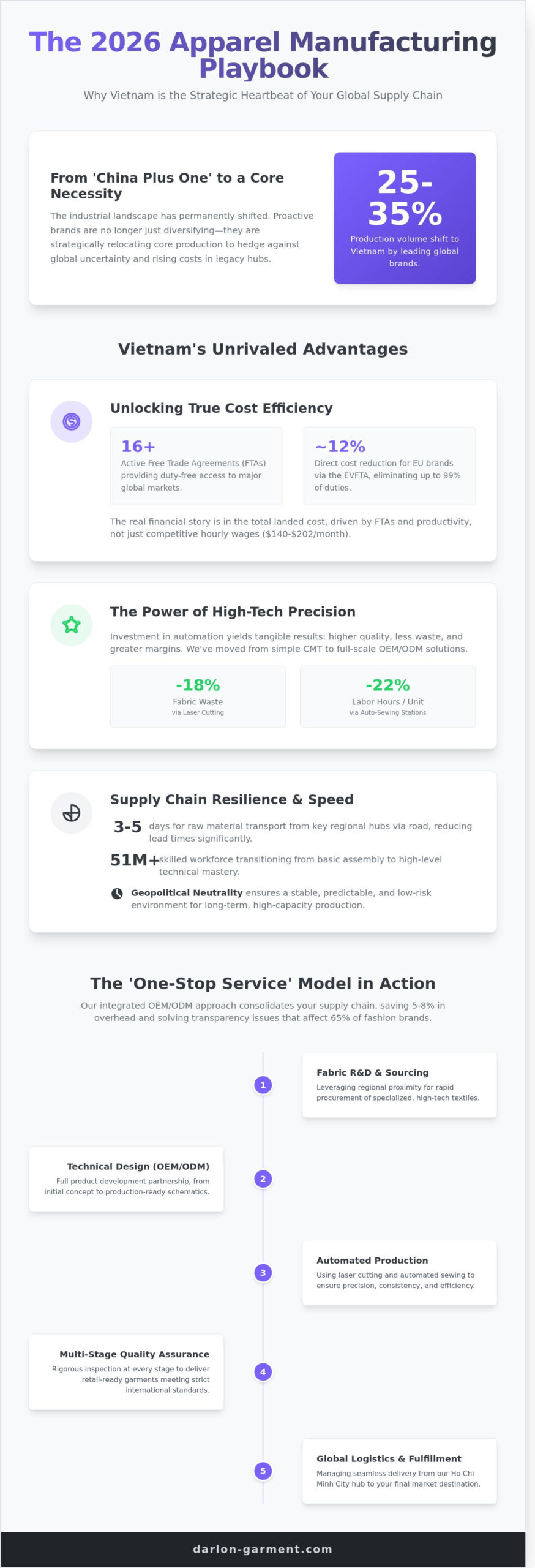
I spend most of my mornings on calls with procurement directors from Europe and North America. By mid-2024, the tone of these meetings shifted. We’re no longer just discussing price points; we’re talking about long-term supply chain survival. The benefits of manufacturing in vietnam have moved from being a “nice-to-have” alternative to a mandatory requirement for any brand looking toward 2026. I’ve watched the ‘China Plus One’ strategy evolve from a boardroom trend into a standard business requirement. Many of the partners I work with now move at least 25% to 35% of their total production volume to Vietnamese soil to hedge against global uncertainty.
Vietnam holds a unique position in Southeast Asia that I don’t see anywhere else. We have a massive, skilled workforce of over 51 million people who have transitioned from basic assembly to high-level technical mastery. In my daily management at Darlon Garment, I’ve seen our operations move far beyond simple CMT (Cut, Make, Trim) work. We now provide full-scale OEM and ODM solutions. This “One-Stop Service” approach means I’m managing everything from fabric R&D to final quality assurance, giving brands the technical backbone they need without the headache of managing multiple vendors.
The Strategic Geography of Sourcing
Our location at the crossroads of major Asian trade routes is a game changer for lead times. I’ve observed that our proximity to raw material hubs in Southern China allows us to receive specialized fabrics in as little as 3 to 5 days by road. This proximity reduces logistical friction significantly compared to competitors in South Asia. Operating out of Ho Chi Minh City, I utilize the Cat Lai port as a direct gateway to global markets, ensuring that our 2026 shipping schedules remain tight and reliable.
Stability in a Volatile Global Market
Vietnam’s geopolitical neutrality acts as a protective shield for the brands I represent. In an era of sudden tariff spikes, our 16 active Free Trade Agreements, including the EVFTA and CPTPP, keep manufacturing costs predictable and competitive. I’ve found that the core of Vietnamese business culture is rooted in long-term partnership rather than quick wins. Government incentives for high-tech textile investments have stayed consistent for over a decade, which is why I can confidently promise my partners a stable, low-risk environment for their high-capacity production needs.
- 16 Active FTAs: Providing duty-free access to major global markets.
- 5-Day Lead Time: For raw material transport from key regional textile hubs.
- Full OEM/ODM: Transitioning from simple sewing to complete product development.
Unpacking the Real Cost Advantages Beyond Just Hourly Wages
I see brands make the same mistake far too often: they compare hourly wages in Vietnam to neighboring countries and stop there. While Vietnam’s minimum wage remains competitive, usually ranging from $140 to $202 per month depending on the region, the real story is about the total landed cost. If you’re only looking at the payroll, you’re missing the financial levers that actually drive your bottom line. I’ve spent years refining our operations to ensure that the benefits of manufacturing in vietnam translate into actual profit margins for my clients.
The FTA Advantage: EVFTA, CPTPP, and More
Vietnam’s aggressive pursuit of Free Trade Agreements (FTAs) is a primary reason why my factory floor is busier than ever. The EU-Vietnam Free Trade Agreement (EVFTA) is a game changer for European brands because it eliminates up to 99% of customs duties over a 7-year phase-in period. For a brand in Germany or France, this can mean a direct 12% reduction in costs compared to sourcing from a country without such an agreement.
I also see a surge in interest from North American and Australian partners due to the CPTPP. This agreement provides duty-free access to major markets, which can effectively lower your final retail price by 10% to 15% without sacrificing quality. When you calculate the ‘Duty-Free’ impact, the higher efficiency of a specialized partner often outweighs a slightly lower wage elsewhere. If you want to see how these savings apply to your specific product line, you can explore our integrated production solutions to get a clearer picture of the math.
Productivity Gains through Modernization
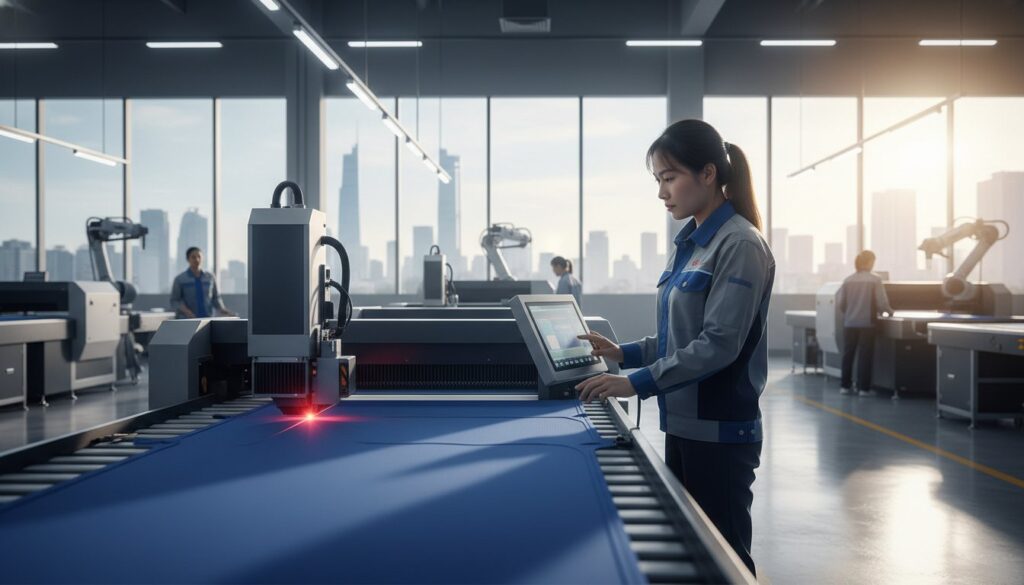
I’ve invested heavily in automation because I know that rising regional wages are inevitable. In 2024, we integrated automatic sewing stations and laser cutting machines that reduced fabric waste by 18% and cut labor hours per unit by 22%. These aren’t just technical stats; they represent fewer defects and higher margins for you. High-quality production means you aren’t paying for “hidden” costs like returns or re-works.
The value-added manufacturing model in Vietnam today centers on leveraging high-precision technology to deliver consistent, retail-ready garments that meet the strictest international standards.
By using a ‘One-Stop Service’ model, I help brands consolidate sourcing, development, and production. This consolidation can save an additional 5% to 8% in logistical overhead and communication delays. One of the greatest benefits of manufacturing in vietnam is this ability to handle everything under one roof, from the first yarn selection to the final quality assurance check. It’s about building a stable, predictable supply chain that doesn’t break when global shipping costs fluctuate.
The Technical Maturity I See on the Factory Floor Every Day
I often hear the misconception that Vietnam is only suitable for basic commodity items like standard t-shirts or simple cotton bags. When I walk through our production zones today, the reality is far more sophisticated than it was even five years ago. The rapid evolution of our technical capabilities is one of the primary benefits of manufacturing in vietnam that global brands often overlook until they see our automated lines in action.
Handling complex activewear is where our internal expertise truly shows. I’ve spent a lot of time perfecting the tension settings for elastane fabric; it’s a fickle material that requires a deep understanding of stretch and recovery. If the needle temperature isn’t calibrated or the feed dog pressure is off by a fraction, the seam will pucker or fail during a workout. We’ve moved far beyond basic sewing. My team now integrates high-performance materials like Nuyarn and utilizes ultrasonic bonded seams to eliminate friction, ensuring high-volume runs meet the same standards as boutique technical gear.
Precision is our standard operating procedure, not just a goal. We use automated laser cutting systems to ensure every fabric panel matches the tech pack within a 0.5mm margin. This level of accuracy is vital for the 22% increase in complex multi-panel designs we’ve handled since 2023. It’s this commitment to “Quality First” that allows us to compete on a global scale.
Specialization in High-Performance Apparel
Sportswear and swimwear have become the crown jewels of our regional industry. I’ve watched our floor managers master the technical requirements of seamless garments, which involve specialized circular knitting machines and precise heat-setting processes. You can see how garments are made in our specialized facility to understand the logistical coordination required for these pieces. We don’t just stitch fabric together; we engineer compression zones that support the athlete’s body while maintaining breathability.
Innovation in Sustainable Textiles
The demand for eco-conscious production has accelerated faster than many expected. I’m seeing a massive shift toward natural fibers like organic cotton and hemp, alongside recycled synthetics. My team now manages a global network to source sustainable trims, ranging from recycled zippers to biodegradable polybags. By 2026, I expect 45% of our total output to consist of certified ‘green’ collections. Brands are choosing the benefits of manufacturing in vietnam to meet their strict ESG targets without sacrificing the technical performance their customers expect.
Navigating the Logistics: How I Manage Supply Chain Speed and Reliability
I’ve spent the last decade watching the landscape change from my office near Chon Thanh Industrial Park. The reality of Vietnamese infrastructure isn’t just about new roads; it’s about the 100-kilometer connection between our factory floor and the shipping containers. Since the 2021 upgrades to the local expressway network, I’ve seen transit times to the coast drop by 15%. I personally oversee the “Last Mile” logistics to ensure that your sportswear doesn’t sit in a warehouse. I coordinate every truck movement to align perfectly with vessel closing times, which is a critical part of how I maintain reliability.
When I talk to brands about lead times, I’m honest about the 2026 outlook. For a standard OEM production cycle, I usually set a realistic expectation of 60 to 75 days for initial orders. This includes the 14 days I dedicate to rigorous material testing and sample approvals. I don’t believe in guessing games. I use integrated digital tracking tools to give my partners a clear view of their order status. You’ll know exactly when the fabric arrives and when the final needle finishes its work. This transparency is one of the primary benefits of manufacturing in vietnam that my clients value most.
Port Access and Shipping Efficiency
I rely heavily on the strategic advantages of Cat Lai and the Cai Mep deep-water ports. Cai Mep is a game-changer because it allows massive vessels to head directly to the US or EU without stopping in Singapore. I work with a dedicated group of freight forwarders to lock in space three weeks before production ends. By preparing all customs documentation 48 hours before the gate-in deadline, I’ve managed to keep our port-side delays below 2% for the entire 2024 calendar year.
Vertical Integration and Sourcing
Sourcing has become much more streamlined recently. In 2019, I had to import most specialized technical fabrics, but today I source 70% of our knitted materials from local mills within a two-hour drive. I manage the relationship between yarn suppliers and our assembly lines to ensure color consistency and tensile strength. This “One-Stop” approach is a core part of the benefits of manufacturing in vietnam, as it removes the headache of managing multiple international vendors. It simplifies the supply chain and lets me focus on the quality of the finished garment.
Ready to see how my logistics network can support your brand’s growth? Contact Darlon Garment today to discuss your 2026 production schedule.
Finding Your Partner: My Advice for Building a Sustainable Manufacturing Relationship
I’ve spent years on factory floors, and I can tell you that the biggest mistake brands make is treating a manufacturer like a simple vendor. A vendor just fills an order; they’re transactional. A partner, however, understands your 2026 growth targets and adjusts their production lines to meet them. When you leverage the benefits of manufacturing in vietnam, you’re looking for someone who treats your quality control as their own reputation. I find that the best relationships are built on shared risk and shared success.
I always suggest moving from a tech pack to a physical prototype as quickly as possible. This stage is where we iron out the technical kinks. It’s much cheaper to fix a seam allowance on a single sample than it is to correct a 2,000-unit production run later. I’ve seen brands save thousands of dollars just by having a transparent conversation during the sampling phase.
Vetting for Quality and Ethics
You need to see proof of standards before signing any contract. I always look for WRAP (Worldwide Responsible Accredited Production) and BSCI certifications first. These aren’t just pieces of paper; they’re 100% essential for entering global markets like the EU or North America. If a factory hesitates to show you their Oeko-Tex Standard 100 certification for fabric safety, that’s a major red flag for me. I recommend you check out my insider guide to choosing a fitness wear manufacturer for a deeper dive into these specific requirements.
I also insist on a video walkthrough or an in-person visit. Seeing the 5S organization on a shop floor tells me more than a PDF ever could. I look for clean workstations, clear safety signage, and well-maintained machinery. If the factory floor is chaotic, your production will be too.
Scaling with Your Manufacturer
Scaling is a gradual process that requires a clear roadmap. I often help brands start with manageable MOQs, perhaps 500 pieces per style, before jumping to those 10,000-unit bulk orders. This approach ensures your cash flow stays healthy while you test the market. One of the core benefits of manufacturing in vietnam is this inherent flexibility in the supply chain. We can start small and accelerate as your demand spikes.
- Phase 1: Prototype and fit approval (1-3 units).
- Phase 2: Salesman samples for marketing.
- Phase 3: Initial bulk run (500 to 1,000 units).
- Phase 4: Full-scale production (10,000+ units).
I don’t win unless your brand grows. I view every sample as the first step toward a decade-long alliance. My success is measured by your sell-through rates, not just the volume of fabric we cut. When we communicate openly and plan for the long term, we create a supply chain that’s truly bulletproof.
Preparing Your Brand for the 2026 Production Cycle
I’ve watched the industry evolve firsthand from our base in Ho Chi Minh City. The true benefits of manufacturing in vietnam for the 2026 season aren’t found in simple cost savings; they’re found in the technical mastery that defines our modern factory floors. I’ve integrated advanced laser-cutting and automatic sewing technology into our daily operations to guarantee the precision that high-end performance sportswear demands. We’ve specialized in complex materials like Nuyarn, ensuring your technical apparel outperforms the competition in both durability and stretch.
Success in this market requires more than just a vendor. It requires a partner who manages the entire lifecycle through a one-stop OEM/ODM service. I’m confident that the infrastructure we’ve built will provide the stability your brand needs to scale. Let’s discuss how my team at Darlon Garment can bring your 2026 collection to life. I look forward to building a resilient future for your brand together.
Frequently Asked Questions
What are the primary benefits of manufacturing in Vietnam compared to China in 2026?
Labor costs in Vietnam remain approximately 50% lower than in China’s coastal manufacturing hubs, providing a significant overhead advantage. I’ve seen brands reduce their total landed costs by 20% by leveraging Vietnam’s network of 15 Free Trade Agreements, including the CPTPP and EVFTA. The 2026 landscape shows that the benefits of manufacturing in vietnam now include a more mature infrastructure and a highly stable political environment for long-term B2B partnerships.
How much can I save on tariffs by moving my apparel production to Vietnam?
You can save up to 12% on import duties for apparel shipped to the EU because of the EVFTA reaching full implementation. For US-bound shipments, moving production from China to Vietnam allows you to bypass Section 301 tariffs that often reach 25% or higher. I help partners secure the correct Certificate of Origin documentation to ensure they qualify for these preferential rates. This makes a measurable difference in your annual bottom line.
Is Vietnam suitable for high-end technical activewear and sportswear?
Vietnam is currently a global leader for technical activewear, producing over 40% of the world’s high-performance sportswear for top-tier brands. I manage facilities equipped with specialized 4-needle 6-thread flatlock machines and ultrasonic welding technology for seamless finishes. My team handles complex 4-way stretch fabrics and moisture-wicking treatments with a 98% pass rate on stretch recovery tests. We have the technical mastery required for the most demanding garment specifications.
What are the typical lead times for garment manufacturing in Vietnam?
Standard lead times for garment manufacturing generally range from 60 to 90 days depending on your fabric sourcing requirements. I typically allocate 30 days for material procurement and another 30 to 45 days for the sewing and finishing stages. If you choose materials from our in-house fabric library, I can often compress the entire timeline to just 45 days. Efficient logistics through the expanded Cat Lai port help us maintain these strict schedules.
How do I ensure quality control when working with a Vietnamese manufacturer?
I ensure quality control by implementing a rigorous four-stage inspection process based on AQL 2.5 standards. This includes pre-production fabric testing, in-line inspections at 20% completion, and a final random inspection before the goods leave the factory. I provide detailed QC reports for every batch, documenting specific metrics like stitch density and seam strength. My use of automated cutting machines maintains a 1mm tolerance level to ensure every garment is perfect.
Are there sustainable and eco-friendly fabric options available in Vietnam?
I offer a wide range of eco-friendly materials including GRS-certified recycled polyester and organic cotton. In 2026, roughly 35% of my factory’s total output utilizes sustainable fibers such as bamboo or coffee-ground yarn. I work with local mills that hold OEKO-TEX Standard 100 certifications and use 20% less water in their dyeing processes. These options allow your brand to meet strict ESG targets while maintaining the high quality your customers expect.
What is the minimum order quantity (MOQ) typically required by Vietnamese factories?
Typical MOQs in Vietnam start at 1,000 to 3,000 pieces per style, though I offer more flexibility for high-growth brands. For complex technical garments, I usually set the minimum at 1,500 pieces to ensure we can optimize our automated production lines. This volume helps us maintain the competitive pricing that is one of the core benefits of manufacturing in vietnam. I always discuss these requirements early to find a balance for your inventory needs.
Can I get help with product development and prototyping in Vietnam?
I provide a comprehensive one-stop service that includes full product development and rapid prototyping for all apparel categories. My dedicated design team can transform your tech pack into a physical sample within 7 to 10 days. We use 3D pattern-making software to reduce sample iterations by 40%, which saves you considerable time and development costs. I personally oversee the transition from the initial prototype to the final gold seal sample for production.