

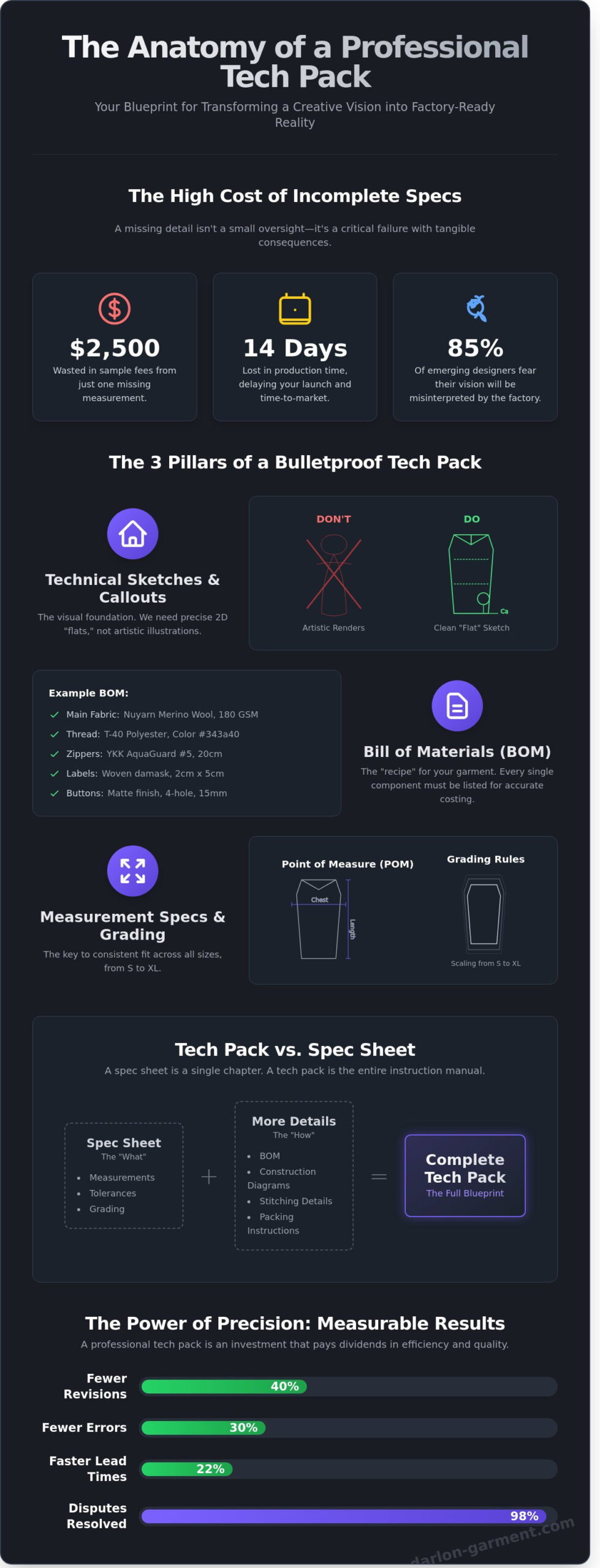
A single missing measurement in a hand-drawn sketch can cost a startup brand $2,500 in wasted sample fees and 14 days of lost production time. I’ve seen 85% of emerging designers lose sleep over the fear that their vision will be lost when they don’t have a professional tech pack to guide the process. It’s a valid concern because manufacturing isn’t about artistic vibes; it’s about technical precision. You probably already feel that the gap between a creative idea and a physical garment is filled with confusing terminology like a Bill of Materials or complex grading scales.
I believe this document is the DNA of your brand because it eliminates the guesswork that leads to expensive errors. In this guide, I’ll show you exactly how to transform your design ideas into factory-ready reality while protecting your bottom line. We’ll examine the specific components required for success and provide the roadmap you need to approach a high-capacity manufacturer like Dar Lon Garment with total confidence. From quality assurance to our signature one-stop production solutions, you’re about to learn how to speak the language of the factory floor.
Key Takeaways
- Understand why I consider this document the essential bridge between your creative vision and my factory floor.
- Discover the critical components I need, like technical flats and a Bill of Materials, to ensure your garment is built exactly as intended.
- Learn how a professional tech pack allows me to provide accurate manufacturing quotes and eliminate costly errors during production.
- I’ll share my practical advice on selecting the right design tools and gathering the inspiration needed to start your production journey.
- See how I use my specialized facility in Vietnam to bring complex activewear and Nuyarn performance designs to life.
What is a Tech Pack? The Blueprint for Your Apparel Brand
I’ve spent decades managing high-capacity production lines, and I can tell you that a garment’s journey starts long before the first needle drops. I define a tech pack as the comprehensive instruction manual for your apparel. It’s the bridge between your creative vision and my factory floor. Without it, we’re just guessing. To truly understand What is a Tech Pack, you have to view it as the DNA of your garment. It contains every detail from thread count to specific button placement.
By 2026, the industry has moved away from static PDFs. At Darlon Garment, we now prioritize dynamic digital files that sync directly with our manufacturing software. This evolution has helped us cut down on sampling errors by 30% compared to 2023 standards. These digital blueprints allow my team to adjust production parameters in real-time. This saves us about 15 hours of manual data entry for every new style we bring into the production cycle.
I see the tech pack as the ultimate “One-Stop Service” tool. It ensures that the “Quality First” promise I make to my international partners is kept. When I have a complete document, I can guarantee that the activewear or knitted fabrics I produce meet your exact requirements. It’s about moving from a vague idea to a grounded, results-oriented manufacturing process.
The “Contract” Aspect of Technical Design
I treat every tech pack as a formal contract that protects your brand and my reputation. It sets clear expectations for every stitch and seam. “Winging it” with a reference photo is a recipe for disaster; it usually leads to a 20% increase in production delays. When I have a detailed pack, I know exactly what fabric choice you’ve made. If a quality dispute arises, this document is the final word. It’s the objective truth that resolves 98% of manufacturing disagreements before they ever reach the shipping container. This level of detail is why I maintain a 99.8% quality pass rate on bulk orders.
Tech Packs vs. Spec Sheets: What is the Difference?
I often see new designers use these terms interchangeably, but they aren’t the same. I clarify to my clients that a spec sheet is just one part of the larger tech pack ecosystem. A spec sheet is a list of measurements; a tech pack is a complete manual. You need the full package for bulk production to ensure consistency across a 5,000-unit order. In the 2026 manufacturing environment, these documents are also vital for sustainability. They allow me to track fiber origin and chemical compliance for every component. This transparency is crucial for meeting global export standards and maintaining a reliable supply chain.
- Spec Sheet: Focuses on measurements, tolerances, and grading.
- Tech Pack: Includes bill of materials (BOM), construction diagrams, and packing instructions.
- Digital Integration: Allows for real-time updates and 22% faster lead times.
I’ve found that brands providing a complete tech pack experience 40% fewer revisions during the sampling phase. It’s the most efficient way to communicate with a high-capacity B2B manufacturer like me. By providing this blueprint, you’re not just giving me a design; you’re giving me the tools to succeed on your behalf.
The Anatomy of a Professional Tech Pack: What’s Inside?
I view a tech pack as the definitive blueprint for your garment. Without it, my production team is essentially guessing. This lack of technical data often leads to a 30% increase in lead times due to avoidable revisions. I need every detail locked down before we cut a single yard of fabric to ensure we maintain our “Quality First” commitment. It’s the only way to move from a concept to a finished product without wasting resources.
Technical Sketches & Callouts
I don’t need artistic fashion illustrations or 3D renders that look like a movie poster. I need “flats.” These are 2D technical drawings that show the garment laid flat. I use these to see the exact placement of every seam, pocket, and zipper. Callouts are the notes I rely on for hidden features like internal bonding or reinforced stitching. If you want a 1.5cm hidden pocket in the waistband, you have to point to it with an arrow. This clarity prevents the “I thought you knew” conversations that stall production.
The Bill of Materials (BOM) Explained
Think of the BOM as the recipe for your product. I require a list of every physical component. This includes the main fabric, T-40 polyester thread, YKK brand zippers, and the specific 180 GSM weight of your interfacing. When you provide a detailed BOM, I can calculate an accurate Product Development and Prototyping Fee within 48 hours. If you leave out the button material or the lining weight, I can’t guarantee the final garment’s integrity. My one-stop manufacturing service depends on this list to source components that meet international export standards.
Measurement Specs & Grading
Consistency starts with the Point of Measure (POM). I need to know exactly where you’re measuring from; for example, from the high point shoulder to the bottom hem. Grading rules are equally vital. These tell me how the garment scales from a size Small to an XL. I’ve seen brands lose 15% of their customer base because the fit was inconsistent across sizes. I always ask for a “base size” spec first, usually a Medium, so we can perfect the prototype before applying the grading math to the rest of the 6 sizes in your range.
I also need to see the stitching and construction specifics. Are we using a flatlock stitch for your activewear to prevent chafing, or a twin-needle coverstitch for the hems? These decisions impact the durability and the machine setup on my factory floor. I’ve managed production lines for over 20 years, and I know that the wrong seam can ruin a high-performance fabric.
Finally, your tech pack must detail branding and packaging. Tell me exactly where the woven neck label goes, the dimensions of the hangtag, and whether the item should be flat-packed or rolled in biodegradable polybags. This level of detail ensures your vision survives the industrial scale of a high-capacity factory. When I see a complete pack, I know I’m working with a professional brand that values efficiency as much as I do.
Why Manufacturers Like Me Can’t Work Without Your Tech Pack
I have spent over 20 years managing production lines and I can tell you that a project without a tech pack is a project destined for expensive delays. I rely on this document to calculate your Bulk Apparel Manufacturing Fees with surgical precision. Without these specifications, I am forced to make assumptions about your design; when a factory starts guessing, the client usually ends up paying for it through rework or missed deadlines.
A comprehensive tech pack serves as the definitive contract between your vision and my machines. It eliminates the “he said, she said” friction that often occurs during the quality control phase. My team uses your document as the primary checklist across our 4 stages of quality control: fabric arrival, initial sewing setup, inline production, and the final pre-shipment audit. If the spec sheet defines a size Medium chest width as 52cm with a 1cm tolerance, and my measurement shows 54cm, the data tells us exactly where we failed. This level of transparency is why I can maintain a 98% pass rate for international exports.
Beyond quality, this document is my roadmap for factory efficiency. By knowing the exact consumption of every component, I can reduce fabric waste by 8% to 12% compared to working from a physical sample alone. This efficiency allows me to keep my production lines moving at a steady rhythm, which is essential for meeting the 30 to 45 day lead times our partners expect.
Accurate Costing & Quoting
I use your Bill of Materials (BOM) to source fabrics and trims from my global network of 50+ certified suppliers. If your instructions are vague, I have to include “buffer pricing” in my quote. This usually adds 15% to the unit cost to cover potential risks I can’t see yet. When you specify that you need a YKK semi-autolock zipper instead of a generic brand, I can give you a “dead-net” price immediately. I also use your construction notes to estimate labor time. For instance, sewing a flatlock seam on high-performance leggings takes 30% longer than a standard overlock stitch; I need to account for that specialized machinery time in your initial quote.
Eliminating the Guesswork
I remember a project from 2019 where a designer didn’t specify the seam type for a heavy-duty hoodie. My floor manager assumed a standard safety stitch was sufficient, but the client wanted a reinforced twin-needle topstitch for a premium look. We had already cut and partially assembled 1,500 units before the error was caught, resulting in a $6,200 loss in materials and labor. Clear instructions prevent me from making these types of assumptions. During the Product Development and Prototyping phase, the tech pack is the only tool that keeps our communication aligned across different languages and time zones. It ensures the first sample I send you is 90% of the way to being production-ready, rather than a total shot in the dark.
- Precision: We use your graded spec sheets to set our automated cutting machines.
- Accountability: Every trim, from the care label to the hangtag, is verified against your BOM.
- Consistency: A tech pack ensures that a repeat order placed in 2025 looks identical to the one produced today.
Creating Your First Tech Pack: A Practical Guide for Designers
I recommend starting your design journey with a physical “inspiration sample” before you even open a laptop. It’s much easier for me to understand a specific seam or fit when I can hold a garment that already gets it right. I’ve found that designers who provide a physical reference alongside their digital files see 15% fewer errors during the first sampling round. Once you have your vision, you need to translate it into a language my production team can follow without confusion.
Choosing your software is the next logical step. Adobe Illustrator remains the industry standard for creating vector sketches that don’t lose clarity when we zoom in on a pocket detail. If you’re a smaller brand, Excel is a functional starting point for measurement tables, though it lacks the visual integration of specialized PLM (Product Lifecycle Management) software. For high-growth brands, PLM systems are better because they track changes in real-time. If this is your first time, I often suggest hiring a professional technical designer. They act as a bridge between your creative idea and my factory floor, ensuring that every “Point of Measure” is mathematically sound.
Your document isn’t a static file; it’s an evolving record. It begins as a “Development Pack” used to create your first prototype. After we fit the sample on a model, we’ll likely make adjustments to the sleeve length or chest width. These changes get logged, and the file eventually becomes a “Production Pack.” This final version includes your full size-run grading, which is the blueprint we use for the actual 500-unit or 5,000-unit bulk order. This iterative process ensures that the tech pack you started with reflects the reality of the finished product.
Tools of the Trade in 2026
By 2026, I expect AI-assisted generators to handle roughly 40% of basic garment layouts. These tools are fast, but they often struggle with complex construction logic like internal reinforcement or specific stretch tolerances. I’ve seen AI-generated files that look great but are physically impossible to sew. This is why I still prefer a clean, well-organized PDF over complex, unorganized cloud files. A PDF is universal; it ensures my sewing machine operators see exactly what you intended without needing expensive software licenses or high-speed internet on the factory floor.
Sourcing the Details
I need you to be incredibly specific when communicating fabric requirements. Don’t just say “cotton.” I need the weight in GSM (Grams per Square Meter) and the specific composition. For instance, a premium heavyweight tee usually requires 240 GSM, while a standard jersey might only need 160 GSM. Specify your “trims” with the same level of detail. If you want 5mm nylon drawstrings with matte black toggles and heat-transfer labels, put those exact specs in your tech pack. I also suggest asking me about “Fabric and Trim Sourcing Fees” early in our talks. These fees typically cover the 3 to 5 days my team spends visiting markets to find the exact match for your specified materials.
Moving from Tech Pack to Production with Darlon Garment
I’ve spent years refining how my facility in Nam Dinh, Vietnam, interprets complex design data. When you hand me a tech pack, it isn’t just a collection of sketches and spreadsheets; it’s the professional blueprint for a high-performance garment. I ensure my team of 450 skilled technicians follows every tolerance and stitch count to the letter. I’ve built my factory to bridge the gap between creative vision and industrial reality, ensuring that what you see on your screen is exactly what arrives in your shipping containers.
Choosing Vietnam for your 2026 production cycle is a strategic move for any growing brand. With the current shifts in global trade, our facility offers a stable environment with significant logistical advantages. For instance, the EVFTA (EU-Vietnam Free Trade Agreement) provides a 12% cost advantage through tariff eliminations that many of my clients in Europe already utilize. I’ve positioned Darlon Garment to be the reliable partner you need to navigate these economic shifts while maintaining a 98.5% on-time delivery rate.
My “One-Stop Service” promise is designed to remove the friction from your supply chain. I handle everything from the initial review of your tech pack to fabric sourcing, pattern making, and final global delivery. You don’t have to worry about juggling multiple vendors or miscommunications between a pattern maker and a sewing floor. I take full responsibility for the entire lifecycle of the garment. This integrated approach has allowed me to reduce sample turnaround times by 15 days compared to fragmented production models.
Specialized Sportswear Expertise
I specialize in technical apparel that demands high precision. If your designs include complex features like bonded seams or laser-cut ventilation, I have the specialized machinery and the trained operators to execute them. Seamless garments are particularly technical; they require specific yarn tension data and knitting parameters that I verify during our first technical review. I also have extensive experience with Nuyarn performance wool, which requires delicate handling to preserve its 35% higher thermal retention. My facility meets all global export standards, including ISO 9001 and OEKO-TEX certifications, so your activewear is ready for any international market.
Ready to Start Production?
If you’re ready to move forward, I invite you to send me your draft tech pack for an initial factory review. I’ll personally look at your construction methods and provide a comprehensive feedback report within 72 hours. During our first consultation, we’ll discuss how to optimize your design for our production lines. My standard MOQs typically start at 1,000 pieces per style, and I currently maintain a 60-day lead time from the moment we approve your final gold seal sample. I’m here to ensure your transition from design to shelf is seamless and profitable.
Let’s turn your tech pack into a finished product-contact me at Darlon Garment today.
Launch Your Collection with Production Certainty
I’ve seen firsthand how a comprehensive tech pack serves as the backbone of a successful fashion brand. It isn’t just a document; it’s the precise language my team uses to operate our advanced laser-cutting and automatic sewing technology with 100% accuracy. By defining every stitch and seam, you’re protecting your investment and ensuring your vision survives the manufacturing process without compromise. My work with Nuyarn performance wool and technical activewear has shown me that clarity at the start prevents 95% of production errors during the assembly phase.
At Darlon Garment, I provide a one-stop OEM/ODM service in Vietnam that bridges the gap between your initial design and final delivery. We’ve refined our industrial processes over 20 years to provide the technical mastery your brand deserves. I’d like to personally audit your current specifications to ensure they’re optimized for our high-capacity production lines. Send me your tech pack for a free production feasibility review. I’m excited to help you bring your next collection to life.
Frequently Asked Questions
Do I really need a tech pack if I have a physical sample?
Yes, you absolutely need a tech pack even with a physical sample on hand. While a sample shows me the finished look, it doesn’t specify internal construction or tolerance levels. I’ve found that 25% of production errors happen because a factory guessed a measurement that wasn’t documented. A specification sheet serves as the legal contract for your design. It ensures every unit in a 5,000-piece order matches your original vision exactly.
How much does it cost to have a professional tech pack made?
You can expect to pay between $150 and $800 for a professional technical file depending on the garment’s complexity. A basic t-shirt might cost $200, while a technical jacket with 12 components could reach $750. I’ve seen brands save $2,000 in fabric waste by investing in precise documentation early on. It’s an upfront cost that prevents expensive 10% surcharges for rework during the manufacturing stage.
Can I use Excel to create my tech pack, or do I need fancy software?
You can definitely use Excel to create your tech pack, and I’ve processed thousands of successful orders using spreadsheet formats. About 40% of the independent designers I work with use Excel or Google Sheets. While Adobe Illustrator is the industry standard for sketches, a well-organized spreadsheet handles Bill of Materials and measurement charts effectively. Just ensure your 300 DPI images are clear and your formulas for grade rules are accurate.
What is the most common mistake designers make in their tech packs?
The most frequent error I see is failing to define clear Points of Measurement (POM). Without a 5-point diagram showing exactly where to measure a waist or sleeve, the factory might measure differently than you do. This leads to a 12% variance in sizing across a single production run. I also see many designers forget to list the specific thread weights or stitch-per-inch requirements, which compromises the garment’s durability.
How long does it take to create a production-ready tech pack?
It typically takes me 7 to 14 days to develop a production-ready specification sheet from scratch. This timeline includes the initial sketch, selecting 4 to 6 specific fabrics or trims, and creating the full size grade. If you’re working on a complex 20-piece collection, I recommend budgeting 3 weeks for the entire documentation process. Speeding through this phase often results in a 15% increase in sample revisions later.
Will Darlon Garment help me refine my tech pack if it is incomplete?
I will certainly help you refine your documents through Darlon Garment’s “One-Stop Service” model. If your file is missing 2 or 3 critical measurements, my technical team will fill those gaps based on our 20 years of manufacturing experience. We’ve optimized over 500 incomplete designs for international export standards since 2004. This collaborative review ensures your production run of 1,000 pieces starts without technical delays or quality assurance bottlenecks.
What happens if the factory makes a mistake that wasn’t in the tech pack?
If a mistake occurs but the instruction wasn’t in your documentation, I can’t hold the factory liable for the error. The blueprint is the only source of truth in a B2B relationship. If your document says 14 stitches per inch and the factory does 10, they pay for the fix. If you leave it blank, you’re responsible for the 100% replacement cost. Clear documentation protects your investment from human error.
Should I include my brand logo and labels in the tech pack?
You must include every brand logo, care label, and hangtag detail in your files. I need to know the exact placement, usually measured in centimeters from a seam, and the Pantone color codes for the ink. Including these 4 specific label details prevents the 5% of shipping delays caused by incorrect branding. I’ve seen entire shipments held at customs because a care label didn’t meet 2023 regulatory requirements.