

The most recognizable name on your manufacturing shortlist might actually be the biggest bottleneck for your brand growth in 2026. When you research tld apparel vietnam, you’re likely hunting for a partner that balances high-volume capacity with the technical precision required for elite activewear. I’ve seen too many brands get lost in the bureaucracy of massive factories where innovation takes a backseat to basic throughput. You want the stability of a top three global exporter, but you don’t want your fabric developments, like Nuyarn or specialized knits, ignored by a partner that’s simply too big to care about the details.
I’ll guide you through the current landscape in Ho Chi Minh City to find your ideal production fit. Since the U.S. Supreme Court invalidated the 20% reciprocal tariff on February 20, 2026, the competitive advantage of sourcing here has surged. I’m going to compare the one-stop solutions of TLD Apparel with specialized OEM partners so you can decide which model supports your 2026 goals. We’ll look at how to manage the 7.2% minimum wage hike that started on January 1 and map out a clear, professional strategy to get your high-performance garments on shelves.
Key Takeaways
- I’ll help you distinguish between high-level supply chain managers and traditional direct-to-factory relationships so you can pick the right operational model for your brand.
- You’ll learn why technical mastery and in-house R&D are far more important than factory size when it comes to launching complex activewear in 2026.
- I’ll break down the trade-offs between using tld apparel vietnam for broad supply chain solutions versus working directly with a specialized OEM partner.
- You’ll get my personal vetting checklist, including the specific questions I use to verify if a factory actually owns the advanced machinery they claim to have.
- I’ll show you how to find an agile manufacturing partner that provides the industrial scale of a conglomerate with the precision of a high-end atelier.
Navigating the Vietnam Apparel Landscape: Who is TLD Apparel?
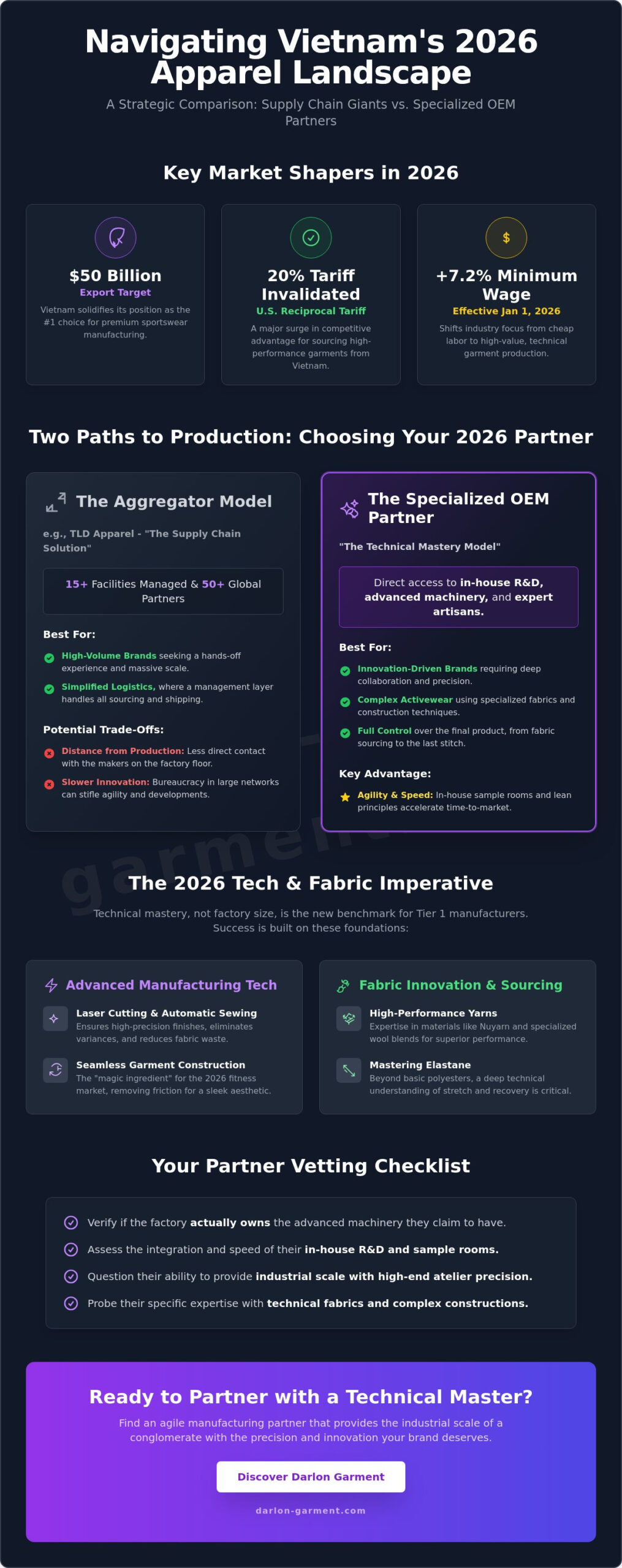
I’ve watched the Vietnamese garment sector transform from a basic assembly line into a global powerhouse. When you start searching for tld apparel vietnam, you’re entering a world that has moved far beyond simple “cut-make-trim” operations. TLD Apparel has built its reputation by acting as a massive bridge. They don’t just run one factory; they manage a network of over 15 facilities and more than 50 global partners. This “Supply Chain Solution” model is different from a traditional factory relationship. Instead of talking directly to the person who owns the sewing machines, you’re talking to a management layer that handles the logistics and sourcing for you. It’s a powerful tool if you need high volume, but it’s vital to understand that this layer adds both a safety net and a specific type of distance between your design team and the production floor.
The Rise of the Vietnam Garment Hub
Vietnam’s socialist-oriented market economy has created a unique environment where industrial scale meets rapid modernization. I’ve seen Ho Chi Minh City become the beating heart of this trade because of its proximity to Cat Lai, the country’s busiest port. As of April 2026, the industry is chasing a $50 billion export target, and we’ve reached a point where Vietnam is the #1 choice for premium sportswear. This isn’t just about cheap labor anymore. With the 7.2% minimum wage increase that hit on January 1, 2026, the focus has shifted toward high-value, technical garments. Brands aren’t just looking for capacity. They’re looking for the agility to pivot when market trends change.
TLD Apparel vs. The Competition
When you look at tld apparel vietnam, you’re looking at a Tier 1 aggregator. I categorize manufacturers in this region into three distinct tiers. Tier 1 includes the massive conglomerates and supply chain managers who handle everything from fabric sourcing to final shipping. They’re great for brands that want a “hands-off” experience. However, there’s a growing movement toward specialized OEM and ODM factories. These are the technical partners who own their machinery, like laser cutters and bonding stations, and offer direct access to the production floor. If your 2026 strategy requires deep innovation or boutique-level precision, you have to decide if you want the “Big Box” safety of an aggregator or the technical intimacy of a direct manufacturer. Both have their place, but the choice depends entirely on how much control you need over the actual needle and thread.
What Sets Top-Tier Vietnam Manufacturers Apart in 2026?
I’ve always believed that the “Tier 1” label should be earned through technical mastery rather than just sheer factory size. In 2026, being a leader in the Vietnamese market means more than just managing a massive workforce; it requires a deep commitment to advanced R&D and in-house sample rooms. These facilities are the secret to speeding up your launch. When you look at a major player like tld apparel vietnam, you’re seeing the result of decades of industrial scaling. But for a brand to truly succeed today, that scale must be paired with lean manufacturing principles. This isn’t just a buzzword for me. It’s the methodology I use to eliminate waste and keep your production costs low without sacrificing the quality of the stitch.
Advanced Manufacturing Tech: Beyond the Sewing Machine
I prioritize laser cutting and automatic sewing machines because they provide the high-precision finish that modern activewear demands. Manual cutting often leads to slight variances that can ruin the fit of high-compression leggings or performance tops. I’ve found that seamless garment construction is the “magic” ingredient for the 2026 fitness market. It removes friction points for the athlete and creates a sleek, professional aesthetic. Understanding how garments are made in these high-tech environments is crucial, as the efficiency of these machines directly influences your final retail price. Precision at the cutting stage means less fabric waste, which is a win for both your budget and the environment.
Fabric Innovation and Sourcing
The foundation of any elite sportswear line is the material. I’ve spent years working with high-performance yarns like Nuyarn and specialized wool blends that offer superior moisture management. While many factories stick to basic polyesters, I focus on a global sourcing network to find the best trims and accessories. Elastane fabric remains the backbone of the industry, but mastering its stretch and recovery in 2026 requires a technical eye. This technical sophistication is a major driver behind Vietnam’s Rise as a Top Apparel Supplier. We aren’t just sewing anymore; we are engineering textiles. If you’re looking for a partner that understands this level of detail, I invite you to explore how Darlon Garment approaches technical production to ensure your designs perform exactly as intended.
Comparing Supply Chain Solutions: TLD vs. Specialized OEM Partners
I’ll help you decide if you need a massive supply chain manager or a direct OEM partner. The choice often comes down to the level of control you want over your production line. When you look at tld apparel vietnam, you’re looking at a powerhouse that manages high-level logistics for massive global brands. It’s the “Big Box” approach. This model works well if you have a huge internal team to manage the manager. But for many of the brands I work with, a direct OEM relationship is the better fit. I believe you shouldn’t have to sacrifice scalability just to get the personal touch of a dedicated merchandiser who actually knows your specific stitch requirements.
I’ve seen how the “one-stop service” promise can sometimes lead to inflated costs if the factory is simply acting as a middleman for various services. I ensure that my version of a one-stop solution is rooted in physical infrastructure. This means I control the machinery and the timeline directly. It protects your bottom line because you aren’t paying for multiple layers of management. You get the efficiency of a large supply chain with the technical intimacy of a boutique factory.
FOB vs. CMPT: Which Model Saves You More?
I break down cost structures for international clients based on their internal capabilities and where they sit in the global market. FOB (Free on Board) is almost always the superior choice for brands based outside of Asia. In this model, I take full responsibility for the fabric sourcing, production, and transport to the shipping port. It’s cleaner and more predictable. If you choose CMPT, you’re responsible for getting the fabric to my door. Unless you have a dedicated sourcing office in Ho Chi Minh City, the logistics of CMPT can quickly eat up any perceived savings through shipping delays or fabric defects that I can’t control.
Quality Control: The Institutional Pride of Vietnam
Quality control is where institutional pride shows up on the factory floor. I use a strict four-stage QC process to maintain standards across every order. I’ve found that transparency in this workflow is the fastest way to build trust with my partners. This is how I ensure consistent quality even when we’re scaling up for high-volume runs:
- Raw material inspection: We check every roll of fabric for dye-lot consistency and stretch recovery before it’s cut.
- In-line inspection: My team catches sewing errors while the garments are still on the machines to prevent batch-wide issues.
- End-of-line check: Every single piece is inspected for loose threads, seam strength, and measurement accuracy.
- Final packing audit: We perform a random audit of packed boxes to verify quantities and packaging standards before the containers are sealed.
My Insider Checklist for Vetting Vietnam Garment Factories
I always tell my clients to ask five specific questions before they even think about signing a contract. When you research a major name like tld apparel vietnam, you’re looking at massive infrastructure, but you still need to verify the specific capabilities of the factory floor assigned to your brand. Check the machinery. Does the factory actually own the laser cutters they claim to have? I’ve seen shops outsource technical cutting to third parties, which destroys your lead times and compromises quality. You need to see the WRAP, BSCI, or ISO certifications with your own eyes to ensure ethical standards for the 2.7 million workers currently employed in our industry as of April 2026.
The “Sample Test” is my favorite way to separate the pros from the amateurs. I watch how quickly and accurately they turn a tech pack into a physical prototype. If they can’t get the fit right in the first two rounds, they won’t get it right during a 10,000-unit production run. I always invite brands to see my Ho Chi Minh City facilities in person. There’s no substitute for walking the floor and seeing the rhythm of the production line yourself. It’s the only way to know if your partner is as organized as they claim to be.
The Tech Pack Litmus Test
I evaluate a brand’s readiness based on the detail in their technical drawings. A good manufacturer will actually push back on your design to improve production efficiency. If I see a seam that will likely fail during high-intensity training, I’ll tell you. My pattern makers are the heroes of the R&D phase; they translate your vision into something that can be sewn efficiently. If a factory agrees to everything without a single technical question, that’s a massive red flag. It usually means they’ll figure out the problems on your dime later.
Finding Your Perfect Fit
Matching your brand’s volume to a factory’s “sweet spot” is the key to a long-term partnership. Choosing a sportswear factory in Vietnam is like dating. It’s all about the long-term vibe and shared expectations. I’ve seen brands get ignored by massive conglomerates because their orders weren’t big enough. Conversely, boutique brands often get crushed by factories that lack the technical machinery for high-performance stretch. If you want to see how a technical OEM partner can streamline your 2026 launch, contact me at Darlon Garment to review your tech pack and discuss a prototype run.
Scaling Your Brand with Darlon: Beyond the Standard Factory Model
I’ve built Darlon Garment to be the agile alternative to the massive conglomerates that dominate the region. While the tld apparel vietnam model is excellent for brands requiring a vast, multi-factory network, I focus on combining that high-volume capacity with the surgical precision of a high-end atelier. My goal is to ensure you don’t feel like just another number in a production queue. I specialize in high-performance categories like Sportswear, Activewear, Swimwear, and Sleepwear because these garments require more than just a basic stitch; they require an understanding of how fabric moves with the human body.
Being a “One-Stop Solution” means I solve your headaches before they reach your desk. Whether it’s navigating the 7.2% minimum wage increase that took effect on January 1, 2026, or ensuring your shipment meets standard MFN rates for U.S. export, I handle the logistics. This allows you to focus on design and marketing while I manage the technical backbone of your brand. It’s about creating a reliable, silent partnership that supports your growth without the friction of “big factory” bureaucracy.
My Commitment to Innovation
I’m constantly pushing our capabilities by integrating the latest textile technology. We showcase Nuyarn performance wool and seamless garment construction because they represent the future of the industry. I use automatic sewing machines to ensure every single piece in a 10,000-unit run is identical to the approved sample. There’s no room for human error when your brand reputation is on the line. I always say that choosing the right fitness wear manufacturer starts with a serious conversation about technology. If a factory isn’t investing in automation in 2026, they’re already falling behind the global curve.
Let’s Build Something Great Together
I enjoy the process of transitioning brands from small, experimental prototypes to full-scale bulk manufacturing. My “Quality First” philosophy isn’t just a slogan; it’s a protective barrier for your brand. In an industry where Vietnam is aiming for $50 billion in export revenue this year, the competition is fierce. I want your brand to stand out because of its technical superiority. I love being part of this garment revolution in Vietnam, and I’m ready to help you navigate this landscape with a partner who values long-term stability over short-term gains. Let’s start with your 2026 collection and prove what a technical partnership can do for your bottom line.
Your Next Step in the Vietnam Garment Revolution
Success in the 2026 manufacturing landscape requires a strategic choice between massive industrial aggregators and technical OEM partners. I’ve walked you through how to evaluate the broad supply chain reach of tld apparel vietnam against the direct, precision-focused approach of a specialized factory. You now have the checklist needed to verify machinery, certifications, and technical prototypes before committing your brand’s future to a contract. As the industry pushes toward its $50 billion export target this year, the brands that thrive will be those that embrace innovation over raw volume.
I established Darlon Garment in 2019 to provide this exact level of technical mastery. From our state-of-the-art facilities in Ho Chi Minh City, we offer a one-stop OEM/ODM solution specializing in Nuyarn, seamless construction, and bonded apparel. I’ve built this company to be the reliable, agile backbone your brand needs to stay competitive in a fast-moving market. Ready to scale your production? Let’s talk about your next collection. I can’t wait to see your designs come to life on our production floor.
Frequently Asked Questions
What is the typical MOQ for a garment manufacturer in Vietnam like TLD or Darlon?
A high-capacity manufacturer typically requires a minimum order quantity of 1,000 to 2,000 units per style. These numbers ensure that specialized automated machinery and fabric dyeing vats run at peak efficiency. While some smaller workshops might accept 500 units, they often lack the technical bonding or laser-cutting tools found in Tier 1 facilities.
How long does the production process take from tech pack to delivery?
You should plan for a total lead time of 90 to 120 days from the moment you hand over a finalized tech pack. The first 30 days are dedicated to the R&D and sampling phase to perfect the fit. Once the pre-production sample is approved, bulk manufacturing and quality control take another 60 to 90 days depending on the complexity of the garment.
Can I source specialized fabrics like recycled polyester or Nuyarn in Vietnam?
Yes, you can absolutely source high-performance materials like GRS-certified recycled polyester or technical wool blends within the local market. The Vietnamese supply chain has expanded rapidly to include mills that produce high-recovery elastane and moisture-wicking knits. Sourcing these locally helps you avoid the import duties and delays often associated with bringing fabric in from other countries.
What is the difference between an OEM and an ODM service?
OEM means I build the garment exactly according to your technical drawings and specifications. ODM is a more collaborative model where I provide a library of pre-developed designs that you can customize with your own branding. Most performance brands prefer the OEM route to maintain full control over their unique silhouettes and technical features.
Is it better to work with a supply chain solution or a direct factory?
Choosing between a broad manager like tld apparel vietnam and a direct factory depends on your internal team’s size. A supply chain solution handles the heavy lifting of managing multiple sub-contractors for massive catalogs. I believe a direct OEM relationship is better if you need technical intimacy and want to avoid the communication lag that happens when you’re several steps removed from the sewing machine.
How do I handle shipping and logistics when manufacturing in Vietnam?
Most international contracts are handled under FOB terms, meaning I manage the goods until they reach the port in Ho Chi Minh City. From there, your freight forwarder takes over for the ocean or air journey. With the 2026 export infrastructure in place, shipping from Cat Lai port remains the most cost-effective method for bulk orders heading to the U.S. or Europe.
What certifications should I look for in a Vietnamese garment factory?
You should prioritize factories that hold WRAP or BSCI certifications to ensure ethical labor practices. These audits prove that the facility treats its workers fairly and follows strict environmental protocols. For performance wear, I also recommend looking for OEKO-TEX Standard 100 to ensure that the chemicals used in the dyeing process are safe for skin contact.
Can I visit the factories in Ho Chi Minh City before starting production?
I always encourage brands to visit my facilities in Ho Chi Minh City before starting a partnership. Seeing the production line in person allows you to verify the machinery and meet the team that will be handling your brand. Professional manufacturers will help coordinate these visits so you can see the full scope of their quality control and R&D departments firsthand.