

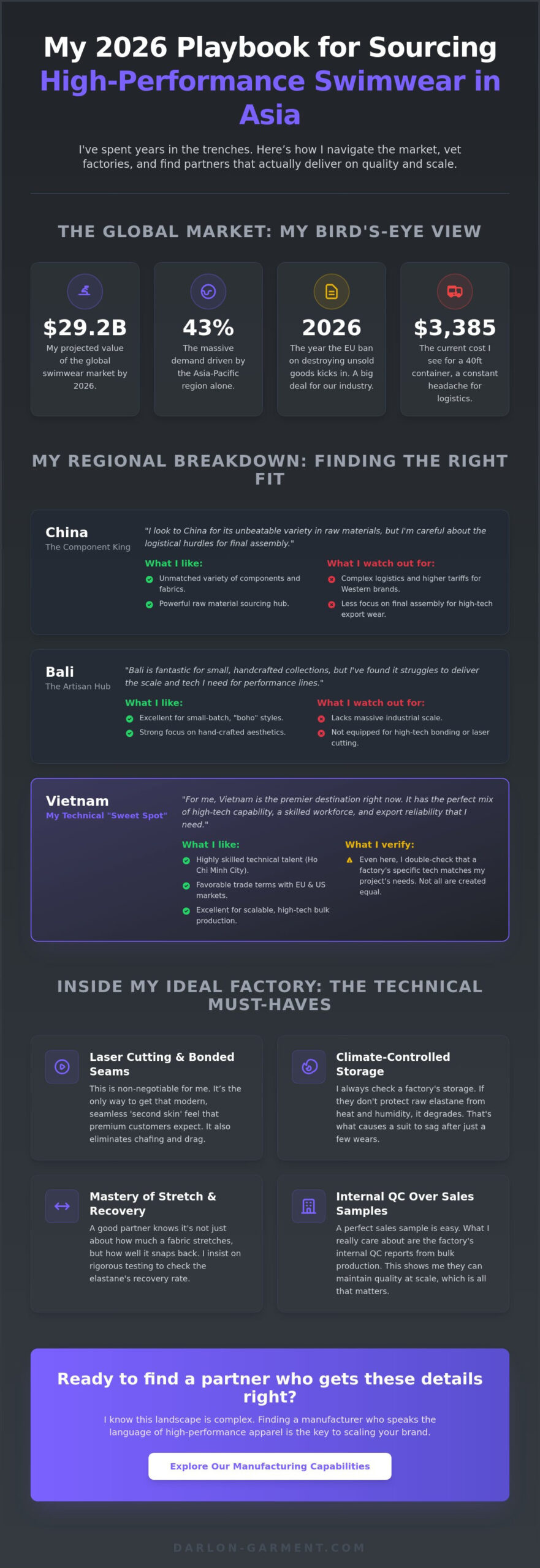
Did you know that the global swimwear market is projected to reach $29.2 billion in 2026, with the Asia-Pacific region driving a massive 43% of that demand? I’ve spent years watching brands struggle with the same recurring headaches, from poor communication with overseas teams to inconsistent quality in stretch fabrics. Finding the top swimwear manufacturers in Asia isn’t just about chasing the lowest labor costs anymore. It’s about finding a partner who understands complex bonding technology and the strict new EU regulations, like the July 19, 2026, ban on destroying unsold goods.
I know you’re likely feeling the pressure of elevated shipping rates, with a 40-foot container from Shanghai to Los Angeles currently costing around $3,385. I’ll show you how to navigate this landscape, identify high-tech factories, and choose a partner that scales with your brand. We’ll look at how to vet technical mastery in seamless garments, manage rising material costs, and ensure your supply chain remains stable despite geopolitical shifts. By the end of this guide, you’ll have a clear roadmap for sourcing high-performance apparel that meets global standards.
Key Takeaways
- Learn how to distinguish between component sourcing hubs and final assembly centers to optimize your production efficiency across different Asian regions.
- Identify the top swimwear manufacturers in Asia by looking for specific technical infrastructure like four-needle six-thread flatlock machines and advanced bonding capabilities.
- Discover why I prioritize factory-internal QC reports over perfect sales samples to ensure your production quality remains consistent at scale.
- Understand the critical differences between factories that cater to agile startups and those equipped for global enterprise volume to avoid a partnership mismatch.
- Master the shift toward sustainable production by vetting a manufacturer’s energy use and waste management rather than just looking at fabric certifications.
Navigating the Landscape of Swimwear Manufacturing in Asia for 2026
I’ve watched the Asian manufacturing map shift dramatically over the last five years. It’s no longer a race to the bottom on price. Instead, it’s a race toward technical mastery and supply chain resilience. While China remains the undisputed powerhouse for raw materials and component sourcing, many of the top swimwear manufacturers in Asia have moved their final assembly lines to Southeast Asia. This shift is driven by a need for specialized skills that go beyond simple stitching. Modern swimwear is essentially technical gear. It requires high-precision bonding and laser-cutting capabilities that weren’t standard a decade ago.
In my experience, a “Full Service” factory in 2026 must offer more than just a cut-and-sew operation. They need to be deeply integrated into the global textile industry to secure the best recycled yarns and specialized elastics. I look for partners who can handle everything from pattern digitizing to final quality control reports. This level of vertical integration is the only way to maintain consistency when you’re moving thousands of units across borders. It’s about stability. You need a backbone that doesn’t break when shipping rates spike or regulations change.
Why the Shift to Vietnam is Accelerating
I’m seeing an incredible influx of brands moving their production to Vietnam, particularly for technical swimwear and activewear. The trade benefits are hard to ignore. With favorable terms for both the EU and US markets, it’s a strategic move to mitigate the impact of shifting tariffs. Ho Chi Minh City has become a hub for technical talent. The workers here aren’t just sewing; they’re operating complex machinery that handles the high-stretch fabrics we use for performance gear. Vietnam’s infrastructure has also seen massive upgrades, allowing for faster bulk production runs that keep pace with global demand.
Regional Comparison: Vietnam vs. Bali vs. China
I often get asked which region is best for a new collection. Bali is a fantastic choice if you’re doing small-batch, “boho” styles with a focus on hand-crafted aesthetics. However, I’ve found that Bali often struggles with massive industrial scale and the high-tech bonding required for competitive performance wear. China still offers the widest variety of components, but the logistical hurdles and high tariffs make it a complex choice for Western brands. Vietnam provides what I call the “sweet spot.” It offers the technical performance of high-end factories with the ability to scale up quickly. Many of the top swimwear manufacturers in Asia are now centered here because of the stable political environment and skilled workforce. If you’re looking for a reliable sportswear factory vietnam is currently the premier destination for brands that need a mix of technical skill and export reliability.
The Technical Specs I Look for in High-Performance Swimwear Factories
I’ve learned that treating swimwear like standard apparel is the fastest way to lose customers. It’s high-performance gear. It has to survive constant exposure to salt, chlorine, and intense UV rays without losing its shape or color. When I vet the top swimwear manufacturers in Asia, I don’t just look at their finished samples. I look at their factory floor. If they aren’t using specialized four-needle six-thread flatlock machines, the seams won’t have the durability or the stretch required for professional-grade activewear.
Storage is another factor that most brands overlook. Elastic fibers are sensitive. If a factory doesn’t have climate-controlled storage for their raw materials, the elastane can degrade before it even hits the cutting table. This leads to that dreaded “sag” after just a few wears. I also prioritize partners who handle both OEM and ODM development in-house. It ensures that the technical design intent isn’t lost when moving from a prototype to a bulk production run. If you’re looking for a partner that understands these technical nuances, you can check our manufacturing capabilities to see how we handle complex builds for international brands.
Laser Cutting and Bonded Seams: The Non-Negotiables
I’ve found that laser cutting is absolutely essential for modern, seamless styles. It’s the only way to prevent fabric fraying at the edges without adding bulky hems. Bonding technology is what creates that “second skin” feel. Premium customers expect a smooth silhouette today. These technologies don’t just look better; they reduce bulk and increase the aerodynamic properties of the suit. This is crucial for competitive swimwear where every millimeter of drag matters.
Mastering Stretch: Working with High-Performance Elastane
Choosing the right elastane fabric is the difference between a suit that lasts years and one that sags in weeks. I look for partners who deeply understand the recovery rate of different Lycra blends. It’s not just about how much it stretches, but how fast it snaps back. I always insist on rigorous testing protocols during mass production. We check for colorfastness in chlorinated water and stretch retention after repeated cycles. This data-driven approach is what separates the top swimwear manufacturers in Asia from the standard garment shops.
My Top Swimwear Manufacturers in Asia: The 2026 Elite List
I’ve spent a lot of time on factory floors across the continent to narrow down this list. When I evaluate the top swimwear manufacturers in Asia, I’m looking for a rare combination of technical capability, ethical standards, and export reliability. I’ve found it’s easy to find a shop that can sew a basic bikini. It’s much harder to find a partner that can scale alongside a growing brand without sacrificing quality. I’ve seen many businesses fail because they chose a partner based on price alone, only to realize the factory couldn’t handle the complexities of high-performance stretch fabrics at volume.
A “top” manufacturer for a startup might actually be a nightmare for a global enterprise. Startups need low minimums and flexibility. Enterprises require vertical integration to keep production timelines on track and costs predictable. I also look at an “innovation score” based on a factory’s material R&D. With the global swimwear market reaching $29.2 billion in 2026, the brands that win are those using smart fabrics and advanced construction. If a factory isn’t researching new recycled blends or testing UV-resistant coatings, they aren’t on my elite list. My vetting process ensures the partner you choose can handle the July 19, 2026, EU regulations regarding product durability and lifecycle transparency.
Dar Lon Garment (Vietnam): The Technical Powerhouse
I take a lot of pride in what we’ve built at Dar Lon Garment in Vietnam. We’ve positioned our facility to merge the precision of high-end sportswear with the specific aesthetics of modern swimwear. I focus on providing one-stop OEM solutions. This means we handle everything from your initial tech pack development to the final bulk delivery. Our investment in laser cutting and automatic sewing machines has made us a leader in the region. These tools allow us to maintain tolerances that manual sewing simply can’t match. I invite you to see how garments are made in our facility to understand the level of detail we bring to every stitch.
Alternative Hubs: When to Consider Bali or China
I still recommend Bali for specific brand profiles. If your USP is handcrafted details like crochet or intricate hand-beading, Bali’s smaller boutique factories are excellent. They offer a specific aesthetic that’s hard to replicate in a high-volume industrial setting. China remains the go-to if you need incredibly niche hardware, like custom-molded metal clasps, or if you’re producing very low-cost promotional items. China’s three main production bases still produce nearly 40% of total global output. However, you’ll have to weigh these benefits against higher tariffs and more complex logistics compared to Vietnam. Choosing a partner among the top swimwear manufacturers in Asia is about finding the right technical fit for your specific business model.
How I Recommend Vetting Your Asian Manufacturing Partner
I’ve seen too many brands fail because they rushed the vetting phase. It’s tempting to jump in when you see a beautiful sample, but samples are often made by a factory’s most skilled sample room tailors, not the bulk production line. When evaluating the top swimwear manufacturers in Asia, I always ask to see their internal QC reports from the last three months. This gives me a factual look at their defect rates and how they actually handle errors during a high-volume run. I want to see evidence of their consistency, not just a one-off success.
I also use the “Video Tour” test. Since I can’t always fly to every facility every week, I request a live video call. I want to see the specialized machinery I mentioned earlier, like the four-needle six-thread machines, in actual operation. If a factory is hesitant to show their floor in real-time, it’s a red flag. I believe clear, proactive communication is far more valuable than the lowest price per unit. A cheaper price doesn’t help you if your shipment is delayed due to poor planning or quality issues. The top swimwear manufacturers in Asia will always be transparent about their internal processes and production schedules.
Deciphering the Tech Pack and Sampling Phase
I always tell my clients that a perfect tech pack is your best insurance policy. For swimwear, this must include specific stretch factors for both the shell and the lining. If you don’t specify the recovery rate of the elastane, you’re leaving your quality to chance. I recommend managing the “sample loop” by being extremely detailed in your initial tech pack. This prevents you from blowing your entire launch budget on five rounds of physical revisions that could have been handled digitally.
Understanding the Pricing Models: CMT vs. FOB
I find that many new brands are confused by CMT and FOB models. In CMT (Cut, Make, Trim), you provide the fabric and trims, which requires you to have a massive logistical footprint. In the FOB (Free On Board) model, the factory handles everything until the goods are on the ship. I recommend the FOB model for brands that don’t have a local sourcing team. It simplifies your logistics and puts the responsibility of material quality squarely on the manufacturer. You can learn more about how to choose clothing manufacturers who offer this level of transparency in our detailed guide. If you’re looking for a partner who values this kind of clarity, contact our team today to review your production requirements.
Sustainable Innovation: The Future of Swimwear Production
I’m seeing a massive shift in global sourcing toward eco-conscious production, and it’s happening faster than many predicted. As of May 2026, the global swimwear market has reached a projected $29.2 billion, and a huge portion of that growth is driven by consumers demanding transparency. The top swimwear manufacturers in Asia are no longer just competing on speed; they’re competing on their environmental footprint. I’ve realized that true sustainability isn’t just about picking a recycled fabric from a catalog. It’s about the factory’s holistic approach to waste management and energy use.
One of the biggest changes I’ve implemented involves moving away from traditional screen printing. Traditional methods consume vast amounts of water and often result in chemical runoff. By switching to digital printing, we’ve significantly reduced water consumption while maintaining the vibrant colors swimwear requires. I also focus on minimizing fabric waste during the cutting phase. Using the automatic sewing and precision laser-cutting tools I mentioned earlier, we can optimize marker layouts to ensure that almost every square inch of fabric is utilized. This is a critical factor that many “eco-friendly” boutique shops in places like Bali often miss because they lack the industrial machinery to track these metrics accurately.
Recycled Polyamide and Eco-Friendly Sourcing
Recycled nylons like Econyl are quickly becoming the industry standard for premium collections. In May 2026, standard recyclate prices in Southeast Asia are holding at approximately $2,220 per metric ton, making it a viable long-term choice for brands that want to scale. I’ve also been experimenting with natural fibers to see how they can be integrated into lifestyle swimwear. The challenge is always balancing that eco-friendly profile with the high-performance durability needed for salt and chlorine. If a suit doesn’t last, it isn’t truly sustainable. This is why I prioritize recycled polyamide blends that offer the same recovery rates as virgin materials.
Nuyarn and Beyond: Performance Meets Planet
I’m particularly excited about Nuyarn technology for our performance-focused apparel lines. By using specialized spinning techniques, we can create garments that dry significantly faster and last longer than traditional ring-spun fabrics. This longevity is essential, especially with the EU’s Ecodesign for Sustainable Products Regulation (ESPR) coming into full effect. Starting July 19, 2026, large enterprises will be banned from destroying unsold goods, which means every piece we manufacture must be designed for a long lifecycle. I’m already preparing for the future of circular fashion by exploring how we can integrate digital product passports into our production lines. The top swimwear manufacturers in Asia must be proactive in these areas to remain relevant in a regulated global market. If you’re ready to build a collection that meets these high standards, reach out to us to discuss your 2026 sourcing strategy.
Building Your 2026 Swimwear Strategy
I hope this guide has clarified how much the manufacturing landscape has shifted. Success in this market now depends on choosing a partner that prioritizes technical specs like laser cutting and bonded seams over just chasing the lowest unit price. As I mentioned earlier, vetting the top swimwear manufacturers in Asia requires looking beyond the sample room and into the actual production data and QC reports. I’ve found that focusing on regional hubs like Vietnam provides the balance of scalability and technical expertise needed to stay ahead of upcoming global regulations.
I’ve built my facility to act as a one-stop manufacturing partner, handling everything from initial development to final bulk delivery. I specialize in high-performance bonded and laser-cut apparel, and I’m proud to be a trusted partner for global brands in the technical sportswear space. Ready to scale your swimwear brand? Let’s discuss your production needs today. I’m excited to see how your next collection comes to life with the right technical backbone supporting your vision.
Frequently Asked Questions
What is the average MOQ for swimwear manufacturers in Asia?
Average MOQs typically range from 500 to 1,000 pieces per style across the high-capacity facilities I’ve worked with. While smaller boutique shops might offer lower minimums, the top swimwear manufacturers in Asia usually require these volumes to maintain efficiency on specialized machinery. I’ve found that some technical facilities will offer flexibility for bonded or laser-cut styles if you use their in-stock performance fabrics.
How do I ensure the quality of swimwear samples from an overseas factory?
I ensure quality by requesting a pre-production sample made on the actual bulk production line rather than in a separate sample room. I always insist on testing these samples for stretch recovery and colorfastness in chlorinated water before giving the green light. It’s vital to compare this sample against your original tech pack specs to verify the factory didn’t take shortcuts with the lining or elastic quality.
Which Asian country is best for sustainable swimwear production?
Vietnam is currently the premier destination for sustainable swimwear due to its advanced infrastructure for recycled polyamide and digital printing. While Bali is popular for eco-branding, Vietnam’s industrial scale allows for much better waste management and energy efficiency. I prefer Vietnam because the factories there are already adapting to the July 19, 2026, EU regulations regarding product durability and circularity.
What are the typical lead times for bulk swimwear orders in Vietnam?
Typical lead times for bulk swimwear orders in Vietnam range from 60 to 90 days after you approve the final sample. This timeline accounts for fabric sourcing, which can take up to 45 days, followed by the cutting, sewing, and quality control phases. If your designs involve specialized techniques like bonding or laser-cutting, I recommend adding an extra 14 days to the schedule to ensure the technical execution is perfect.
Do I need to provide my own designs, or do manufacturers offer ready-made styles?
Most high-end manufacturers operate on an OEM basis, which means I expect you to provide the designs and detailed tech packs. However, some of the top swimwear manufacturers in Asia also offer ODM services where they have a catalog of proven styles you can label as your own. I usually suggest the OEM route for brands that want to differentiate themselves with unique performance features or specific fit requirements.
How do I handle shipping and customs when manufacturing in Asia?
I recommend using the FOB model where the manufacturer handles the goods until they are loaded onto the vessel at the port of origin. From that point, you’ll need a freight forwarder to manage the ocean or air transit and clear customs in your home country. Keep in mind that as of May 2026, shipping a 40-foot container from Shanghai to Los Angeles costs around $3,385, so factor these rates into your landing costs.
Is it better to work with a factory directly or use a sourcing agent?
Working directly with a factory is better for established brands with technical expertise, while agents can help startups navigate the initial landscape. I prefer the direct relationship because it eliminates communication lag and hidden commissions. If you have a clear tech pack, dealing directly with the factory floor ensures your technical requirements for bonded seams or seamless garments are met without any translation errors.
What certifications should I look for in an ethical swimwear manufacturer?
I look for globally recognized validations like WRAP or BSCI to ensure the factory meets international labor standards and safety requirements. These audits provide a level of institutional transparency that is crucial for modern brand accountability. I also check for Oeko-Tex Standard 100 certification for the fabrics. This ensures the materials are free from harmful substances, which is a non-negotiable requirement for swimwear that sits directly against the skin.