
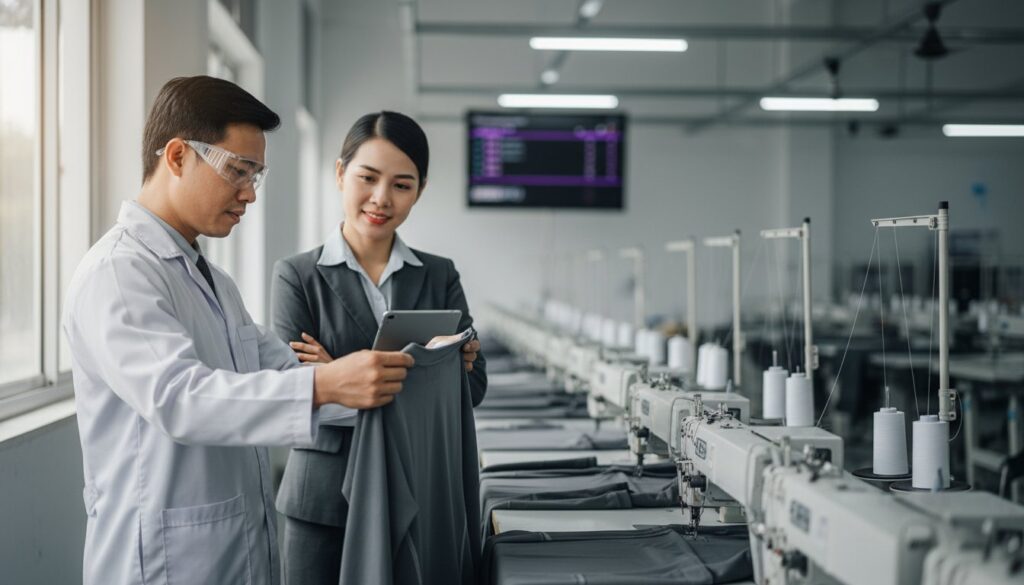
In January 2024, a colleague of mine received a flawless activewear sample, but the subsequent bulk order arrived with a 32% defect rate in the seam construction. It’s a frustrating reality that many brands face when they realize a great sample doesn’t always guarantee a reliable production line. I know the anxiety that comes with communication barriers and the fear of hidden costs surfacing right before shipping. Vetting apparel manufacturers shouldn’t feel like a high-stakes gamble with your brand’s reputation.
I’ve spent over a decade on factory floors developing a rigorous auditing framework that prioritizes technical mastery and transparency. I’ll walk you through my personal process for auditing factories so you can skip the scams and find a production partner that actually delivers on its promises. This guide provides a clear checklist for screening potential partners, ensuring you can move forward with confidence. We’ll examine how to verify certifications and assess “One-Stop Service” capabilities to build a scalable, long-term manufacturing relationship for 2026 and beyond.
Key Takeaways
- I’ll show you how to protect your brand’s startup budget by identifying critical red flags before you sign a production contract.
- Learn why I prioritize advanced machinery like laser cutting and automatic sewing to guarantee the precision required for high-performance activewear.
- I’m sharing my proven 5-step framework for vetting apparel manufacturers, including the specific reference checks I use to verify factory claims.
- Discover which ethical certifications, such as BSCI and WRAP, I consider non-negotiable when auditing a potential partner’s reliability.
- Find out how a “one-stop” manufacturing approach can simplify your logistics and ensure your technical standards are met from start to finish.
Why I Believe Vetting Your Apparel Manufacturer is a Make-or-Break Move
I’ve witnessed brand owners lose $50,000 or more in a single season because they skipped the due diligence phase. It’s a heartbreaking scenario that happens more often than people realize. To me, vetting is the multi-stage process of verifying a factory’s legal standing, technical capacity, and ethical standards before a single dollar changes hands. In the global apparel manufacturing sector, this isn’t just a checklist. It’s the only way to protect your capital.
The landscape in 2026 looks different than it did even three years ago. The massive shift toward Vietnam as a primary sourcing hub has created incredible opportunities, but it’s also led to a surge of middlemen. These agents often pose as factories on digital platforms but lack their own physical infrastructure. I’ve spent years vetting apparel manufacturers across Southeast Asia, and I’ve learned that the goal is to find a partner, not just a vendor. A vendor sells you a product; a partner invests in your long-term scalability and technical success.
The Real Cost of Poor Vetting
A single bad bulk run can destroy your brand’s reputation overnight. If you ship 1,000 units with inconsistent sizing or failing seams, your return rate will likely spike above 15%. This creates a logistical nightmare that most startups can’t survive. I often tell my clients that the cheapest quote usually ends up being the most expensive. You might save $1.50 per garment on the initial invoice, but you’ll spend $5.00 per garment later on third-party inspections, fabric testing, and air-freight to replace defective goods.
I also warn against the “Sample Trap.” This happens when a factory uses their most skilled sample maker and specialized machinery for your prototype, but moves the bulk order to a lower-tier production line. Without proper vetting apparel manufacturers for their actual floor capacity, you won’t know the truth until the shipping containers arrive at your warehouse.
What I Look for in a First Impression
I evaluate a manufacturer based on the quality of the questions they ask me. If a factory representative asks about specific GSM weights, stitch-per-inch requirements, or Pantone matching systems, I know I’m talking to a professional. I prioritize a “One-Stop” service mindset. This means the factory handles everything from fabric sourcing to final packaging, which reduces the risk of communication gaps between multiple suppliers.
Transparency is my favorite green flag. If a factory tells me they can’t handle a specific high-stretch performance fabric because they don’t have the right flatlock machines, I trust them immediately. That honesty is much more valuable than a vendor who says “yes” to every request just to secure a deposit. I want a partner who knows their limitations as well as their strengths.
Technical Deep Dive: Vetting for Performance and Precision
When I’m vetting apparel manufacturers for activewear, I don’t care about mood boards or fancy office lobbies. I care about what’s on the production floor. By 2026, the gap between standard factories and high-performance partners has widened significantly. If you’re building a technical fitness brand, you need to verify they have the specialized hardware to handle your designs. Surface-level aesthetics won’t help you when a seam pops during a high-intensity workout.
The Machinery Audit
I always ask for live video tours or unedited photos of the production floor in action. In my experience, roughly 85% of manufacturing errors in performance wear stem from outdated equipment. I look for advanced tech like laser cutting machines and automatic sewing units. These tools ensure consistent seam strength across every single batch. This is non-negotiable for modern bonding and laser-cut finishes that define high-end 2026 apparel. You can see how these machines integrate into a professional workflow by reviewing how garments are made at a high-capacity facility. I also check for specialized “Seamless” knitting capabilities. This technology remains a massive differentiator for fitness brands that want to reduce friction and improve athlete comfort.
Handling technical fabrics like Nuyarn or high-elastane blends requires specific tension controls that basic machines simply don’t have. I vet for this by asking about their needle cooling systems and specialized attachments. This technical scrutiny is also where I verify their adherence to CPSC safety standards to ensure every component meets international regulatory requirements. If a factory can’t discuss these technical specs comfortably, they aren’t the right partner for a scaling brand.
Vetting the Product Development Team
A factory’s technical skill is truly revealed during the prototyping phase. I prioritize partners with an in-house team dedicated to tech pack development and rapid prototyping. If they can’t iterate on a fit test within 7 to 10 days, they’ll likely struggle with your production timeline later. Prototyping is the ultimate stress test for a manufacturer; it shows me how they interpret complex instructions and whether their pattern makers understand the nuances of body movement. I’ve found that factories offering a one-stop service for development and production generally maintain higher quality control because the communication loop is closed. When vetting apparel manufacturers, I always look for this internal synergy to avoid the “lost in translation” errors that plague outsourced development.
Certifications and Compliance: What I Look for to Prove Reliability
I view certifications as the ID cards of the manufacturing world. They prove a factory can actually execute the standards they claim in their marketing decks. When I’m vetting apparel manufacturers, I don’t just take a PDF at face value. I prioritize BSCI (Business Social Compliance Initiative) and WRAP (Worldwide Responsible Accredited Production) because they focus on the humans behind the machines. These certifications are non-negotiable for me. They ensure that the 500 or 1,000 workers on the floor are treated with dignity, paid fairly, and work in safe environments.
Verification is where most brands fail. I’ve seen factories present certificates that expired in 2023 or belong to a different facility entirely. I always verify these documents by logging into the Amfori database for BSCI or the WRAP portal. If the address on the certificate doesn’t match the factory gate where my goods are being sewn, it’s an immediate red flag. For 2026, I also demand GOTS (Global Organic Textile Standard) or GRS (Global Recycled Standard) documentation to ensure the “eco-friendly” claims aren’t just greenwashing.
Social and Technical Audits
I always separate social compliance from technical capability. A social audit tells me if the factory is ethical, but a technical audit tells me if they can actually sew a complex waterproof jacket. If I can’t visit a facility in person, I hire third-party inspectors like QIMA to perform a 100-point check on their machinery and quality control loops. If you’re sourcing from Southeast Asia, you should check out this guide on finding a sportswear factory vietnam to understand the specific regional benchmarks you need to hit.
Environmental Responsibility
In 2026, ethical manufacturing is a requirement, not a bonus. I vet for waste management systems and energy-efficient machinery, specifically looking for factories using servo motors that cut power usage by 30 percent compared to older models. I’m also seeing a significant pivot toward natural fibers, which makes vetting the raw material source even more critical. I want to see the transaction certificates that track the fiber from the farm to the mill. Vetting apparel manufacturers effectively means following the paper trail until you’re certain every link in the chain is solid.
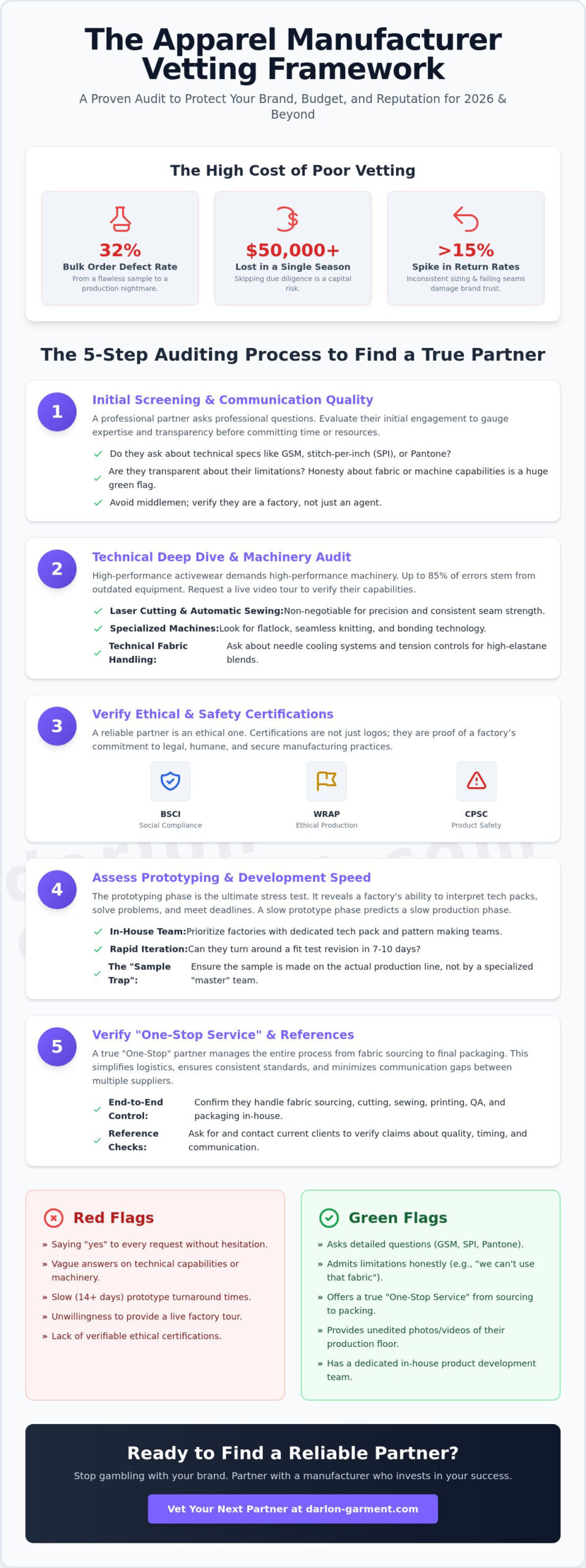
My 5-Step Framework for Vetting Potential Partners
I’ve refined my process for vetting apparel manufacturers over the last 15 years. It’s a system designed to filter out the noise and find partners who actually deliver on their promises. I don’t rely on flashy websites or marketing brochures; I rely on data, performance tests, and direct communication.
- Step 1: Initial Screening. I check for at least 10 years of documented history in the industry. Stability is non-negotiable. I also verify that they specialize in my specific niche, like high-performance activewear or technical knits, rather than being a “jack of all trades.”
- Step 2: Reference Checks. I always ask for three recent clients from the last 18 months who produce similar product categories. Speaking with these brands directly often reveals more about a factory’s reliability than any sales pitch.
- Step 3: The Tech Pack Test. I send a complex design to see how they interpret technical specs. A reliable partner will ask detailed questions about seam allowances or stitch density. If they accept a complex pack without a single question, it’s a sign they might cut corners later.
- Step 4: Sample Run. This is the physical proof of capability. I evaluate the construction finish and the elastane fabric recovery. In my quality tests, high-grade stretch fabric must retain 98% of its original shape after 50 extension cycles.
- Step 5: The Communication Stress Test. I purposely ask a tricky question or request a minor mid-process change. Their reaction tells me everything. I want a partner who explains the cost and timeline impact immediately, not one who gives vague “no problem” answers.
Red Flags I Never Ignore
I’ve learned that unusually low prices are the biggest warning sign. If a quote is 25% lower than the industry average, they’re likely using inferior materials or unethical labor practices. I also watch for a lack of transparency. If a factory won’t name their yarn suppliers, they’re hiding something. Vague answers about production capacity or lead times usually mean they’re overbooked and your order will be delayed.
Questions I Wish More Brands Asked Me
I’m always impressed when a brand asks what happens if the bulk order doesn’t match the golden sample. It shows they understand the reality of production variances. I also suggest asking for mid-line quality control reports. Checking 10% of the garments while they’re still on the sewing line prevents massive errors at the end. Finally, always ask to see a third-party audit report, like a BSCI or SEDEX certificate, dated within the last 12 months to ensure compliance.
Finding Your ‘One-Stop’ Fit: How I Approach Manufacturing at Dar Lon Garment
I’ve built Dar Lon Garment to be the exact type of partner I’d look for if I were launching a brand today. Vetting apparel manufacturers often feels like a gamble, so I focused our operations on the high-performance sportswear niche where technical excellence is non-negotiable. I believe that a manufacturer should be a silent backbone for your brand, providing the stability you need to focus on marketing and design. My approach is rooted in transparency and the “One-Stop” advantage. By keeping fabric sourcing, pattern making, and bulk assembly under one roof, I eliminate the 15% to 20% delay typically caused by coordinating between multiple third-party vendors.
My focus on activewear makes the vetting process easier for specialized brands because I already speak your language. I understand the nuances of compression, moisture-wicking properties, and four-way stretch. I invite you to start a conversation with me about your 2026 production goals. Whether you’re refining an existing line or launching something entirely new, I’m ready to show you how a disciplined, industrial-scale partner operates.
Why Vietnam is My Choice for 2026
Being based in Ho Chi Minh City and Binh Phuoc provides a massive logistical edge for global exports. Our proximity to major shipping hubs allows us to move goods faster than inland competitors. I’ve equipped our facilities with advanced technology, including Nuyarn spinning and precision laser cutting, to ensure we meet the highest global standards. If you want a deeper look at how we apply these technical skills, read my guide on choosing a fitness wear manufacturer. We currently manage a production capacity that supports both established labels and rapidly scaling newcomers.
Ready to Start?
I’ve streamlined our onboarding process to be as predictable as our production lines. We begin by reviewing your tech packs and aligning on your 2026 volume requirements. I typically set MOQs at 500 pieces per style, which provides the flexibility that growing activewear labels need to manage their inventory without overextending capital. Our team handles everything from initial sampling to final quality assurance checks before delivery.
- Initial consultation to define your 2026 supply chain strategy.
- Technical review of fabric compositions and garment construction.
- Structured sampling phase to lock in fit and performance.
- Scalable production runs designed for international export.
Taking the first step toward a secure supply chain is the most important move you’ll make this year. I’m here to ensure that vetting apparel manufacturers ends with you finding a partner you can trust for the long haul.
Secure Your Production Future Today
I believe the difference between a brand that scales and one that stalls comes down to the rigor of your selection process. When I talk about vetting apparel manufacturers, I’m focusing on finding technical mastery and verified compliance standards that protect your reputation. It’s why I’ve built my own approach around transparency and performance. Since 2019, Dar Lon Garment has operated state-of-the-art facilities in Vietnam; we bridge the gap between complex engineering and global delivery. We specialize in high-performance sportswear and advanced Nuyarn technology, providing a one-stop OEM/ODM solution that removes the guesswork from your supply chain. You need a partner that acts as a silent backbone for your brand, handling everything from fabric sourcing to final quality assurance with industrial precision. I’ve seen how the right foundation changes everything for a business. If you’re ready to move past the uncertainty of traditional sourcing, I’m here to help you build something that lasts.
Let’s discuss your production needs: Contact Dar Lon Garment today
Frequently Asked Questions
How do I know if an apparel manufacturer is a middleman or a real factory?
I always ask for a live video tour of the sewing lines and fabric cutting area to verify physical ownership. A real factory provides a business license showing a manufacturing scope rather than just trading. When vetting apparel manufacturers, I check if their ISO 9001 certificate matches the address on their invoice. Trading companies often hesitate to show specific machinery or raw material stockpiles during a spontaneous call.
What are the most important certifications to check when vetting in 2026?
I prioritize the Global Recycled Standard and OEKO-TEX Standard 100 because they ensure chemical safety and material traceability. By 2026, 85% of major retail brands require these certifications to meet new environmental laws. I also look for a valid BSCI or Sedex audit report from the last 12 months. These documents prove the facility follows ethical labor practices and maintains safe working conditions for every employee on the floor.
Can I vet a manufacturer without visiting the factory in person?
You can absolutely vet a partner remotely by hiring a third-party inspection firm like QIMA or SGS to perform a factory audit. These agencies provide a detailed 20 page report including high resolution photos of the facility and equipment within 48 hours. I also use virtual reality tours or detailed drone footage to inspect the infrastructure. This approach saves me thousands of dollars in travel costs while providing objective data on their production capacity.
What should I do if a manufacturer refuses to provide references?
I stop the negotiation immediately if a supplier won’t share references or redacted case studies. Transparency is the foundation of any B2B partnership, and a refusal usually hides a lack of experience or past quality issues. In my experience, 95% of reputable manufacturers are proud to showcase their work with previous international clients. If they claim confidentiality, I ask for a list of countries they export to or generic proof of past shipments.
How much does a professional factory audit typically cost?
A standard factory audit generally costs between $300 and $600 for a single man-day of work. This price covers a professional inspector from a firm like Intertek visiting the site to verify licenses, machinery, and labor standards. I find this investment tiny compared to the risk of a $50,000 production error. Most inspectors deliver a comprehensive digital report with a pass or fail grade based on international quality standards within 24 hours.
How do I protect my intellectual property when vetting new suppliers?
I protect my designs by signing a China-centric or Vietnam-centric NNN agreement before sharing any tech packs. An NNN covers non-use, non-disclosure, and non-circumvention, which is far more effective than a standard US-based NDA. I also ensure the contract is written in the local language and governed by local courts. This legal framework provides actual leverage if a factory tries to sell my proprietary patterns to other customers in 2026.
What is a ‘golden sample’ and why is it critical for vetting?
The golden sample is the final, perfect prototype that I approve as the exact benchmark for mass production. It serves as a physical contract between me and the factory regarding stitching quality, fit, and fabric hand-feel. During the final inspection, I compare the bulk goods against this sample to identify deviations. Without a signed golden sample, I have no objective way to reject a shipment if the quality drops during the manufacturing process.
Is it better to vet manufacturers in Vietnam or China for sportswear?
I choose Vietnam for large-volume activewear orders because of its 15 active Free Trade Agreements and lower tariff rates. However, I still turn to China for high-tech sportswear that requires complex bonded seams or specialized synthetic blends. China’s supply chain for raw materials remains 30% faster for sourcing niche trims and performance fabrics. Vetting apparel manufacturers in both regions allows me to balance cost-efficiency with technical complexity based on the specific garment needs.