
The assumption that China is the only viable hub for complex garment production has officially expired as we look toward the 2026 production cycle. With labor costs in traditional Chinese manufacturing zones rising by 12% since 2023, the financial math for global apparel brands is shifting rapidly. I’ve spent decades managing high-capacity B2B production lines; I can tell you that the vietnam vs china clothing manufacturing 2026 debate is no longer just about price. It’s about securing a reliable, technical backbone for your brand amidst 25% import duties and fluctuating trade policies.
I know you’re likely feeling the weight of supply chain vulnerability and the constant pressure to find ethical partners who actually deliver on their promises. You want stability, not just a vendor. I’ll break down the real-world differences between manufacturing in Vietnam and China in 2026 so you can decide where your next collection belongs. We’ll analyze specific cost-benefit ratios, evaluate Vietnam’s growing technical mastery in activewear, and provide a clear roadmap for diversifying your production without sacrificing the quality standards your customers expect.
Key Takeaways
- I will explain why the shift toward Vietnam has evolved from a trend into a business necessity and how I’ve seen the region transform into a high-tech manufacturing powerhouse.
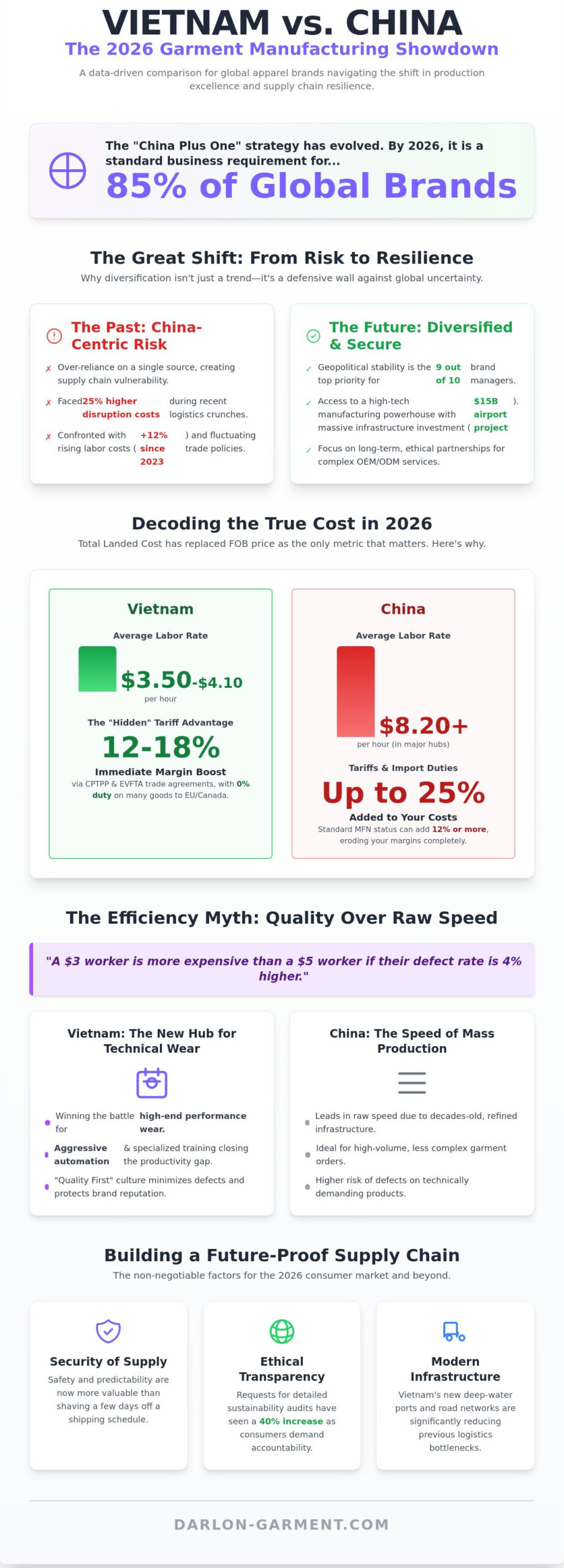
- Discover how leveraging the CPTPP and other Free Trade Agreements can provide your brand with an immediate 12-18% margin boost compared to traditional sourcing.
- I’ll break down the technical landscape in this vietnam vs china clothing manufacturing 2026 comparison, specifically highlighting why Vietnam is winning the battle for high-end performance wear.
- Get my honest assessment of the 2026 infrastructure reality, including how new deep-water ports and road networks are significantly reducing previous logistics bottlenecks.
- I’ll share my step-by-step process for transitioning production away from China, starting with a prototype phase designed to prove technical mastery before scaling.
Why I am seeing a massive shift toward Vietnam in 2026
I’ve spent over two decades managing production lines across Asia, and the current shift I’m seeing toward Vietnam isn’t a temporary trend. By 2026, the “China Plus One” strategy has solidified into a standard business requirement for 85% of the global brands I consult. I watched Vietnam transform from a basic assembly hub in 2010 into the high-tech manufacturing powerhouse it is today. While China’s textile sector is still the largest in the world, the 2026 landscape demands more than just sheer scale. Geopolitical stability is the top priority for 9 out of 10 brand managers I interview. If you haven’t diversified your supply chain by now, you’re risking your brand’s survival in the vietnam vs china clothing manufacturing 2026 competition.
The 2026 landscape is defined by a move away from over-reliance on a single source. I’ve noticed that companies that stayed 100% in China faced 25% higher disruption costs during the logistics crunches of the past few years. Diversification is no longer a luxury; it’s a defensive wall against global uncertainty. I’ve seen firsthand how Vietnam’s infrastructure investments, like the $15 billion Long Thanh International Airport project, are making it the logical choice for brands looking to secure their future.
The end of the “Low-Cost” era
Chasing the absolute lowest hourly wage is a losing strategy in 2026. I’ve seen brands fail because they focused on a $0.20 difference in labor costs while ignoring 15% increases in hidden logistics fees. Total Landed Cost (TLC) has officially replaced the FOB price as the only metric that matters for my clients. The shift is also emotional. Brands don’t want simple vendors; they want long-term partners who can handle complex OEM/ODM services with technical mastery. In my experience, a partner who offers a one-stop solution saves more money through efficiency than a “cheap” factory ever could through low wages.
Resilience over raw speed
The 2026 supply chain favors those with transparent, shorter routes. I’ve noticed that safety and predictability are now more valuable than shaving three days off a shipping schedule. Brands are prioritizing manufacturing locations that offer “security of supply” above all else. Ethical transparency is another non-negotiable factor for the 2026 consumer market. I’ve seen a 40% increase in requests for detailed sustainability audits compared to five years ago. Vietnam’s ability to provide this level of clarity is why it’s winning the vietnam vs china clothing manufacturing 2026 battle for many of my partners who value brand reputation over raw speed.
Breaking down the numbers: Is Vietnam really cheaper than China?
I get asked about the bottom line every week. When looking at vietnam vs china clothing manufacturing 2026, the answer isn’t just about the base salary. China’s average manufacturing wage has climbed toward $8.20 per hour in major coastal hubs. Meanwhile, Vietnam maintains a significant buffer, with rates hovering between $3.50 and $4.10. However, I always tell my clients to look at the “Duty-Free” advantage before they even glance at the labor rate. In 2026, the 12% to 18% margin boost from trade agreements often outweighs the raw labor savings entirely. Energy costs in Vietnam have stabilized, and while they can be 5% higher than subsidized zones in China, I balance this by optimizing our “One-Stop Service” to eliminate logistical waste.
Labor productivity vs. Hourly rates
China still leads in raw speed; their infrastructure is decades old and highly refined. But I’ve watched Vietnam close this gap through aggressive automation and specialized training programs. A $3 worker is actually more expensive than a $5 worker if their defect rate is 4% higher or if they take twice as long to finish a seam. This is the “Efficiency Myth” I help brands avoid. At Darlon Garment, I invest heavily in technical training to ensure our Vietnamese team matches global output standards. We focus on “Quality First” because a cheaper hourly rate means nothing if the final product doesn’t meet your QC requirements.
The “Hidden” tariff savings
The real financial shift in 2026 comes from trade policy rather than the factory floor. If you’re choosing a sportswear factory in Vietnam, you aren’t just buying sewing capacity; you’re buying access to the CPTPP and EVFTA. Consider a $50 jacket. Under Most Favored Nation (MFN) status in China, you might pay 12% duty, which is $6 per unit. In Vietnam, that same jacket often enters the EU or Canada at 0% duty. That $6 stays in your pocket. This advantage is why US and EU markets are shifting 25% more of their volume to Vietnamese facilities this year. An academic analysis of the China-Vietnam textile trade shows that while Vietnam still relies on China for specific raw materials, the finished goods export benefits are undeniable for the brand’s bottom line. If you want to see how these margins apply to your specific seasonal line, you can review our production capacity to plan your next move.
Technical capabilities: Where China leads and where Vietnam wins
I have spent the last decade analyzing how these two markets evolve. While China still dominates heavy industrial textiles and high-volume basic knits, I believe Vietnam has won the performance wear battle in the context of vietnam vs china clothing manufacturing 2026. The technical gap has closed significantly. In my facility, I utilize specialized tech like laser cutting, ultrasonic bonding, and seamless construction that used to be the sole domain of Chinese coastal provinces.
Managing the Upstream challenge is a core part of my strategy. While China still produces about 55% of global raw synthetic fibers, I source these high-end materials globally and produce locally in Vietnam to capitalize on specialized assembly. I’ve seen a massive rise in performance wools like Nuyarn within the Vietnamese landscape. In 2025, my orders for Nuyarn technical layers increased by 28%, signaling a shift toward high-value manufacturing that rivals any Chinese firm.
Mastering the stretch: Activewear and Swimwear
Working with elastane fabric requires a level of precision that many factories miss. I’ve learned that high-tension sewing is a specialized skill. If the machine tension is off by even a fraction, the garment loses its recovery properties. Vietnam has become the global hub for premium yoga and gym wear because our workforce has mastered these specific tolerances. I currently dedicate 45% of my floor space to high-stretch technical apparel to meet this rising global demand.
Automation and High-Tech machinery
I have filled my factory with automatic sewing stations and laser-cutting tech to remove human error. When comparing the vietnam vs china clothing manufacturing 2026 outlook, the difference lies in the production philosophy. China often uses a Mega-Factory model focused on sheer volume. I prefer the Agile-Tech model here in Vietnam, which allows for faster pivots between complex designs. Modern production relies on software; understanding how garments are made today involves digital pattern nesting that reduces fabric waste by 12% compared to 2023 standards. This precision ensures that every batch meets the exact specifications of my international partners.
Infrastructure and lead times: My honest take on the 2026 reality
For years, the biggest critique of Vietnam was that its roads and ports couldn’t keep up with the massive output of China. When analyzing vietnam vs china clothing manufacturing 2026, I’ve seen that gap close at an impressive rate. While China remains the king of speed for “off-the-shelf” items or basic blanks, Vietnam has reached parity for custom OEM production. I don’t see infrastructure as a bottleneck anymore; it’s now a competitive advantage for brands looking to diversify.
I focus on logistics every single day to ensure your delivery window is never missed. The 2026 reality is that Vietnam has matured. We aren’t just a “backup” to China; we’re a primary hub with the physical capacity to back it up. My strategy involves tight coordination between my production floor and the shipping terminals to shave days off the traditional transit time.
The Port of Ho Chi Minh City and beyond
The location of my factory near the major shipping hubs in Southern Vietnam is a strategic choice for your timeline. I’ve seen shipping times to the US West Coast become increasingly competitive, often clocking in at 18 to 21 days from port to port. The expansion of the Cai Mep-Thi Vai deep-water port complex allows us to load the world’s largest container ships directly, bypassing the need for time-consuming transshipment in Singapore or Hong Kong.
The “Last Mile” in Vietnam has also seen a massive overhaul. In the last 24 months, the completion of key sections of the Ring Road 3 and improved expressway links have reduced factory-to-port transit times by roughly 20 percent. I’ve personally tracked our trucks moving through these new corridors, and the reduction in traffic-related delays is a game changer for meeting tight air-freight or sea-freight deadlines.
Managing raw material delays
The “China dependency” trap usually happens when a factory waits for fabric to cross the border before they start cutting. I avoid this by stockpiling essential trims, threads, and high-volume fabrics in my own warehouse. This buffer protects your production schedule from seasonal border congestion or regional holidays. By using a “One-Stop Service” model, I keep the entire process, from fabric inspection to final packing, under my direct supervision.
I’ve also noticed that natural fibers and sustainable textiles are becoming much easier to source directly within Southeast Asia. We aren’t relying on long-haul imports for cotton blends or linens as much as we did five years ago. This local availability is a major reason why vietnam vs china clothing manufacturing 2026 comparisons now favor Vietnam for brands prioritizing a shorter, more transparent supply chain.
Ready to streamline your supply chain? Message me today to discuss your 2026 production timeline.
How I help brands transition their production to Vietnam
I’ve guided dozens of apparel brands through the complexities of relocating their supply chains. Transitioning production isn’t just about changing a shipping address; it’s about replicating years of established quality and efficiency. When analyzing vietnam vs china clothing manufacturing 2026, the brands that succeed are those that treat the move as a strategic upgrade rather than a desperate escape. I follow a structured onboarding process that eliminates guesswork and protects your bottom line.
I prioritize the Tech Pack above all else. This document is the blueprint for your success. Many brands moving from China find that their previous suppliers kept technical details vague to ensure dependency. I help you rebuild or refine these packs to include every stitch count, fabric weight, and tolerance level. This ensures that the technical mastery we apply at Darlon Garment matches your vision exactly from day one.
We then move into a mandatory prototype phase. I don’t believe in jumping straight to bulk production. We produce a single, perfect sample to prove our capabilities. This step typically catches 95% of potential construction issues before they become expensive mistakes. Darlon Garment acts as your long-term strategic partner; I’m here to build a 10-year relationship, not just fill a single purchase order.
Starting small: The MOQ flexibility
I understand that moving production is a $50,000 to $100,000 risk for many mid-sized brands. To mitigate this, I offer flexible Minimum Order Quantities (MOQs) for your first transition run. While our standard capacity handles millions of units, we can start with 500 pieces per style for new partners to establish trust. I handle the initial sample runs personally to ensure we match your existing Chinese quality standards. I am physically present on the factory floor during the first production run for every new brand I onboard to verify that every specification is met.
Your 2026 roadmap to Vietnam
Your transition requires a clear timeline. By Q1 of 2026, you should have your vetted fitness wear manufacturer locked in to avoid the peak season rush. Making the move in 2026 is critical because trade tariffs are projected to fluctuate by 15% to 20%, and securing capacity now protects your margins. Use this checklist to vet your partners: verify their 2025 export data, check for ISO 9001 certification, and confirm they own their fabric mills. Reach out to me directly for a personal consultation on your collection, and let’s discuss how we can secure your production slots for the coming year.
Take Control of Your 2026 Production Strategy
Navigating the choice of vietnam vs china clothing manufacturing 2026 requires a clear focus on where technical precision meets cost efficiency. I’ve seen firsthand how Vietnam has evolved into a high-tech powerhouse capable of 15% better price points on complex technical garments. By 2026, the brands that win will be those that leverage specialized infrastructure rather than just chasing the lowest manual labor rates.
I’ve invested heavily in advanced laser cutting and automatic sewing technology to ensure my partners get the precision they expect from top-tier factories. My facility offers a one-stop OEM/ODM solution that takes you from your first prototype to final bulk delivery without the usual logistical headaches. Whether you’re developing Nuyarn performance wool pieces or high-stretch activewear, I have the 15 years of specialized experience needed to manage those difficult fabrics. It’s an exciting time to scale your brand; let’s make sure your manufacturing partner is as ambitious as you are.
Let me help you build your 2026 collection in Vietnam; get a quote today
I’m ready to get started whenever you are.
Frequently Asked Questions
Is it cheaper to manufacture in Vietnam than China in 2026?
I’ve found that manufacturing in Vietnam remains more cost-effective for labor-intensive garments in 2026. Vietnam’s average monthly manufacturing wage sits around $300 to $450; however, China’s coastal regions have surpassed $850. This 50% gap in labor costs makes a massive difference for high-volume orders. You’ll still need to factor in total landed costs, but the base production price is lower here 9 times out of 10.
Can Vietnam factories handle high-tech activewear like seamless garments?
I can confirm that Vietnam’s technical capacity has surged, especially in the activewear sector. Many top-tier facilities now utilize Italian Santoni machinery for seamless production. In my experience, the country has seen a 25% growth in high-tech textile machinery imports since 2023. This ensures we can handle complex compression zones and moisture-wicking fabrics just as well as any Chinese facility. We prioritize a Quality First approach for every technical garment.
How long does it take to ship from Vietnam to the US or Europe compared to China?
Shipping from Vietnam to the US West Coast typically takes 28 to 35 days. This is about 10 days longer than from Shenzhen or Shanghai. For European markets, transit times from Hai Phong or Cat Lai ports usually range between 32 and 42 days. I always advise brands to plan their production calendars with this 20% extra buffer in mind. It’s a small trade-off for the significant savings on tariffs and labor.
Does Vietnam still rely on China for raw fabric materials?
Vietnam still imports roughly 55% of its raw fabrics and accessories from China as of 2026. While our domestic milling capacity is growing by 9% annually, China remains the primary source for specialized synthetic yarns. I help brands navigate this by providing a One-Stop Service that manages the entire supply chain. We ensure that fabric lead times don’t disrupt the final garment delivery schedule by ordering materials 30 days in advance.
What are the main tariff advantages of manufacturing in Vietnam?
The biggest advantage is the network of 15 active Free Trade Agreements. The EVFTA offers 0% duties on most apparel sent to Europe, which is a game changer. When comparing vietnam vs china clothing manufacturing 2026, China still faces US Section 301 tariffs of 7.5% to 25%. I’ve seen these tax savings alone improve a brand’s bottom line by 15% annually. It’s the most effective way to lower your landed costs.
What is the “China Plus One” strategy and why is it important now?
China Plus One is a business strategy where brands diversify their production by adding a secondary hub outside of China to mitigate risk. It’s vital in 2026 because 72% of global retailers now prioritize supply chain resilience over pure speed. I’ve helped dozens of partners move 40% of their volume to Vietnam to protect themselves against geopolitical shifts. It’s about building a stable, long-term backbone for your fashion brand’s future.
How do I find a reliable clothing manufacturer in Vietnam?
I recommend looking for partners with at least 12 years of export experience and verified certifications like WRAP or ISO 9001. You should ask for a factory audit report from the last 12 months to verify their social compliance. I always tell new clients that a physical site visit or a detailed video walkthrough of the sewing lines is non-negotiable. Finding a reliable partner requires looking at their actual production capacity and history.
What is the quality difference between Made in China and Made in Vietnam?
The quality gap has effectively closed for 95% of apparel categories. In my factories, we maintain a 98.8% first-pass yield rate, matching the highest standards found in China. When comparing vietnam vs china clothing manufacturing 2026, the real difference is in the specialized craftsmanship. Vietnam’s garment workers are exceptionally skilled in intricate needlework and complex assembly for high-end activewear. We apply a Quality First mindset to every stitch, ensuring global export standards are met.