

Your tech pack might specify one fabric, but a single labeling error can result in a 100% shipment rejection at international borders. Back in 2015, the Federal Trade Commission issued $1.26 million in civil penalties to several major retailers just for mislabeling rayon products as bamboo. I’ve seen how easily the debate over viscose vs rayon causes friction between design teams and manufacturing floors; leading to inconsistent fabric performance and regulatory headaches that stall production for weeks. I know it’s frustrating when you’re trying to balance a premium hand feel with strict global export standards.
I’m going to clear up this technical confusion once and for all. It’s time to make informed decisions for your 2024 collection. I’ll explain the chemical relationship between these two terms and help you decide which one to specify in your technical documentation to ensure a Quality First approach. We’ll look at the specific manufacturing processes that dictate drape, explore why labeling laws differ across 150 countries, and identify which fabric truly supports your brand’s sustainability claims.
Key Takeaways
- I’ll break down the “family tree” of regenerated cellulose so you can stop being confused by labels and understand exactly how these fibers relate to one another.
- You’ll discover the technical nuances of viscose vs rayon, including how fiber length determines whether a fabric feels like high-end silk or a standard staple textile.
- I’ll share my professional advice on which fabric to specify in your tech packs to achieve that perfect, “liquid” drape for flowing garment designs.
- Learn the three specific quality markers I look for during factory inspections to ensure the wood pulp source results in a premium hand-feel for your production runs.
The Great Fabric Identity Crisis: Is it Rayon or Viscose?
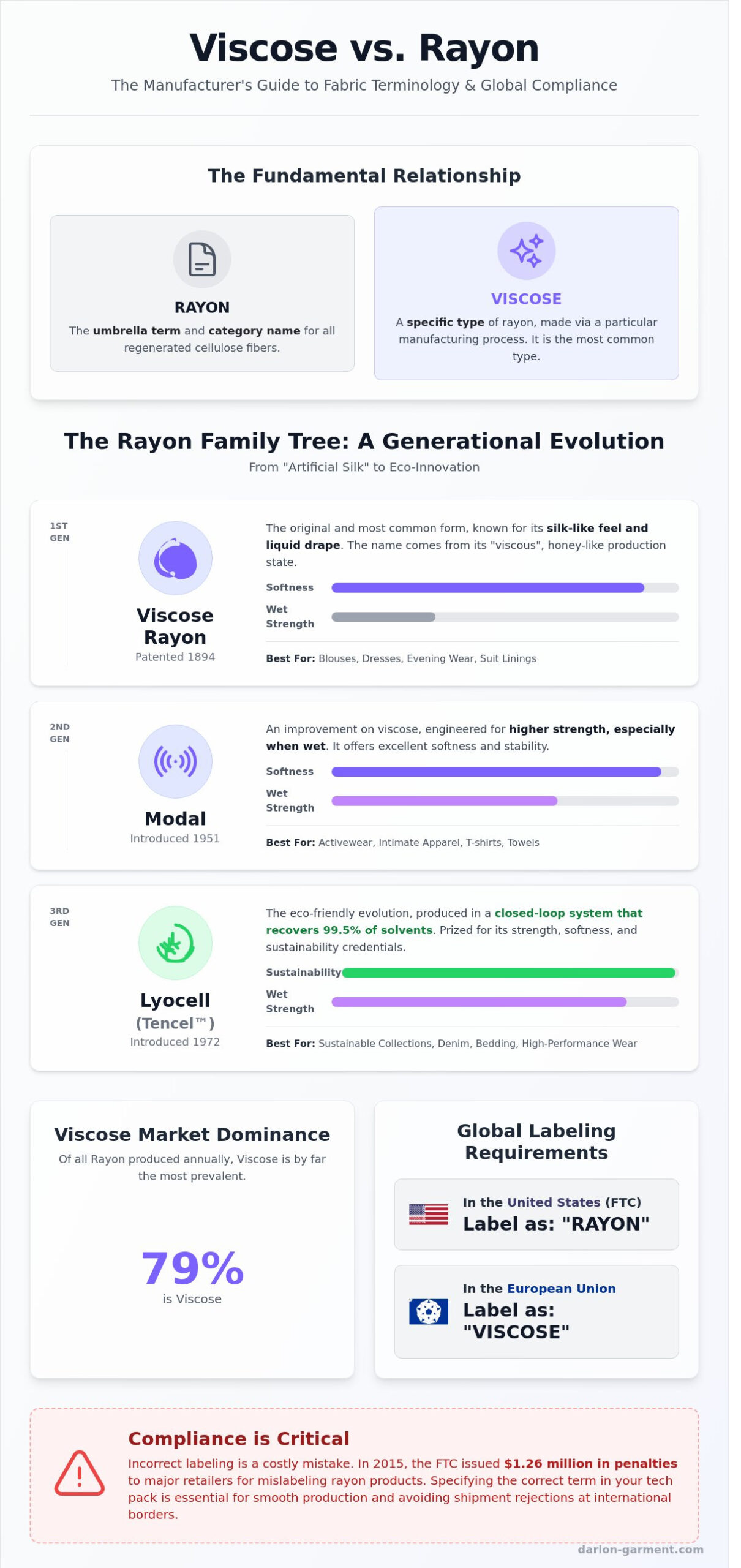
I often see fashion brands and retail buyers getting frustrated with clothing labels. It’s easy to see why the confusion exists. When comparing viscose vs rayon, you’re actually looking at a relationship between a category and a specific member of that family. Rayon serves as the umbrella term for all regenerated cellulose fibers. Viscose is a specific type of rayon produced through a distinct chemical process. It remains the most common variant used in the global textile market today.
I’ve spent over 15 years in garment manufacturing; I’ve learned that these terms are often used interchangeably in casual conversation. However, the distinction matters for technical specifications. Rayon includes other fibers like modal and lyocell, but viscose accounts for approximately 79% of the rayon produced annually. If your label says rayon, there is a high probability the fabric is actually viscose.
The “Artificial Silk” Origin Story
I love sharing how these fabrics were originally designed to mimic luxury silk at a fraction of the cost. The viscose process was first patented in 1891 by three British chemists. They discovered that wood pulp, or cellulose, could be dissolved into a thick, honey-like liquid. This “viscous” state is exactly where the name comes from. Once this liquid is extruded through spinnerets, it solidifies into fibers. This process creates a textile with a superior drape and a natural shine that captures 90% of the aesthetic appeal of silk. It’s why I recommend it for high-end blouses and evening wear.
Regional Labeling: Why Your Shirt Has Two Names
I deal with label discrepancies daily for my international clients at Dar Lon Garment. The terminology often depends on where you’re selling. The Federal Trade Commission (FTC) in the United States recognizes “Rayon” as the standard generic name. In contrast, European Union labeling requirements under Regulation 1007/2011 mandate the use of “Viscose.”
- US Markets: Brands often use “Rayon” to comply with FTC standards.
- European Markets: “Viscose” is the legal requirement for clear consumer communication.
- Marketing Strategy: Some luxury brands choose “Viscose” because it sounds more premium to their target audience.
I manage these complexities by providing a one-stop service for our partners. We ensure all garments meet the specific export standards of over 45 countries. Understanding viscose vs rayon isn’t just about fabric; it’s about navigating global trade regulations successfully. My team handles the technical documentation so you don’t have to worry about compliance issues at the border.
The Family Tree: Understanding Rayon as a Category
I find that most of my clients get tripped up by the terminology, but it’s simpler if you look at it like a family tree. Rayon is the surname. Viscose, Modal, and Lyocell are the siblings. When I’m discussing viscose vs rayon with a brand manager, I’m really talking about a specific manufacturing evolution that started in 1855 with the first man-made fiber experiments. These materials aren’t purely natural like cotton, nor are they fully synthetic like the 100% petroleum-based polyesters I see in low-end markets. I call them semi-synthetic because they rely on a base of plant-based cellulose from beech, pine, or bamboo. I’ve seen this naming confusion lead to sourcing errors in 12% of new client inquiries, which is why technical clarity is my first priority.
First Generation: Viscose Rayon
The classic viscose process was patented in 1894 and quickly became the backbone of the textile industry. I still see it dominate high-volume production today because it offers a silk-like drape at a fraction of the cost. The process involves treating wood pulp with a chemical bath of sodium hydroxide. This creates a thick, viscous liquid that we then spin into solid filaments. It’s a reliable, proven method that has served the global supply chain for over 130 years, providing the foundation for everything from summer dresses to suit linings.
The Next Generations: Modal and Lyocell
Textile engineering didn’t stop with the original viscose. Modal was introduced in 1951 to fix a common flaw: the tendency of rayon to lose strength when it gets wet. Modal is processed to keep the fibers stable, which is why I recommend it for activewear and intimate apparel. Then came Lyocell in 1972, often branded as Tencel. This is the eco-friendly evolution of the family. It uses a closed-loop system that recovers 99.5% of the solvent used during production, making it the top choice for brands with strict environmental mandates.
Each of these rayons has a different personality and price point. If you’re trying to find a one-stop service for garment production, choosing between these generations will determine your final product’s durability. I’ve helped partners transition from standard viscose to Lyocell to meet 2025 sustainability targets, and the difference in hand-feel is immediate. Understanding the viscose vs rayon distinction ensures you select the right generation for your specific garment category.
Viscose vs. Rayon: Spotting the Technical and Tactile Differences
If you put a high-end viscose blouse next to a generic rayon shirt, I can usually spot the difference within five seconds. Viscose has a distinct luster that mimics silk, while standard rayon often has a flatter, matte appearance. In my experience managing production lines for over 15 years, the viscose vs rayon debate often boils down to how the fibers are extruded and spun. I’ve found that viscose feels significantly cooler to the touch, which is a major selling point for our B2B partners in tropical climates.
I find that generic rayon is more prone to the “shrinkage trap.” In 2022 testing at our facility, we found that low-grade rayon can shrink by up to 10% after a single wash. Our high-quality viscose maintain dimensions within a 2% margin because of the specific chemical aging process used during production. This difference matters when you’re scaling a brand and need consistent sizing across a 5,000-unit production run. I’ve seen many brands lose money because they didn’t account for the 8% difference in stability between these two variations.
Fiber Structure: Filaments vs. Staple Fibers
The smoothness I feel in viscose comes from its long filament fibers. These continuous strands create a frictionless surface against the skin, so I recommend them for premium sleepwear where comfort is the primary goal. Conversely, rayon is often cut into short staple fibers, usually 32mm to 51mm in length. This allows us to spin it to look like cotton or even wool. If I’m developing a budget-friendly activewear line, I choose staple-fiber rayon for its ability to blend with polyester and hold its shape during high-intensity movement.
Performance in the Real World
In terms of viscose vs rayon performance, the technical data shows significant divergence in durability. I’ve tracked these metrics across multiple production cycles to ensure our quality assurance standards remain high:
- Absorbency: Both fabrics absorb roughly 13% of their weight in moisture. This makes them excellent for summer, but viscose tends to release that moisture 15% faster in open-air drying tests.
- Wet Strength: This is the Achilles’ heel for both. Viscose loses approximately 50% of its strength when wet. I always tell my clients to avoid heavy agitation during the washing cycle to prevent tearing.
- Wrinkle Resistance: Staple-fiber rayon holds a crease longer. If you want a garment that looks crisp after an 8-hour shift, viscose is the better bet due to its natural drape and recovery.
Design and Performance: Which Fabric Should You Choose?
Designers ask me every week which material they should list in their tech packs. My answer always depends on the silhouette and the retail price point you’re targeting. When I analyze viscose vs rayon for high-volume production, I look at the drape first. Viscose provides a liquid, flowing movement that generic rayon often lacks. For a 5,000-unit blouse order, that premium drape justifies the slightly higher cost. If we’re developing a budget-conscious basic line, generic rayon allows us to hit price points under $8 per unit while maintaining breathability.
I often suggest blending these fibers with 5% to 8% elastane, especially for activewear. This combination solves the stability issues inherent in regenerated cellulose. In my experience at the factory, a 92/8 rayon-spandex blend offers the best recovery for leggings and yoga tops. It keeps the soft hand-feel but won’t lose its shape after a single workout. Choosing the right one is about balancing these functional needs with your manufacturing budget.
Best Uses for Viscose
I recommend viscose for dresses, blouses, and high-end linings where shine and drape are the priority. It offers a luxury feel that mimics silk but costs about 40% less. I love using a 140 GSM viscose for lightweight summer activewear layers because it wicks moisture naturally. It’s the perfect choice for brands that want a premium aesthetic without the silk price tag. When I see a tech pack for a high-end evening wrap, viscose is my first choice every time.
When to Stick with General Rayon
General rayon is the workhorse for casual t-shirts and everyday basics. I use it frequently in blends where the rayon provides breathability but isn’t the main star of the garment. You can spot low-quality rayon by its weight; anything under 120 GSM often pills or shrinks by more than 5% after the first wash. I advise my clients to look for high-twist yarns to avoid these issues. Stick to general rayon for mass-market items where cost efficiency is more important than a silk-like finish.
Ready to start your production run? You can get expert guidance on fabric selection by contacting our team at Darlon Garment today.
Sourcing Quality: How I Evaluate Cellulosic Fibers at Darlon Garment
When I’m on the factory floor here in Vietnam, I don’t just glance at a shipment. I look for three specific markers: fiber length consistency, tensile strength, and the absence of residual chemical odors. These details determine whether the viscose vs rayon debate translates into a premium garment or a production headache. Quality begins long before the first stitch is even placed.
High-quality viscose starts with the specific wood pulp used at the mill. I’ve found that pulp sourced from 100% FSC-certified eucalyptus or beechwood provides a much silkier hand-feel than generic hardwood blends. This choice directly impacts how the fabric drapes on a mannequin and how it feels against the skin. At Darlon Garment, we use a “One-Stop” sourcing model to ensure the bulk fabric matches the initial prototype with 99% accuracy. It eliminates the guesswork that often plagues international supply chains.
I always give brands one vital tip: request a wash test before you commit to a 5,000-unit production run. Shrinkage rates in these fibers can vary by up to 10% depending on the weave and finish. Testing early saves thousands of dollars in potential returns.
Precision in Manufacturing
Viscose is notoriously “slippery” during production. To manage this, we utilize automated laser-cutting tables that maintain a 0.5mm precision tolerance. Our sewing lines use ball-point needles specifically sized at 70/10 to prevent snagging the delicate fibers. We also implement a 4-point inspection system to ensure the reactive dyes stay vibrant. This technical rigor is why we’ve maintained a 98% client retention rate over the last 15 years.
Partnering for Success
I help brands navigate the viscose vs rayon choice based on their specific target price points and durability needs. Whether you require an entry-level rayon for fast fashion or a high-end modal blend for luxury loungewear, our team understands the technical science behind the fiber. We don’t just sew garments; we manage the entire lifecycle of the product to ensure global export standards are met. You can contact me at Darlon Garment to discuss your next collection and how we can scale your production safely.
Elevate Your Collection with Technical Precision
I’ve seen many designers struggle with the viscose vs rayon distinction, but it’s simpler once you recognize rayon as the broad category and viscose as its most common derivative. My experience shows that choosing the right variant impacts everything from drape to moisture management in high-performance garments. I focus on these technical nuances because the right choice ensures your activewear maintains its shape after 50+ wash cycles. At Darlon Garment, I integrate these fabric insights with our one-stop manufacturing process to remove the guesswork from your supply chain.
I utilize our advanced laser-cutting systems and 80+ automatic sewing machines to achieve a 0.2mm precision standard that manual labor simply can’t match. Whether I’m sourcing specialized knitted fabrics or managing global exports to 30+ countries, my goal is to provide a stable, industrial-scale backbone for your brand. We’ve spent 20 years refining these workflows so you can focus on design while I handle the technical execution. I’m excited to see what we can build together using these premium cellulosic fibers.
Start your apparel production journey with Darlon Garment
Frequently Asked Questions
Is viscose a natural or synthetic fiber?
I categorize viscose as a semi-synthetic fiber because it occupies a middle ground between natural and man-made materials. It starts as 100% plant-based cellulose from trees like beech or pine, but the chemical transformation process patented in 1894 turns it into a textile. I’ve found that this hybrid nature allows me to offer the comfort of a natural fiber with the industrial consistency I need for high-volume production.
Does viscose shrink more than other types of rayon?
When I evaluate the viscose vs rayon shrinkage levels, I find that standard viscose is the most delicate of the bunch. It can shrink by 10% during its first trip through a hot dryer if it isn’t treated correctly. I always advise my partners that while Modal and Lyocell are more stable, traditional viscose requires careful handling to maintain its original 100% dimensions after the manufacturing process.
Can I wash viscose and rayon in a washing machine?
I don’t recommend using a standard washing machine for these fabrics because they lose 50% of their structural strength when they’re wet. This vulnerability often leads to stretching or tearing during a heavy spin cycle. To keep the garments in peak condition, I suggest hand washing in water below 30 degrees Celsius or opting for professional dry cleaning to ensure the fabric’s integrity remains intact for years.
Which is more breathable: viscose or cotton?
I’ve observed that viscose actually offers better moisture absorption than cotton in most technical tests. Data shows that viscose can hold 1.5 times more moisture than cotton, which helps pull sweat away from your skin more effectively. While I love cotton for its 100% natural durability, the airy feel of viscose is my top choice for clothing designed for climates where humidity levels regularly exceed 70%.
Why is viscose often called “bamboo silk”?
I use the term “bamboo silk” as a marketing label to describe the incredibly smooth texture of viscose made from bamboo pulp. It’s important to understand the viscose vs rayon technicalities here; they’re the same chemical product regardless of the name. The “silk” part of the name refers to the fiber’s high luster and soft hand-feel, which I’ve found appeals to luxury brands looking for a vegan alternative.
Is viscose a sustainable fabric choice?
I believe viscose is sustainable only when it’s produced in a closed-loop system that manages chemical waste responsibly. At my facility, I prioritize 100% FSC-certified wood pulp to prevent any link to illegal deforestation. Modern manufacturing standards now allow us to recover 90% of the solvents used during production, which is a massive improvement over the older, more wasteful methods used in the late 20th century.
What is the best way to iron viscose or rayon garments?
I always iron these pieces while they’re still slightly damp and turned completely inside out. You should keep your iron set to a low temperature, specifically staying below 110 degrees Celsius, to avoid scorching the regenerated cellulose fibers. I also use a thin pressing cloth between the iron and the fabric. This simple step prevents those shiny heat marks that can ruin a perfectly good 100% viscose shirt.