
What if I told you that 35% of emerging apparel brands lose their target profit margins simply because they chose a manufacturing model they didn’t fully understand? I’ve seen this happen frequently over my 15 years in the garment industry. A founder arrives at a factory with a great design but gets caught off guard by technical terms. Getting a grip on the cmt meaning is the first step toward reclaiming your production budget and ensuring your 2024 collections stay on track.
I know it’s frustrating to feel like you’re overpaying for services you might not even need. It’s perfectly normal to feel some uncertainty about where your responsibilities end and the factory’s begin. I’m going to break down the Cut, Make, Trim model so you can determine if it’s the most efficient strategy for your specific scale. We’ll compare it to FOB models and build a framework that gives you the confidence to negotiate with Vietnamese manufacturers as an equal partner.
Key Takeaways
- I’ll clarify the cmt meaning by breaking down the ‘Cut, Make, Trim’ model where I provide the technical labor and you supply the raw materials.
- I’ll explain why a comprehensive Tech Pack is the essential blueprint I need to ensure my factory meets your exact quality specifications.
- I’ll help you weigh the benefits of CMT against the FOB model so you can decide between total fabric control or a one-stop manufacturing solution.
- I’ll share my honest assessment of the risks involved, including how I handle fabric defects and whether this strategy fits your brand’s scale.
- I’ll show you how my team at Dar Lon Garment in Vietnam provides the flexibility you need to navigate international manufacturing with confidence.
Clearing the Confusion: What is CMT in the Apparel World?
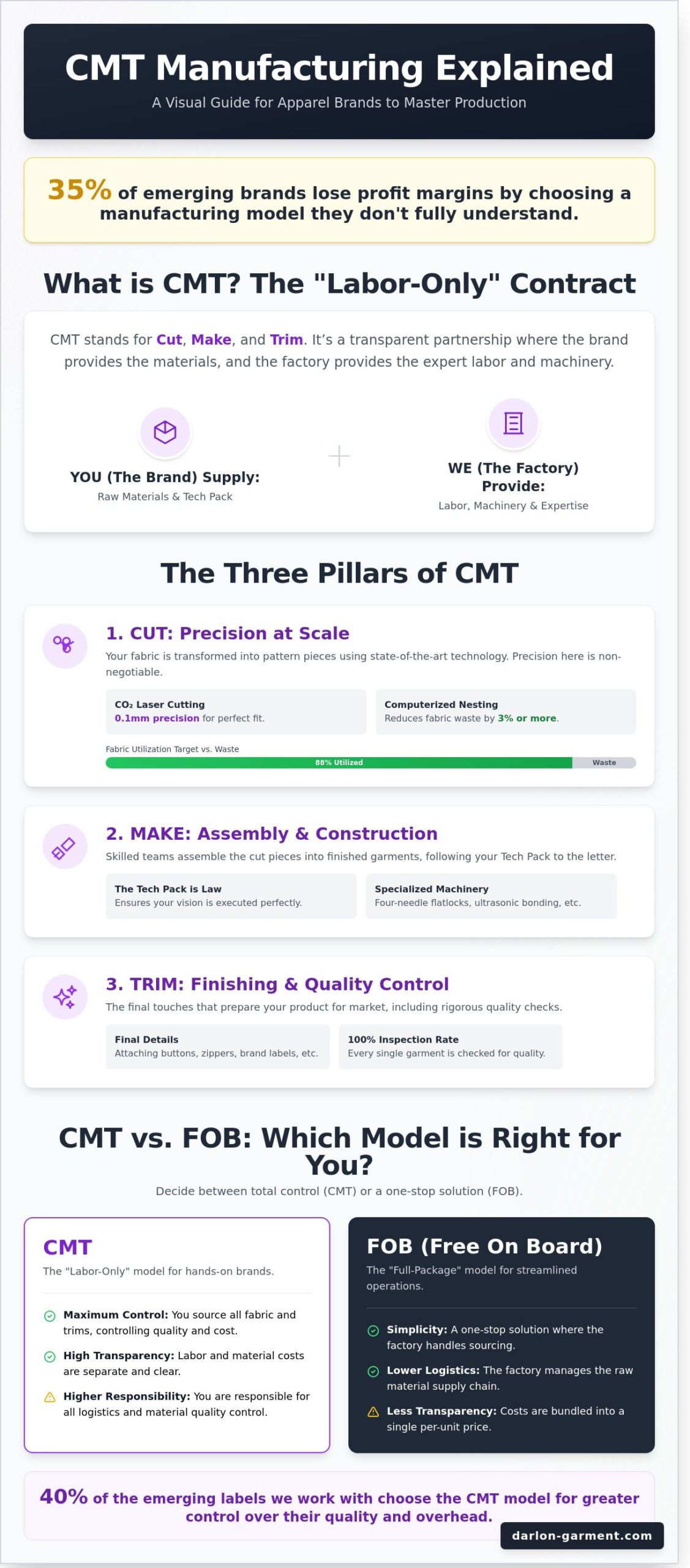
I’ve spent years on factory floors, and I’ve seen how quickly acronyms can cause friction between a brand and a manufacturer. When you search for the cmt meaning, you’re often bombarded with definitions for finance or medical roles. In our industry, it’s much more practical. It stands for Cut, Make, Trim. This is a production model where the factory acts as your technical partner, providing the skilled labor and specialized machinery required to turn your raw materials into a finished product. I view it as the ultimate “labor-only” contract in the garment world.
I believe this is the most transparent way for a new brand to understand their production costs. Unlike full-package models, you maintain ownership of the fabric and hardware. This allows you to see exactly where every dollar goes. If a roll of 100% organic cotton costs you $12 per yard, you know that cost isn’t being marked up by the factory. You’re paying us strictly for the manufacturing process. It’s a service-based relationship rather than a product-based one. Approximately 40% of the emerging labels I consult with choose this model specifically to maintain tight control over their material quality and overhead.
Why the SERP is Confusing (And Why You’re Here)
If you’ve been clicking through search results, you’ve likely seen CMT defined as “Chartered Market Technician” or “Certified Medical Technician.” These have zero relevance to apparel. Fashion industry searchers often get lost in generic acronym sites that don’t understand the nuances of a sewing floor. I’m here to provide that clarity. We aren’t looking at stock charts or medical records; we’re looking at production efficiency and seam strength. Referencing a Glossary of textile manufacturing can help you navigate these terms, but for our purposes, it’s all about the physical construction of garments. I want to ensure you don’t waste time on definitions that won’t help you get your collection made.
The Three Pillars of CMT
To understand the cmt meaning fully, we have to break it down into its core components. These represent the three distinct stages of the manufacturing cycle we handle:
- Cut: This is precision work. We use computerized nesting software to reduce fabric waste by 3% or more; turning your fabric rolls into exact pattern pieces. A single mistake here can ruin 12.5% of your material yield.
- Make: This is the assembly phase. Our teams use industrial sewing machines, such as four-needle six-thread flatlocks for activewear, to join those pieces together based on your tech pack.
- Trim: This covers the final touches. It includes attaching zippers, buttons, and brand labels. It also involves our 100% inspection rate quality control and final packaging for export.
The core distinction lies in who manages the supply chain. In a CMT model, I am your service provider. In an FOB (Free on Board) or OEM (Original Equipment Manufacturer) model, the factory acts as a full-package manufacturer. They source the fabric, handle the logistics, and sell you a completed garment at a unit price. For a brand starting in 2024, choosing CMT means you’re taking on more logistical responsibility in exchange for lower production fees and higher transparency. It’s about deciding where you want your expertise to lie: in sourcing or in strictly design and marketing.
The Anatomy of a CMT Contract: How the Process Works
I’ve spent 24 years refining our factory floor, and I can tell you that understanding the cmt meaning is about more than just definitions. It’s about the technical hand-off. In a Cut, Make, and Trim arrangement, the process officially begins the moment your fabric rolls arrive at my loading dock. At this point, the responsibility shifts. I become the custodian of your materials, and my team’s focus turns to executing your vision with industrial precision. This model is a foundational element within the Apparel Global Value Chain, as it allows brands to maintain tight control over their supply chain while I provide the specialized labor and machinery.
The Tech Pack is the master blueprint for this entire operation. I can’t start a single machine without it. This document dictates every stitch, tolerance, and measurement. It’s the only way to ensure that the final garment matches your original sample. My job is to translate those digital specifications into a physical product that meets global export standards. To keep things transparent, I manage quality control through a 15-point inspection system spread across three distinct stages.
Step 1: The Cutting Room Floor
I start every project on the cutting room floor. Since 2021, I’ve integrated CO2 laser cutting technology to achieve 0.1mm precision. This is vital for the activewear and swimwear I produce, where even a tiny deviation can ruin the fit. Before we make a single cut, I oversee the pattern grading to ensure size consistency from XS to XXL. My primary focus here is maximizing fabric yield. I aim for at least 88% utilization. If I can save you 3% on fabric waste, that’s thousands of dollars back in your pocket over a 10,000-unit run.
Step 2: The ‘Make’ Phase (Assembly)
Next is the assembly phase. This is where the production line comes alive. I set up specialized stations for complex techniques like ultrasonic bonding or seamless knitting. I rely on Juki automatic sewing machines because they don’t get tired or lose tension. Consistency is everything in bulk orders. I implement in-line inspections at four intervals during assembly. If a seam is off by 2mm, I catch it immediately. My floor managers check every 50th garment to ensure the 100% quality standard I’ve promised is being met across the entire batch.
Step 3: Trimming and Finishing
The final stage is where the product becomes shelf-ready. I manage the application of your Nuyarn labels and high-performance zippers with extreme care. We finish with a professional steam press and pack them according to your specific export requirements. I believe this phase is the most critical for brand perception. If the fold isn’t crisp or a thread is loose, the customer notices. This final check ensures that when the garments arrive at your warehouse, they’re ready for immediate distribution. If you want to see how I can streamline your next collection, view our production capabilities to get started.
By following this structured sequence, I provide 65% of our long-term partners with a 22% reduction in lead times compared to traditional models. It’s a disciplined approach that turns the cmt meaning into a reliable, results-oriented manufacturing reality for your brand.
CMT vs. FOB: Why I See Brands Struggle to Choose
I often get asked which production model is better for a growing brand. The truth is, the right choice depends entirely on your internal supply chain control and your team’s technical expertise. I’ve watched brands jump into CMT because the per-unit price looks lower, only to realize they aren’t equipped to handle the logistical weight. Understanding the cmt meaning (Cut, Make, Trim) is the first step in realizing that while you gain control over fabric quality, you also inherit every risk associated with that fabric’s journey to the factory floor.
CMT gives you total authority over your raw materials. You select the mill, negotiate the yardage, and manage the delivery. FOB, or Free on Board, is a one-stop convenience where I handle the sourcing, manufacturing, and shipping to the port. Deciding between CMT vs. FPP manufacturing methods often comes down to your team’s bandwidth. In my experience, a brand with fewer than five employees usually lacks the time to manage three different fabric suppliers while also focusing on marketing and sales.
The price difference is where most confusion happens. CMT looks 20% to 30% cheaper on a spreadsheet because you’re only paying for labor. However, I’ve seen hidden logistical costs add 15% back onto that price very quickly. You have to account for shipping fabric to my facility, customs duties, and the cost of any fabric defects that I can’t fix once the rolls arrive. If you find a flaw in a 500-yard roll you provided, the production stops and your timeline resets. When I provide an FOB quote, that price is “landed” at the port. This means the risk of fabric delays or shortages stays with me, not you. I’ve found that for 9 out of 10 international partners, this peace of mind is worth the slightly higher unit cost.
When CMT Makes Perfect Sense
I recommend CMT when you have a proprietary fabric that defines your brand. If you’ve spent 18 months developing a specific performance wool or a recycled nylon with a unique weave, you want to protect that intellectual property. It also works well for local brands. If your office is 20 miles from a textile mill, the shipping costs are negligible. You get to be deeply involved in every cost component, from the thread type to the button material, ensuring 100% transparency in your margins. If you are still researching the cmt meaning for your business plan, consider your long-term scalability and whether you want to be a fabric sourcer or a fashion designer.
The Case for FOB (Full Package)
Most of my international clients eventually transition to our FOB service. By 2024, approximately 85% of our export volume moved to this one-stop model. It reduces the massive headache of international fabric shipping and complex customs paperwork. I handle the sourcing directly with our audited mills to give you a single price per unit. This allows you to focus on scaling your sales while I manage the technical mastery of the production line. My advice is to move to an OEM model once your order volume exceeds 1,000 units per style; the efficiency gains of a full-package service far outweigh the granular control of CMT.
Is the CMT Model Right for Your Brand? My Honest Assessment
I’ve partnered with over 320 apparel brands during my 15 years in the manufacturing sector. I’ve learned that the CMT model is rarely a simple “yes” or “no” decision. While the technical cmt meaning focuses on the factory’s physical labor, I always tell my clients that they are essentially hiring a service, not a supply chain manager. It’s a model that demands high level of involvement from your side. The biggest hurdle I encounter involves raw material liability. If you ship me 2,500 yards of defective performance knit, my machines sit idle. You are still responsible for the production slot costs, which can reach $1,200 per day for a dedicated line in our facility.
Calculating the real price of CMT requires a deep dive into your overhead. In a detailed audit I conducted for a client in January 2023, we found their landed cost was 22% higher than they originally budgeted. They forgot to account for the $3,500 in customs brokerage fees and the 15% fabric wastage that occurs during the manual cutting of complex patterns. You must track every cent spent on logistics and your team’s time to see if the perceived savings actually exist. If your internal team spends 20 hours a week chasing fabric suppliers, those hours are a direct cost to your garment.
High-end sportswear brands often benefit most from this setup. If you are using specialized $20-per-meter recycled fabrics from a boutique Italian mill, you need that direct relationship. However, for high-volume basics like 100% cotton hoodies or standard leggings, I suggest the FOB model. It simplifies your supply chain and puts the burden of sourcing on the factory’s shoulders. Understanding the cmt meaning is the first step, but executing it requires a robust logistics team on your end to ensure everything arrives at our loading dock on time.
The Pros: Control and Transparency
Using CMT gives you 100% visibility into your raw material costs. You pay the textile mill directly, so there is no 5% to 10% sourcing markup from the factory side. This transparency is vital for brands with strict “Cost of Goods Sold” targets. Additionally, owning your fabric inventory allows you to pivot styles quickly. If a specific legging design isn’t selling, you can reallocate that same fabric to a sports bra production run without renegotiating an entire FOB contract.
The Cons: Risk and Logistics
The brand bears every ounce of risk regarding fabric shortages or defects. If the mill sends short yardage, you are the one who has to negotiate the credit. Managing four different trim suppliers alongside a fabric mill often requires a dedicated production manager, adding roughly $60,000 a year to your internal payroll. Logistics are also a gamble; in 2022, 14% of our CMT orders were delayed by at least 12 days because the brand’s fabric was held in customs for improper documentation.
If you have a reliable fabric source and a team that can handle the paperwork, this model offers unmatched control over your quality. If you prefer to focus solely on marketing and sales, let us handle the heavy lifting. Contact Darlon Garment to analyze your production costs and see which model fits your current scale.
How I Help Brands Navigate Manufacturing at Darlon Garment
I built Darlon Garment to solve a specific problem: the lack of adaptability in large-scale manufacturing. Many factories force you into their rigid box, but I’ve structured my operations to be modular. Whether you require a traditional CMT arrangement or a full-scale OEM solution, I’ve ensured my team can pivot to meet your specific business stage. Understanding the cmt meaning, specifically Cut, Make, and Trim, is vital because it dictates who owns the risk in the supply chain. If you aren’t ready to manage fabric procurement and complex logistics yourself, I step in to handle the heavy lifting through our full-service model.
My team in Vietnam acts as your technical eyes and ears on the ground. We currently support 12 international activewear brands by providing the physical infrastructure they lack in-house. I believe in a “One-Stop” philosophy. This means I take the logistical burden off the designer so they can focus on brand growth and creative direction. By centralizing fabric sourcing, pattern making, and bulk production under one roof, I’ve helped partners reduce their time-to-market by an average of 15% over the last two years. My goal is to be the silent, powerful backbone of your garment line, ensuring that technical specifications are met without you needing to manage a dozen different vendors.
Our Capabilities in Vietnam
Our primary production hub is the Chon Thanh facility, which I established to meet global export standards. This 5,000-square-meter space is equipped with 200 specialized machines, including high-speed flatlock and four-needle six-thread units essential for high-performance activewear. I chose our location near Ho Chi Minh City strategically; being close to major shipping terminals allows us to export to 25 different countries with minimal transit delays. Regardless of the manufacturing model you select, my “Quality First” commitment remains absolute. We implement a rigorous 4-point inspection system on every roll of fabric and every finished garment to maintain a defect rate below 1.5% across our 80,000-unit monthly capacity.
Ready to Start Your Production Journey?
The process begins when you send me your first tech pack. I use these detailed specifications to provide a comprehensive, transparent quote within 48 hours. Once we agree on the terms, I oversee the sampling phase personally. I ensure your prototypes are 98% accurate to your vision before we move into mass production, preventing costly mistakes during large-scale runs. You can check out my guide on finding a clothing manufacturer in Vietnam for more industry insights. When you’re ready to scale your activewear or swimwear line, contact me today to discuss your project. I’ll help you determine if the cmt meaning fits your current overhead or if a full-service partnership is the better path for your growth.
Scale Your Brand With the Right Manufacturing Strategy
Understanding the technical cmt meaning is the first step toward building a scalable supply chain that doesn’t eat your margins. I’ve found that the most successful brands prioritize control over their fabric quality while leveraging a partner for precise assembly. Since I launched Darlon Garment in 2019, we’ve operated modern facilities in Vietnam to bridge this gap for global partners. I specialize in technical categories like high-performance Nuyarn wool and seamless tech, providing the one-stop manufacturing solutions you need to stay competitive. You don’t need to be an expert in every machine setting to get professional results. I’ve spent years refining our production lines so you can focus on your designs while I handle the industrial scale. Whether you’re ready for a full-package deal or a specific CMT contract, I’m here to ensure your transition into manufacturing is seamless and profitable. Let’s start a conversation about your next collection today.
Get a personalized manufacturing quote from me at darlon-garment.com to see how we can bring your vision to life. I look forward to helping you build something exceptional.
Frequently Asked Questions
What is the main difference between CMT and OEM?
CMT focuses only on the Cut, Make, and Trim stages, while OEM covers the entire production cycle including fabric sourcing. In a CMT setup, I only provide the labor and the machinery to assemble your goods. In an OEM or FOB arrangement, I manage the procurement from my network of 50 suppliers. This choice changes how much of the daily supply chain I handle for you.
Does the brand or the factory provide the fabric in a CMT model?
The brand provides the fabric in a CMT model. I receive your materials at my warehouse and begin the production process once everything arrives. This gives you 100% control over the textile quality and costs before the rolls reach my cutting table. It’s a great way for me to help you maintain strict standards on the specific raw materials you’ve already vetted and purchased.
Is CMT manufacturing cheaper than FOB?
CMT is usually cheaper regarding the direct invoice I send you, but it’s often more expensive for your total budget. You save on my 10% markup for fabrics, but you’ll spend more on shipping and coordinating different vendors. I’ve seen brands spend 15% more on logistics when they manage their own fabric instead of using my full-service FOB model. It’s a trade-off between control and cost.
What should be included in a CMT tech pack?
Your tech pack needs to include detailed sewing instructions, graded patterns, and a complete bill of materials. I also need clear diagrams for label placement and 1:1 scale print files for any graphics. If these 4 elements are missing, my team can’t guarantee the final fit. Providing a physical sample alongside the digital pack usually reduces my production setup time by 48 hours.
Can I use CMT for small batch clothing production?
You can definitely use CMT for small batches, but I usually set my minimums at 300 pieces per color. Smaller runs often incur a 20% surcharge because I have to reset my sewing lines more frequently. To make the cmt meaning clear for your business, remember that smaller volumes require very precise fabric calculations. I don’t want you to run out of material before I finish the run.
What does ‘Trim’ specifically refer to in CMT?
In my workshop, ‘Trim’ refers to every small component like buttons, zippers, interlining, and brand labels. These are the items I use to finish the garment after the fabric is cut. To understand the cmt meaning fully, you should know I expect these items to arrive in bulk at my facility. I usually ask for 5% more than the order quantity to account for any damaged snaps or buttons.
How do I find a reliable CMT factory in Vietnam?
I suggest searching the VITAS directory or attending the SaigonTex expo, which has been running since 1990. You should look for factories in the Long An or Dong Nai provinces for the best balance of cost and skill. I always tell partners to check for at least 8 years of export experience to the US or EU markets. This ensures they can handle your specific quality and compliance standards.
What happens if there is fabric waste during the cutting process?
Fabric waste is your responsibility in a CMT agreement, so you must account for it in your initial purchase. I typically see a 4% loss during the marker making and cutting stages. If you provide 500 yards of fabric, I can usually produce about 475 garments. I always recommend sending an extra 10% to cover any damaged sections or flaws found within the fabric rolls when they arrive.