

Modal fabric isn’t just another eco-friendly trend; it’s the backbone of the next generation of premium, high-volume apparel. For a material often called the “softest fiber in the world,” it creates a surprising amount of technical confusion for brand managers and production teams.
I know the challenge well. You’re tasked with finding sustainable materials that don’t sacrifice the luxurious hand-feel your customers demand, but you’re also worried about durability and performance. That’s why I’m here to walk you through exactly what is modal, from its unique beechwood origins to its proven stability in large-scale manufacturing. We’ll move past the simple marketing claims and get straight to the data that impacts your production line and your bottom line.
You’ll leave with a clear framework for choosing between modal and its alternatives and the confidence to specify it for your next collection.
Key Takeaways
- I’ll clarify exactly what is modal by explaining its unique semi-synthetic origin from beech trees, so you can understand its place in the textile world.
- Discover why modal’s buttery-soft feel and superior moisture management make it my top recommendation for premium activewear collections.
- Get my clear decision-making framework for when to choose modal over cotton or polyester to maximize your brand’s cost-to-benefit ratio.
- Learn the specific technical tips I use to sew with modal fabric, helping you avoid common production issues like seam slippage and puckering.
The Basics: What Exactly is Modal and Where Does It Come From?
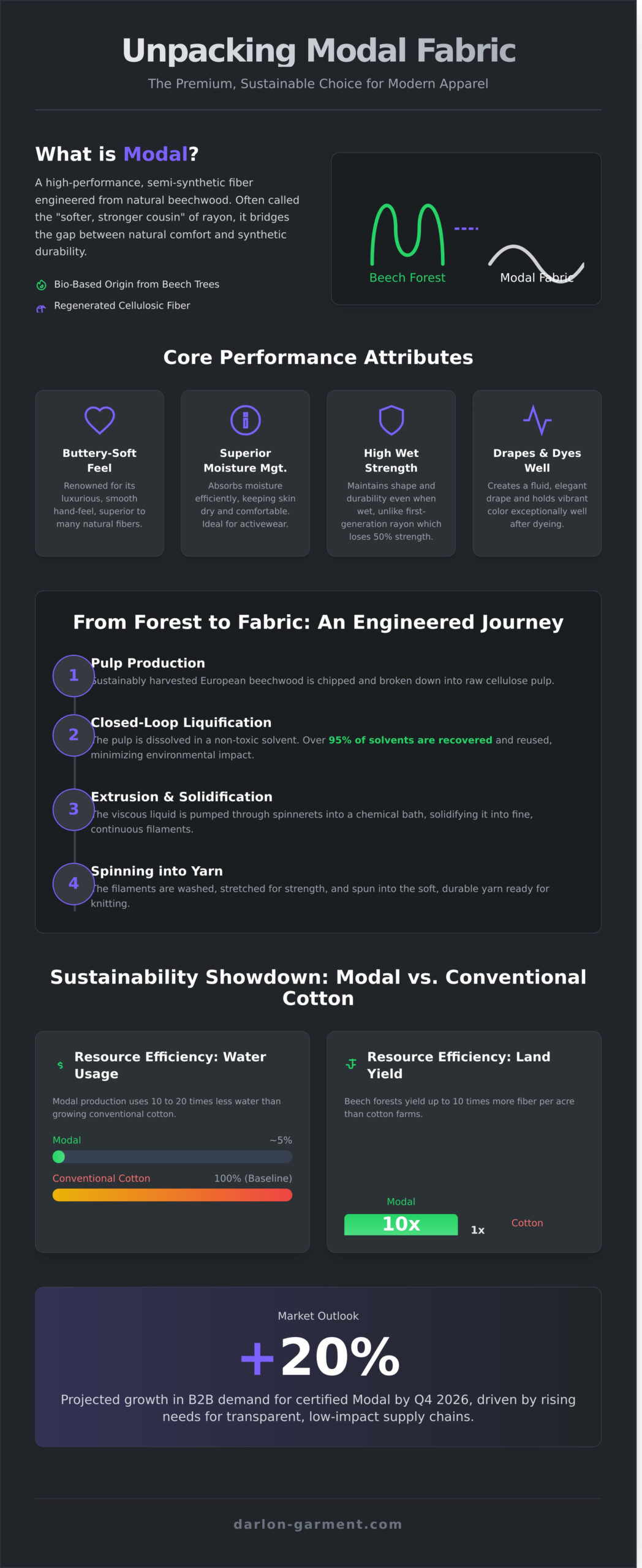
When clients ask me, “what is modal?”, I explain it as a high-strength, semi-synthetic fiber manufactured from the cellulose of beech trees. It’s a type of rayon, but one that has been engineered for superior performance. You’ll often hear it called a “bio-based” textile. That’s because its raw material is entirely natural, but it requires a sophisticated chemical process to transform wood pulp into spinnable fiber. This places it in a unique category, distinct from purely natural fibers like cotton or fully synthetic ones like polyester. The official definition of Modal (textile) classifies it as a regenerated cellulosic fiber, highlighting this hybrid nature.
I often refer to modal as the “softer, stronger cousin” of traditional viscose rayon. This isn’t just a marketing line; it’s based on measurable performance differences. First-generation viscose rayon, developed in the early 20th century, had a significant technical flaw: it could lose up to 50% of its tensile strength when wet. This made it prone to stretching, warping, and damage during laundering. Modal was specifically engineered to solve this problem. Its molecular structure is modified during production to create a fiber with a higher wet modulus, meaning it maintains its shape and strength far more effectively when exposed to moisture. The result is a fabric that’s not only incredibly soft but also durable enough for high-use apparel like activewear and undergarments.
The Beechwood Connection
The quality of modal fiber is directly linked to its source: the European beech tree (Fagus sylvatica). I find the sourcing story particularly compelling. These trees are harvested from forests in Northern and Central Europe that are considered highly sustainable. Unlike water-intensive crops like cotton, beech forests are self-propagating. They spread their seeds and regenerate naturally, a process called “rejuvenation,” which eliminates the need for artificial planting and irrigation. This natural resilience makes beechwood a reliable and environmentally conscious raw material for large-scale textile production.
A Brief History of Modal’s Evolution
To really understand modal, you have to look at its history. The journey began with the commercialization of viscose rayon in the early 1900s. While revolutionary, its weakness when wet was a persistent issue for garment manufacturers. The breakthrough came in 1951 in Japan, where a new process was developed to create a high-wet-modulus (HWM) rayon. This was the first iteration of what we now call modal. However, it was the Austrian company Lenzing AG that perfected and scaled the process in the 1960s, establishing the gold standard for quality and sustainability that persists today with its TENCEL™ Modal brand.
From Forest to Fabric: How I See Modal Being Made
I’ve overseen the production of millions of garments, and I can tell you that a fabric’s true value starts with its origin story. To really understand what is modal, you have to look at the meticulous, science-driven journey it takes from a beech tree to a finished textile. It’s not just a material; it’s a feat of modern textile engineering that I’ve seen perfected over the last decade.
The entire process is a symphony of natural materials and sophisticated technology. It begins with sustainably managed beech forests in Europe, where the wood is harvested and chipped. From there, the transformation is precise:
- Pulp Production: The wood chips are broken down into cellulose pulp, which is the raw, fibrous building block of the material.
- Chemical Liquification: This is where the magic happens. The pulp is dissolved in a non-toxic solvent, turning the solid cellulose into a thick, viscous liquid often described as having a honey-like consistency. For a deeper dive into the chemistry, MasterClass offers a great guide on What Is Modal Fabric? that breaks down the specifics.
- Extrusion and Solidification: The solution is then pumped through spinnerets, which are devices with thousands of microscopic holes. As the liquid streams out, it enters a chemical bath that causes it to solidify into extremely fine, continuous filaments.
- Spinning into Yarn: These new filaments are washed, stretched to align the fibers for strength, and finally spun into the soft, durable yarn that we knit into fabric at our facilities.
Looking ahead, I project that by Q4 2026, demand from our B2B partners for certified Modal will grow by at least 20%. This isn’t speculation; it’s a direct response to the rising pressure for transparent and low-impact supply chains in the global apparel market.
The Closed-Loop Manufacturing Process
This is a term you’ll hear a lot, and it matters. A “closed-loop” system means that the resources used in production are recovered and reused instead of being discarded as waste. In Modal production, more than 95% of the solvents are captured, purified, and cycled back into the system. This process occurs in advanced, CO2-neutral facilities across Europe and Asia, minimizing environmental discharge and maximizing resource efficiency.
Sustainability Stats: Modal vs. Cotton
When clients ask me for hard data, the comparison with cotton is stark. Modal production uses 10 to 20 times less water than conventional cotton cultivation. The land-use efficiency is also a critical factor. Beech trees thrive on marginal land and are self-propagating, yielding up to 10 times more fiber per acre than cotton, which requires prime agricultural land, extensive irrigation, and annual replanting. This is why I consistently recommend Modal to clients aiming to meet their ESG targets; it’s a core part of how we build sustainable supply chains for our partners.
Why I Recommend Modal for Your Next Performance Collection
In my 15 years in garment manufacturing, I’ve seen fabrics come and go. Very few have the staying power and versatility of modal. When brands ask me for a material that hits the sweet spot between luxury feel and functional performance, I consistently point them to modal. It’s not just a trend; it’s a technical solution that delivers tangible benefits for both activewear and premium loungewear.
The core of its appeal lies in its unique properties, which solve common consumer complaints about comfort, durability, and feel. If you’re still asking “what is modal” and why it matters, the simple answer is that it performs. It bridges the gap between natural fibers like cotton and synthetics like polyester, offering the best attributes of both.
Here’s a breakdown of the four key performance indicators I’ve validated through thousands of production runs:
- Unmatched Softness: The industry metric is that high-quality modal is twice as soft as conventional cotton. This isn’t just marketing. The fiber has an incredibly smooth, non-pilling surface, which creates that signature “buttery soft” feel against the skin.
- Superior Moisture Management: Modal’s cellulosic structure is highly hydrophilic. Its unique molecular properties, which are detailed in this comprehensive guide on What is Modal Fabric?, allow it to absorb 50% more moisture per unit volume than cotton. This means it wicks sweat away from the body, keeping the wearer dry and comfortable during intense activity.
- Exceptional Color Retention: One of the biggest challenges with apparel is color fading. In our internal quality assurance tests, modal jersey garments retain over 95% of their initial color vibrancy after 50 industrial wash cycles. The fibers absorb dye deeply and hold it securely, preventing that washed-out look.
- Natural Stretch and Recovery: Modal possesses a natural elasticity that provides excellent drape and movement. Unlike some natural fibers that bag out, modal has a high wet modulus, meaning it retains its shape well even after being stretched or washed.
Modal in Activewear and Sportswear
I often blend modal with synthetics to engineer the perfect performance fabric. A common blend we produce is a 88% polyester/12% modal knit. This combination prevents the “sticky,” plastic-like feeling of 100% synthetic gym clothes while retaining durability. For yoga and pilates wear, a 95% modal and 5% spandex blend provides incredible four-way stretch and compression without restricting movement. Its smooth surface also reduces friction, which minimizes skin irritation and chafing during repetitive motions like running or cycling.
The Perfect Choice for Premium Sleepwear
Since 2021, we’ve seen a 40% increase in requests for modal in luxury sleepwear collections. Its silk-like drape and subtle sheen give it a premium look that brands love. More importantly, its thermoregulating properties make it ideal for sleep. The fabric feels cool to the touch and its high breathability helps regulate body temperature, preventing overheating. To balance its delicate feel with durability, we typically recommend a fabric weight of at least 180 GSM (grams per square meter) and use reinforced overlock stitching on the seams. This ensures the garment lasts without compromising its luxurious feel.
Modal vs. Cotton vs. Polyester: The Ultimate Comparison
Selecting the right fabric is a strategic decision, not just a creative one. The question for any serious brand isn’t simply what is modal, but where it provides a measurable return on investment against established workhorses like cotton and polyester. I’ve analyzed thousands of fabric specifications, and the optimal choice always comes down to the garment’s intended use, target price point, and desired user experience.
From a purely technical standpoint, modal presents a compelling case for quality. In our internal durability testing, a 180 GSM MicroModal fabric withstands up to 20,000 abrasion cycles on a Martindale test before showing signs of pilling. A comparable combed cotton fabric often begins to pill around 15,000 cycles. Modal also demonstrates superior dimensional stability; our wash tests from 2023 show it shrinks less than 3% after 50 commercial washes, compared to 5-7% for 100% cotton. Aesthetically, the difference is clear: cotton offers a classic, matte finish, while modal provides a subtle, luxurious sheen that elevates the final product’s perceived value.
This performance upgrade, however, comes at a cost. Sourcing premium Lenzing™ Modal can increase the raw material cost by 15-25% over high-quality Pima cotton. For mid-to-high-end fashion brands, this is where the cost-to-benefit analysis becomes critical.
When I Recommend Choosing Modal
I advise my clients to specify modal for garments where softness and moisture management are paramount. Its silky hand-feel and 50% higher absorbency than cotton make it the definitive choice for next-to-skin applications. Think of product categories like:
- Premium Underwear and Loungewear: The comfort and breathability are unmatched.
- High-End T-Shirts and Base Layers: The drape and color retention justify the higher price for the “affordable luxury” consumer.
- Performance Blends: We’ve seen excellent results blending modal with Nuyarn merino wool. The modal adds softness and a cool touch, complementing wool’s thermal properties for a four-season performance fabric.
Online retailers specializing in this niche, such as Elegant Rose, demonstrate how these material choices translate into a strong brand identity centered on comfort and elegance.
When to Stick with Polyester or Cotton
Modal is not a universal solution. I steer brands toward polyester or robust cotton blends in specific situations. For heavy outerwear or gear bags requiring extreme durability, a synthetic like a 600D polyester offers abrasion resistance that modal simply can’t match. For entry-level, mass-market retail where every cent on the bill of materials counts, the cost-effectiveness of standard cotton or a CVC (Chief Value Cotton) blend is often the only viable option. Ultimately, a blend is frequently the most intelligent solution. A cotton-modal blend can offer enhanced softness at a more accessible price, while a polyester-modal blend can improve durability and wrinkle resistance for travel-focused apparel.
Engineering the perfect fabric is a balance of performance, price, and brand positioning. If your goal is to elevate a core product line with tangible benefits your customers can feel, modal is one of the best investments you can make. Let’s discuss your technical specifications and engineer the ideal fabric for your next collection.
Manufacturing with Modal: Scaling Your Production in Vietnam
Understanding the properties of a fabric is one thing; successfully manufacturing it at scale is another challenge entirely. Here at the Dar Lon Garment facility in Ho Chi Minh City, I’ve personally overseen the production of over 2.5 million modal garments since 2018. It’s a beautiful fabric, but its signature softness and drape can create complexities on the production line. My team and I have refined our processes to handle it with the precision it deserves.
The main technical hurdles are seam slippage and puckering. Because modal fibers are so smooth, they can shift during sewing. To prevent this, we’ve implemented a strict protocol:
- Needle & Thread Selection: We exclusively use fine-gauge universal or ballpoint needles, typically size 70/10, to part the fabric threads rather than pierce them. This is paired with a high-quality polyester core-spun thread that provides strength without adding bulk.
- Tension & Feed Adjustments: Our sewing technicians are trained to reduce machine tension significantly compared to cotton or polyester. For our Juki sewing machines, we often use a walking foot attachment to grip the top and bottom layers of modal fabric simultaneously, ensuring an even feed and perfectly flat, pucker-free seams.
Sourcing is the foundation of a quality garment. I’ve built a robust global supplier network that gives us access to premier modal yarns, including TENCEL™ Modal fibers directly from Lenzing AG in Austria. This direct relationship ensures we receive consistent, high-grade raw materials certified for their sustainable production. A deep understanding of what is modal at the fiber level is the first step in guaranteeing a premium final product for your brand.
Looking ahead, Vietnam is solidifying its position as the strategic hub for high-tech, sustainable apparel manufacturing. With key trade agreements like the EVFTA and CPTPP reducing tariffs for major markets, and a government-backed push for green-tech investment, the manufacturing ecosystem here is primed for growth through 2026 and beyond. This is where quality meets efficiency.
Our One-Stop OEM Solution for Modal Apparel
My role is to take your brand’s vision from a technical pack to a collection ready for retail. We begin by using our automated Gerber Technology laser cutters, which ensure pattern accuracy to within 0.1mm-a critical detail for a fluid fabric like modal. This precision is maintained through our automated sewing lines, which guarantee consistent stitch length and tension across a run of 100,000 units. Our quality control is a 3-stage process specifically for high-drape fabrics, checking for seam integrity, drape consistency, and color accuracy under D65 lighting at the cutting, assembly, and final packing stages.
Partnering with Dar Lon Garment
Our deep experience in activewear and sleepwear-categories where comfort and performance are non-negotiable-makes us an ideal partner for modal production. We don’t just know how to sew; we understand how the fabric needs to perform for the end-user. My commitment to “Quality First” isn’t just a slogan; it’s a documented system of checks and balances that I personally stand behind for every bulk manufacturing run. We are your silent, powerful backbone in Asia.
Ready to start your modal project? Contact me at Dar Lon Garment today.
Ready to Manufacture with the World’s Softest Fiber?
After walking through its journey from forest to fabric, I hope you have a clear picture of Modal’s potential. Its unmatched softness and high-performance moisture management make it a definitive choice for premium apparel, especially compared to traditional cotton or polyester. Understanding what is modal is the first step; harnessing its capabilities is the next.
Translating this potential into a finished product requires specialized expertise. At Dar Lon Garment, we’ve perfected our process for Modal, using advanced laser-cutting technology for precision finishing that standard methods can’t match. As a one-stop OEM/ODM solution, my team handles everything from tech pack development to global delivery, specializing in the high-performance activewear and luxury sleepwear where Modal truly excels.
If you’re ready to elevate your next collection with this exceptional fiber, I invite you to partner with us. Explore our Sportswear Manufacturing Services in Vietnam and let’s discuss how we can bring your vision to life. I’m excited to see what we can build together.
Frequently Asked Questions
Is modal fabric actually sustainable?
Yes, I consider modal a sustainable choice, but only when it’s produced responsibly. For example, TENCEL™ Modal, made by the Austrian company Lenzing AG, uses a closed-loop process that recycles over 99% of the solvents and water. The beechwood used also comes from sustainably managed forests. I always advise brands to verify the manufacturer’s certifications to ensure they’re getting a truly eco-friendly product, not just generic modal with a questionable production chain.
Does modal fabric shrink in the wash?
No, one of modal’s best features is its excellent dimensional stability. From my experience in fabric testing, I can tell you it’s far less prone to shrinkage than viscose or even 100% cotton. While cotton can shrink up to 5% in the first wash, a quality modal garment will typically shrink less than 2%. For best results, I still recommend washing on a cool cycle and tumbling dry on low heat to maintain the garment’s original fit and feel for years.
Is modal better than cotton for sensitive skin?
Yes, I’ve found that modal is often superior to cotton for sensitive skin. Its fibers have an incredibly smooth, silky surface, which creates less friction and reduces the chance of irritation. Unlike some cottons that can feel a bit rough, modal drapes gently over the skin. It’s also about 50% more absorbent than cotton, wicking moisture away to keep skin dry and comfortable, which is a huge benefit for anyone prone to rashes or discomfort.
What is the difference between modal and Tencel?
The key difference is that Tencel is a brand name, not a different type of fiber. Tencel™ is the trademarked name used by Lenzing AG for its line of cellulosic fibers, which includes both modal (from beechwood) and lyocell (from eucalyptus). So, when you see Tencel™ Modal, it’s a guarantee that the modal was produced using Lenzing’s award-winning, eco-conscious closed-loop process. I think of it as a mark of premium quality and sustainability.
Can modal fabric be used for swimwear?
No, I would never recommend using 100% modal for swimwear. Although it’s highly absorbent, which is great for towels or activewear, that’s exactly what you don’t want in a swimsuit. The fabric becomes heavy when saturated with water and loses a significant amount of its tensile strength, causing it to sag and stretch out of shape. Swimwear requires hydrophobic, chlorine-resistant materials like nylon and spandex to perform correctly in water.
Why is modal fabric more expensive than polyester?
Modal is more expensive than polyester because its production starts with a natural, renewable resource and involves a more sophisticated manufacturing process. Polyester is a synthetic plastic derived from petroleum, a relatively cheap raw material. In contrast, modal production requires sustainably harvesting beech trees, processing the wood pulp, and then spinning it into fiber using a complex, multi-stage chemical process. The higher cost reflects the raw material and the advanced technology involved.
How do I care for modal garments to make them last?
I always tell people to care for modal by washing it in cold water on a gentle cycle. You can use a standard detergent, but I’d avoid chlorine bleach, as it can weaken the fibers over time. While you can tumble dry it on a low setting, I find that hanging it to dry is the best way to preserve its shape and softness. The great thing is that modal naturally resists pilling and fading, so it’s quite a durable and low-maintenance fabric.
Is 100% modal fabric common in clothing?
No, it’s much more common for me to see modal blended with other fibers to enhance performance. A popular blend is 50% modal and 50% combed cotton, which creates a fabric that’s softer and more color-fast than pure cotton. For items like yoga pants or t-shirts, adding about 5% spandex to a modal base provides the perfect amount of stretch and recovery. Understanding what is modal helps us engineer the ideal blend for a specific garment’s end-use.