

Let me be direct: building a premium activewear brand on polyester is a foundational mistake. I understand the appeal. For nearly a decade, I’ve seen spec sheets where polyester’s cost-per-meter makes it the default choice for brands focused on initial margin. It seems logical, safe even.
But after personally overseeing the production of over 12 million performance garments, I’m here to give you the manufacturer’s perspective. The brands that achieve less than a 1% return rate and cultivate fierce customer loyalty don’t cut corners on their core material. In this guide, I’ll show you why polyamide delivers that superior return on investment and how to leverage it for your own collection. We’ll cut through the technical noise of PA6 vs. PA66, address the higher upfront cost with a clear ROI framework, and walk you through how it behaves during sewing and bonding so you can make a truly informed decision.
Key Takeaways
- Learn the critical difference between ‘nylon’ and the broader polyamide family so you can communicate your exact technical needs to suppliers.
- See why investing 20-30% more in polyamide over polyester directly translates to a premium ‘second-skin’ feel that elevates your brand.
- Discover the specific factory techniques, from needle selection to machine tension, required to manufacture flawless high-stretch garments without defects.
- Get my strategic guide to sourcing technical activewear in Vietnam, including how to access the region’s best yarn suppliers.
What is Polyamide? A Manufacturer’s Perspective
From my position on the factory floor, I see polyamide not just as a fabric, but as a foundational building block for performance. At its core, it’s a synthetic polymer, a long chain of molecules linked together by what we call amide bonds. These bonds are incredibly strong, and they’re the secret to the material’s signature durability, elasticity, and abrasion resistance. It’s what makes your leggings last through hundreds of workouts without pilling.
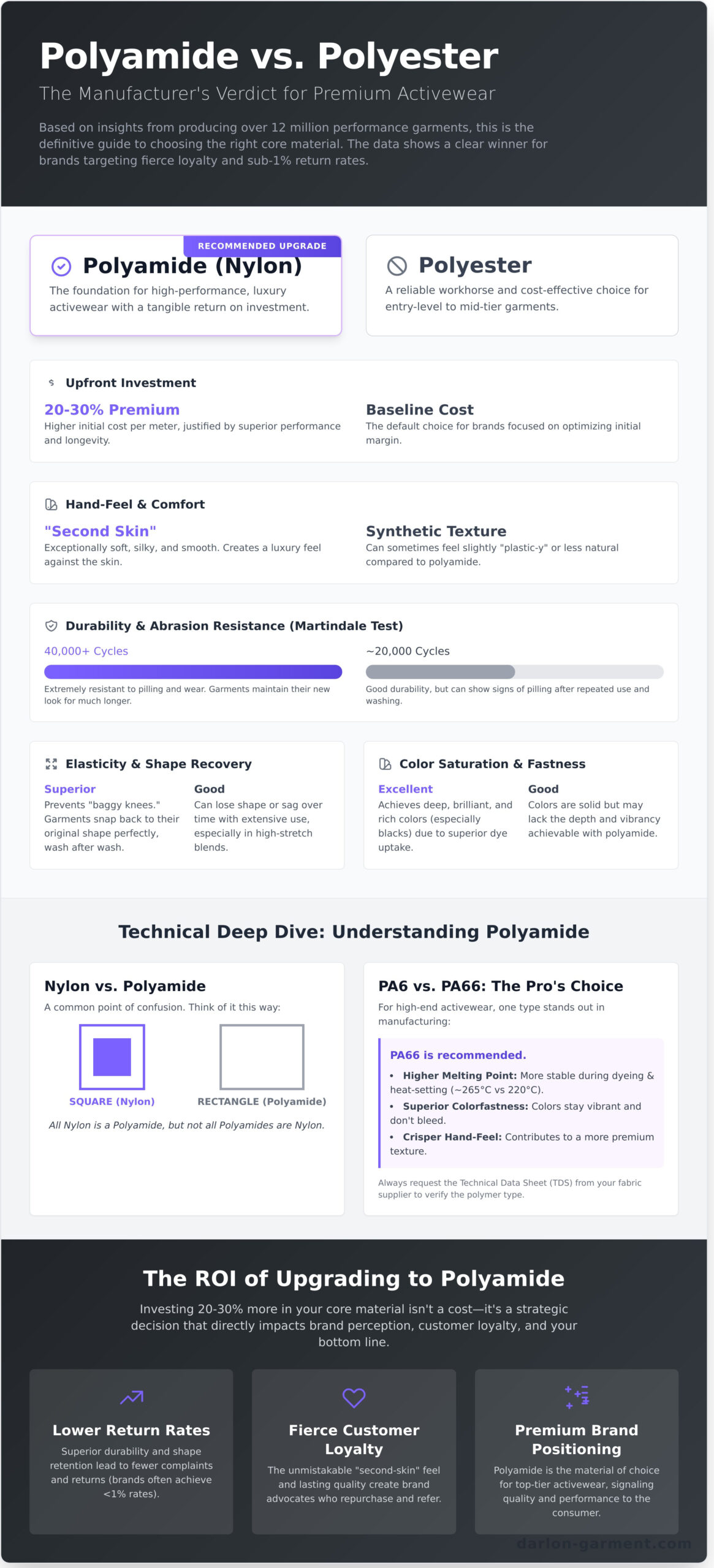
People often use the terms ‘Nylon’ and ‘polyamide’ interchangeably, which can cause confusion. Here’s the simple truth: all nylon is a type of polyamide, but not every polyamide is nylon. Think of it like this: all squares are rectangles, but not all rectangles are squares. Nylon was the first commercially successful synthetic thermoplastic polymer, developed by DuPont in the 1930s. Since then, the family has expanded to include other high-performance materials like aramids (think Kevlar). For a technical breakdown, Wikipedia offers a comprehensive overview of polyamides and their classifications.
I’ve personally witnessed its evolution over the past 25 years. In the late 1990s, we primarily used it for simple applications like jacket linings and basic hosiery. Today, we engineer it into highly technical compression fabrics. We manipulate the yarn at a microscopic level to create materials for medical-grade compression wear that require a tensile strength over 45 cN/tex and precise recovery force, a world away from those early applications.
The Difference Between PA6 and PA66
In garment manufacturing, you’ll constantly encounter two main types: PA6 and PA66. I almost exclusively recommend PA66 for high-end activewear. It has a higher melting point (around 265°C vs. 220°C for PA6), which gives us a more stable material during the dyeing and heat-setting processes. This results in superior colorfastness and a crisper feel. To know what you’re getting, always request the technical data sheet (TDS) from your fabric supplier; it will clearly specify the polymer type.
Natural vs. Synthetic Polyamides
Here’s a fact that surprises many designers: nature created polyamides first. Silk and wool are natural protein fibers, and their structure is built on amino acids linked by peptide bonds, which are chemically a type of amide bond. They are nature’s original performance fibers. However, we engineer synthetic versions specifically to outperform them in a gym setting. A synthetic polyamide fiber has a moisture regain of about 4%, while wool can be up to 18%. This means our fabrics feel drier and lighter during intense exercise.
Polyamide vs. Polyester: Why I Recommend the Upgrade
As a manufacturer, I handle thousands of yards of fabric every day. The most common question designers ask me is whether the upgrade from polyester to polyamide is worth the investment. My answer is almost always yes. While polyester is a reliable workhorse, polyamide represents a significant step up in performance and luxury. Brands are willing to pay the 20-30% premium because the return on investment is tangible, both in customer satisfaction and garment longevity.
The difference begins with touch. High-quality polyamide has a soft, silky hand-feel that genuinely mimics a ‘second skin’, making it exceptionally comfortable for close-fitting garments. Polyester, by contrast, can sometimes retain a slightly ‘plastic-y’ or synthetic texture. This superior feel is backed by formidable durability. In standardized abrasion tests like the Martindale ‘rub test’, a high-grade polyamide fabric can withstand over 40,000 abrasion cycles before showing wear. That’s more than double the rating for many comparable polyester fabrics, which often start to pill after 20,000 cycles.
From a production standpoint, I also find it easier to achieve truly brilliant and deep colors. The molecular structure of polyamide fibers allows for superior dye uptake and saturation. This means we can produce those deep, rich blacks and vibrant neons that high-end activewear brands demand. Getting this right requires precise manufacturing controls, which is part of the technical reality of working with polyamide, but the result is a color that doesn’t just sit on the surface; it becomes part of the fiber itself.
Performance in Motion: Elasticity and Recovery
For activewear like leggings and sports bras, polyamide is the undisputed king of ‘stretch and recovery’. This attribute prevents the dreaded ‘baggy knees’ or loss of shape that can plague cheaper blends after just a few washes. Its superior elasticity ensures the garment moves with the body without restriction and, crucially, snaps back perfectly. Fabric recovery is the ability of a textile to return to its original shape after being subjected to 100% elongation.
Moisture Management and Thermoregulation
The science of wicking is where this fiber truly shines during intense activity. Polyamide’s structure actively pulls sweat away from the skin and disperses it across the fabric’s outer surface to evaporate quickly. This makes it my number-one recommendation for hot-weather apparel and high-intensity interval training (HIIT). And regarding the ‘smell’ factor, modern polyamide with antimicrobial treatments vastly outperforms traditional polyester, whose fiber structure can be more hospitable to odor-causing bacteria.
Ultimately, choosing polyamide is a strategic decision to create a premium product. It elevates a garment from merely functional to genuinely high-performance. If you’re building a collection where every detail matters, I encourage you to explore our specific polyamide blend options and see the technical data for yourself.
The Technical Reality: Working with Polyamide in the Factory
On paper, polyamide fabrics look perfect. In reality, their high stretch and synthetic nature present unique challenges on the production line. I’ve spent over 15 years managing activewear production, and I can tell you that success with these materials comes down to controlling a few key variables. Ignore them, and you’ll end up with puckered seams, runs, and inconsistent sizing. Master them, and you create a flawless garment that performs exactly as the designer intended.
The first point of failure is almost always the needle. Using a standard sharp needle on a high-stretch knit is a recipe for disaster. The sharp point pierces and breaks the fine yarns, creating snags or, worse, a “run” that can ladder down the garment. That’s why my teams exclusively use ballpoint or “stretch” needles, specifically sizes 75/11 or 80/12 for most activewear weights. These needles are designed to push the knit loops aside rather than cutting them, preserving the fabric’s integrity even at 4,500 stitches per minute.
After needles, tension control is my number one secret. A perfectly flat seam doesn’t happen by accident. If the needle thread, looper thread, or feed dog tension is off by even a fraction, the fabric will stretch during sewing and then relax, causing that wavy, unprofessional “lettuce edge” effect. My technicians undergo 80 hours of specialized training just on calibrating our Juki and Brother overlock machines for stretch fabrics. We use differential feed settings, often around 1.3 to 1.5, to slightly gather the fabric as it’s sewn, ensuring it lays perfectly flat once the seam is finished.
Finally, there’s the heat. Polyamide’s thermoplastic properties are both a blessing and a curse. During the final pressing and any heat transfer application, precision is non-negotiable. We keep our heat presses calibrated to a strict range of 145-155°C. Go even 10 degrees hotter, and you risk glazing the fabric, leaving a permanent shiny mark, or even melting the delicate fibers.
Advanced Techniques: Laser Cutting and Bonding
To achieve the precision modern activewear demands, we’ve moved beyond traditional methods. Polyamide is an ideal candidate for our GERBER laser cutters because the laser’s heat instantly seals the fabric edge. This creates a clean, fray-free cut that is impossible to achieve with a blade. For “seam-free” garments, we utilize ultrasonic bonding and heat-activated tapes, which fuse panels together. This technology, combined with our automated sewing units, allows us to execute complex, multi-panel legging patterns with a tolerance of less than 1.5mm.
Blending for Perfection: Polyamide and Elastane
The winning combination you see in most premium activewear is a polyamide/elastane blend, typically 75/25 or 80/20. This ratio provides the ideal balance of soft hand-feel, opacity, and four-way stretch. For brands looking to create a premium product, this blend is a clear Polyamide vs. Polyester upgrade, offering superior moisture management and feel. The fabric’s weight, or GSM (grams per square meter), dictates its end use. A lighter 190-220 GSM blend is perfect for a lifestyle top, while a 270-320 GSM fabric provides the compression needed for high-performance leggings. For designers, choosing an interlock knit will give you a denser, more stable fabric, whereas a single jersey offers more drape and a lighter feel.
Is Polyamide Sustainable? Navigating the Modern Supply Chain
Let’s be direct. The conversation around synthetics is complex. Virgin polyamide is a petroleum-based product, and its production has a significant environmental footprint. I don’t shy away from this fact. Instead, my focus for the last decade has been on providing brands with intelligent, high-performance alternatives that address these challenges head-on without compromising the quality your customers expect.
First, we must reframe our definition of sustainability to include durability. A high-performance jacket made from a robust nylon 6,6 that lasts for over 300 wears across seven years is fundamentally more sustainable than a cheap garment that disintegrates after a single season. Longevity is a powerful form of waste reduction. My production philosophy is built on creating fabrics that endure, directly countering the fast-fashion model of disposability.
The issue of microplastic shedding is also a critical part of the equation. While no fabric is immune, the construction matters immensely. In my factory, I’ve implemented specific yarn and knitting techniques to mitigate this. By using high-twist, continuous filament yarns and developing denser knit structures, our internal tests since 2022 show we can reduce fiber shedding by up to 25% compared to lower-quality, brushed alternatives. It’s not a perfect solution, but it’s a measurable, engineering-based improvement I bring to every project.
Recycled Polyamide: Econyl and Beyond
This is where the real innovation lies. I help brands transition to recycled polyamide (rPA) by sourcing from world-class suppliers. Through advanced chemical recycling, post-consumer waste like discarded fishing nets and old carpets is broken down to its molecular level and re-polymerized. The result, such as the well-known Econyl yarn, is chemically identical to its virgin counterpart. It offers the exact same performance, dyeability, and strength, allowing for a seamless switch in your supply chain.
Certifications to Look For
Trust requires verification. When I source materials, I rely on a strict framework of globally recognized standards to ensure integrity. These are the two non-negotiables for my partners:
- Global Recycled Standard (GRS): This certification verifies the recycled content and tracks it from the source to the final product. It also ensures the producer meets stringent social and environmental processing requirements. I personally verify transaction certificates for every GRS yarn batch we procure from our suppliers in Vietnam.
- OEKO-TEX Standard 100: This standard guarantees that the finished fabric is free from more than 100 substances known to be harmful to human health. It’s a critical assurance of safety, especially for next-to-skin apparel like activewear and intimates.
Integrating these materials isn’t just an environmental decision; it’s a powerful marketing tool. A 2023 McKinsey report confirmed that products with clear ESG-related claims averaged 28% cumulative growth over the previous five-year period, versus 20% for products without. Let’s discuss how I can integrate certified recycled materials into your next collection.
Sourcing Polyamide Garments from Vietnam: A Strategic Guide
As someone who has built a garment manufacturing business from the ground up here in Vietnam, I’ve had a front-row seat to the country’s transformation into a global leader for technical apparel. It’s no accident. Brands looking for high-performance activewear and swimwear are increasingly turning to Vietnam, and I want to explain why it’s a strategic move for your design business.
The entire ecosystem is built for efficiency. We have direct access to the world’s most advanced synthetic yarn producers in Taiwan, South Korea, and China. This premium raw material is then brought to specialized mills right here in the region, where it’s transformed into the high-performance fabrics your collections demand. However, navigating this supply chain can be complex. That’s why I always recommend a ‘One-Stop’ manufacturing partner. When you keep fabric sourcing and sewing under one roof, you eliminate critical points of failure. There’s no finger-pointing between a mill and a factory; there is one team with total accountability for your final product, from textile quality to stitch precision.
Why Vietnam Beats Other Regions for Technical Apparel
Our competitive edge is built on three pillars. First is the skilled labor force; intricate sewing for stretch fabrics isn’t just a job, it’s a craft that has been refined here for decades. Second, landmark trade agreements like the EVFTA, which eliminated 99% of customs duties with the EU, and the CPTPP offer significant cost advantages. Finally, our strategic location minimizes lead times and shipping costs from the region’s best high-tech fabric mills.
Partnering with Dar Lon Garment for Your Next Collection
My goal is to make this process seamless for you. I help you choose the right polyamide fabric GSM and blend based on your specific designs, ensuring the material has the perfect compression, moisture-wicking, and hand-feel properties. Our prototyping process is straightforward: you provide the tech pack, and my team engineers a physical sample that meets your exact specifications. This commitment to quality and partnership is how we build trust.
We are equipped to grow with your brand. Our modern, 2019-founded facility is designed for flexibility, capable of handling both mid-range production runs for emerging labels and bulk orders for established global brands. We’ve structured our operations to be the silent, powerful backbone your business needs to scale effectively.
If you’re ready to leverage Vietnam’s manufacturing strengths for your brand, I invite you to reach out. Let’s discuss your polyamide activewear project today.
Let’s Build Your Next Best-Selling Activewear Line
I hope this guide has made one thing clear: choosing the right material is a strategic decision, not just a line item. For premium activewear, that choice is almost always polyamide. But selecting the fabric is only the first step. You need a manufacturing partner who can handle its technical demands with precision and scale, a challenge I’ve dedicated my career to solving.
At my facility, we don’t just assemble garments; we engineer them. Our investment in advanced laser cutting and automatic sewing technology means we can execute complex designs flawlessly. We’re specialists in innovative materials like Nuyarn and complex seamless constructions. Every production run is managed under certified quality control standards trusted by global brands. I’m proud to offer a true one-stop service from sourcing to final shipment.
If you’re ready to elevate your brand, I’m here to help you make it happen. Ready to start your production? Contact me for a custom quote today. I look forward to building something exceptional with you.
Frequently Asked Questions About Polyamide
Is polyamide the same as nylon?
Yes, I often explain that nylon is a specific trade name for a type of polyamide. Think of it this way: all nylons are polyamides, but not all polyamides are nylons. The term “polyamide” refers to the entire family of polymers, while “Nylon” was the name DuPont gave to its specific invention back in the 1930s. In the textile industry, the terms are frequently used interchangeably to describe this durable and versatile synthetic material.
Does polyamide fabric shrink in the wash?
No, one of its best qualities is its excellent dimensional stability, so it doesn’t shrink. I make sure to wash my polyamide garments in cool or lukewarm water, always staying below 40°C (104°F). The real danger isn’t shrinking but melting. Because it’s a thermoplastic, extremely high heat from a dryer or iron can permanently damage the fibers. I always recommend air-drying or using a no-heat tumble setting for the best results.
Is polyamide breathable enough for summer sportswear?
Yes, it’s an excellent choice for summer sportswear due to its moisture-wicking properties. While the fiber itself has a low moisture absorbency of about 4%, modern manufacturing creates micro-knit structures that pull sweat away from my skin and spread it across the fabric surface to evaporate quickly. This process, known as wicking, is what keeps you feeling cool and dry during intense activity, making it a top material for high-performance apparel.
Why is polyamide more expensive than polyester?
I find polyamide is more expensive primarily because its manufacturing process is more complex and energy-intensive than polyester’s. The chemical synthesis requires more steps and costlier raw materials. This higher production cost translates to a higher price per yard. However, you are paying for superior performance; it generally offers a softer hand-feel, better abrasion resistance, and greater elasticity than its polyester counterpart, justifying the investment for premium garments.
Can you print on polyamide fabric?
Absolutely, you can get fantastic prints on polyamide, but it requires the right technique. From my experience, acid dyes are the industry standard for achieving deep, vibrant, and colorfast results on this fabric. Sublimation printing is also an option, particularly for polyamide-elastane blends, but it works best on white or light-colored bases and needs precise temperature control, typically between 190°C and 200°C, to ensure the ink transfers correctly without damaging the material.
How do I care for my polyamide activewear to make it last?
To make it last, I always wash my polyamide activewear in cold water on a gentle cycle. It’s best to turn garments inside out and avoid washing them with abrasive items like denim or anything with zippers. I skip fabric softener entirely, as it can clog the fabric’s micro-pores and inhibit its moisture-wicking capabilities. For drying, I either hang it to dry or use a tumble dryer on the lowest, coolest setting available.
Is polyamide fabric waterproof?
No, by itself, polyamide fabric is water-resistant, not waterproof. The fibers absorb very little moisture, which is why it dries so quickly. For a garment to be fully waterproof, I’d look for a polyamide fabric that has been laminated with a waterproof membrane or treated with a DWR (Durable Water Repellent) finish. These additional processes are what create a barrier that prevents water from penetrating the fabric during a downpour.
Is polyamide safe for people with sensitive skin?
Yes, for most individuals, polyamide is considered hypoallergenic and safe for sensitive skin. Its fibers are very smooth, reducing the chance of irritation from friction against the skin. However, sensitivities can sometimes be caused by the dyes or chemical finishes applied to the fabric. I always recommend designers source fabrics that have an OEKO-TEX STANDARD 100 certification, which confirms every component has been tested for over 100 harmful substances.