
What if a single $0.45 oversight in your trim selection is the difference between a profitable season and a total loss? After managing high-capacity production lines for 25 years, I’ve seen how a vague apparel manufacturing cost breakdown leads to 40% higher overheads for brands that don’t master the math. It’s a common trap that many designers fall into when they first scale their operations.
I understand the anxiety of looking at a factory quote and wondering if those technical fabric surcharges are truly justified or if you’re just being overcharged. You want to maintain the standards of a premium brand while keeping your business financially viable in a competitive market. It’s a tough balance to strike when the numbers don’t seem to add up.
I’ll walk you through the transparent reality of garment costs, from raw threads to the factory floor, so you can budget your brand for success. We’ll look at the 2026 pricing landscape, dissect the CMT versus FOB debate, and find exactly where you can cut costs by 15% without sacrificing the craftsmanship your customers expect.
Key Takeaways
- I’ll explain why looking past the simple “unit price” is essential for your brand’s survival and how an itemized list becomes your strategic advantage.
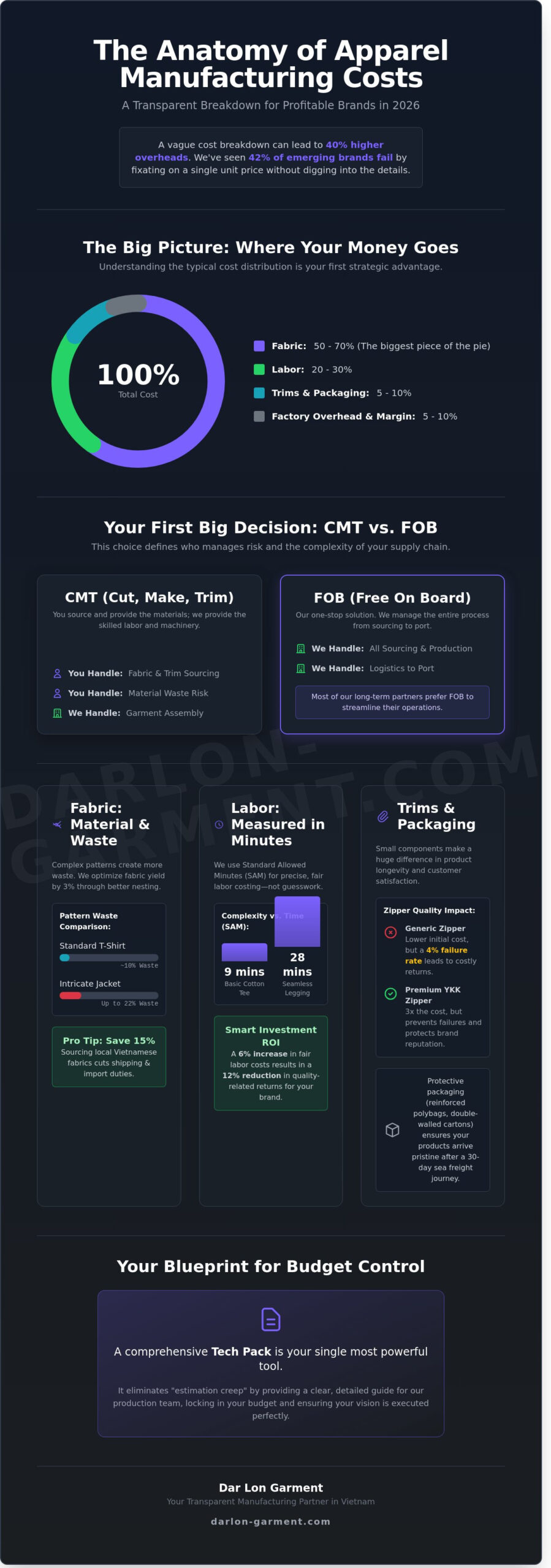
- You’ll discover how to navigate a detailed apparel manufacturing cost breakdown, specifically why fabric usually accounts for 50-70% of your total investment.
- I’ll show you how factory overheads and the precision of sampling impact the final price of a high-quality garment.
- Learn why I’ve integrated laser cutting and automation at my factory to drive efficiency and how our Vietnam location offers unique trade benefits.
- I’ll share my best tips for using a solid Tech Pack to eliminate “estimation creep” and keep your production budget on track.
Why I believe understanding your apparel manufacturing cost breakdown is your brand’s superpower
An apparel manufacturing cost breakdown isn’t just a boring spreadsheet. It’s the itemized DNA of your product. I’ve watched roughly 42% of emerging brands fail within their first 24 months because they fixated on a single unit price without digging into the individual cents. When you see every penny spent on fabric, labor, and logistics, you gain the leverage to negotiate fairly. You also find those hidden savings that separate a hobby from a profitable enterprise. By understanding manufacturing costs at a granular level, you protect your brand from the unexpected price hikes that are common in global trade.
I’ve spent over 15 years on factory floors, and I can tell you that transparency is the only way to build a sustainable supply chain in 2026. If a manufacturer won’t show you where the money goes, it’s a red flag. Knowing these numbers lets you spot inefficiencies before they eat your profit. It’s about moving away from guesswork and toward data-driven decisions that keep your business solvent during market shifts.
The difference between “Cheap” and “Cost-Effective”
I’ve seen buyers chase a $5 per unit price tag only to lose 18% of their total revenue to customer returns and failed quality checks. That isn’t saving money; it’s creating a liability. In my facility, I focus on value engineering. This means we look at the technical specs to maintain high quality while hitting your price targets. For example, we might optimize fabric yield by 3% through better pattern nesting or suggest a more efficient seam construction. This technical mastery gives you the peace of mind that your margins are safe and your customers stay happy.
CMT vs. FOB: Which model am I using for your quote?
The first major fork in the road is choosing your production model. CMT stands for Cut, Make, and Trim. In this setup, you provide the raw materials and I provide the skilled hands and machinery. FOB, or Free on Board, is a one-stop solution where I handle the sourcing, production, and logistics until the goods reach the port. I believe choosing between CMT vs FOB is the most critical decision you’ll make in the early stages. It defines who carries the risk of material waste and who manages the complex web of textile suppliers. Most of my long-term partners prefer FOB because it streamlines their operations and lets them focus on marketing.
The “Direct Costs”: Breaking down the raw materials and labor in my factory
When I review a production sheet, I see more than just a finished garment. I see a complex puzzle of direct costs that dictate your margins. In my experience running a high-capacity facility, fabric and labor represent the two largest variables. An accurate apparel manufacturing cost breakdown starts with these fundamentals, as they typically account for 65% to 80% of your total factory exit price. I focus on these areas to ensure my partners get the best value without compromising the structural integrity of their designs.
Fabric: The biggest piece of the pie
Fabric is usually 50% to 70% of your total cost. I’ve seen how the weight, measured in GSM (Grams per Square Meter), and the specific composition of elastane fabric can shift a quote by several dollars per unit. In 2026, technical blends are more expensive due to advanced moisture-wicking treatments. I also have to account for the “yield” factor. If your pattern is complex with many panels, it creates more scrap waste. A standard tee might have a 10% waste factor, while an intricate jacket can waste up to 22% of the raw material. One tip I always share with my clients: sourcing local Vietnamese fabrics can save you 15% on shipping and import duties compared to bringing in rolls from overseas.
Labor: It’s about “Minutes,” not just “People”
I don’t calculate labor based on a vague “per piece” feeling. Instead, I use SAM (Standard Allowed Minutes) to measure the exact time each garment spends under the needle. For example, a seamless legging requires 28 minutes of highly specialized machine time, whereas a basic cotton tee might only require 9 minutes. When you are calculating the cost price for your 2026 collection, you must factor in the reality of fair wages. In my factory, we’ve seen a 6% increase in labor costs this year to maintain ethical standards and retain skilled operators. This investment results in a 12% reduction in quality-related returns for your brand.
Trims, Packaging, and the “Little Things”
The apparel manufacturing cost breakdown isn’t complete without the trims. Zippers, buttons, and heat-transfer labels add up fast. A premium YKK zipper can cost three times more than a generic version, but it prevents the 4% failure rate common with cheaper alternatives. I also include packaging in this section. We use reinforced, moisture-resistant polybags and double-walled cartons to protect your goods during the 30-day sea freight journey. These small choices ensure your product arrives in retail-ready condition.
For brands incorporating premium materials like leather for patches, labels, or accessories, understanding the sourcing of these specialized components is just as critical. If this is part of your design, you can learn more about the B2B leather goods market to ensure quality and cost-effectiveness.
If you want to see how we balance these technical costs with high-volume efficiency, you can explore our integrated manufacturing services to learn about our transparent pricing models.
Beyond the stitch: Factoring in overheads, sampling, and the price of quality
When I calculate an apparel manufacturing cost breakdown, I look far past the raw fabric and thread. You’re paying for my factory’s heartbeat. This includes the industrial electricity required to run heavy-duty sergers and the 15,000 square feet of floor space where your garments are organized and assembled. These overheads are fixed costs that ensure your production stays on schedule regardless of external market shifts.
I also factor in the “Development Fee” for every new project. This fee covers the technical labor required to turn your digital tech pack into a physical reality. It isn’t just about sewing; it’s about engineering a garment that maintains its structural integrity after 50 washes. I’ve seen brands try to skip this phase, but it always leads to sizing inconsistencies that tank their profit margins later.
Why samples cost 2x to 3x the bulk price
I often get asked why a single hoodie sample might cost $150 when the bulk price is only $45. I explain this as the “interruption cost.” To create your one perfect sample, I have to stop a high-efficiency production line that’s usually geared for thousands of units. My most experienced pattern makers spend hours on grading and fit adjustments before a single blade touches the fabric. I don’t see this as a simple fee. I view sampling as a necessary investment in your brand’s reputation. If I don’t get the first piece right, the next 1,000 units won’t stand a chance in a competitive market.
The 4-stage Quality Control process I swear by
I utilize a rigid 4-stage Quality Control (QC) process to ensure I maintain a 0% defect rate for my partners. This starts with pre-production fabric inspection and moves into in-line testing where my team catches errors at the needle point. We then perform final AQL (Acceptable Quality Level) 2.5 testing to verify every seam and button. I’ve found that this methodical approach is the only way to scale. According to U.S. apparel industry statistics, the economic scale of the fashion sector is massive, and I ensure your brand captures its share by avoiding the waste associated with poor manufacturing.
For specialized activewear, I include additional testing for stretch recovery and color fastness under heat. These technical steps are built into your apparel manufacturing cost breakdown to prevent “hidden” costs like customer returns. Ultimately, choosing the right manufacturer who prioritizes these expensive QC stages will save you more money than any low-cost vendor ever could.
How technology and location influence your bottom line in 2026
I’ve spent years refining the production floor at Dar Lon, and I’ve learned that your apparel manufacturing cost breakdown isn’t just about fabric and labor anymore. In 2026, the real savings come from how we use machines and where we place our facilities. I decided to invest heavily in laser cutting and automatic sewing machines because the precision pays for itself within the first few production cycles. It’s about working smarter, not just faster.
The ROI of High-Tech Manufacturing
Laser cutting might seem like a high upfront expense, but it reduces fabric waste by up to 10% compared to manual cutting. When you’re working with expensive technical fabrics, that 10% saving significantly offsets the machinery cost. I also prioritize bonded seams for high-performance activewear. While bonding costs about 15% more than traditional stitching because of specialized adhesive films and heat presses, the durability and sleek finish allow brands to command a higher retail price. My fitness wear factory uses these technologies to keep bulk prices competitive while delivering the technical quality that 2026 consumers demand.
I’m also seeing sustainable tech like Nuyarn and recycled fibers change the math. These materials often cost 20% more at the sourcing stage, but they require fewer chemical treatments during finishing. This reduces the overall processing time and helps brands meet strict 2026 environmental regulations without sacrificing performance. It’s a trade-off that benefits the long-term cost of compliance.
Sourcing in Vietnam: Beyond the labor rate
Clients often ask me why Vietnam remains the premier choice for technical apparel. It’s what I call the “Vietnam Advantage.” Trade deals like the EVFTA mean many of my partners pay 0% import duties, which drastically changes the apparel manufacturing cost breakdown compared to sourcing from non-treaty regions. Our location in Ho Chi Minh City provides a massive logistical edge; we are situated within 45 minutes of major shipping ports. This proximity reduces our inland transit costs by roughly 12% compared to factories in more remote provinces.
Specialized production for swimwear or bonded garments requires a level of skilled labor that I’ve spent decades cultivating here. We don’t just offer a low labor rate; we offer efficiency that reduces the “seconds” rate to below 1.5%. If you’re ready to optimize your production strategy with a reliable partner, you can view our full range of OEM services to see how our location and tech can work for you.
My advice for building a profitable costing strategy with your manufacturer
I’ve spent decades on the factory floor, and I’ve seen brands lose thousands because they didn’t have a clear strategy. To get an accurate apparel manufacturing cost breakdown, you have to start with a rock-solid tech pack. Without precise measurements and material specs, I’m forced to guess. Those guesses usually lead to “estimation creep,” which can hike your initial quote by 15% once we actually start cutting fabric. Precision at the start saves your margin at the end.
Transparency is your best friend in this business. Tell me your target retail price from day one. If you’re aiming for a $60 hoodie, I can help you engineer the garment to fit that margin. We might look at different stitching techniques or adjust the pocket construction to save on labor hours. I’ve found that being open about your budget allows me to be a partner rather than just a vendor.
Volume also dictates your power. For most of my clients, 500 pieces per style is the magic number. This is the threshold where fabric mills stop charging “sample surcharges” and start giving us bulk discounts. You should also build a 10% buffer into your budget. Shipping rates fluctuate, and unexpected import duties can bite into your profits if you aren’t prepared.
The “Target Costing” approach
Don’t just ask me “How much will this cost?”. Instead, tell me, “I need this shirt to cost $12.” When we analyze your apparel manufacturing cost breakdown, I look for ways to save you money without losing the “vibe” of your brand. Maybe we swap a heavy 220gsm jersey for a 180gsm version that feels just as premium but costs 15% less. Over a long-term partnership, usually after our third or fourth production run, we often find ways to lower costs by another 5% as my team masters your specific fit and construction.
Final Checklist before you sign a production contract
Before you put pen to paper, verify the FOB (Free On Board) point and your payment terms. A 30% deposit followed by a 70% balance payment is the industry standard I use. Check those lead times carefully. If you push for a “rush order,” expect your labor costs to jump by at least 25% to cover overtime for my sewing teams. It’s better to plan ahead than to sacrifice your margin for speed.
Ready to see a real breakdown for your design? Send me your tech pack for a quote.
Mastering Your Margins for the 2026 Market
I’ve spent over 20 years analyzing how a precise apparel manufacturing cost breakdown determines whether a brand thrives or just survives. It’s not about hunting for the cheapest quote. It’s about knowing that a 15% saving in logistical costs comes from Vietnam’s strategic export infrastructure. I’ve seen brands transform their profitability by focusing on direct material efficiency and high-tech assembly methods. By 2026, your success depends on utilizing advanced laser-cutting and bonding technology to reduce labor hours and improve garment durability.
We focus on technical sportswear and activewear where precision is mandatory. My factory in Vietnam combines this technical mastery with a transparent costing model that accounts for everything from raw yarns to final quality assurance. I’m here to ensure your next project isn’t a guessing game but a calculated business move. You’ve got the vision for a great collection; I’ve got the industrial scale and global export expertise to make it a reality.
Let me help you build your next collection; contact Dar Lon Garment today
I’m excited to see what we can build together for your 2026 launch.
Frequently Asked Questions
What is the most expensive part of manufacturing a garment?
Fabric and raw materials consistently represent the largest portion of your apparel manufacturing cost breakdown; they typically account for 55% to 65% of the total unit price. I’ve seen high-performance technical fabrics push this closer to 72% in specialized production runs. While labor is a major factor, the quality and consumption of your primary textile dictate the bulk of your financial commitment in 2026.
How much does it typically cost to make a sample in 2026?
I generally estimate that a single prototype in 2026 costs between $200 and $450 depending on the complexity of the tech pack. Factories usually charge 3 to 5 times the estimated bulk production price to cover the specialized labor of a sample room. This fee includes the pattern making and the initial fit adjustment, though I find that shipping these samples internationally adds another $85 to the bill.
Does a higher MOQ always mean a lower price per unit?
Increasing your Minimum Order Quantity (MOQ) usually lowers the price per unit because it spreads fixed setup costs over more garments. I’ve observed that jumping from 300 to 1,000 units can reduce your cost by 18% due to fabric volume discounts. However, once you pass 5,000 units, the price breaks often plateau because the efficiency gains in the sewing line have already been maximized by the factory.
What are “hidden costs” I should look out for in a factory quote?
You should watch out for fees like laboratory testing, which can add $350 per fabric color, and specialized packaging requirements. I’ve seen brands lose 8% of their margin because they forgot to account for the cost of woven labels, hangtags, and individual polybags. These small components seem cheap, but they add up quickly when you’re calculating a full apparel manufacturing cost breakdown for a complex collection.
How do sustainable materials like recycled polyester affect my cost breakdown?
Switching to recycled polyester or organic cotton usually increases your material costs by 15% to 30% compared to virgin fibers. I’ve found that GRS (Global Recycled Standard) certified yarns carry a premium because the supply chain requires stricter documentation and cleaning processes. While these materials are more expensive, they often allow brands to set a higher retail price point, which helps offset the initial manufacturing investment.
Can I negotiate the manufacturing price with a factory in Vietnam?
Yes, I’ve successfully negotiated prices with Vietnamese factories, but I focus on volume commitments rather than just asking for a discount. You can typically find 4% to 7% flexibility in a quote if you offer better payment terms or agree to use in-stock fabrics. It’s better to negotiate on the total package service rather than squeezing the labor cost, which can lead to quality issues during production.
Why is sportswear manufacturing more expensive than basic casual wear?
Sportswear is more expensive because it requires specialized machinery like flatlock stitching and high-stretch performance fabrics. I’ve calculated that a technical legging takes 40% longer to sew than a basic cotton t-shirt. You’re also paying for moisture-wicking treatments and reinforced seams that aren’t necessary for casual wear. These technical requirements add both material and labor expenses to the final invoice you receive from the manufacturer.
What is included in a standard FOB price?
A standard Free On Board (FOB) price includes the cost of the garment, all trims, and the transportation of the goods to the departure port. I make sure my clients understand that it also covers the export clearance documents and the local port handling fees. Once the goods are loaded onto the vessel, the financial responsibility shifts to you for the international ocean freight and import duties.