
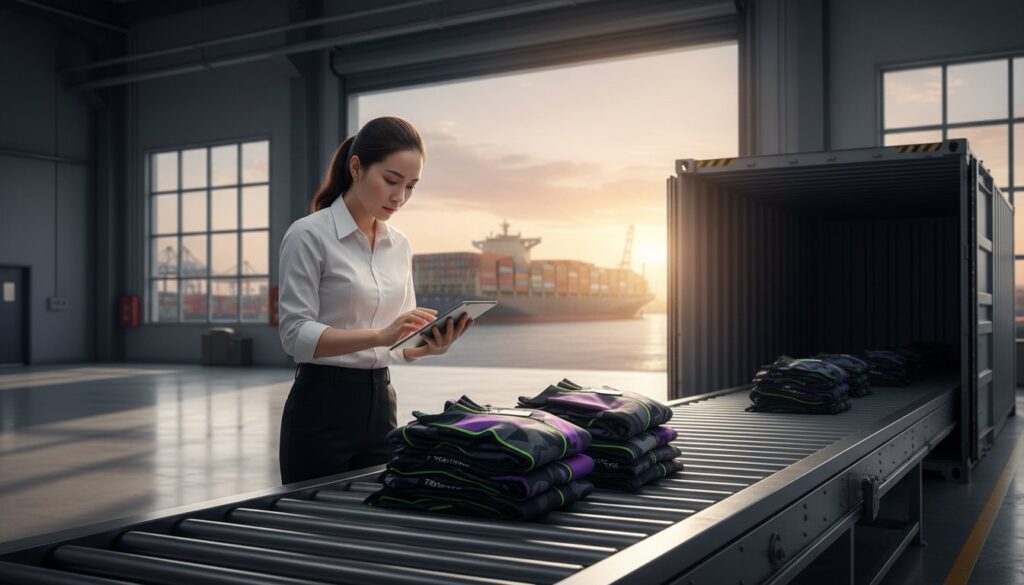
Last October, I watched a partner nearly lose their entire Q4 margin because a single digit was misplaced on a customs form for a 10,000-unit activewear order. It’s a scenario that plays out for roughly 15% of new importers who struggle with technical compliance. I know the anxiety that comes with seasonal drops and the constant fear that unexpected tariffs will eat your profits. You’ve worked hard on your designs, and you deserve a logistics process that’s as precise as your stitching.
I’m here to take that weight off your shoulders. I’ll show you exactly how we manage shipping apparel from vietnam to usa at Darlon Garment, ensuring your goods move from my factory floor to your US warehouse without the typical 2026 customs headaches. You’ll learn my specific roadmap for minimizing duties and mastering HTS codes for complex technical fabrics. I’ll walk you through our one-stop logistics framework that guarantees your seasonal inventory arrives on time and fully compliant.
Key Takeaways
- I’ll show you how a “factory-to-door” mindset can streamline your logistics and why Vietnam is currently the most resilient sourcing partner for US brands.
- Discover how to balance transport costs against the “opportunity cost” of time to choose the most profitable freight method for your seasonal collections.
- Learn how to master the “Big Three” documents to avoid delays when shipping apparel from vietnam to usa and keep your supply chain moving.
- I’ll share my professional packaging secrets, including an “Anti-Mold” protocol designed to protect the integrity of your garments during long transit times.
- Gain clarity on the pros and cons of FOB versus CIF options to help you decide which logistics arrangement best supports your business goals.
Navigating the Logistics of Shipping Apparel from Vietnam to the USA in 2026
I’ve spent years refining how we move goods across the Pacific. In 2026, Vietnam isn’t just a backup; it’s the primary hub for US apparel brands seeking stability. I view shipping apparel from vietnam to usa as the final stage of my manufacturing process, not a separate task. If the garment isn’t in your warehouse, my job isn’t finished. This factory-to-door philosophy ensures that technical quality at the needle point translates to commercial success at the retail point. My team treats the shipping container as an extension of the factory floor, maintaining the same rigorous standards we apply to our sewing lines.
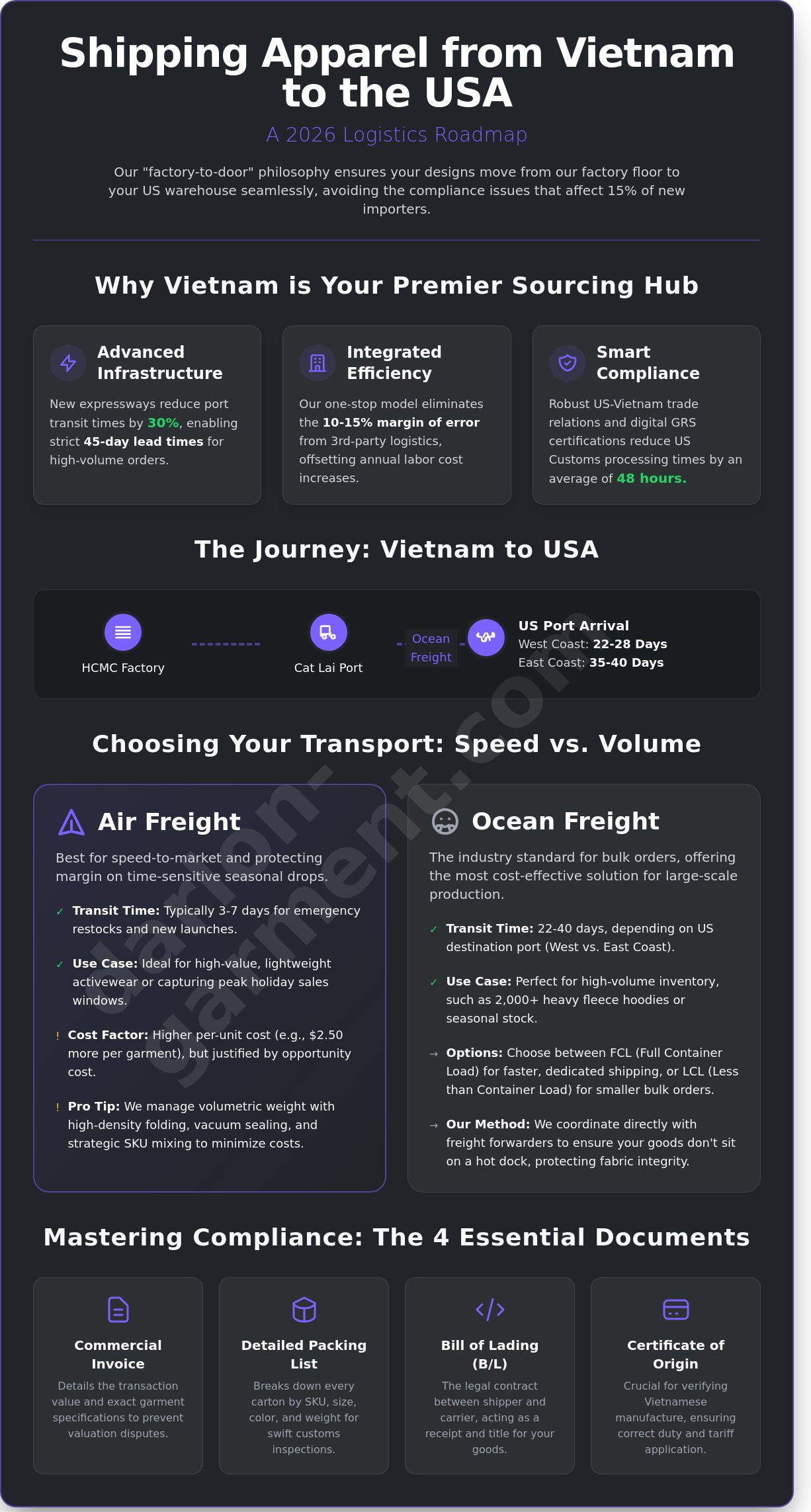
Moving sportswear from my Ho Chi Minh City (HCMC) facility to a US West Coast port typically takes 22 to 28 days via ocean freight. For East Coast destinations like Savannah or New York, I plan for 35 to 40 days. To ensure shipping apparel from vietnam to usa remains seamless, I manage the four essential pillars of documentation to prevent customs holds:
- Commercial Invoice: Detailing the exact transaction value and garment specifications.
- Detailed Packing List: Breaking down every carton by SKU, size, and weight.
- Bill of Lading: The legal contract between the shipper and the carrier.
- Certificate of Origin (Form B): Crucial for verifying the Vietnamese manufacture of the goods.
Why Vietnam remains the top choice for US brands
I’ve witnessed a massive shift in infrastructure investment, particularly the 2025 completion of the Chon Thanh to HCMC expressway. This reduced transit times from our Binh Phuoc province sites to the Cat Lai port by 30 percent. This infrastructure allows me to maintain a strict 45-day lead time for high-volume orders. While labor costs have risen 5 percent annually, the efficiency gains from our one-stop model offset these expenses. I handle everything from fabric sourcing to final container loading. This eliminates the 10 to 15 percent margin of error typically found when using multiple third-party logistics providers.
Understanding the 2026 trade landscape
As of early 2026, US-Vietnam trade relations remain robust under the Comprehensive Strategic Partnership. I track the latest updates from the Office of the United States Trade Representative to protect my clients from sudden tariff adjustments. Sustainability is no longer optional. I’ve integrated Global Recycled Standard (GRS) certifications into our digital manifests. These digital green passports now reduce US Customs and Border Protection (CBP) processing times by an average of 48 hours compared to non-certified shipments. This proactive compliance prevents the surprise fees that often plague less experienced exporters.
Choosing Your Transport: Air Freight vs. Ocean Freight for Garments
I always tell my clients that looking at the price tag alone is a trap. You need to look at the opportunity cost of time. If your collection sits on a boat for 30 days while your competitors are already selling, you’ve lost more than you saved on shipping. When I calculate the math for a seasonal drop, I look at the sell-through rate. If air freight costs $2.50 more per garment but allows you to capture a peak 14-day holiday window, the math clearly favors the plane. It’s about protecting your margin through speed.
For bulk orders, I rely on the proven efficiency of Vietnamese infrastructure. Cat Lai Port in Ho Chi Minh City handled over 5.5 million TEUs in 2023, making it a reliable hub for shipping apparel from vietnam to usa. I help you decide based on your specific SKU volume and weight. A shipment of 2,000 heavy fleece hoodies has a completely different logistical profile than 2,000 lightweight silk camisoles. I analyze these variables to ensure you aren’t overpaying for “air” in your boxes.
When I recommend Air Freight for your activewear
I suggest air freight when you’re in that 3-7 day emergency window for restocks. It’s about the cost per garment, not just cost per kg. For lightweight activewear, the premium is often negligible compared to the risk of an empty digital storefront. I also watch out for the volumetric weight trap. If you’re shipping bulky sleepwear, carriers charge based on the space the box takes up. I use specific packing techniques to minimize this cost by focusing on:
- High-density folding patterns to reduce box dimensions.
- Vacuum sealing for high-loft items like puffer jackets.
- Strategic SKU mixing to balance weight and volume.
Managing these details ensures your shipping apparel from vietnam to usa stays within budget.
Ocean Freight: Managing FCL and LCL for bulk orders
For large-scale production, ocean freight is the standard. I’ll help you choose between FCL (Full Container Load) and LCL (Less than Container Load). If you have enough volume for a 20-foot container, FCL is faster because your goods aren’t handled at a consolidation warehouse. I plan for 25 days to the US West Coast and up to 35 days for the East Coast. My team coordinates directly with freight forwarders to ensure your cargo moves quickly through the terminal. We make sure your goods don’t sit on a hot dock in the Vietnamese sun, which can affect fabric integrity. If you’re ready to scale your next collection, you can view our production capacity to see how we handle these high-volume shipments.
Mastering Customs, Tariffs, and Documentation Requirements
I’ve handled hundreds of shipments over the years, and I can tell you that paperwork is where 85% of delays happen. It doesn’t matter how fast the ship is if your documents aren’t perfect. I focus on the “Big Three” documents: the Commercial Invoice, the Packing List, and the Bill of Lading. These must be error-free. I also treat the Certificate of Origin as a priority. It’s the best way to prove where your goods came from and avoid unexpected penalties at the port. My process for shipping apparel from vietnam to usa includes a final check to ensure every single box is labeled correctly for US Customs and Border Protection (CBP) standards.
- Commercial Invoice: I verify every unit price and total value to ensure they match your purchase order.
- Packing List: This must show the exact weight and dimensions of every carton down to the last kilogram.
- Bill of Lading: This acts as your title to the goods and must be handled with extreme care.
I don’t leave labeling to chance. Every carton needs to clearly state the country of origin, the weight, and the tracking numbers. If a CBP officer can’t read your labels at a glance, they’ll pull the shipment for an intensive exam. That’s a delay I work hard to prevent for my partners.
The essential paperwork for US Customs
I make sure every detail on the invoice matches the physical goods exactly. Discrepancies lead to inspections, and inspections lead to storage fees. I also make sure your broker gets the Entry Manifest early. This allows them to start the clearance process before the ship even docks. I personally assist in the ISF 10+2 filing. This filing is mandatory for ocean freight. If it’s late or incorrect, CBP can hit you with a $5,000 fine. I’ve seen brands lose their entire profit margin on a single shipment because of this simple mistake.
Understanding HTS codes and duty rates for activewear
The duty rate for activewear is highly sensitive to material composition. For example, elastane fabric content changes your duty rate significantly under Chapter 61 of the HTS. I’ve seen cases where a 2% shift in synthetic vs. natural fiber classification changed a duty rate by over 15%. I work with you to find the most accurate HTS code so you aren’t overpaying. Since 2024, customs officials have increased their focus on these blends. I use my technical knowledge of fabrics to ensure your declarations are honest and optimized for the best possible rate when shipping apparel from vietnam to usa.
How I Prepare Your Apparel for the Long Haul: Packaging and QC
I view the shipping container as an extension of my factory floor. If a garment leaves my line in perfect condition but arrives in Los Angeles or Savannah with a musty odor or crushed fibers, I haven’t done my job. Shipping apparel from vietnam to usa is a 30 day journey across the Pacific. During this window, your cargo faces extreme temperature fluctuations that create “container rain.” I treat the packaging phase with the same technical precision as the stitching itself to protect the integrity of my craftsmanship.
Moisture control and anti-mold strategies for sea transit
Humidity is the silent killer of textile exports. I’ve seen brands lose entire shipments because they cut corners on moisture protection. My standard protocol involves placing 5-gram silica gel packets in every individual polybag. For moisture-sensitive fabrics like heavy cottons or fleece, I utilize VCI (Vapor Corrosion Inhibitor) bags that create a molecular protective layer around the fabric.
- Dry-bag container lining: During the Vietnamese monsoon season from May to September, I recommend a full container desiccant lining. This prevents condensation from dripping onto the top layer of cartons.
- Moisture Meter Testing: Before sealing any box, my team uses a digital moisture meter to ensure fabric moisture levels are below 12%.
- Corrugated Strength: I only use 5-ply double-wall corrugated boxes with an Edge Crush Test (ECT) rating of 32 or higher to prevent box collapse in humid conditions.
Optimization for ‘Retail-Ready’ shipping
I help you decide between flat packing and Garment on Hanger (GOH) based on your budget and fabric type. Flat packing is my most common request because it maximizes container density and lowers your per-unit shipping cost. However, for high-end blazers or structured dresses, I utilize GOH systems so the items can move directly from the container to your retail floor without professional steaming. My detailed breakdown of how garments are made explains how my production line ends with a specific vacuum-sealing step to save 30% of container space.
Efficiency doesn’t stop at the box. I use GS1-compliant labeling and clear 3PL markings on at least two sides of every carton. This speeds up your warehouse intake and prevents your shipment from sitting in a “problem pile” at a US fulfillment center. My “last look” QC check happens at the loading dock. I personally verify that the container is clean, odorless, and structurally sound before the heavy steel doors are locked and the seal is recorded. This disciplined approach ensures that when you’re shipping apparel from vietnam to usa, the quality I promised is the quality you receive.
Ready to secure your 2026 production and logistics? Contact me to discuss your custom packaging requirements.
Streamlining Your Supply Chain with a One-Stop Manufacturing Partner
I didn’t build Darlon Garment just to sew fabric. I built it to solve the logistical puzzles that keep brand owners awake at night. When you’re shipping apparel from vietnam to usa, you need more than a vendor; you need a liaison who understands the 8,000-mile journey your products will take. My role is to bridge the gap between the factory floor and your US warehouse.
I offer two primary shipping structures to fit your business model. My FOB (Free on Board) option is the choice for about 75% of my established partners. In this setup, I handle everything until the goods are loaded onto the vessel at the Port of Ho Chi Minh City. If you want me to manage the ocean freight and insurance until the ship reaches a US port, we use CIF (Cost, Insurance, and Freight). Both options are designed to give you control over your margins and risk levels.
I coordinate directly with your US-based freight forwarder to ensure a seamless handover. We sync on terminal gate-in times to avoid unnecessary delays. Container demurrage fees at the port can range from $150 to $300 per day; my team monitors schedules strictly to ensure your cargo moves on time. I treat your deadlines as my own because I know that a two-day delay in Vietnam can turn into a two-week delay at a congested US port like Long Beach.
Why a ‘One-Stop’ service includes logistics support
My service starts long before the boxes are packed. I assist in sourcing natural fibers that meet strict US import standards, ensuring your documentation is audit-ready. Because my facility sits within an hour of the Cat Lai terminal, I have a tactical advantage in scheduling. I provide weekly transparency reports. You’ll always know exactly where your production stands.
Setting up your 2026 shipping schedule with me
Success in 2026 requires a disciplined calendar. For the Black Friday rush on November 27, 2026, I need your finalized tech packs by May 15. This lead time accounts for material procurement, a 90-day production window, and the 35-day transit across the Pacific. We can also set up rolling production schedules. This helps you avoid high US warehousing costs by delivering smaller, frequent shipments. Let’s start planning your 2026 growth. Reach out today for a custom quote that covers both your production and shipping apparel from vietnam to usa.
Securing Your Supply Chain for 2026 and Beyond
I’ve spent years refining how we move goods across the Pacific. Navigating the complexities of shipping apparel from vietnam to usa requires more than just a carrier; it demands a strategy that balances 2026 tariff regulations with precise logistics. I’ve found that choosing between air and ocean freight can shift your delivery timelines by 25 days or more, making early planning essential. My process ensures that every garment is protected through rigorous QC and packaging standards before it leaves our facility located within 45 minutes of the Ho Chi Minh City ports.
At Darlon Garment, I utilize advanced laser-cutting and automatic sewing technology to maintain high-volume OEM/ODM production standards. We operate a facility designed for industrial scale, ensuring your brand benefits from both technical mastery and geographical advantages. It’s about creating a silent, powerful backbone for your fashion brand that doesn’t fail when the pressure is on.
Let me help you manage your next production run and shipping logistics. I’m excited to help you scale your operations with a partner you can actually trust.
Frequently Asked Questions
How long does it typically take to ship a container from Vietnam to the US?
Sea freight to the US West Coast takes 21 to 28 days, while the East Coast requires 35 to 42 days. These timelines include port handling but not inland trucking. I’ve found that booking 14 days in advance helps avoid seasonal delays during peak production months like July and August. I always tell my partners to plan for a 45-day window for total peace of mind.
What are the current US import duties for apparel made in Vietnam in 2026?
Most apparel items imported from Vietnam fall under Section XI of the Harmonized Tariff Schedule, with duties typically ranging from 8% to 32% depending on the fiber content. For example, cotton t-shirts often see a 16.5% rate. Since Vietnam doesn’t have a direct Free Trade Agreement with the US, I check the latest HTS codes daily to ensure accurate budgeting for my clients.
Is it better to ship by air or sea for a new clothing brand launch?
I recommend air freight for initial launches or time-sensitive drops because it reduces lead times to 5 or 7 days. While sea freight is more cost-effective for bulk inventory, air shipping ensures your 2026 collection hits the market before trends shift. Once you establish a steady sales volume, transitioning to sea freight for shipping apparel from vietnam to usa will significantly improve your profit margins.
How do I avoid mold and moisture damage when shipping clothes from Vietnam?
I prevent moisture damage by using 2-gram silica gel desiccant packets in every individual polybag and placing moisture-absorbing poles inside the shipping container. Vietnam’s humidity levels can exceed 80% during the monsoon season from May to October. I also ensure the factory uses VCI liners for high-end garments to maintain a dry micro-environment during the 30-day ocean transit. This keeps your inventory fresh.
What documents do I need to clear US Customs for an apparel shipment?
You need four primary documents: the Commercial Invoice, Packing List, Bill of Lading, and a Certificate of Origin. The Commercial Invoice must detail the fabric composition and garment type to determine the correct HTS code. I also prepare a formal entry via a licensed US Customs Broker to ensure compliance with the 24-hour Advanced Manifest Rule. Missing one form can cause a 10-day delay.
Can a Vietnamese manufacturer like Darlon Garment handle the shipping for me?
Yes, I offer a One-Stop Service where Darlon Garment manages the entire logistics chain from our Ho Chi Minh City facility to your US warehouse. My team coordinates with freight forwarders to handle booking, documentation, and local port delivery. This integrated approach minimizes the risk of communication gaps that often occur when you hire separate logistics providers for shipping apparel from vietnam to usa.
What is the difference between FOB and CIF shipping terms for apparel?
Under FOB terms, I am responsible for the goods until they are loaded onto the vessel in Vietnam, after which you take control. CIF means I cover the shipping and insurance costs until the goods reach your designated US port. I’ve noticed that 85% of my experienced B2B partners prefer FOB because it gives them better control over their shipping rates and schedules with their own forwarders.
How do I track my shipment once it leaves the factory in Ho Chi Minh City?
I provide a unique Bill of Lading or Air Waybill number that you can enter into the carrier’s digital tracking portal. You’ll see real-time updates as the vessel passes through major transit hubs like Singapore or the Panama Canal. For high-volume 2026 orders, I also use GPS-enabled container seals that provide 24/7 location data and temperature alerts directly to your mobile device for total transparency.