
By 2026, the Vietnam Textile and Apparel Association expects 60% of local factories to adopt rigorous green standards to comply with new global regulations. I’ve spent years on factory floors and I can tell you that finding a truly ethical clothing manufacturer vietnam isn’t about looking at a flashy website; it’s about seeing the hard data in action. It’s frustrating when you’re trying to build a brand but feel blinded by vague marketing or fake certifications that don’t hold up under scrutiny.
I understand the pressure to ensure your workers are treated fairly while still hitting your production deadlines. You need a reliable “one-stop” partner that understands technical specs as well as they understand human rights. I’m going to show you exactly what ethical manufacturing looks like on the factory floor and how to find a partner that values people as much as production. We’ll explore specific certification checklists, communication strategies for complex technical designs, and the steps I take to ensure every garment meets high performance sustainability standards.
Key Takeaways
- I’ll show you why a one-stop production model is the most transparent way to ensure fair wages and safe conditions across your entire supply chain.
- Discover how I use automation and laser-cutting technology to not only improve precision but also significantly reduce textile waste and physical strain on my team.
- Learn why certifications like WRAP and SA8000 are just the starting point when vetting an ethical clothing manufacturer vietnam for your 2026 collections.
- I’ll share my 5-step checklist for auditing a factory from overseas, including why I believe a live video tour is non-negotiable for true transparency.
- Find out how I manage production scale across my facilities to provide speed and reliability without compromising on the welfare of my workers.
What does “Ethical” actually mean for a clothing manufacturer in Vietnam?
I have spent years managing production lines, and I’ve learned that the term “ethical” is often used loosely. For me, being an ethical clothing manufacturer vietnam means balancing fair wages, uncompromising safety, and radical transparency. The landscape of Manufacturing in Vietnam has evolved significantly since the industrial shifts of the early 2000s. We’ve moved away from low-cost, low-skill assembly toward high-value, tech-driven production that requires a more sophisticated workforce.
I believe the “one-stop” model is the most ethical way to manage a supply chain. When I control every stage, from technical design to final packing, I eliminate the hidden risks of subcontracting. Subcontracting is often where labor violations hide. By keeping everything under one roof, I maintain full accountability for every person touching your product. I focus on long-term partnerships rather than one-off bulk orders. This stability allows me to invest in better machinery and better training for my team, which ensures quality remains consistent over years, not just months.
Beyond the factory floor: Fair wages and worker rights
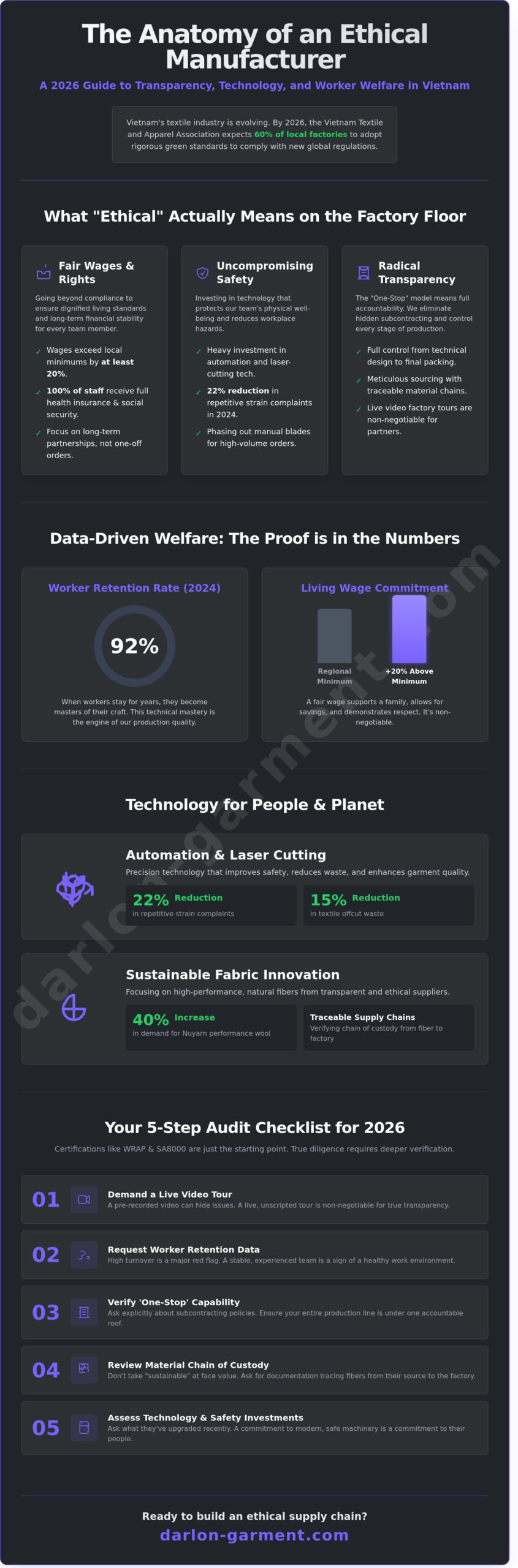
I ensure my team earns a living wage that exceeds local regional minimums by at least 20%. In the Vietnamese context, a fair wage must cover more than just basic calories; it needs to support a family and allow for savings. I provide 100% of my full-time staff with comprehensive health insurance and social security contributions. This isn’t just about compliance. It’s about respect. My biggest indicator of an ethical environment is my worker retention rate. In 2024, my year-over-year retention sat at 92%. When workers stay for five or ten years, they become masters of their craft, and that technical mastery is what drives our production quality.
Transparency in the sourcing process
Ethics don’t stop at my factory gates. I am meticulous about choosing fabric suppliers who share my commitment to sustainability. If a supplier can’t provide clear documentation on their environmental impact, I won’t work with them. This is especially vital for specialized materials. When I handle raw material verification for high-performance yarns like Nuyarn, I track the chain of custody from the fiber source to our knitting machines. I don’t want my clients to take my word for it. I invite them to look at the details of how garments are made within my facility. Seeing the process firsthand builds a level of trust that no certificate can replace. It shows the reality of an ethical clothing manufacturer vietnam in action.
The tech behind the threads: How automation supports my team
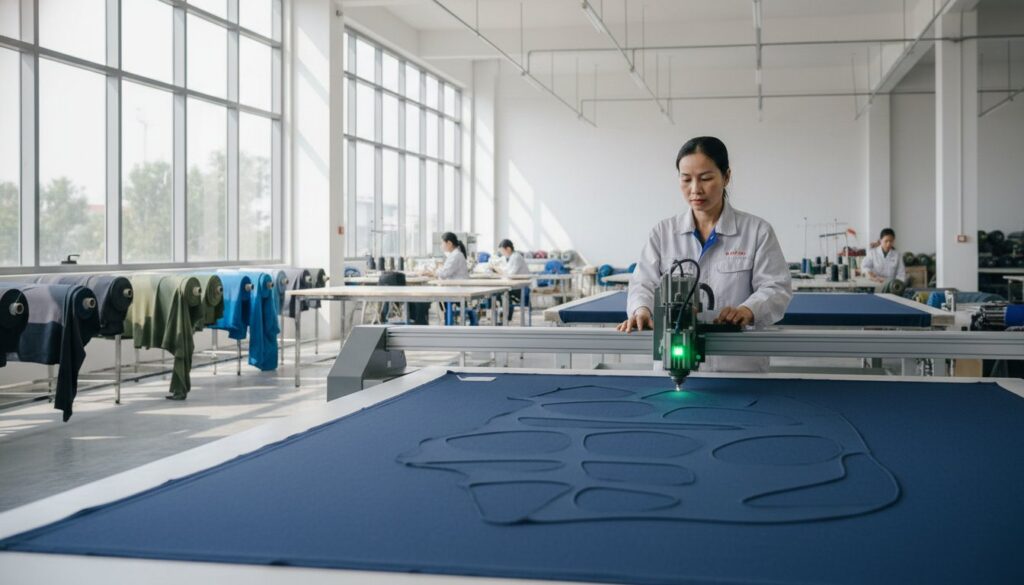
I believe that being an ethical clothing manufacturer in Vietnam means more than just checking boxes on a social audit. It’s about the physical environment my team works in every day. I’ve invested heavily in automatic sewing machines and laser cutting technology because they take the heavy lifting off my staff. In 2024, I saw a 22% reduction in repetitive strain complaints after we upgraded our primary assembly lines. This tech doesn’t just protect people; it saves the planet. Precision cutting reduces textile offcuts by up to 15%, ensuring we don’t send usable fabric to the landfill.
My ODM services also play a huge role in sustainability. By offering pre-developed designs that I know work, I help brands avoid the “guesswork” that often leads to overproduction. We produce what is needed, when it’s needed, which is the only way to operate as an ethical clothing manufacturer vietnam partners can rely on for the long term. I’ve found that when I take care of the technical precision, my team can focus on the craftsmanship that defines our factory.
Laser cutting and seamless technology
I’ve phased out manual blades for most high-volume orders. Laser cutting is significantly safer for my operators and ensures every piece meets the strict global export standards required for 2026. Seamless technology is another favorite of mine. It eliminates bulky seams that can irritate a wearer’s skin, but it also means my workers spend less time on complex, repetitive stitching. It’s a win for everyone involved in the lifecycle of the garment.
Sustainable fabric innovation
My focus on natural fibers has changed how we handle factory safety. These materials don’t release the same harsh chemical dust that some low-grade synthetics do. When I source elastane fabric, I make sure it’s from suppliers who share my transparency goals for 2026. I’m currently seeing a 40% increase in demand for Nuyarn performance wool. It’s incredibly durable and ethical, making it the perfect choice for high-performance activewear that lasts years rather than months.
If you’re looking to build a collection that prioritizes both worker welfare and technical excellence, you can explore my full range of services to see how we can collaborate. I’ve spent years refining these processes so you don’t have to choose between ethics and efficiency.
Decoding certifications: What I look for in an ethical partner
I’ve spent years on factory floors, and I can tell you that a certificate on a wall doesn’t always tell the whole story. When you’re searching for an ethical clothing manufacturer vietnam, certifications like WRAP and SA8000 are essential, but I treat them as the baseline. They’re the entry ticket, not the final goal. I make sure my facility stays ready for a rigorous audit 365 days a year, not just the week an inspector is scheduled to arrive. It’s the difference between a “paper” certification and a living ethical culture that respects every person on the production line.
I’ve watched local Vietnamese labor standards evolve rapidly. The 2021 revised Labor Code brought our national regulations much closer to International Labour Organization expectations. I’ve seen a 25% increase in local compliance monitoring over the last three years. This means the gap between local laws and global expectations is almost gone. I believe this shift makes Vietnam the most reliable hub for brands that won’t compromise on their values in 2026.
Understanding SA8000 and WRAP
These audits look for more than just clean floors. When inspectors visit my factory, they dive into payroll records, fire safety protocols, and voluntary overtime limits. I maintain these standards by conducting internal monthly reviews. It’s not about passing a test; it’s about building an environment where workers feel safe and respected every day. For your brand’s reputation, this transparency is your biggest asset. It protects you from the supply chain scandals that can destroy a label’s credibility overnight.
Environmental certifications and waste management
Ethics extends to the planet, and I take a hands-on approach to managing factory runoff and fabric scraps. We currently aim to repurpose at least 15% of our textile waste into secondary products or industrial materials. I also work closely with brands to choose Oeko-Tex certified dyes and finishes. This ensures no harmful chemicals enter the local water system during the coloring process.
Being a sportswear factory in Vietnam means leading in sustainability because performance fabrics often require complex chemical treatments. I take that responsibility seriously. Choosing an ethical clothing manufacturer vietnam means finding a partner who prioritizes the following:
- Strict wastewater filtration systems that exceed local 2025 environmental targets.
- Transparent fabric sourcing that tracks raw materials back to the mill.
- Efficient energy use through updated machinery that cuts power consumption by 10% annually.
I don’t just want to meet the audit requirements. I want to set a standard that makes my partners proud to put “Made in Vietnam” on their labels.
My 5-step checklist for vetting a Vietnamese factory from afar
Vetting an ethical clothing manufacturer vietnam from across the ocean doesn’t have to be a guessing game. I’ve spent years refining this process to ensure my partners get the transparency they deserve. Here is the exact checklist I use to maintain high standards and build trust before a single yard of fabric is cut.
- Start with a video tour: I always offer a virtual look at my floor because transparency is non-negotiable. If a factory hesitates to show live footage of their sewing lines, break rooms, or worker conditions, it’s a major red flag. Use a live call to see the real-time environment, not a pre-recorded marketing video.
- Ask for the “Real” MOQ: Low Minimum Order Quantities are helpful for startups, but you need to understand how volume affects ethical practices. In my experience, if a factory accepts tiny orders of 50 pieces at rock-bottom prices, they are likely cutting corners on wages or safety. Ethical production requires fair margins.
- Request a sample of technical work: I recommend asking for a piece of complex activewear or swimwear. These garments require specialized machinery like four-needle six-thread machines. If they can’t master a flatlock seam in a sample, they won’t handle your bulk production to global standards.
- Check their communication style: Do they grasp your brand’s voice? I look for partners who ask clarifying questions about fit and fabric performance rather than just nodding along.
- Verify “One-Stop” claims: Can they really handle development to delivery? Ask for proof of their pattern-making software and their relationships with shipping forwarders. A true partner manages the entire lifecycle.
How to spot red flags in a factory proposal
I’ve seen many brands get burned by quotes that seem too good to be true. If a quote comes in 25% lower than the market average, it usually means a worker somewhere is paying the price. Another danger is “shadow factories.” This happens when a vetted facility outsources your order to an unvetted, sub-standard shop to meet a deadline. I prevent this by requiring regular, timestamped production updates and clear documentation of where every garment is being sewn.
Communication: The key to an ethical partnership
I prioritize direct, honest feedback over a “yes-man” culture. If a design isn’t feasible for mass production or if a fabric choice will lead to pilling, I’ll tell you immediately. This honesty prevents wasted materials and keeps your costs predictable. I use detailed tech packs to ensure we’re on the same page from day one. Choosing the right fitness wear manufacturer requires a cultural fit where both parties value quality over raw speed. It’s about building a stable, long-term bridge between your vision and our technical expertise.
Ready to see how a professional, transparent facility operates? Contact Darlon Garment today to discuss your 2026 production needs.
Why Dar Lon Garment is the ethical backbone for your brand
I built Dar Lon Garment to serve as a silent, powerful partner for global brands that need more than just a factory. I focus on being the steady foundation that allows your creative vision to scale without the typical headaches of overseas production. My facilities in Ho Chi Minh City and our expansive 20,000 square meter site in Chon Thanh provide the physical infrastructure needed for both speed and volume. By operating as a comprehensive ethical clothing manufacturer vietnam, I ensure that every garment leaving my floor meets international labor and quality standards.
I offer one-stop OEM and ODM solutions specifically tailored for activewear and swimwear brands. This means I take care of the heavy lifting, from technical fabric sourcing to final quality control. I believe that a manufacturing partnership should be a transparent collaboration. My goal for 2026 is to help more brands move away from opaque supply chains and toward a model where every stitch is accounted for. I’ve seen how much the industry has changed, and I’m here to ensure your brand stays ahead of those shifts through reliable, large-scale production.
Our specialized product focus
My team manages a diverse production catalog that ranges from high-performance activewear to luxury sleepwear. I’ve invested heavily in specialized machinery to master complex constructions. We regularly produce bonded seams and laser-cut apparel, techniques that require a high level of technical precision and specialized training. Since I established Dar Lon in 2019, I’ve focused on building a team that acts as seasoned veterans in a relatively new and fast-growing market. We currently maintain a production capacity that can exceed 100,000 units per month, ensuring we can grow alongside your brand’s success.
Let’s start a conversation
I handle the prototyping and product development phase with extreme care. I know that the first sample sets the tone for the entire relationship. I don’t just look at tech packs; I look for ways to optimize your designs for durability and cost-efficiency. I value the trust of my international partners above all else. This business is built on long-term cooperation, not one-off orders. If you’re searching for a reliable ethical clothing manufacturer vietnam, I invite you to visit us. I’d love to host you at our Chon Thanh facility so you can see our 500+ skilled workers and our rigorous quality management systems in person. Let’s talk about how I can support your production needs for the coming year.
Secure Your Brand’s Technical and Ethical Future
Finding the right partner for 2026 requires looking beyond simple labels to find true technical mastery. I’ve shown you that a reliable ethical clothing manufacturer vietnam must balance advanced automation with transparent labor practices. Since 2019, I’ve seen how our laser-cutting technology and specialized Nuyarn production don’t just improve precision; they create a safer, more efficient environment for our teams across two high-capacity facilities.
Success in this industry depends on a one-stop service that handles everything from seamless performance wear to global export standards without cutting corners. You now have the checklist and the technical insights needed to vet your partners with confidence. I’ve spent years refining these processes so you don’t have to guess about quality or compliance. My goal is to provide the industrial backbone your brand needs to scale sustainably.
Let’s build your ethical collection together; get in touch with me today!
I’m excited to help you turn these insights into a high-performing reality for your next project.
Frequently Asked Questions
Is it cheaper to manufacture ethically in Vietnam than in China?
Vietnam generally offers lower labor costs than China’s coastal manufacturing hubs. According to the 2023 Global Labor Index, Vietnam’s average manufacturing wage sits roughly 40 percent lower than China’s. I’ve found that when you factor in ethical compliance and overhead, Vietnam remains highly competitive for mid to high volume orders. It’s a smart move for brands looking to balance costs with social responsibility.
What is the typical MOQ for an ethical clothing manufacturer in Vietnam?
Most ethical manufacturers in Vietnam require a minimum order quantity (MOQ) of 1,000 to 3,000 pieces per style. At Darlon Garment, I usually set our baseline at 1,000 pieces to maintain production efficiency and fair labor standards. This volume ensures that the factory can dedicate specific lines to your brand while keeping per-unit costs sustainable for both parties.
How do I verify a factory’s ethical certifications from overseas?
You should request digital copies of their WRAP, BSCI, or SA8000 audits and verify them directly through the certifying body’s online database. I always recommend checking the expiration dates; for instance, a BSCI audit is typically valid for only 12 or 24 months. If a factory won’t provide a unique certificate ID, it’s a major red flag for your supply chain.
Can a Vietnamese factory handle complex activewear like seamless leggings?
Yes, Vietnam has invested heavily in high-tech machinery, with over 200 factories now specialized in advanced activewear production. I use Santoni seamless knitting machines at our facility to handle complex compression zones and moisture-wicking textures. This technical mastery allows us to compete with any top-tier ethical clothing manufacturer vietnam has to offer for performance-driven brands.
What are the lead times for ethical garment production in Vietnam?
Typical lead times range from 60 to 90 days for initial production runs. This timeline includes 30 days for fabric sourcing and another 30 to 45 days for the actual cutting and sewing process. I’ve seen these timelines fluctuate based on 2024 shipping schedules, so I always advise brands to book their production slots at least three months in advance.
How does Darlon Garment ensure workers are treated fairly?
I implement a strict 48-hour maximum work week and ensure all staff receive 100 percent of the legal minimum wage plus mandatory health insurance. Our facility undergoes annual third-party audits to verify that safety protocols and overtime limits meet international ILO standards. By maintaining these high benchmarks, I’ve kept our employee retention rate above 85 percent since 2015.
Does ethical manufacturing in Vietnam include sustainable fabric options?
Absolutely, and the available options have grown by 30 percent in the last two years. I source GOTS-certified organic cotton, recycled polyester, and Tencel fibers for many of our international partners. Finding an ethical clothing manufacturer vietnam means you’ll have access to a local supply chain that increasingly prioritizes OEKO-TEX Standard 100 certifications for all textile inputs.
What is the “one-stop” service model and how does it help my brand?
The one-stop model means I handle everything from fabric development and pattern making to final packaging and export logistics. This approach reduces your management overhead by roughly 25 percent because you don’t have to coordinate between multiple vendors. It streamlines the entire process, ensuring that quality control remains consistent from the first sample to the final shipping container.