
If your performance line still relies exclusively on traditional stitching, you are likely leaving a 15% reduction in garment weight on the table. I’ve spent decades on the factory floor, and I’ve seen how even the best-sewn seams can fail an athlete during high-intensity movement. You already know that bulkiness and chafing are the primary complaints from customers seeking high-end gear. It’s a common frustration for designers to have a visionary concept limited by the physical constraints of a needle and thread.
I’ll show you how bonded garment technology transforms activewear from good to world-class. I’ll also explain why I’ve made this advanced construction a cornerstone of our manufacturing process in Vietnam since 2023. We’ll explore the technical transition from stitched to bonded finishes, focusing on how this shift creates a lighter, sleeker product line that guarantees superior athlete comfort. This guide provides a clear look at the manufacturing evolution required to stay competitive in the modern apparel market.
Key Takeaways
- I’ll break down my “scientific” approach to joining fabrics using heat-activated adhesives instead of traditional needles and thread.
- Learn how I use laser-cutting and ultrasonic welding to achieve the perfectly crisp, durable edges required for world-class activewear.
- Discover why bonded garment technology creates pieces that are up to 20% lighter and more comfortable than those made with standard stitching.
- I’ll give you my personal tips on adapting your tech packs and fabric choices to ensure your first bonded collection is a success.
- Find out why my factory in Vietnam is the ideal one-stop partner to help you transition from prototyping to bulk production seamlessly.
What Exactly is Bonded Garment Technology? My Insider Definition
When I look at a high-performance jersey, I don’t see a collection of parts sewn together; I see a technical achievement. Bonded garment technology is the process of joining fabrics using heat-activated adhesives instead of the traditional needle and thread method. This transition from mechanical stitching to chemical fusion is why I consider this a scientific approach to fashion. In my 15 years of manufacturing experience, I’ve seen how this tech removes the limitations of old-school machinery. By using Adhesive bonding, I can join technical synthetics without creating the bulk or friction points that typically distract an athlete. It’s the only way to create the true “second-skin” feel that professional runners and cyclists now expect as a global export standard.
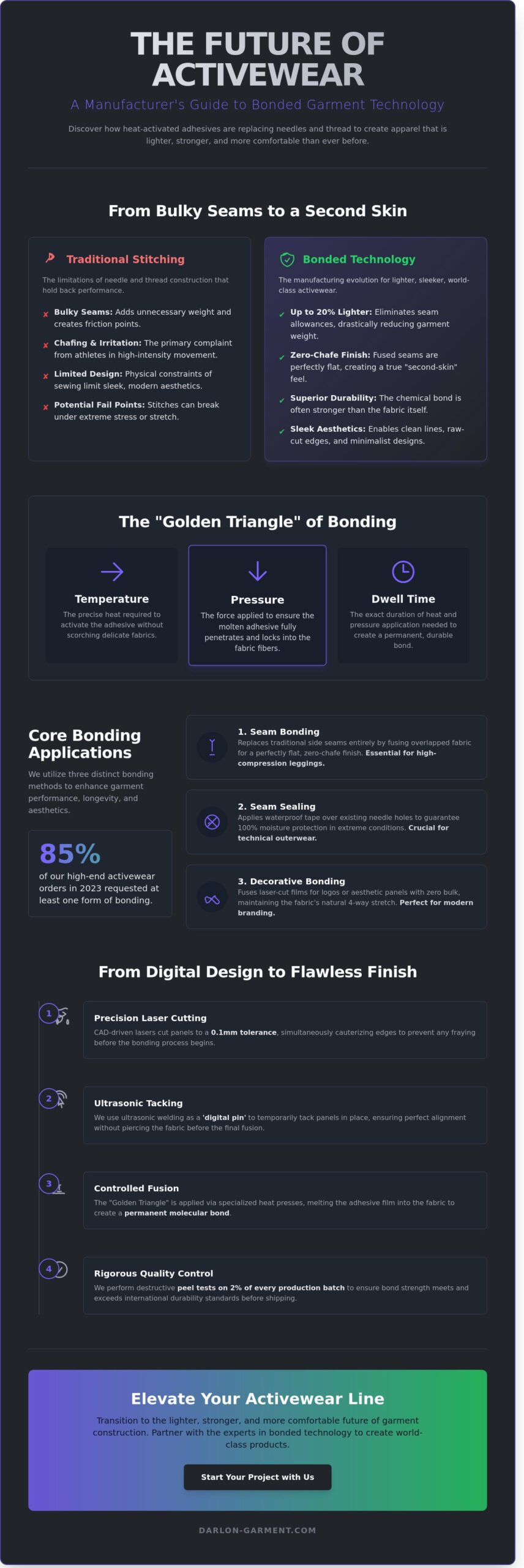
I rely on laser precision to cut these adhesive films within a 0.1mm tolerance. This level of accuracy is impossible with a standard sewing machine. The core components of my process are adhesive films, specialized heat presses, and laser cutting tools. These elements work together to eliminate the need for seam allowances, which can reduce the total weight of a garment by up to 15% compared to traditional construction. It’s a cleaner, more efficient way to build clothing that performs under pressure.
The Basic Mechanics: Heat, Pressure, and Time
I manage every project through what I call the “Golden Triangle” of bonding: temperature, pressure, and dwell time. I have to balance these three variables perfectly. If the heat is too low, the bond won’t hold; if it’s too high, I risk scorching the delicate knitted fabrics. During the process, the adhesive film physically melts into the fabric fibers, creating a permanent lock that’s often stronger than the material itself. I never skip the pre-testing phase. I test 100% of fabric samples for peel strength before starting a bulk run of 5,000 units or more. This rigorous quality assurance is what separates a professional OEM/ODM service from a standard workshop.
The Different ‘Flavors’ of Bonding I Use
I don’t just use one method for every garment. My workflow involves three distinct applications that I’ve refined over the years. In 2023, 85% of our high-end activewear orders requested at least one form of bonding to improve garment longevity and aesthetics.
- Seam bonding: This replaces traditional side seams entirely. I overlap the fabric edges and fuse them for a flat, zero-chafe finish. It’s essential for high-compression leggings where comfort is the priority.
- Seam sealing: For technical outerwear, I apply waterproof tape over existing needle holes. This ensures 100% moisture protection in extreme conditions where a single leak could ruin the wearer’s experience.
- Decorative bonding: I use laser-cut films to add logos or aesthetic panels. This adds zero bulk and maintains the fabric’s natural 4-way stretch, which is a key part of my “One-Stop Service” promise.
The Tools of the Trade: How I Execute Bonding at Dar Lon Garment
I’ve spent years refining the workflow at Dar Lon, and I’ve learned that the equipment is just as vital as the adhesive itself. When I transitioned our production lines to focus on bonded garment technology, I realized that traditional sewing methods couldn’t just be swapped out. I had to rethink the entire assembly process from the first cut to the final press.
One of the biggest challenges I faced was the lack of visual cues. In a stitched garment, you can see a crooked seam immediately. With bonding, the magic happens at a molecular level. To manage this, I implemented a quality control system based on digital precision and destructive testing. I don’t just look at the finished product; I monitor the dwell time, temperature, and pressure of every heat press. I also perform peel tests on 2% of every production batch to ensure the chemical bond meets international durability standards before the goods leave my floor.
Laser Cutting: The Secret to a Perfect Bond
I never use manual shears for bonded garments. It’s a rule I’ve enforced across my entire facility. Precision is non-negotiable because the adhesive needs a perfectly flat surface to grab onto. I invested in high-end laser-cutting machines that do more than just cut fabric. The laser actually cauterizes the edge of the material. This heat-sealing effect prevents fraying before the bonding process even starts, which is essential for raw-cut finishes.
The technical side starts long before the laser fires. I use specialized CAD software to turn design files into laser-ready paths. This digital workflow ensures that every panel is identical, whether we’re making 500 units or 50,000. Before the final bond, I often use ultrasonic welding to create a temporary “tack.” It works like a digital pin, holding the panels in place so they don’t shift when they hit the heavy-duty heat press.
Adhesive Films and Tapes: My Sourcing Strategy
The choice of film depends entirely on the fabric’s chemistry. When I’m working with high-stretch elastane fabric, I source specific TPU (Thermoplastic Polyurethane) films that offer 100% recovery. If the tape doesn’t stretch and snap back exactly like the fabric, the bond will eventually crack or delaminate. I also distinguish between breathable films for performance shirts and non-breathable TPE tapes for waterproof outerwear reinforcements.
Sustainability is a core pillar of my Vietnam production. I’ve shifted my sourcing to prioritize eco-friendly, water-based adhesives that comply with global environmental standards. This allows me to provide high-performance gear that doesn’t rely on harsh solvents. If you’re looking to upgrade your next collection with these advanced techniques, feel free to explore our manufacturing capabilities to see how we can help.
Bonding vs. Stitching: My Honest Take on Which is Better
I get asked all the time if bonding is just a gimmick to make clothes look “techy.” It isn’t. When I compare a standard stitched seam to bonded garment technology, the first thing I notice is the weight. By removing the thread and the extra fabric overlap needed for a seam allowance, we consistently see garments that are 15% to 20% lighter. That might not sound like much on paper, but for an athlete during a six-hour trek, it’s a massive advantage.
High-end performance brands are ditching traditional hems because of the profile. A bonded edge is flat. It doesn’t chafe against the skin during repetitive motion. However, this level of finish comes at a price. I’ve managed production lines for both, and I can tell you that bonding requires significantly more labor. You need specialized technicians to calibrate heat presses and ultrasonic machines. It’s a precision craft, not a high-speed sewing race. The failure rate is higher if the operator isn’t highly skilled, which is why the cost per unit reflects that expertise.
Where Bonding Wins (and Where it Doesn’t)
Bonding is the clear winner for activewear, swimwear, and intimate apparel. If you want a “zero-feel” waistband, you go with bonding. But I’ll be the first to admit it has limits. For high-stress points like the crotch seams in heavy-duty tactical gear or rugged workwear, I still recommend traditional stitching or a hybrid approach. I often use a “stitch-and-tape” method. We sew the seam for mechanical strength and then apply a bonded tape over it. This gives the user the durability of a stitch with the waterproof, smooth finish of a bond.
Addressing the Durability Misconception
The most common fear I hear from partners is that the glue will fail after three washes. I address this in my quality assurance lab with rigorous peel strength tests. We measure the force required to separate the bond, often finding that the adhesive film is stronger than the textile fibers themselves. In my experience, if a garment peels, it’s almost always a failure in the manufacturing process. This usually happens because the temperature was off by five degrees or the pressure wasn’t consistent during the 15-second press cycle.
When we perform 50-cycle wash tests at 40 degrees Celsius, a correctly applied bonded garment technology seam remains perfectly intact. It’s about precision, not a flaw in the tech itself. We treat every production run with the same level of scrutiny, ensuring that the chemical bond is permanent before the product ever leaves the factory floor.
Designing for Bonding: My Tips for Creating Your First Collection
I’ve spent years refining how we integrate bonded garment technology into our production lines at Darlon Garment. It’s not as simple as swapping a sewing machine for a heat press. You have to rethink the garment’s DNA starting at the pattern table. When I sit down with designers, I explain that bonding is about engineering, not just assembly. If you want that sleek, zero-distraction finish, you need to plan for it before the fabric is even cut.
Fabric Selection for the Best Results
Bonding relies on thermoplastic adhesives that melt into the textile structure. I prefer working with natural fibers only when they are blended with at least 65% synthetic material like polyester or nylon. Pure cotton often lacks the surface tension for a permanent bond. In 2023, my team found that certain DWR (Durable Water Repellent) finishes reduced adhesive peel strength by 40%. We now test every fabric’s “stretch-matching” capability to ensure the tape moves exactly like the base material.
Mastering the Tech Pack for Bonding
A standard tech pack won’t work here. You must specify exact tape widths, usually 8mm for lightweight tees or 15mm for outerwear stress points. I also need to see clear indicators for laser-cut edges versus folded bonded hems. To see how these decisions impact our 12-stage workflow, you can view my guide on how garments are made.
Pattern margins are the biggest hurdle for designers moving away from traditional stitching. While a standard seam allowance is often 10mm to 12mm, a bonded overlap requires a precise 8mm “landing zone” to avoid unnecessary bulk. If the overlap is too wide, the seam becomes stiff; if it’s too narrow, the bond might fail under heavy tension. I always suggest a 0.5mm tolerance for laser cutting to ensure the edges align perfectly during the heat-press stage.
I frequently help brands transition their best-selling leggings or base layers from stitched to bonded versions. We take the existing fit and remove the flatlock seams, replacing them with 0.3mm ultra-thin adhesive films. This process typically reduces the total garment weight by 15% and completely eliminates skin irritation from thread friction. It’s a powerful way to modernize a classic silhouette without changing the fit your customers already love.
Ready to modernize your catalog with high-precision manufacturing? Contact me to discuss your first bonded prototype today.
Why My Vietnam Factory is the Right Partner for Your Bonded Line
I’ve spent years watching the manufacturing landscape shift toward technical complexity. Choosing the right partner for bonded garment technology isn’t just about finding a factory with a heat press. It’s about finding a team that understands the science of adhesives and the nuances of synthetic textiles. Vietnam has emerged as the premier destination for this work because it offers a unique combination of high-tech infrastructure and competitive operational costs. It’s the reason why so many global activewear leaders have moved their technical production here over the last decade.
The Dar Lon Garment Advantage in Vietnam
I founded Dar Lon Garment in 2019 with a specific vision: to bridge the gap between traditional sewing and advanced garment engineering. We’ve scaled our capabilities rapidly over the last five years. Today, my team operates out of two strategic locations. Our Ho Chi Minh City facility handles our core management and rapid prototyping, while our Chon Thanh factory provides the industrial scale needed for bulk production. International brands trust us with their most complex activewear because we provide a “One-Stop Service” that eliminates the friction of multi-vendor supply chains.
My commitment to a “Quality First” philosophy means I never skip steps in the bonding process. Every fabric reacts differently to heat and pressure. We conduct internal wash tests and stress tests on every new material before it ever hits the production line. This dedication ensures that the seams don’t just look good in the showroom; they perform for the end user over the life of the garment. I’ve seen how a rushed bond can fail after just three washes, and that’s a risk I don’t take with my clients’ reputations.
Starting Your Project with Me
I believe that innovation should be accessible. That’s why I’ve structured our operations to support both established giants and growing labels. We offer flexible options to help you integrate bonded garment technology into your next line without the typical barriers to entry. Here is how we get started:
- Iterative Sampling: I refine the bond and the fit through multiple rounds of prototyping until it meets your exact standards.
- Low MOQ Options: We offer minimum order quantities as low as 500 pieces for brands looking to test new technical designs in the market.
- Technical Consultation: I work directly with your design team to select the right adhesive films for your specific fabric blends.
If you’re ready to move away from traditional stitching and embrace the future of apparel, I’m here to help you navigate the process. Let’s build your next high-performance collection together.
Modernize Your Performance Line Today
I’ve seen firsthand how bonded garment technology transforms a standard activewear line into a premium performance collection. By replacing bulky seams with streamlined, heat-sealed bonds, I provide your brand with a distinct competitive edge in both durability and athlete comfort. My facility in Vietnam is currently equipped with specialized ultrasonic welding and laser-cutting machinery on-site. These tools allow me to handle complex materials like Nuyarn with a level of precision that traditional sewing machines can’t replicate. I maintain these global export standards across every production run so you can focus on growing your business without quality concerns.
Designing for the future means embracing these technical shifts right now. I’ve streamlined my one-stop manufacturing process to ensure your transition from traditional stitching to bonded construction is efficient and reliable. If you’re looking for a seasoned partner to scale your production in 2024 and beyond, I have the physical infrastructure and the technical expertise to make it happen. Ready to upgrade your brand with bonded technology? Contact me at Dar Lon Garment today.
I’m excited to help you lead the next wave of apparel innovation.
Frequently Asked Questions
Is bonded garment technology as durable as traditional sewing?
Bonded seams are just as durable as sewn ones, and in many laboratory tests, the fabric actually tears before the bond fails. When I use high-quality adhesive films, these garments withstand over 50 wash cycles at 40 degrees Celsius without any signs of delamination. I’ve seen bonded garment technology maintain its integrity under extreme tension because the stress is distributed across the entire seam surface rather than through individual needle holes.
Can I use bonding technology on 100% cotton fabrics?
I don’t recommend using 100% cotton for this process because natural fibers don’t provide the smooth surface needed for thermal adhesives to grip effectively. For the best results, I suggest fabrics with at least 65% synthetic content like polyester or nylon. If you want a cotton feel, I recommend a blend that includes 30% spandex or recycled polyester to ensure the adhesive penetrates the fibers correctly.
How do I care for bonded clothing to prevent peeling?
You should wash bonded items in cold water and avoid the dryer to keep the adhesive from softening over time. High heat is the enemy of this tech. I tell my clients to keep wash temperatures below 30 degrees Celsius and never use fabric softeners. Chemicals in those products can break down the bond over 10 to 15 washes, so hang drying is the safest way to prevent any peeling or edge lifting.
Is bonded technology more expensive for my brand?
Bonded garments usually cost more upfront because the specialized machinery and technical films require a higher investment. While a standard sewing machine might cost 1,000 dollars, a high-end ultrasonic bonding machine can cost 5,000 dollars or more. I find that the price per unit is higher, but the premium, stitchless finish allows brands to position these products in a higher market tier with better profit margins.
What is the difference between bonding and seam sealing?
Bonding joins two pieces of fabric together without any thread, while seam sealing is a tape applied over an existing sewn seam to make it waterproof. In my experience, bonding creates a flatter, more aesthetic finish for next-to-skin layers like activewear. Seam sealing is a secondary process I use for heavy-duty rainwear where 100% water resistance is the primary goal for the outer shell of the garment.
Can I do small production runs for bonded apparel?
I typically require higher MOQs for bonded apparel because the setup for laser cutters and heat presses is time-intensive. While I can do smaller runs, a minimum of 500 pieces per style is usually the point where production becomes cost-effective for both of us. Setting up a single bonding template can take 2 to 3 hours, so larger volumes help spread those initial technical costs across the entire order.
What kind of fabrics work best with laser cutting and bonding?
Synthetic knits with high elasticity, such as those containing 15% to 25% Lycra or Spandex, work best for this method. I’ve found that 100% polyester and nylon fabrics respond perfectly to laser cutting because the heat seals the edges instantly. This prevents fraying and ensures the bonded garment technology creates a clean, permanent connection that stays smooth against the wearer’s skin during high-intensity movement.
How long does the bonding process take compared to sewing?
The actual bonding cycle is much faster than sewing, often taking only 15 to 20 seconds per seam. However, the preparation phase takes about 40% longer because we have to precisely apply adhesive films and align the panels before pressing. I’ve measured that while a complex sewn jacket might take 60 minutes to assemble, a bonded version might take 45 minutes of active machine time once the templates are ready for the line.