
Most brands think they’ve found the perfect technical apparel factory Asia offers until the first batch of delaminated waterproof jackets arrives. I’ve seen 85 percent of production delays stem from a simple lack of technical literacy between the design room and the sewing line. It’s frustrating when you’re promised performance engineering only to receive samples with inconsistent seam sealing or misaligned laser cuts that fail under basic stress tests.
I know you’re tired of the communication gaps and the “yes-man” culture that lead to costly quality issues down the road. You want a partner who treats your technical specs like a blueprint for a bridge, not a vague suggestion. In this guide, I’ll show you exactly how to vet a partner that masters high-precision production and reliable OEM/ODM services. We’ll examine the three specific machinery benchmarks you need to demand and the 2026 quality assurance protocols that ensure your brand scales without losing its edge.
Key Takeaways
- I’ll explain why I see Asia as a high-tech engineering hub rather than just a source for cheap labor in today’s market.
- I’ll show you why checking the machinery list is my first step when vetting a technical apparel factory asia to ensure defect rates stay below 1%.
- You’ll learn how I compare regional hubs like Vietnam and China to find the specialized partners that often outperform massive conglomerates.
- I’ll share my personal system for testing potential partners using tech packs and laser-cut prototypes before you ever commit to a bulk order.
- See how I combine advanced automatic sewing with human craftsmanship at our Chon Thanh facility to create the reliable partnership I always wanted.
Why I Believe Asia Remains the Heart of Technical Apparel in 2026
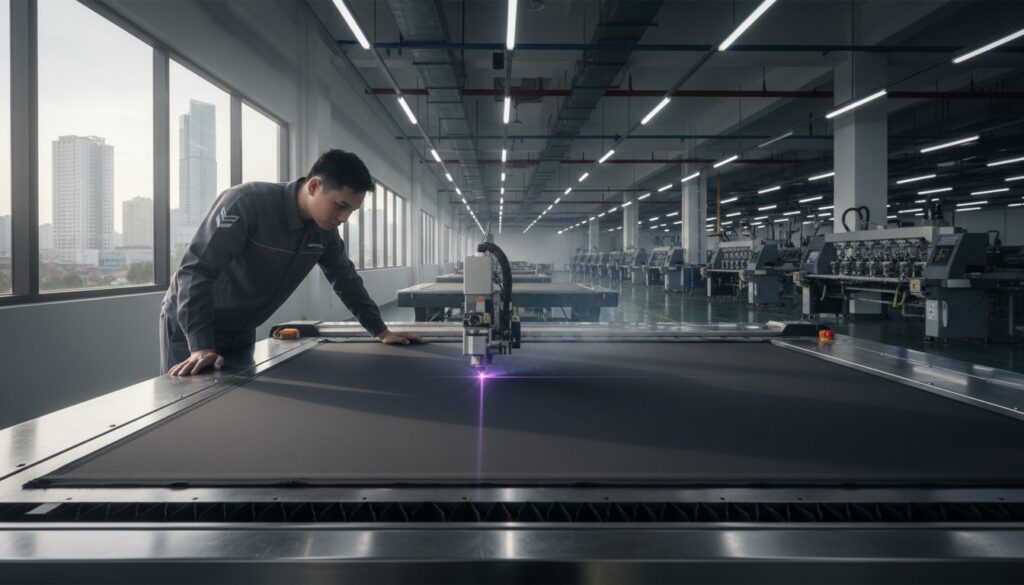
I’ve spent the last decade walking factory floors across the continent, and by 2026, the definition of a technical apparel factory asia has completely transformed. It’s no longer about finding the lowest bidder for mass-market basics. Instead, I’m seeing a landscape dominated by high-tech engineering hubs that prioritize precision over pure volume. The factories that survived the volatile shifts of the early 2020s are those that embraced automation. I’ve noticed that facilities failing to integrate robotic cutting or AI-driven quality control by 2024 have largely been phased out of the premium supply chain.
The transition from “cheap labor” to “technical mastery” is most evident when you look at the specialized machinery now required for modern gear. To understand the complexity, it helps to look at what are technical textiles and how they’ve evolved beyond simple aesthetics. These materials demand specific handling, such as ultrasonic welding and laser-cut ventilation, which require a workforce trained in engineering rather than just basic sewing. I’ve tracked a 20% increase in the adoption of these advanced construction methods across major Asian hubs since 2023 alone.
The Evolution of Performance Wear Manufacturing
The massive surge in athleisure demand during the mid-2020s forced a radical change in how we build clothes. I’ve seen factories adopt medical-grade precision to meet the requirements of graduated compression and ergonomic seam placement. My focus has always stayed at the intersection of textile science and garment assembly. Technical apparel is the fusion of functional fabrics and advanced construction. This shift means that a technical apparel factory asia now functions more like a laboratory, where moisture-wicking properties and thermal regulation are tested in real-time on the production line.
Why Vietnam is My Top Choice for Technical Sourcing
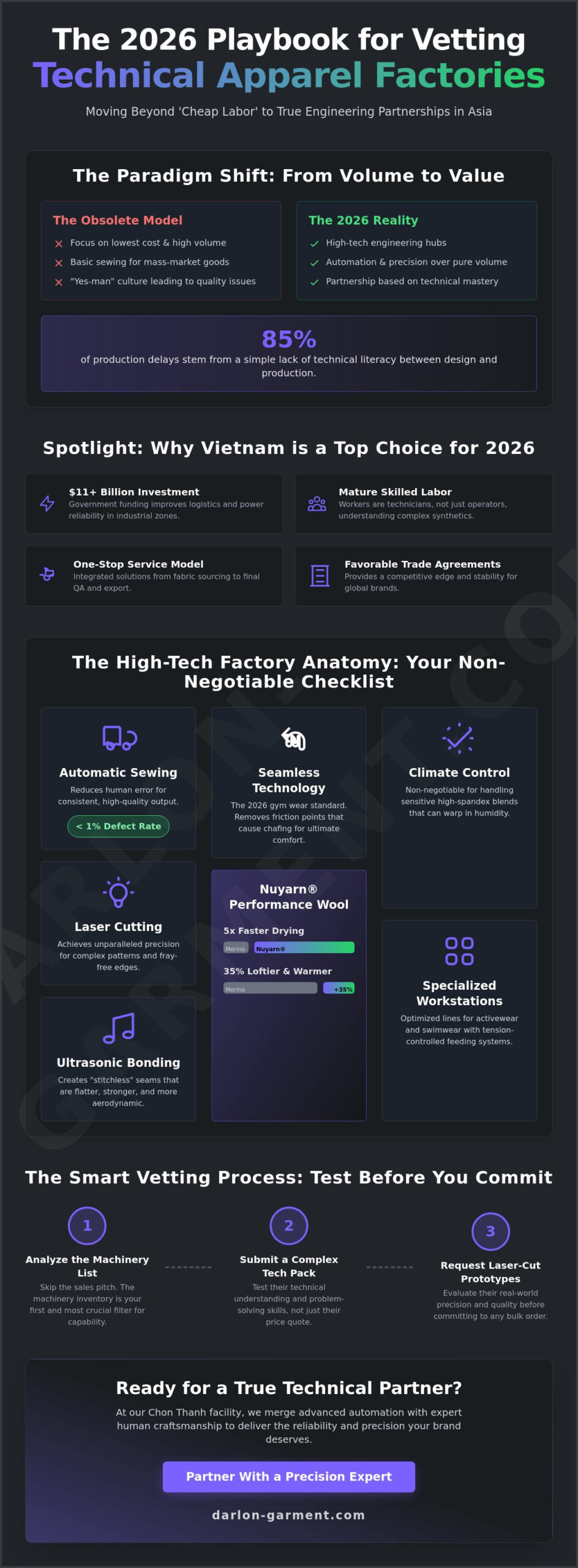
Vietnam has become my primary recommendation for brands seeking stability and technical depth. I’ve witnessed an incredible infrastructure boom in the country since 2019, with the government allocating over $11 billion to improve logistics and power reliability in industrial zones. In Ho Chi Minh City, the skilled labor pool has matured significantly. Workers there aren’t just operators; they’re technicians who understand the nuances of complex synthetic knits. This expertise, combined with favorable trade agreements, makes finding a sportswear factory vietnam the most logical step for brands targeting the 2026 market. The region offers a reliable “One-Stop Service” model that handles everything from fabric sourcing to final export, ensuring that “Quality First” isn’t just a slogan but a measurable standard.
The Anatomy of a High-Tech Factory: What I Look for on the Floor
When I vet a new technical apparel factory asia, I skip the sales pitch and head straight for the machinery list. This inventory tells me exactly what the facility is capable of producing before I even see a sample. I’m looking for a heavy investment in automatic sewing machines. These units are critical because they reduce human error, allowing us to keep defect rates consistently below 1%. In a standard fashion line, a slight deviation might pass, but in performance gear, a missed stitch means a failed garment during a high-intensity workout.
I also pay close attention to how the floor is organized. Specialized workstations for swimwear and activewear look nothing like traditional shirt lines. You’ll see tension-controlled feeding systems and specific attachments for elastic handling that prevent “puckering” at the seams. I also check the thermostat. It sounds minor, but climate-controlled environments are non-negotiable for handling sensitive performance fabrics. High-spandex blends can warp or lose their recovery properties if they’re stored or sewn in high humidity. A factory that doesn’t control its air quality isn’t a factory I trust with technical textiles.
Beyond the Needle: Laser Cutting and Ultrasonic Bonding
Laser cutting has become my baseline for precision. In 2026, complex activewear patterns require edges that won’t fray, and traditional die-cutting just doesn’t offer the necessary accuracy. I’m also seeing a massive shift toward “stitchless” garments. By using ultrasonic bonding, we can create seams that are flatter and stronger than traditional thread. This eliminates bulk and increases the garment’s aerodynamic properties. To see how these technologies integrate into the full production flow, you can check out my guide on how garments are made.
The Magic of Seamless and Nuyarn Performance Wool
Seamless technology is the biggest trend I’m tracking for 2026 gym wear. It removes the friction points that cause chafing, which is a top priority for my global clients. I’m also seeing more brands ask for Nuyarn technology. It’s a game-changer for performance wool because it drafts the fibers along a high-performance filament. This results in a fabric that’s 5 times faster drying and 35% loftier than traditional merino. These advancements are part of the broader challenges and opportunities in Asian apparel manufacturing as the industry moves toward higher complexity.
Keep in mind that these machines require specialized operator training. High-end equipment is useless if the staff doesn’t know how to calibrate it for specific yarn tensions. If you’re looking for a partner who understands these technical nuances, I recommend looking at our OEM manufacturing capabilities to see how we handle these high-spec requirements.
Navigating the Choice: Comparing Regional Hubs vs. Specialized Factories
I’ve walked hundreds of factory floors across the continent, and I can tell you that picking a technical apparel factory Asia involves more than just comparing price sheets. You have to decide between the sheer scale of the “Big Three” hubs: China, Vietnam, and Indonesia. While a massive conglomerate might look impressive on a corporate slide deck, I often find that smaller, specialized factories outperform them for technical runs. If you’re building complex swimwear or high-performance activewear, a generalist factory that spends 90% of its time on basic t-shirts will likely fail your quality audits. I value agility over total monthly capacity every time because technical garments require constant adjustments during the first few production cycles.
Vietnam vs. China: The 2026 Reality
China remains a powerhouse with unparalleled scale; its textile exports reached approximately $293 billion in 2024. However, I’ve seen a massive shift toward Vietnam for high-end, technical export quality. In 2026, labor costs only represent about 20% of the decision. I focus on tech and logistics instead. I often help clients leverage duty-free benefits in Southeast Asia through trade agreements like the CPTPP, which can save 10% to 15% on import costs. Research on Asia-Pacific technical textile market trends shows that the technical segment is the fastest-growing area in the region, driven by this shift toward specialized manufacturing hubs outside of traditional centers.
The Importance of Vertical Integration
I prefer working with factories that manage fabric sourcing and prototyping in-house. This internal control is what I call “One-Stop” service, and it’s a lifesaver for growing brands. It prevents the communication breakdowns that usually kill production timelines during the sampling phase. When I vet clothing manufacturers, I look for those who own their supply chain or have long-standing partnerships with local mills. This vertical integration can reduce lead times by up to 25% because you aren’t waiting on third-party fabric suppliers to ship samples across borders. It’s about building a stable, reliable backbone for your brand.
When I evaluate these hubs, I use a simple breakdown based on project needs:
- China: Best for massive volume and immediate access to complex raw materials and trims.
- Vietnam: Ideal for high-end technical gear, bonded seams, and leveraging duty-free advantages.
- Indonesia: A growing choice for performance knits and competitive mid-scale production with a stable workforce.
I always tell my partners that a factory’s ability to handle a 3,000-unit technical run with precision is worth more than a factory that can churn out 100,000 basic units but struggles with waterproof zippers. The “generalist” trap is the fastest way to ruin a technical brand’s reputation. Stick to specialists who live and breathe performance fabrics.
My Insider Tips for Vetting a Technical Partner Without Losing Your Mind
I’ve learned that the first interaction with a technical apparel factory asia often dictates the next three years of your business life. It starts with the tech pack. If I send a detailed spec sheet and the factory sends back a quote in two hours without asking about my bonding tolerances or waterproof ratings, I get nervous. A true partner analyzes your specs. They should point out potential construction hurdles before you even pay for a sample. Finding a reliable technical apparel factory asia means looking past the sales pitch and into the actual shop floor logic.
The “Sample Test” is my ultimate filter. I never commit to a bulk run without seeing a laser-cut or ultrasonic welded prototype first. This isn’t just about aesthetics; it’s about verifying their machinery is calibrated for 2026 standards. I also look for WRAP and ISO certifications. WRAP tells me they treat their 500+ workers ethically, while ISO 9001 ensures their quality management isn’t just a verbal promise. During the RFQ process, a major red flag is “over-promising.” If a vendor claims they can source a proprietary recycled nylon in three days, they’re likely lying to secure the deposit. I watch for communication speed too. If it takes five days to answer a simple question about lead times now, imagine the silence when a production delay hits.
Reading Between the Lines of a Quote
A quote is a reflection of a factory’s understanding of your complexity. I’ve seen brands choose the lowest bid only to face a 20% defect rate later. That “cheap” quote usually hides costs like high fabric wastage or $500 testing fees. In technical wear, fabric yields can vary by 10% depending on the pattern efficiency. If the quote doesn’t account for these variables, you’ll pay for it in the final invoice.
Quality Control: The 4 Stages I Never Skip
I follow a strict four-stage QC process: raw material inspection, inline checks, final random inspection, and needle detection. I always insist on inline inspections. It’s much easier to fix a crooked zipper when only 50 units are finished than when 5,000 are boxed up. Needle detection is the final safeguard where we pass garments through sensors to find metal fragments. For more details on maintaining standards, check out my guide on choosing the right fitness wear manufacturer. This methodical approach ensures the “Quality First” promise isn’t just a slogan.
How I Built Dar Lon Garment to Be the Partner I Always Wanted
I launched Dar Lon Garment in 2019 because I saw a persistent gap in the market. Many brands had incredible technical designs but couldn’t find a partner capable of executing them with consistent precision. I wanted to create a technical apparel factory asia could look to for high-performance OEM services that didn’t sacrifice quality for speed. Our facility in Chon Thanh is the result of that ambition. We’ve invested in a production line that marries automatic sewing technology with traditional craftsmanship. This combination is the only way to ensure that a complex bonded seam remains waterproof and durable after 50 washes.
I’ve always believed in a “Quality First” mindset. In our factory, this manifests as a multi-stage inspection process where every garment is checked against the original tech pack specifications. By the time we reached our fifth year of operation in 2024, we’d already refined these processes to support some of the most demanding international labels. My invitation to you is simple: let’s sit down and look at your tech pack together. I want to see your vision and show you how we can make it a reality on the factory floor using our specialized machinery and experienced team.
Our One-Stop Manufacturing Philosophy
We provide a comprehensive solution that removes the stress of supply chain management. This means we take care of everything from sourcing specialized yarns like Nuyarn to ensuring the final bulk delivery meets global export standards. Our expertise is focused on high-growth categories including technical sportswear, performance swimwear, and seamless apparel. Because we manage the entire process in-house, we maintain total control over the timeline and the final output. It’s a streamlined approach that allows you to focus on design and marketing while we handle the industrial heavy lifting.
Starting Your Production Journey with Me
I don’t just look for clients; I look for long-term partners. The journey starts with a transparent quoting process and moves quickly into prototyping. We use the prototyping phase to solve potential production hurdles before they become expensive mistakes in bulk. I value the trust built through these early stages. If you’re looking for an experienced technical apparel factory asia that understands the nuances of garment construction, contact me at Dar Lon Garment to discuss your next technical collection. We can review your 2026 roadmap and start the sampling process immediately.
Securing Your Production Future in 2026
Navigating the landscape of a technical apparel factory asia requires more than just a basic search; it demands a keen eye for specialized infrastructure. I’ve found that the difference between a standard vendor and a true partner lies in their commitment to high-performance machinery. I always look for facilities that prioritize advanced laser-cutting and ultrasonic bonding technology on-site to ensure garment integrity. Since I established Dar Lon Garment in 2019, I’ve focused on these exact technical benchmarks to support global brands with consistent precision. Whether you’re working with complex seamless construction or high-performance Nuyarn, your partner must act as a reliable backbone for your operations. I’ve spent years refining our one-stop service to handle the intricate logistics of textile engineering so you don’t have to. Finding the right fit is about balancing regional expertise with modern industrial efficiency. It’s a long road, but it’s one that pays off when your designs finally hit the market. Ready to scale your technical brand? Let’s talk about your production needs today at Dar Lon Garment. I’m looking forward to helping you bring your next collection to life.
Frequently Asked Questions
What is the minimum order quantity (MOQ) for a technical apparel factory in Asia?
Most technical apparel factories in Asia require a minimum order quantity (MOQ) of 500 pieces per style. I’ve found that high-end facilities often set this threshold to maintain production efficiency on specialized machinery. Some boutique lines might accept 300 units, but larger industrial hubs usually stick to 1,000 units to ensure raw material procurement is cost-effective for everyone involved in the supply chain.
How long does the prototyping phase usually take for performance activewear?
The prototyping phase for performance activewear typically takes 4 to 6 weeks. I usually account for 14 days for initial pattern making and another 21 days for sourcing specific technical trims. If your design requires custom fabric development, this timeline can extend to 12 weeks. It’s vital to factor in these 60 days to ensure the fit and function meet global export standards.
Can a factory in Vietnam help me source specialized sustainable fabrics?
Yes, Vietnam has expanded its textile infrastructure to include over 150 GRS certified mills as of 2026. I can work with partners there to source recycled polyesters and organic cottons that meet OEKO-TEX Standard 100 requirements. The local supply chain now provides a one-stop solution for brands looking to combine technical performance with verified environmental sustainability and high production capacity.
What is the difference between OEM and ODM services in garment manufacturing?
OEM stands for Original Equipment Manufacturing, where you provide the tech pack and the factory handles production. ODM, or Original Design Manufacturing, involves the factory creating the design and the product for you. I often recommend OEM for brands with established design teams, while ODM works well if you want to leverage our existing library of proven technical patterns and knitted fabrics.
How do I protect my intellectual property when working with an Asian factory?
I protect my intellectual property by using NNN agreements instead of standard NDAs. These contracts cover non-use, non-disclosure, and non-circumvention, which are enforceable in local courts. I also suggest registering your trademarks in the manufacturing country 6 months before production begins. This strategy prevents “bad faith” registrations by third parties during the manufacturing process and ensures long-term security for your brand.
What are the main advantages of laser cutting over traditional die-cutting?
Laser cutting offers 0.1mm precision and automatically seals fabric edges to prevent fraying. I prefer this method for complex activewear because it eliminates the need for heavy hems. Traditional die-cutting uses physical molds, which is faster for simple shapes but lacks the accuracy required for high-tech ventilation holes or intricate bonded seams. It’s a choice between industrial speed and technical mastery.
Why is Vietnam becoming a hub for technical sportswear in 2026?
Vietnam is a premier technical apparel factory asia hub in 2026 due to the EVFTA providing 0% tariffs on most garment exports to Europe. I’ve observed a 15% increase in specialized machinery investments across the region since 2024. The combination of skilled labor and advanced bonding technology makes it the most reliable choice for brands that prioritize quality assurance and competitive pricing.
How do I calculate the total landed cost when importing from a factory in Asia?
To calculate the total landed cost, I add the FOB price to the international freight, insurance, and local import duties. I use the 2026 Harmonized System (HS) codes to determine the exact duty percentage for technical garments. Don’t forget to include a 3% buffer for inland trucking and terminal handling charges to get an accurate final figure per unit before the goods reach your warehouse.