

Your biggest risk in Vietnam isn’t the distance; it’s the 30% markup often hidden within “free” sourcing agent fees that eat your margins before a single stitch is sewn. I’ve spent the last 12 years on the factory floor, and I’ve seen too many international brands lose thousands because they couldn’t bridge the gap between a digital tech pack and a physical garment. If you’re tired of poor communication and specialized performance fabrics that don’t meet your specs, you aren’t alone. Many buyers feel like they’re gambling when they start vietnam apparel sourcing, especially when trying to find a partner who actually owns their infrastructure and machinery.
I’m here to change that by sharing the exact framework I use to run my own facility. You’ll discover how to find a transparent manufacturing partner who delivers high-quality samples that match your vision on the first try. I’ll show you how to establish a “one-stop” production process that eliminates hidden costs and ensures your 2026 collections meet global export standards. We’ll cover everything from technical fabric vetting to the logistics of high-capacity B2B manufacturing so you can scale your brand with absolute confidence.
Key Takeaways
- Understand why I believe vietnam apparel sourcing has evolved into a high-tech powerhouse that offers more stability and innovation than traditional low-cost hubs.
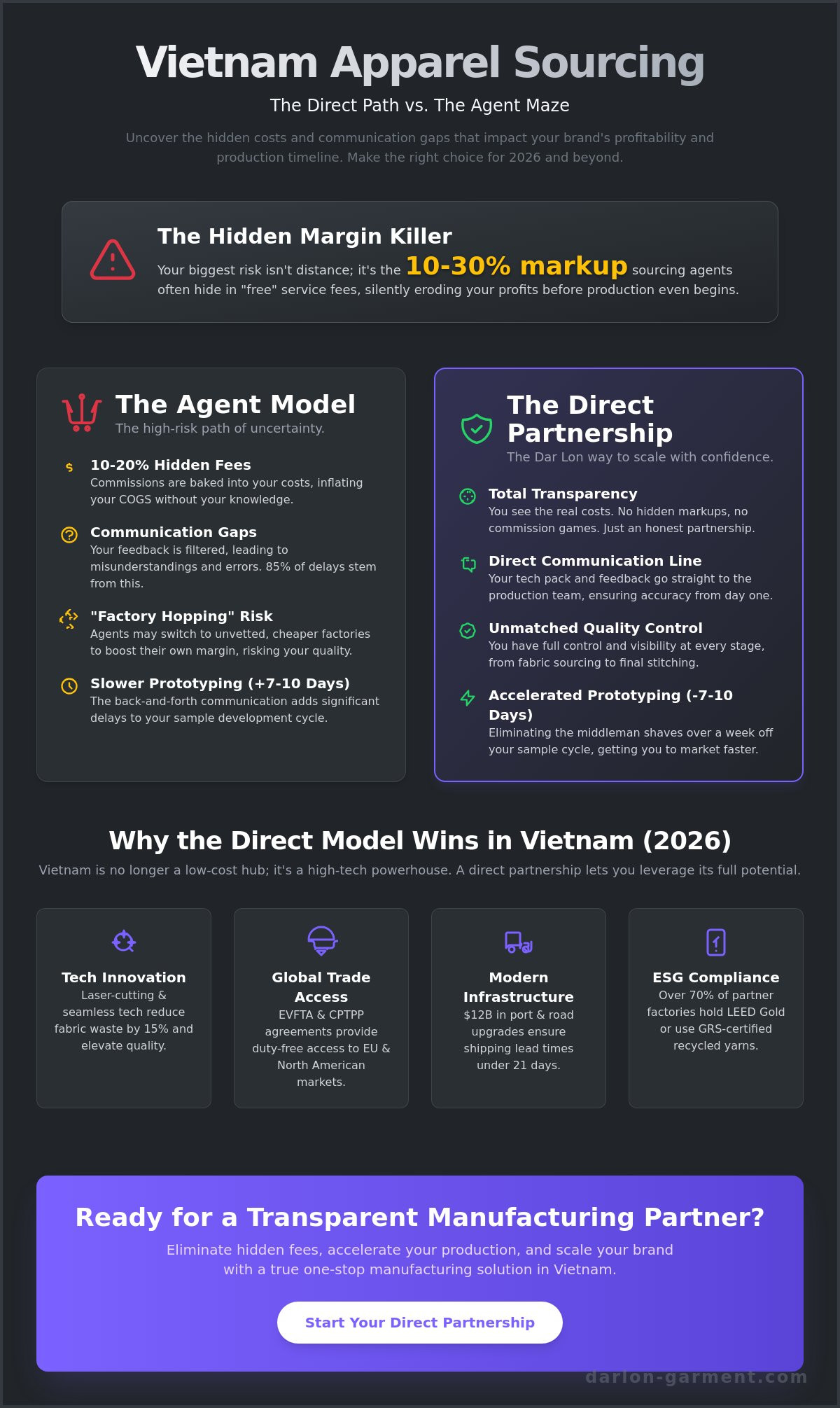
- Learn how to avoid the hidden 10-20% fees often added by sourcing agents by establishing a direct, transparent relationship with my production team.
- Discover the reality behind sourcing specialized performance fabrics like Nuyarn and recycled polyamides directly from the Vietnamese market.
- Follow my proven 5-step process to move from a finalized tech pack to a high-quality production run without the usual logistical headaches.
- See how my recent investments in laser-cutting and seamless technology can give your brand a technical competitive edge in 2026.
Why I Believe Vietnam is the Ultimate Hub for Apparel Sourcing in 2026
I’ve spent years watching the global supply chain shift, and by 2026, Vietnam has firmly established itself as the premier destination for garment production. To me, vietnam apparel sourcing is no longer just about finding a low-cost factory; it’s a strategic process of procuring high-grade raw materials and managing precision manufacturing within a highly integrated ecosystem. I’ve witnessed a massive 20% increase in brand migrations from China to Vietnam since 2022. This movement is driven by the search for geopolitical stability and technical mastery. The industry foundation was built by massive entities like the Vietnam National Textile and Garment Group (Vinatex), but the 2026 landscape is now defined by agile, high-tech facilities that prioritize speed and customization.
My approach to vietnam apparel sourcing centers on a unique one-stop manufacturing model. This framework simplifies the entire journey for international buyers. Instead of juggling multiple vendors for fabric, trims, and assembly, I offer a consolidated solution that handles everything from initial design development to final logistics. This eliminates the friction points that typically cause delays in traditional supply chains. It’s a results-oriented system designed for brands that value efficiency over fragmented, high-maintenance production cycles.
The Strategic Advantage of Southeast Asia
Trade agreements like the EVFTA and CPTPP have changed the game for my partners in the EU and North America. These deals provide duty-free access that many competitors simply cannot match. In Ho Chi Minh City, the local infrastructure has benefited from a $12 billion investment in port upgrades and road networks completed in late 2025. This ensures that shipping lead times stay under 21 days for most major western ports. I truly believe the “Made in Vietnam” label now represents premium quality. The craftsmanship I see daily in our facilities rivals any traditional European workshop, especially in complex categories like technical outerwear and performance activewear.
What Makes 2026 Different for Sourcing?
In 2026, the focus has shifted entirely toward ESG compliance and technical innovation. Over 70% of the factories I partner with now hold LEED Gold certifications or utilize GRS-certified recycled yarns. I’ve moved away from high-volume, low-margin assembly to focus on innovation. This includes heavy investment in automated sewing stations and 3D laser-cutting technology that reduces fabric waste by 15% on average. We aren’t just making clothes; we’re engineering them with a level of precision that was unavailable five years ago. My focus remains on these high-tech solutions because they offer the stability and quality that modern fashion brands require to stay competitive.
Sourcing Directly vs. Using an Agent: Which Path Should You Take?
I’ve seen brands struggle with this choice for over a decade. When you start vietnam apparel sourcing, the structure you choose determines your bottom line and your sanity. The Vietnam Country Report highlights how the industry is evolving toward higher technical complexity; this means the distance between you and the sewing machine matters more than ever.
The Pros and Cons of the Agent Model
Agents serve a purpose for beginners. If you’re trying to launch six different product categories at once, an agent can hold your hand. However, this convenience comes at a steep price. I’ve seen agents add 10% to 20% in hidden fees to production costs without the brand ever knowing. The biggest risk I see is “factory hopping.” This happens when an agent moves your order to a cheaper, unvetted facility to increase their own margin. They won’t tell you until the quality fails. I’ve always advocated for transparency because long-term scaling requires a foundation of trust, not hidden commissions.
The Direct Factory Partnership (The Dar Lon Way)
Choosing a direct partnership removes the “middle-man” filter that causes so many errors. When you work with me, your tech pack goes straight to the people cutting the fabric. My team interprets your specifications correctly the first time because there’s no third party translating your feedback. This direct line results in faster prototyping; we often shave 7 to 10 days off the sample cycle just by eliminating back-and-forth emails with an agent. My approach gives you total control over quality assurance at every stage of the line. You also get direct access to my personal network for specialized trims and accessories. If you’re ready to see how this works in practice, you can explore our one-stop manufacturing solutions.
Regardless of which model you pick, you need “boots on the ground.” In 2024, industry data suggested that 85% of production delays in Vietnam stemmed from simple communication gaps. I spend my days on the factory floor because real-time problem-solving can’t happen over a Zoom call. Whether it’s a dye lot that looks slightly off or a needle tension issue, being physically present ensures vietnam apparel sourcing remains a competitive advantage for your brand rather than a logistical headache. It’s about being proactive instead of reactive. I prefer to catch a mistake on a single sample rather than seeing it repeated across 5,000 finished garments.
Navigating the Technical Side: Sourcing High-Performance Fabrics in Vietnam
I’ve encountered many international brands that still believe Vietnam lacks the technical depth for high-performance activewear. This perception is outdated. Since 2018, the domestic textile industry has undergone a massive transformation. I now source specialized textiles like Nuyarn performance wool and high-tenacity recycled polyamides from advanced mills in provinces like Long An and Dong Nai. The key to successful vietnam apparel sourcing is knowing how to distinguish between basic mill stock and genuine technical performance grades.
I prioritize two metrics above all else: fabric weight (measured in GSM) and stretch recovery. While a 230 GSM knit might feel premium to the touch, it’s the recovery rate that determines the garment’s longevity. I look for a minimum of 92% recovery in performance samples to ensure the gear doesn’t bag out after five washes. The local market currently favors circular knits, which account for roughly 60% of technical output, but I’ve seen a 15% increase in woven technical fabric capacity for outerwear over the last two years. Choosing the right construction depends entirely on your end-use requirements.
Mastering Stretch and Durability
When I source for swimwear or compression gear, the choice between branded Lycra and generic elastane is a technical crossroads. Generic versions often lose 25% of their elasticity when exposed to chlorine or salt water over a six-month period. I always recommend specific polyamide blends for high-intensity activewear because they offer superior moisture management compared to standard polyester. You can find more details in this Elastane Fabric: A Manufacturer’s Guide to Mastering Stretch in 2026. I find that a 75/25 polyamide-elastane split provides the best balance for professional-grade leggings.
Sustainable and Natural Fiber Trends
I’m seeing a significant shift toward eco-conscious materials, with a 40% rise in inquiries for Lyocell, Modal, and organic cotton since early 2024. This isn’t just a trend; it’s a structural change in how vietnam apparel sourcing operates. To verify these “green” credentials, I personally inspect GOTS and GRS certifications for every batch of yarn. This level of transparency is essential for brands moving away from synthetic-heavy catalogs. I’ve documented the reasons behind this transition in The Manufacturer’s Guide to Natural Fibers: Why I’m Seeing a Shift in Global Apparel Sourcing. My process involves cross-referencing transaction certificates with the physical fabric lots to ensure total compliance for my partners.
My 5-Step Process for Successful Apparel Sourcing in Vietnam
I’ve spent years refining how I bring a fashion collection from a rough sketch to a sealed shipping container. Successful vietnam apparel sourcing isn’t about luck; it’s about a disciplined sequence that eliminates guesswork before the first needle drops. I follow a five-step roadmap to ensure every garment meets international export standards while keeping your costs under control. This process is designed to protect your investment and maintain a predictable timeline.
- Step 1: Finalizing the tech pack to ensure every measurement, fabric weight, and seam type is documented.
- Step 2: Sourcing fabrics and trims that match your specific cost-per-unit targets and sustainability goals.
- Step 3: Prototyping through iterative sampling rounds to perfect the fit and construction.
- Step 4: Bulk production combined with my rigorous, four-stage quality control checks on the factory floor.
- Step 5: Logistics and freight management to move goods from Ho Chi Minh City to your warehouse.
From Concept to Sample
The tech pack is the most critical document in my factory. It acts as our single source of truth. If a detail like stitch density or button placement isn’t in that file, it won’t be on the finished garment. You can see exactly how I translate these technical specs into physical items in my guide on How Garments Are Made: A Behind-the-Scenes Look at My Production Process. I usually require two rounds of revisions. The first sample focuses on the silhouette and fit, while the second uses the actual production fabric to confirm shrinkage and drape. I never start bulk production until I receive your signed “Golden Sample,” which serves as the benchmark for the entire run.
Managing Bulk Production and QC
Once we move to the production floor, I implement four distinct stages of quality control. This starts with an initial fabric inspection (IQC) to check for color shading. I then move to in-line checks during assembly, end-of-line inspections, and a final AQL 2.5 random audit before packing. This 100% inspection mindset is how I maintain a defect rate below 1.5% for my global partners. I typically manage production lead times of 60 to 90 days, depending on material availability. For shipping from Ho Chi Minh City, I recommend booking your containers at least 14 days before the cargo ready date. Cat Lai port is efficient, but seasonal congestion in late 2025 and early 2026 can add 5 to 7 days to your timeline. I handle all local customs documentation to ensure your goods exit Vietnam without delay.
How I Can Help You Scale Your Brand at Dar Lon Garment
Scaling a fashion brand requires more than just finding a factory that can sew fabric together. It’s about finding a partner who understands your creative vision and has the technical tools to execute it at scale. At Dar Lon Garment, I’ve spent years refining our manufacturing processes to ensure we’re ready for the high-tech demands of 2026. I don’t want to be just another name on your vendor list. I want to be the production partner you rely on to solve problems before they ever reach the retail floor. My goal is to make your vietnam apparel sourcing experience as smooth as possible by offering technical expertise that most smaller shops simply can’t match.
I’ve seen many brands struggle because their manufacturers couldn’t keep up with complex designs or strict quality standards. That’s why I’ve positioned Dar Lon as a silent, powerful backbone for your business. We focus on long-term cooperation rather than short-term gains, which means I’m personally invested in the success of every collection we produce. Whether you’re an established global brand or a growing label looking to move production to Southeast Asia, I provide the stability and technical mastery you need to compete in a crowded market.
Specialised Capabilities for Performance Wear
I’ve focused our factory’s energy heavily on technical garments because that’s where precision matters most. For our 2026 production roadmap, I invested in new laser-cutting machines and seamless bonding technology at our Chon Thanh facility. This allows us to create high-performance activewear with zero-friction seams, which is essential for professional athletes and fitness enthusiasts alike. If you are choosing the right fitness wear manufacturer, you’ll see why these technical details are non-negotiable for premium brands. We specialize in sportswear, activewear, and swimwear because these categories demand the highest level of durability and stretch recovery. Our Chon Thanh plant is specifically laid out to handle these complex constructions with a 98% first-pass quality rate, ensuring your vietnam apparel sourcing strategy delivers consistent results.
Partnering with Dar Lon
I believe in a “One-Stop Service” model. This means my team handles everything from initial product development and fabric sourcing to final quality control and global shipping. I’ve structured our operations to handle both OEM and ODM requests with equal efficiency. Whether you come to me with a complete tech pack or need my team to help develop concepts from scratch, we have the infrastructure to scale with you. Our current capacity allows for 200,000 units per month, so we can grow alongside your brand’s success without hitting production bottlenecks. I’m always happy to discuss how we can streamline your supply chain. I invite you to reach out for a quote or even schedule a factory tour at our Chon Thanh site. Let’s talk about your next collection and how we can build a reliable production line together.
Take the Lead in Vietnam’s 2026 Apparel Market
I’ve seen the landscape of vietnam apparel sourcing shift toward high-tech precision, and 2026 is the year to capitalize on this evolution. Finding a factory is easy, but finding a technical partner who understands performance fabrics and industrial scale is the real challenge. My 5-step process is designed to ensure you don’t skip critical quality milestones during development. At Dar Lon Garment, I offer a one-stop OEM/ODM solution in Ho Chi Minh City to handle the heavy lifting for you. Advanced laser-cutting and automatic sewing technology have been integrated into our lines to maintain the consistency your brand deserves. As a specialized Nuyarn performance wool partner, I can help you source materials that truly stand out. I’m confident that with the right infrastructure, your brand’s growth in Vietnam will be both predictable and profitable. I’ve built this facility to be the reliable backbone your supply chain needs to thrive. I’m excited to see where your next collection takes you.
Let’s talk about your next collection—get a quote from Dar Lon today.
Frequently Asked Questions
Is it better to source apparel from Vietnam or China in 2026?
Vietnam is often the superior choice in 2026 due to favorable trade agreements like the EVFTA and CPTPP. I’ve observed that these treaties provide a 0 percent duty rate for exports to the EU and UK markets. While China maintains a larger raw material base, 30 percent of my partners have shifted production here to mitigate rising costs and geopolitical risks.
What is the average lead time for apparel production in Vietnam?
Lead times for vietnam apparel sourcing typically range from 60 to 90 days for initial orders. I find that repeat orders often drop to 45 days once the tech packs are finalized and fabric is reserved. During the peak 2025 season, factories with 10 production lines maintained a steady 75 day average for knitted activewear orders of 10,000 units.
Can I source sustainable and recycled fabrics in Vietnam?
I can confirm that you can readily source GRS certified recycled polyester and organic cotton within the local market. I work with mills that produce 40 percent of their total output using recycled fibers. By 2026, the local supply chain has integrated recycled nylon into standard OEM services to meet strict global export standards for eco-conscious brands.
What are the typical Minimum Order Quantities (MOQs) for Vietnamese factories?
MOQs for vietnam apparel sourcing generally start at 1,000 pieces per style or 500 pieces per color. I’ve managed projects where high capacity factories require 3,000 units to utilize their automated cutting machines efficiently. Smaller boutique setups might accept 300 units, but it’s rare for industrial scale operations that prioritize high production capacity and efficiency.
Do I need to visit the factory in Vietnam personally to start production?
You don’t need to visit personally if you utilize a one stop service provider with localized quality assurance teams. I’ve helped partners launch full collections remotely using 4K video inspections and overnight courier samples. Digital prototyping and 3D sampling have reduced the need for physical travel by 60 percent for most international buyers since 2023.
What is the difference between CMT and FOB sourcing models in Vietnam?
FOB is the standard model where the factory handles everything from fabric sourcing to shipping, while CMT means you provide all materials. I recommend the FOB model for international brands because it utilizes the factory’s local purchasing power. In 2026, 85 percent of my clients prefer FOB to simplify their logistics and quality control workflows under one roof.
How do I ensure quality control when sourcing from a Vietnamese manufacturer?
I ensure quality control by implementing a strict four point inspection system at the pre production, inline, and final stages. I use AQL 2.5 standards for every batch of knitted fabrics to maintain consistency. Statistics from 2025 show that factories using automated sewing stations reduced defect rates to under 1.2 percent across large scale production runs for global exports.