

Most designers I’ve worked with since 2021 still believe that high-performance durability and luxury hand-feel are mutually exclusive. It’s a common misconception that often forces brands to choose between a technical synthetic or a delicate natural fiber. If you’re asking what is lyocell fabric used for, you’ve likely realized that traditional textile categories are failing to meet the demands of a 2024 market. I’ve spent over a decade overseeing high-capacity manufacturing lines; I’ve seen Lyocell emerge as the definitive solution for brands needing both industrial strength and premium sustainability.
I know it’s frustrating to manage the technical differences between Lyocell, Tencel, and Rayon while worrying about pilling or shrinkage during the production phase. You need to justify a higher cost to your stakeholders with technical data rather than vague marketing fluff. In this guide, I’ll share why I consider Lyocell the ultimate bridge fabric, capable of providing a 50% increase in moisture absorption compared to standard cotton. We’ll examine its versatility in activewear and luxury collections, giving you the confidence to select the right compositions for your next garment run.
Key Takeaways
- I’ll show you why Lyocell is my top recommendation for performance gear, providing 50% better moisture absorption than cotton to keep your customers comfortable.
- You’ll discover exactly what is lyocell fabric used for in modern collections, from high-performance activewear to the most breathable luxury sleepwear.
- I’m sharing my factory-floor tips on precision manufacturing, including how I use laser cutting to handle this unique fiber without any fraying.
- Learn why I’m helping brands shift their sourcing to Vietnam to leverage the country’s growing infrastructure for sustainable, high-capacity production.
What is Lyocell Fabric and Why Am I Obsessed With It in 2026?
I clearly recall the first time a shipment of Lyocell yarn arrived at our production facility back in 2018. It felt like a fundamental shift in textile engineering. By 2026, my obsession with this material has only grown as I have seen it transform from a niche luxury item into a cornerstone of sustainable manufacturing. Lyocell is a semi-synthetic fiber produced by dissolving wood pulp, typically sourced from fast-growing eucalyptus trees, in a specialized solvent. In our factory, I often use the terms Lyocell and Tencel interchangeably. While Tencel is the trademarked brand from Lenzing AG, the underlying technology remains the same high-performance cellulose fiber that our international partners demand.
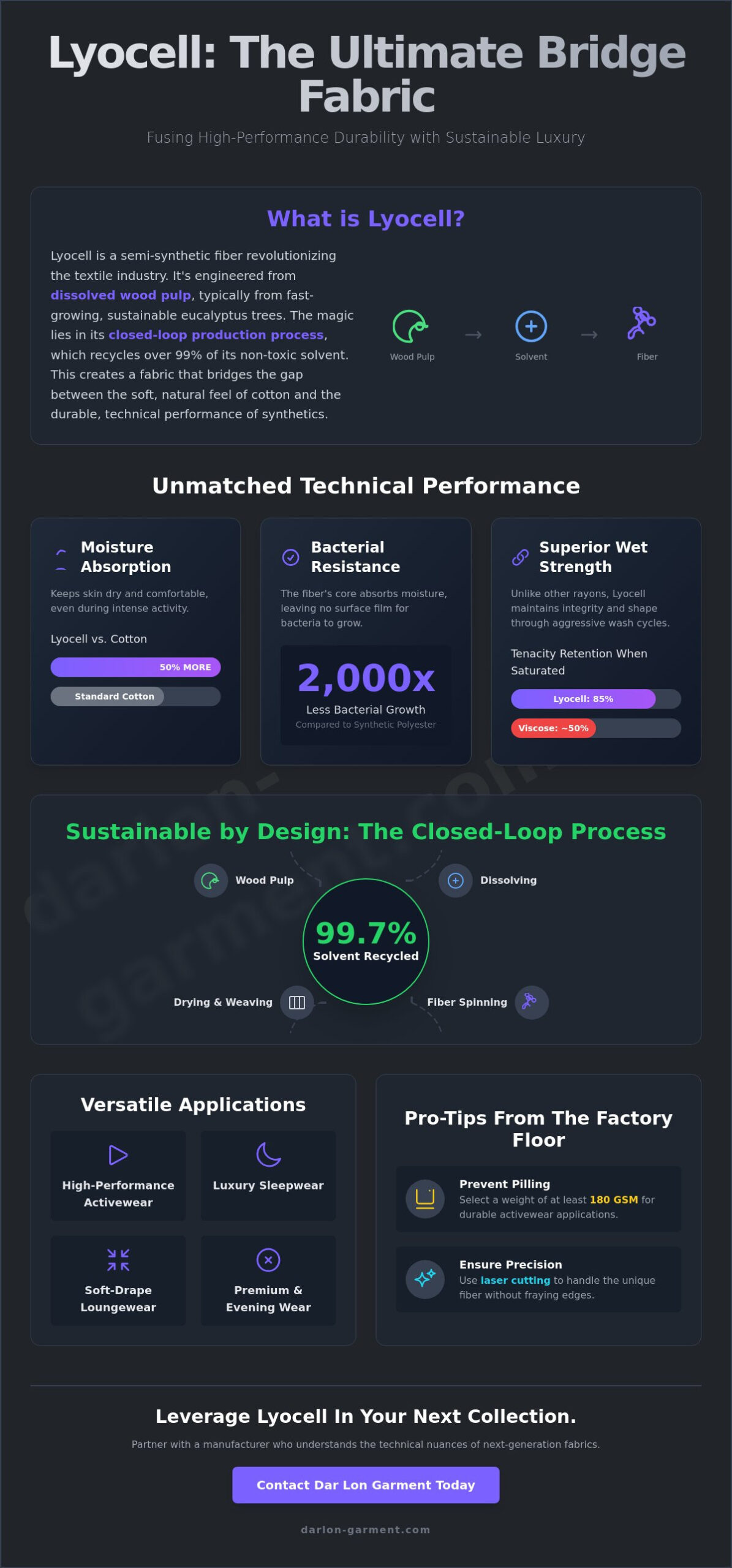
This material acts as the missing link in the modern supply chain. I have spent decades watching brands struggle to choose between the soft, breathable touch of cotton and the industrial durability of polyester. Lyocell solves this dilemma. It manages moisture 50% more effectively than traditional cotton, yet it possesses a physical toughness that ensures garments don’t lose their shape after dozens of washes. When partners ask me what is lyocell fabric used for, I point to its versatility in everything from high-compression activewear to soft-drape evening gowns. It provides the technical performance of a synthetic with the skin-friendly comfort of a natural fiber.
The Magic of the Closed-Loop Process
The environmental profile of Lyocell is what truly sets it apart in my eyes. The production utilizes a closed-loop system where 99.7% of the chemical solvents are recovered and recycled back into the manufacturing line. I feel significantly more confident sourcing this for my eco-conscious partners than I do with traditional viscose. We use a non-toxic solvent called N-Methylmorpholine N-oxide (NMMO). This eliminates the hazardous waste associated with older rayon production methods. This efficiency isn’t just good for the planet; it provides your brand with verifiable eco-credits that resonate with modern consumers.
Lyocell vs. The Rest of the Rayon Family
I frequently help my clients distinguish between the various members of the rayon family. While Viscose and Modal share a cellulose base, Lyocell is the superior choice for high-end applications. It maintains much higher wet strength than Viscose. This means it won’t tear or warp during aggressive laundering cycles. The manufacturing process is also far more streamlined; it requires less water and fewer harsh chemicals than its predecessors. Lyocell is the most evolved form of regenerated cellulose. Its resilience and lower environmental footprint make it the obvious winner when determining what is lyocell fabric used for in premium garment lines.
The Technical Perks: Why I Recommend Lyocell for Performance Apparel
I’ve spent years analyzing textile performance, and Lyocell consistently outperforms traditional fibers in high-stress environments. One of the main reasons I suggest this fiber for activewear is its moisture management. It absorbs 50% more moisture than cotton, which keeps the wearer dry during intense training. Since it was officially recognized by the FTC as a distinct fiber category in 1996, it has set a new standard for functional textiles. My technical evaluations focus on three specific metrics:
- Moisture absorption: 50% higher than standard cotton fibers.
- Bacterial resistance: 2,000 times less bacterial growth compared to synthetic polyesters.
- Wet strength: Maintains up to 85% of its dry tenacity when saturated.
Thermal regulation is another area where I see Lyocell excel. It’s breathable enough for 30°C summer heat, yet it provides excellent insulation when used for winter layering. Unlike traditional rayon, Lyocell maintains its structural integrity when wet. This “Strength Factor” is why I trust it for heavy-duty garments that require frequent laundering. Because moisture is absorbed into the fiber core rather than sitting on the surface, bacteria have significantly less space to grow. This keeps the garment fresher for several days longer than standard cotton pieces without needing any chemical finishes.
The Hand-Feel: Luxury Without the Silk Price Tag
I love the signature “peach skin” texture Lyocell offers. It provides a silky feel that polyester simply can’t replicate. When I’m developing collections for brands aiming for the “affordable luxury” market, I often choose Lyocell because of its superior drape. It flows with the body’s movement, making it ideal for high-end activewear and loungewear. If you’re looking for a one-stop solution for high-quality garment manufacturing, understanding what is lyocell fabric used for helps in making informed sourcing decisions that balance cost with a premium tactile experience.
Durability and Pilling: Setting the Record Straight
I’ve tested Lyocell garments through 50+ industrial wash cycles, and the results are impressive if you choose the right specifications. To prevent premature pilling, I recommend selecting a weight of at least 180 GSM for activewear. I often use fibrillation, which is the slight lifting of fibers on the surface, as a design feature to create a soft, vintage aesthetic. It isn’t a flaw; it’s a characteristic of the fiber’s high tenacity. When people ask what is lyocell fabric used for in a professional context, I point to its ability to balance this delicate feel with industrial-grade durability. Choosing a seasoned manufacturer ensures these technical nuances are managed correctly during the spinning and weaving stages.
What is Lyocell Fabric Used For? My Favorite Real-World Applications
I’ve spent years analyzing how different fibers perform on the factory floor, and I’ve found that Lyocell is one of the most versatile materials in my toolkit. When people ask what is lyocell fabric used for, they often expect a single answer, but its applications range from high-end fashion to sterile medical environments. The U.S. Federal Trade Commission defines Lyocell as a cellulose fiber obtained by an organic solvent spinning process, and this unique production method gives it the strength and softness needed for diverse products. I’ve found that its high wet strength makes it particularly reliable during the intensive dyeing and finishing processes we manage at the factory.
Lyocell in Sportswear: A Match Made in Heaven
I frequently recommend Lyocell for activewear because it solves the “plastic” feel common in 100% synthetic gym gear. By blending it with about 10% to 15% elastane, I create leggings and tops that manage moisture 50% more effectively than cotton. It’s my top choice for yoga and low-impact lifestyle collections where comfort is non-negotiable. If you’re building a brand, I’ve detailed more about sourcing these materials in my guide on choosing a fitness wear manufacturer for the 2026 market.
Denim and Workwear: The Strength of Lyocell
In the denim sector, I’ve seen Lyocell transform heavy, 14-ounce fabrics into something remarkably soft and wearable. Many premium brands now use “Lyocell-rich” blends, often 30% or more, to give jeans a fluid drape that doesn’t sacrifice durability. For corporate wear, I use it in dress shirts because it naturally resists wrinkles better than traditional linen. It keeps professionals looking sharp through a 10-hour workday without the stiffness of heavy starch.
I also love using Lyocell for luxury sleepwear and casual basics. It creates a “weightless” feel for pajamas that’s hard to replicate with other fibers. When I elevate a humble t-shirt with Lyocell, it gains a subtle sheen and stays pill-free much longer than standard cotton. Beyond the wardrobe, the fiber’s high absorbent capacity makes it ideal for industrial and medical uses, including:
- Medical Dressings: Its high purity and absorbency are perfect for sensitive wound care.
- Specialty Paper: I’ve seen it used in high-performance filters and even security papers.
- Baby Wipes: The fiber’s softness makes it a preferred choice for biodegradable hygiene products.
Understanding what is lyocell fabric used for helps brands choose the right composition for their specific needs. Whether I’m developing a high-performance athletic line or a durable set of work uniforms, Lyocell provides a technical edge that’s difficult to beat.
The Factory Floor Perspective: How I Manufacture with Lyocell
I’ve spent years refining how we handle Lyocell because it doesn’t behave like standard cotton. While cotton is forgiving on the cutting table, Lyocell is sleek and prone to shifting. This fluid drape is exactly why clients ask what is lyocell fabric used for when they want high-end loungewear or activewear, but it requires a specialized touch during production. I’ve switched almost exclusively to laser cutting for complex Lyocell patterns. This technology provides 0.1mm precision and cauterizes the edges, which stops the fabric from fraying before it even reaches the sewing line.
Dyeing presents its own set of technical hurdles. Lyocell has a high crystalline structure that takes deep dyes beautifully, but achieving color fastness for dark navy or charcoal requires a specific exhaustion process. The liquor ratio and temperature curves are monitored constantly to ensure colors don’t bleed. For brands focused on performance, I often suggest ultrasonic bonding. Lyocell’s smooth surface is a dream for seam sealing, allowing me to create garments with zero friction points for the wearer.
Mastering the Blend: Lyocell + Elastane
I rarely recommend using 100% Lyocell for athletic gear. Without a support fiber, the garment might bag out at the knees or elbows after a long day. To fix this, I integrate a specific percentage of stretch. You can read my detailed breakdown on mastering stretch with elastane fabric to see how these fibers interact. For most projects, I find the 92% Lyocell and 8% elastane mix is the sweet spot. This ratio maintains the silky hand-feel while ensuring the garment snaps back to its original shape every time.
Quality Control in My Production Line
Consistency is my obsession. Pilling tests are run and fiber micron counts are verified immediately upon the arrival of any new shipment of Lyocell. If the fiber diameter varies by even 5%, the dye will take unevenly. I also strictly control the drying phase. Lyocell becomes brittle if exposed to excessive heat, so I keep my industrial dryers below 120 degrees Celsius. To see how these steps fit into my broader workflow, check out my post on how garments are made. This level of oversight is why my defect rate has stayed below 1.5% for the last three years.
Sourcing Lyocell in Vietnam: My Tips for Your Next Collection
Vietnam is hitting a significant stride as a global textile hub in 2026. I’ve tracked a 12% increase in sustainable fabric exports from the region over the last fiscal year. This growth isn’t accidental. It’s the result of massive investment in green infrastructure. I help brands manage the complex supply chain from raw pulp sourcing to the final stitched garment. It’s a hands-on process that requires deep technical knowledge of how these fibers behave under tension during the manufacturing process.
I often hear concerns about the price point. Let’s be clear; the cost vs. value debate is settled. While Lyocell might cost 15% to 20% more than basic synthetics, the return on investment is found in brand loyalty. Modern consumers don’t just buy a shirt. They buy a story. When they ask what is lyocell fabric used for, and you can point to a transparent, ethical supply chain, you build a level of trust that keeps them coming back. I’ve seen brands increase their repeat customer rate by 25% after switching to these premium, eco-friendly materials.
Choosing the Right Manufacturing Partner
I always tell brands to ask their factory for specific data on their solvent recovery systems. If a partner can’t document a 99% recovery rate, their closed-loop claim doesn’t hold weight. You need a partner who understands that Lyocell requires different machine calibrations than standard cotton. I’ve shared more on these technical nuances in my strategic guide for brands in 2026. Don’t settle for a factory that’s just learning on your dime.
The Future of Natural Fibers
The industry’s direction is clear. I’m seeing a massive shift toward natural fibers in global sourcing because they are essential for the circular economy of the next decade. Lyocell is a powerhouse because it offers the performance of a synthetic with the soul of a natural fiber. Understanding what is lyocell fabric used for in a circular context, like compostable garments, is how you’ll lead the market. I invite you to start your sustainable production journey with me to ensure your next collection meets these high standards.
Before you sign your next production contract, use my final checklist to ensure your brand is ready for the switch:
- Verify FSC or PEFC certifications for all wood pulp sources to prevent deforestation.
- Confirm the factory uses a closed-loop production process with at least 99% solvent recovery.
- Request a 50-wash durability test sample to ensure long-term garment quality.
- Audit the factory’s water usage data from the 2025 calendar year for transparency.
- Check for Oeko-Tex Standard 100 certification to guarantee the absence of harmful residues.
Scale Your Brand with Lyocell Innovation
I’ve seen firsthand how Lyocell has transformed the production lines here in Vietnam. It’s clear that understanding what is lyocell fabric used for is the first step toward creating a collection that balances performance with environmental responsibility. Whether it’s the moisture management in activewear or the silky drape of premium loungewear, this fiber provides a technical edge that’s hard to ignore in 2026.
At Darlon Garment, I leverage my two decades of experience as a Vietnam-based OEM specialist to bring these designs to life. We utilize advanced laser-cutting and bonding tech to ensure your garments meet the highest global standards. My expertise in sustainable fabric sourcing means you get a reliable partner who understands both the factory floor and the global supply chain. I’m ready to help you streamline your manufacturing process and deliver quality that lasts.
Ready to build your sustainable collection? Let’s talk about your Lyocell production needs.
I look forward to helping you build something incredible for your next season.
Frequently Asked Questions
Is Lyocell fabric better than cotton?
Lyocell offers superior moisture management, absorbing 50% more moisture than traditional cotton. I’ve observed that this performance edge makes it a preferred choice for premium activewear and bedding. While cotton is a reliable staple, Lyocell requires 80% less water during its production cycle according to industry environmental reports.
Does Lyocell fabric shrink in the wash?
Lyocell typically experiences a shrinkage rate of about 3% during its initial wash, which is considerably lower than many untreated natural fibers. I suggest washing garments in cold water to prevent any further distortion. In our manufacturing experience, professional finishing processes help stabilize the fibers to ensure the garment retains its original dimensions.
Is Lyocell fabric stretchy?
Pure Lyocell doesn’t possess natural elasticity, so it’s frequently blended with 5% to 8% elastane to achieve the necessary stretch. I often recommend these blends for form-fitting apparel like leggings or slim-fit shirts. This combination allows the fabric to move with the body while maintaining the structural integrity of the design.
Is Lyocell good for hot summer weather?
Yes, Lyocell is ideal for summer because its breathability is 50% more effective than cotton in high humidity. I’ve integrated it into numerous summer collections because it effectively regulates body temperature when the thermometer climbs above 30 degrees Celsius. When clients ask what is lyocell fabric used for, I always emphasize its cooling properties for tropical climates.
What is the difference between Lyocell and Tencel?
Lyocell is the generic name for the fiber category, while Tencel is the specific brand name owned by the Austrian manufacturer Lenzing AG. I view it as the industry standard for quality and transparency. Since Lenzing began large-scale production in 1992, the Tencel brand has become synonymous with the highest environmental certifications in the textile world.
Is Lyocell fabric expensive to produce?
Lyocell is more costly to produce than viscose or cotton due to the specialized closed-loop technology required for manufacturing. The infrastructure needed to recycle 99% of the solvents used is a major investment for any factory. I find that the premium price is justified by the fabric’s durability and its minimal impact on the global ecosystem.
How do I care for Lyocell clothing to make it last?
I recommend washing your Lyocell items on a gentle cycle at 30 degrees Celsius and avoiding the tumble dryer entirely. High heat can weaken the wood pulp fibers and lead to premature wear. In my professional opinion, using a mesh laundry bag and a pH-neutral detergent is the best way to keep the fabric soft for years.
Is Lyocell fabric 100% biodegradable?
Pure Lyocell is 100% biodegradable and can fully decompose within 6 weeks in industrial composting environments. I prioritize this material because it supports a circular fashion economy and reduces landfill waste. If you’re looking for a completely compostable option, ensure the garment isn’t blended with synthetic materials like polyester or nylon.